Report ID: 1124 |
Published Date: 20 Aug 2026 |
Report Format: |
Delivery Timeline: 48-72 Business Hours
Filled Fluoropolymer Market Outlook:
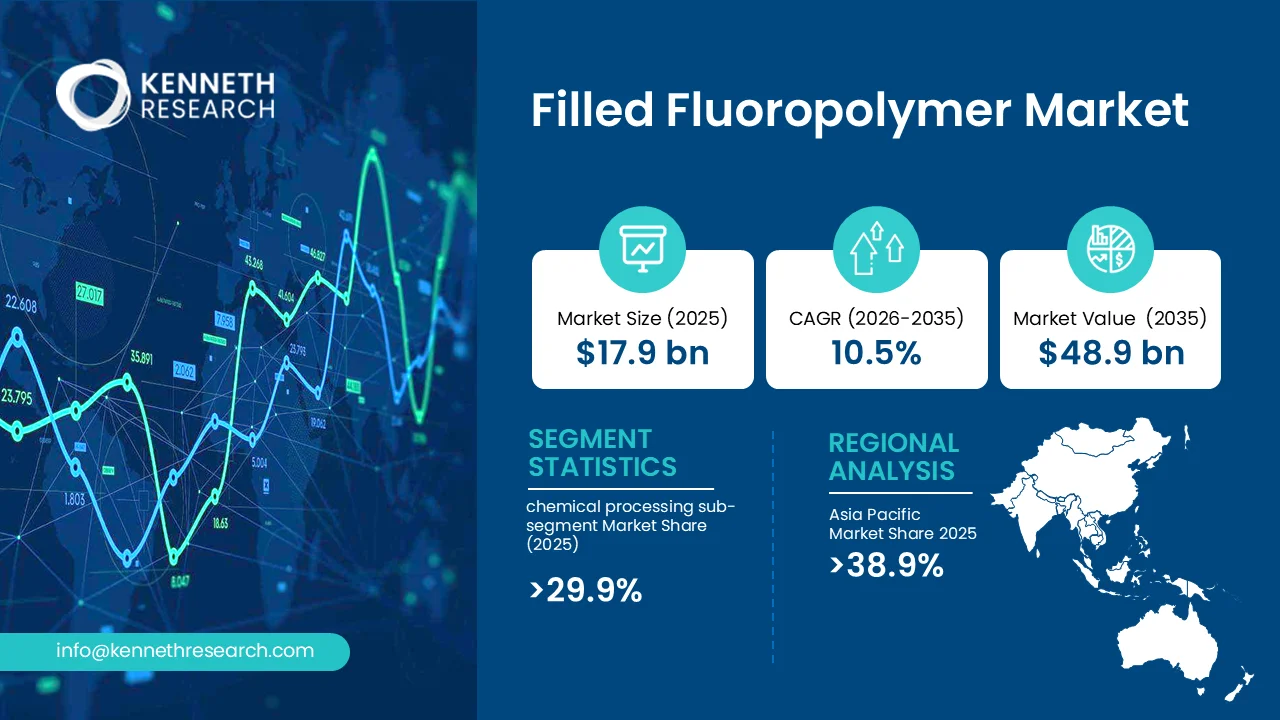
Filled Fluoropolymer Market size was valued at USD 17.9 billion in 2025 and is projected to reach USD 48.9 billion by the end of 2035, rising at a CAGR of 10.5% during the forecast period, i.e., 2026-2035. In 2026, the industry size of the filled fluoropolymer is estimated at USD 19.8 billion.
The primary growth driver for the filled fluoropolymer market is the expanding need for high-performance materials in chemically aggressive and high-temperature industrial environments. According to the OECD, fluoropolymers are increasingly used across industries as standalone materials, coatings, and additives, with global consumption continuing to rise, reinforcing demand for filled grades in critical applications.
The filled fluoropolymer market comprises fluoropolymer resins that are compounded with reinforcing or functional fillers such as glass fiber, carbon, graphite, bronze, ceramics, or mineral-based materials to improve mechanical strength, wear resistance, dimensional stability, thermal conductivity, and electrical performance. These engineered materials retain the inherent advantages of fluoropolymers—including exceptional chemical resistance, low friction, non-stick characteristics, electrical insulation, and stability under extreme temperatures—while delivering enhanced performance for demanding industrial applications.
Filled fluoropolymers are widely utilized in components that operate under corrosive, abrasive, or high-load conditions, including seals, bearings, valve seats, pump parts, gaskets, electrical insulation systems, semiconductor equipment, and processing machinery. Their ability to maintain performance in harsh operating environments makes them suitable for industries requiring long service life and minimal maintenance.
The market plays a strategic role across chemical processing, electrical and electronics, automotive, aerospace, industrial manufacturing, and energy sectors, where material reliability, process efficiency, and resistance to aggressive chemicals and elevated temperatures are essential for operational continuity and product quality.
Key Filled Fluoropolymer Market Insights Summary:
Key Takeaways: Market Trends & Insights
- Filled Fluoropolymer Market is projected to grow from USD 19.8 billion in 2026 to USD 48.9 billion by 2035 at a 10.5% CAGR
- Chemical Processing remained the leading application segment with a 29.9% market share in 2025 driven by sustained demand for corrosion-resistant and high-performance industrial components
- Asia Pacific accounted for the largest regional share at 38.9% in 2025 supported by strong manufacturing capabilities and expanding industrial activity across China and Japan
- Electrical & Electronics is expected to emerge as the fastest-growing application segment owing to increasing adoption in semiconductor manufacturing, electronic components, and high-performance insulation systems
- North America is positioned as the second-leading regional market with continued growth supported by advanced manufacturing investments and rising demand from the United States and Canada
Market Drivers
- Increasing adoption of filled fluoropolymers in electric vehicle battery manufacturing
- Growing use in renewable energy equipment and high-performance electrical insulation
- Rising demand from aerospace and defense for lightweight, chemically resistant components
- Expansion of industrial automation and high-purity fluid handling systems requiring advanced engineering materials
Challenges
- High processing complexity and manufacturing costs
- Raw material availability and supply chain vulnerability
Filled Fluoropolymer Market Overview & Supply Chain
The adoption of filled fluoropolymers is increasing globally as manufacturers seek advanced materials capable of withstanding corrosive chemicals, high temperatures, electrical stress, and continuous mechanical loading. These materials are increasingly specified for chemical processing equipment, semiconductor manufacturing, power infrastructure, and industrial automation because fillers enhance wear resistance, dimensional stability, and thermal performance without compromising the intrinsic chemical inertness of fluoropolymers. Growing investments in sustainable chemical manufacturing and process modernization are further supporting demand for engineered fluoropolymer compounds that improve equipment reliability and operational efficiency. This trend is reinforced by the International Energy Agency (IEA), which reported that global primary chemicals production reached 719 million tonnes in 2022, highlighting the scale of industrial operations requiring durable, chemically resistant materials for processing and handling systems.
The value chain of the filled fluoropolymer market begins with the procurement of fluoropolymer resins, including PTFE, PFA, FEP, ETFE, and PVDF, along with functional fillers such as glass fiber, carbon fiber, graphite, bronze, ceramic particles, and mineral additives sourced from specialty chemical and advanced materials suppliers. Compounders and material manufacturers blend these constituents using precision processing techniques to achieve application-specific mechanical, thermal, tribological, and electrical properties. The compounded materials are subsequently converted into finished components through molding, extrusion, machining, compression molding, or fabrication processes tailored to industrial specifications. Distribution occurs through specialty polymer distributors, industrial component suppliers, OEM procurement channels, and direct manufacturer relationships. End users include chemical processing facilities, electronics and semiconductor manufacturers, automotive suppliers, aerospace companies, energy infrastructure operators, pharmaceutical equipment manufacturers, and industrial machinery producers. Key stakeholders across the ecosystem include raw material producers, compounders, processors, equipment manufacturers, testing and certification organizations, distributors, system integrators, and industrial end users focused on long-term operational reliability and performance.
Filled Fluoropolymer Market: Growth Drivers & Challenges
Growth Drivers:
- Expansion of semiconductor and advanced electronics manufacturing: The increasing investment in semiconductor fabrication and advanced electronics manufacturing is a major growth driver for the filled fluoropolymer market. Filled fluoropolymers are widely used in wafer processing equipment, high-purity fluid handling systems, electrical insulation components, seals, and precision bearings because they combine exceptional chemical resistance with enhanced mechanical strength and dimensional stability. As chip fabrication processes become more sophisticated, manufacturers require materials capable of maintaining performance under aggressive chemicals, elevated temperatures, and cleanroom conditions. The OECD notes that semiconductors are fundamental to telecommunications, computers, medical devices, and automotive electronics, while governments continue to prioritize domestic semiconductor production through industrial policies and strategic investments. This expanding manufacturing ecosystem is expected to sustain long-term demand for high-performance filled fluoropolymer components across electronics value chains.
- Rising demand for high-durability materials in chemical processing infrastructure: The modernization of chemical processing facilities is accelerating the adoption of filled fluoropolymers in equipment exposed to corrosive media, abrasive slurries, and continuous thermal cycling. Compared with unfilled fluoropolymers, filled grades provide superior wear resistance, lower creep, improved compressive strength, and greater dimensional stability, extending the operational life of critical components such as valve seats, pump parts, gaskets, bushings, and bearing systems. Industries are increasingly focused on minimizing maintenance intervals, reducing process downtime, and improving equipment reliability, making advanced engineered materials a strategic investment. Furthermore, stricter operational safety standards and the growing adoption of automated processing systems are increasing the need for precision-engineered components capable of consistent performance under demanding operating conditions. As industrial facilities continue upgrading process equipment, filled fluoropolymers are expected to gain wider acceptance across both greenfield projects and replacement applications.
Challenges:
- High processing complexity and manufacturing costs: Filled fluoropolymers require specialized compounding, precision filler dispersion, and tightly controlled processing conditions to achieve consistent mechanical, thermal, and tribological properties. Variations in filler type, loading levels, and processing parameters can significantly influence product performance, making manufacturing more complex than conventional engineering polymers. The need for specialized equipment, skilled technical expertise, and rigorous quality assurance increases production costs while extending development and qualification timelines. These factors can discourage adoption in cost-sensitive industries where performance improvements may not justify the additional investment. Commercially, manufacturers face pressure to optimize formulations without compromising reliability, while end users evaluate total lifecycle value rather than upfront material costs. As advanced manufacturing technologies and process automation continue to improve, production efficiency is expected to increase, although premium pricing will likely remain a defining characteristic of high-performance filled fluoropolymer products.
- Raw material availability and supply chain vulnerability: The filled fluoropolymer industry depends on a specialized supply network for fluoropolymer resins and high-performance reinforcing fillers, many of which are produced by a limited number of qualified suppliers. Supply disruptions, capacity constraints, evolving environmental regulations, and geopolitical uncertainties can affect the availability of critical raw materials and create procurement challenges for compounders and component manufacturers. Long qualification cycles for alternative suppliers further reduce supply chain flexibility, particularly in highly regulated industries where material consistency is essential. Commercially, these constraints can lead to extended lead times, inventory management challenges, and increased contractual risk for both manufacturers and industrial customers. Looking ahead, companies are expected to strengthen supply resilience through supplier diversification, regional manufacturing expansion, strategic sourcing partnerships, and increased investment in material innovation to reduce dependence on limited raw material sources.
Filled Fluoropolymer Market Size and Forecast:
| Report Attribute | Details |
|---|---|
| Base Year |
2025 |
| Forecast Year |
2026-2035 |
| CAGR |
10.5% |
| Base Year Market Size (2025) |
USD 17.9 billion |
| Forecast Year Market Size (2035) |
USD 48.9 billion |
| Regional Scope |
|
Filled Fluoropolymer Market Segmentation Analysis:
Application Segment Analysis
In the application segment, the chemical processing sub-segment is anticipated to capture the largest market share of 29.9% by the end of 2025.
Chemical processing dominates the filled fluoropolymer market because processing facilities operate under highly corrosive, high-pressure, and high-temperature conditions that demand materials with exceptional chemical inertness and long-term durability. Filled fluoropolymers are extensively used in seals, valve seats, pump components, bearings, gaskets, and lining systems where enhanced wear resistance, reduced creep, and improved dimensional stability are essential for maintaining operational reliability. The industry's growing emphasis on minimizing unplanned downtime, improving process safety, and extending equipment service life continues to accelerate the adoption of filled fluoropolymer components in both new installations and retrofit projects. On the supply side, manufacturers are developing application-specific formulations incorporating glass fiber, carbon, graphite, and mineral fillers to satisfy increasingly stringent industrial performance requirements. Demand is further supported by the scale of the global chemicals industry.
Application Segment Analysis
The electrical & electronics is projected to grow as the second-largest segment in the filled fluoropolymer market due to four converging demand drivers.
The electrical & electronics application segment is projected to witness strong growth as industries demand materials capable of delivering superior electrical insulation, chemical resistance, thermal stability, and dimensional precision in increasingly compact and high-performance electronic systems. Filled fluoropolymers are extensively used in semiconductor fabrication equipment, high-purity fluid handling systems, connectors, cable insulation, wafer-processing components, and electronic sealing applications where conventional engineering plastics may not withstand aggressive processing environments. The rapid expansion of semiconductor manufacturing, advanced packaging technologies, and high-frequency electronic devices is driving demand for engineered fluoropolymer compounds with enhanced wear resistance and mechanical strength. On the supply side, manufacturers are introducing specialized filled formulations optimized for cleanroom compatibility, low particle generation, and improved thermal performance to satisfy stringent electronics manufacturing requirements. The growth outlook is further supported by government-led investments in semiconductor production.
Our in-depth analysis of the global filled fluoropolymer market includes the following segments:
|
Segment |
Sub-segment |
|
Product Type |
|
|
Application |
|
|
Filler Type |
|
Filled Fluoropolymer Market Regional Insights:
Asia Pacific Market Trends & Insights:
Asia Pacific filled fluoropolymer market is projected to hold the largest revenue share of 38.9% by the end of 2025.
The region benefits from continuous investment in advanced manufacturing infrastructure, integrated supply chains for specialty polymers, and government initiatives supporting high-value manufacturing and industrial modernization. Robust demand for corrosion-resistant and high-performance materials in chemical processing plants, semiconductor fabrication facilities, and electrical equipment manufacturing further reinforces regional leadership. The region also hosts several major fluoropolymer processors and component manufacturers, enabling efficient production, formulation, and distribution of filled fluoropolymer products. Supporting this industrial strength, UNIDO states that Asia and the Pacific account for approximately half of global manufacturing value added, underscoring the region's dominant position in advanced industrial production and its substantial demand for engineered materials.
China remains the largest country-level contributor owing to its extensive chemical manufacturing capacity, rapidly expanding semiconductor ecosystem, and broad industrial base requiring high-performance polymer components. Strong investments in advanced manufacturing, automation, and specialty materials continue to stimulate demand for filled fluoropolymers across processing equipment and industrial machinery.
Japan complements the regional market through its leadership in precision manufacturing, specialty chemicals, and high-performance materials engineering. The country's established expertise in semiconductor materials, industrial automation, and advanced polymer technologies supports continuous innovation in filled fluoropolymer formulations used in demanding industrial and electronics applications. Together, China and Japan provide a balanced combination of production scale, technological capability, and downstream industrial demand that sustains Asia Pacific's leadership in the global filled fluoropolymer market.
North America Market Trends & Insights:
North America represents a strategically important region for the filled fluoropolymer market, supported by strong demand from chemical processing, semiconductor manufacturing, aerospace, energy, pharmaceuticals, and advanced industrial equipment sectors. The region places significant emphasis on high-performance engineered materials that improve operational reliability, equipment longevity, and process safety in demanding environments. Manufacturers increasingly specify filled fluoropolymer components for applications involving corrosive chemicals, high temperatures, and precision mechanical performance, particularly in facilities pursuing greater automation and digitalized production. Government initiatives focused on strengthening domestic manufacturing capabilities, expanding semiconductor production, modernizing critical infrastructure, and supporting advanced materials research are creating favorable conditions for long-term market development. Future opportunities are expected to arise from ongoing investments in high-value manufacturing, clean energy technologies, industrial modernization, and resilient supply chains, all of which require durable materials capable of maintaining performance under severe operating conditions.
The United States leads the regional market through its extensive base of chemical manufacturers, semiconductor fabrication facilities, aerospace companies, and industrial equipment producers. Continuous investment in advanced manufacturing technologies, process automation, and specialty materials supports sustained demand for filled fluoropolymer components across multiple industrial applications.
Canada contributes through its well-established mining, energy, chemical processing, and industrial manufacturing sectors, where equipment durability and corrosion resistance are operational priorities. The country's growing focus on advanced manufacturing, clean technology, and industrial innovation is encouraging wider adoption of engineered polymer materials in critical processing equipment and infrastructure. Together, the United States and Canada provide a diversified industrial ecosystem that supports continued growth in filled fluoropolymer demand across both established and emerging applications.
Leading Companies Operating in the Global Filled Fluoropolymer Market:
Here is a list of upstream, downstream, and key players operating in the global filled fluoropolymer market competitive ecosystem:
- The Chemours Company (United States)
- Company Overview
- Business Strategy
- Key Product Offerings
- Financial Performance
- Key Performance Indicators
- Risk Analysis
- Recent Development
- Regional Presence
- SWOT Analysis
- Hindustan Nylons (India)
- Gujarat Fluorochemicals Limited (India)
- HaloPolymer OJSC (Russia)
- FLUORTEN (Russia)
Recent Developments
- In December 2025, a breakthrough study published in Composites Part A reported a novel multifunctional hybrid filler—hollow silica microspheres coated with nanodiamonds (HSM@ND)—for constructing PTFE composites with low dielectric constant and enhanced thermal conductivity . The HSM@ND/PTFE composite with 30 vol% filler achieved a 51.9% reduction in coefficient of thermal expansion, a 92.8% increase in thermal conductivity compared to HSM/PTFE composites, while maintaining a low dielectric constant of 2.01 and dielectric loss of 0.0013.
- In October 2025, AGC showcased Fluon+™ EA-2000 at SEMICON West 2025 in Phoenix, demonstrating its commitment to advanced filled fluoropolymer solutions for semiconductor and electronics applications. The event marked the first time SEMICON West was held in Phoenix, bringing together global leaders in semiconductor innovation.
Frequently Asked Question
In 2025, the filled fluoropolymer market exceeded USD 17.9 billion.
The filled fluoropolymer market is projected to reach USD 48.9 billion by the end of 2035, expanding at a CAGR of 10.5% over the forecast period (2026-2035).
The major players in the market are The Chemours Company (United States), Hindustan Nylons (India), Gujarat Fluorochemicals Limited (India), HaloPolymer OJSC (Russia), FLUORTEN (Russia), and others.
In the application segment, the chemical processing sub-segment is anticipated to capture the largest market share of 29.9% in the future and exhibit lucrative growth opportunities during 2026-2035. This growth trajectory is largely attributed to increasing demand for corrosion-resistant, high-temperature, and wear-resistant materials in chemical processing equipment to improve operational reliability and service life.
Asia Pacific is projected to hold the largest market share of 38.9% by the end of 2035 and provide more business opportunities in the future. Continuous investments in advanced manufacturing, chemical processing, and semiconductor production across China and Japan are fostering the region's dominance.
Why Choose Kenneth Research ?
-
Insight with Impact : We don’t just gather data — we uncover stories, trends, and opportunities that fuel business growth.
-
Experts Who Get It : Our team speaks your industry’s language and knows what really matters to your customers and market.
-
Custom-Built for You : Forget one-size-fits-all. We craft research and consulting solutions as unique as your business vision.
-
Partners, Not Just Providers : We work with you, not for you — collaborating closely to turn insights into smart, strategic moves.
-
Results That Speak : Our work powers brands, startups, and industry leaders alike — with a track record of ideas that work in the real world.
Report ID: 1124 |
Published Date: 20 Aug 2026 |
Report Format: |
Delivery Timeline: 48-72 Business Hours

Copyright © 2025 Kenneth Research. All rights reserved. Terms of Use | Privacy Policy
