Report ID: 1364 |
Published Date: 11 Sep 2026 |
Report Format: |
Delivery Timeline: 48-72 Business Hours
EV Test Equipment Market Outlook:
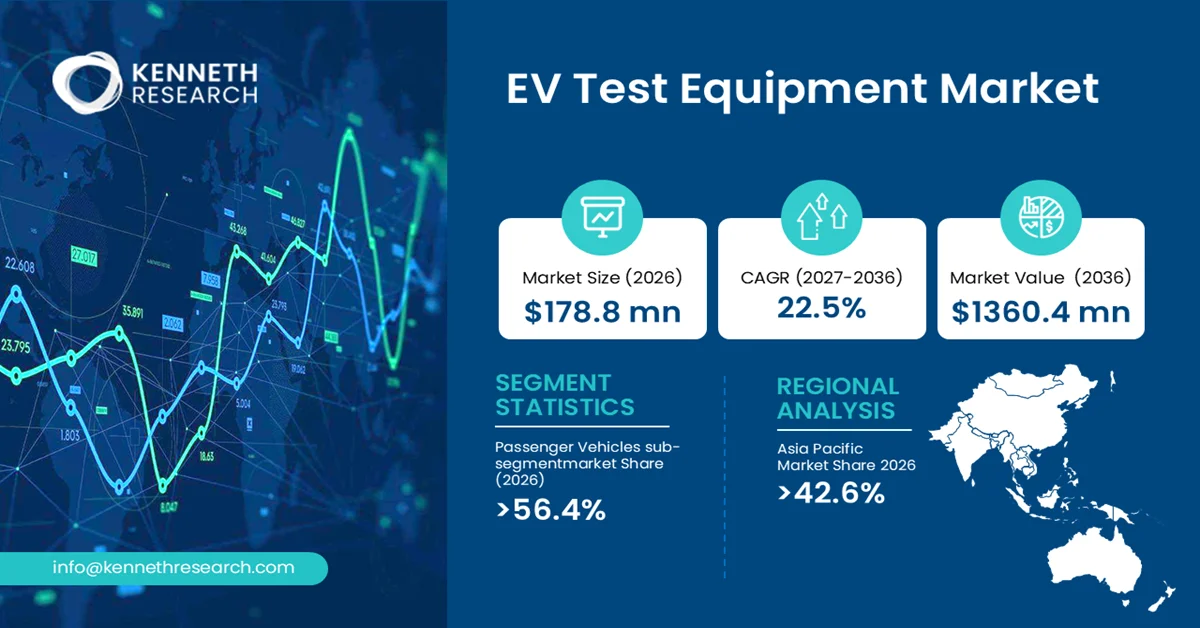
EV Test Equipment Market size was valued at USD 178.8 million in 2026 and is projected to reach USD 1360.4 million by the end of 2036, rising at a CAGR of 22.5% during the forecast period, i.e., 2027–2036. In 2027, the industry size of the ev test equipment market is estimated at USD 219 million.
The primary growth driver is the rapid expansion of electric passenger-vehicle production and deployment, which increases requirements for battery, powertrain, charging, thermal-management, safety, and electronic-system validation.
The EV Test Equipment Market comprises specialized hardware, software, instruments, and integrated testing systems used to evaluate the performance, safety, reliability, durability, and compliance of electric vehicles and their electrical and electronic systems.
A key characteristic of this market is its ability to support testing across multiple stages of the vehicle lifecycle, including research and development, component validation, prototype development, production-line quality assurance, certification, and after-sales diagnostics.
Key EV Test Equipment Market Insights Summary:
Key Takeaways: Market Trends & Insights
- EV Test Equipment Market projected to grow from USD 178.8 million in 2026 to USD 1360.4 million by 2036, expanding at a 22.5% CAGR during 2027–2036.
- Asia-Pacific accounted for the largest regional share at 42.6% in 2026, supported by strong EV manufacturing activity, expanding domestic adoption, and continued investments in battery, powertrain, and charging technologies across Japan and China.
- Passenger Vehicles remained the leading Vehicle Type segment with a 56.4% market share in 2026, driven by expanding EV production and increasing testing requirements for batteries, electric powertrains, power electronics, charging systems, and vehicle-level electronics.
- Mid-Priced Vehicles are positioned for increasing testing demand as automakers expand electrified offerings toward broader consumer markets and seek cost-efficient validation, automation, and scalable testing solutions.
Market Drivers
- Expansion of EV manufacturing and validation requirements
- Increasing software and electronics complexity
- Stricter vehicle safety, emissions, and electrical-compliance requirements
- Growing adoption of automated and data-driven testing methodologies
Challenges
- High capital expenditure and system-integration complexity
- Rapid EV technology evolution and potential equipment obsolescence
EV Test Equipment Market Overview & Supply Chain
Global adoption of EVs is increasing the need for sophisticated validation infrastructure because electric vehicles depend on tightly integrated batteries, electric propulsion systems, power electronics, charging interfaces, sensors, and software. The testing requirement therefore extends beyond conventional mechanical validation toward electrical, thermal, electromagnetic, software, and high-voltage verification. The International Energy Agency reported that global electric-car sales reached 21 million units in 2025, demonstrating the expanding installed base that requires increasingly sophisticated development and quality-assurance capabilities.
The EV test-equipment value chain begins with specialized inputs such as precision sensors, electrical components, power semiconductors, data-acquisition hardware, programmable power supplies, actuators, computing components, thermal-control equipment, and software platforms. Equipment manufacturers integrate these components into battery cyclers, dynamometers, powertrain test benches, charging-test systems, environmental chambers, hardware-in-the-loop platforms, and automated end-of-line systems.
EV Test Equipment Market: Growth Drivers & Challenges
Growth Drivers
- Expansion of ev manufacturing and validation requirements: The rapid expansion of EV manufacturing directly increases demand for testing equipment across component and vehicle development. EVs contain high-voltage batteries, sophisticated power electronics, electric motors, charging systems, and software-controlled functions that require specialized validation beyond traditional vehicle testing. Testing platforms allow manufacturers to reproduce electrical loads, thermal conditions, vibration, charging cycles, and fault scenarios before vehicles reach production.
- Increasing software and electronics complexity: The transition toward software-defined and electronically integrated vehicles is expanding the scope of validation required before commercialization. Modern EVs increasingly combine battery-management systems, motor controls, advanced driver-assistance functions, connectivity, charging communications, thermal controls, and centralized electronic architectures. These systems must operate correctly individually and as integrated vehicle functions.
Challenges
- High capital and integration requirements: Advanced EV testing infrastructure can require substantial investment because comprehensive facilities may combine high-voltage equipment, battery-testing systems, dynamometers, environmental-control systems, simulation platforms, and specialized safety infrastructure. Integration across different equipment and software environments can further increase engineering complexity.
- Rapid technology evolution and equipment obsolescence: EV architectures are evolving rapidly as manufacturers introduce new battery chemistries, voltage architectures, semiconductor technologies, charging standards, electronic-control configurations, and software platforms. Test equipment purchased for one generation of technology may require substantial upgrades when vehicle architectures change. This creates lifecycle-management challenges for users and increases the importance of modular, programmable, and upgradeable systems.
EV Test Equipment Market Size and Forecast:
| Report Attribute | Details |
|---|---|
| Base Year |
2026 |
| Forecast Period |
2027-2036 |
| CAGR |
22.5% |
| Base Year Market Size (2026) |
USD 178.8 million |
| Forecast Year Market Size (2036) |
USD 1360.4 million |
| Regional Scope |
|
EV Test Equipment Market Segmentation Analysis:
Vehicle Type Segment Analysis
In the Vehicle Type segment, the Passenger Vehicles sub-segment is anticipated to capture the largest market share of 56.4% in 2026.
Passenger vehicles remain the leading vehicle-type segment because EV adoption has been particularly concentrated in consumer automobiles, creating extensive requirements for vehicle-level validation and component testing. Passenger EV platforms integrate batteries, electric motors, inverters, onboard chargers, thermal systems, electronic controls, connectivity functions, and increasingly sophisticated software. Each subsystem must be validated individually and under integrated operating conditions.
The scale of the passenger-vehicle transition is also reflected in China's vehicle fleet. China's National Bureau of Statistics reported that new-energy vehicles in civilian ownership reached 31.40 million at the end of 2024, with the stock increasing by 10.99 million during the year. For test-equipment suppliers, this expanding vehicle population reinforces demand not only during vehicle development but also across manufacturing quality control, certification, diagnostics, and lifecycle testing.
Vehicle Class Segment Analysis
Mid-priced vehicles represent an important growth opportunity because they sit closer to the mass-market consumer base than premium EVs while requiring manufacturers to balance affordability with increasingly sophisticated electrical and electronic functionality. The segment therefore creates a strong requirement for cost-efficient testing solutions that can maintain engineering quality without disproportionately increasing vehicle development costs. This positioning creates opportunities for test-equipment suppliers to provide scalable systems capable of validating batteries, propulsion systems, charging functions, and electronic controls across multiple vehicle platforms.
Our in-depth analysis of the global EV test equipment market includes the following segments:
|
Segment |
Sub-segment |
|
Vehicle Type |
|
|
Vehicle Class |
|
|
Testing Type |
|
|
Component |
|
|
End User |
|
EV Test Equipment Market Regional Insights:
Asia-Pacific Market Trends & Insights:
Asia-Pacific is the leading regional market, accounting for 42.6% in 2026, supported by extensive EV manufacturing capacity, expanding domestic consumption, established automotive supply chains, and increasing investment in electrification technologies. Government policies promoting clean mobility, localized battery and power-electronics production, and charging infrastructure are strengthening the region's requirement for advanced validation equipment.
China is the region's principal manufacturing hub, supported by a deeply integrated automotive ecosystem spanning batteries, electronic components, electric powertrains, and complete vehicles.
Japan represents a complementary technology-intensive market. Its government has established a target for electrified vehicles to account for all new passenger-vehicle sales by 2035, while incentives are being used to accelerate clean-vehicle adoption.
North America Market Trends & Insights:
North America represents an important market for EV test equipment because the region combines established automotive manufacturing, rapidly developing battery and charging ecosystems, substantial engineering capabilities, and stringent vehicle-performance and safety requirements. Demand is supported by OEM investments in electrification, battery manufacturing, charging infrastructure, and software-defined vehicle architectures.
The United States remains the principal demand center, supported by a large automotive manufacturing base and continued deployment of electric vehicles and associated infrastructure. Federal programs and industrial policies have encouraged domestic investment in batteries, charging networks, and clean transportation technologies, creating additional requirements for validation and production-quality systems.
Canada offers complementary opportunities through its automotive manufacturing ecosystem, zero-emission vehicle policies, battery investments, and clean-transportation programs.
Leading Companies Operating in the Global EV Test Equipment Market:
Here is a list of upstream, downstream, and key players operating in the global ev test equipment market competitive ecosystem:
- AVL (Austria)
- Company Overview
- Business Strategy
- Key Product Offerings
- Financial Performance
- Key Performance Indicators
- Risk Analysis
- Recent Development
- Regional Presence
- SWOT Analysis
- HORIBA (Japan)
- Keysight Technologies (U.S)
Recent Developments
- June 2026: HORIBA announced the full-scale launch of its Vehicle Thermal Management System Evaluation Facility, designed to support development and evaluation of vehicle thermal-management systems.
- October 2025: Keysight launched the EV2020B EV Manufacturing Functional Test Platform and EV2020BE EV Manufacturing Functional Test Platform for EVSE, expanding its end-of-line testing portfolio for electric mobility manufacturing.
Frequently Asked Question
In 2026, the EV test equipment market exceeded USD 178.8 million.
The EV Test Equipment Market is projected to reach USD 1360.4 million by the end of 2036, expanding at a CAGR of 22.5% over the forecast period (2027-2036).
The major players in the market are AVL, HORIBA, Keysight Technologies, Chroma ATE, and NI, and others.
In the Vehicle Type segment, the Passenger Vehicles sub-segment is anticipated to capture the largest market share of 56.4% in the future and exhibit lucrative growth opportunities during 2027-2036.
Asia-Pacific is projected to hold the largest market share of 42.6% by the end of 2026 and provide more business opportunities in the future.
Why Choose Kenneth Research ?
-
Insight with Impact : We don’t just gather data — we uncover stories, trends, and opportunities that fuel business growth.
-
Experts Who Get It : Our team speaks your industry’s language and knows what really matters to your customers and market.
-
Custom-Built for You : Forget one-size-fits-all. We craft research and consulting solutions as unique as your business vision.
-
Partners, Not Just Providers : We work with you, not for you — collaborating closely to turn insights into smart, strategic moves.
-
Results That Speak : Our work powers brands, startups, and industry leaders alike — with a track record of ideas that work in the real world.
Report ID: 1364 |
Published Date: 11 Sep 2026 |
Report Format: |
Delivery Timeline: 48-72 Business Hours

Copyright © 2025 Kenneth Research. All rights reserved. Terms of Use | Privacy Policy
