Report ID: 1302 |
Published Date: 10 Sep 2026 |
Report Format: |
Delivery Timeline: 48-72 Business Hours
EV Battery Health Monitoring Market Outlook:
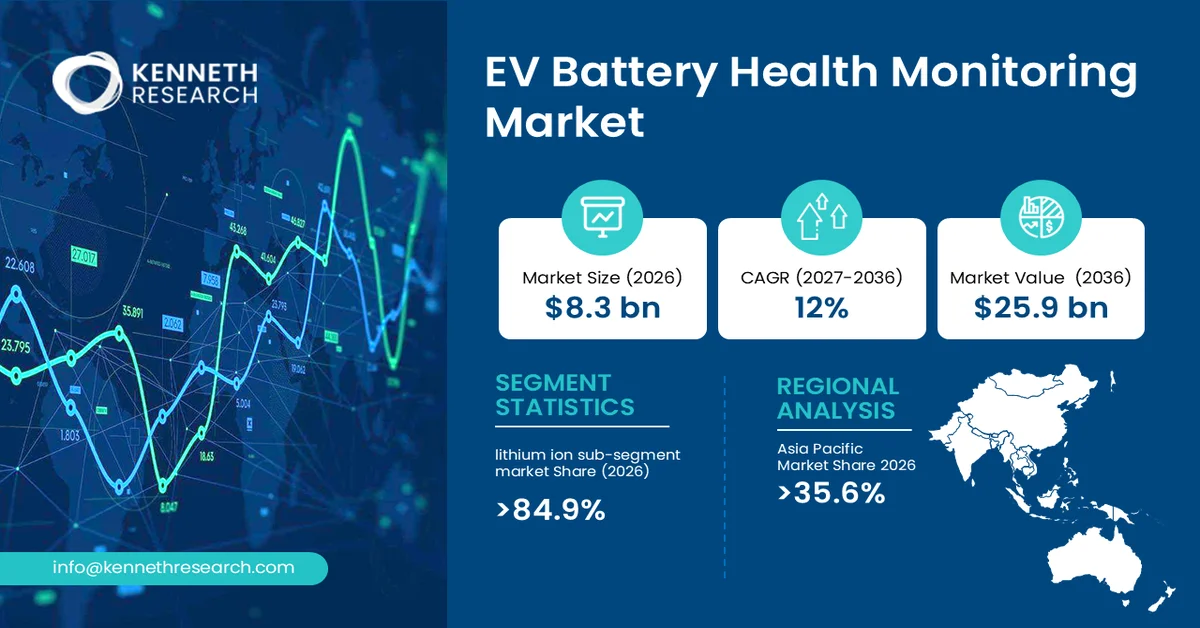
EV Battery Health Monitoring Market size was valued at USD 8.3 billion in 2026 and is projected to reach USD 25.9 billion by the end of 2036, rising at a CAGR of 12% during the forecast period, i.e., 2027–2036. In 2027, the industry size of the global ev battery health monitoring is estimated at USD 9.3 billion.
The primary growth driver is the rapid expansion of electric-vehicle deployment, which increases the installed base of high-value traction batteries requiring continuous condition assessment. The IEA reported that global electric-car sales reached nearly 14 million in 2023, reinforcing demand for technologies that monitor battery condition, performance, degradation, safety, and remaining useful life.
The ev battery health monitoring market comprises technologies, software, sensors, algorithms, and diagnostic solutions used to assess and track the operational condition of batteries installed in electric vehicles. These solutions typically evaluate battery health indicators such as state of health, state of charge, temperature, voltage, current, degradation patterns, cell imbalance, and abnormal operating conditions.
Battery health monitoring is generally integrated with or works alongside the vehicle’s battery management system, enabling continuous data acquisition and analysis at cell, module, pack, and vehicle levels. Advanced solutions can use diagnostic algorithms, predictive analytics, cloud connectivity, and machine-learning techniques to identify degradation trends and potential faults.
Key EV Battery Health Monitoring Market Insights Summary:
Key Takeaways: Market Trends & Insights
- Global market value is projected to rise from USD 8.3 Billion in 2026 to USD 25.9 Billion by 2036, reflecting a 12% CAGR from 2027 to 2036
- Lithium Ion leads the Battery segment with an 84.9% market share in 2026, supported by widespread EV adoption and the established lithium-ion battery ecosystem
- Passenger Car is identified as the second and fastest analysis segment, driven by increasing passenger EV deployment and growing demand for battery diagnostics
- Asia Pacific dominates with a 35.6% market share in 2026, supported by strong EV manufacturing, battery production, and electrification investment across China and Japan
Market Drivers
- Accelerating electric vehicle adoption
- Advancements in battery diagnostics and predictive analytics
- Growing emphasis on battery safety and lifecycle management
- Increasing demand for predictive maintenance and fleet-level battery analytics
Challenges
- Diagnostic complexity and interoperability constraints
- Data access, validation, and cybersecurity risks
EV Battery Health Monitoring Market Overview & Supply Chain
Global adoption is increasing as electric-vehicle deployment expands and battery performance becomes increasingly central to vehicle reliability, safety, lifecycle economics, and fleet management. Battery health monitoring supports continuous assessment of degradation, operating conditions, thermal behaviour, and performance, enabling manufacturers and operators to identify abnormal conditions and optimize maintenance.
The industry value chain begins with raw-material and component suppliers providing battery cells, electronic components, sensors, semiconductor devices, communication modules, and computing hardware required for monitoring systems. Battery and automotive manufacturers then integrate sensing, battery-management electronics, embedded software, diagnostic algorithms, and data-processing capabilities into vehicle battery architectures. Specialized technology providers contribute analytics platforms, predictive diagnostics, cloud infrastructure, and software interfaces. Distribution occurs through direct OEM integration, tiered automotive suppliers, aftermarket channels, fleet-management platforms, and specialized diagnostic-service providers.
EV Battery Health Monitoring Market: Growth Drivers & Challenges
Growth Drivers
- Accelerating electric vehicle adoption: The expanding global electric-vehicle fleet is increasing the need for reliable battery diagnostics because the battery remains a critical determinant of vehicle performance, safety, range, and lifecycle economics. As more vehicles enter operation, automakers, fleet operators, dealerships, and service providers require continuous visibility into battery condition to identify degradation, abnormal operating behaviour, and potential faults.
- Advancements in battery diagnostics and predictive analytics: Technological progress in sensors, embedded electronics, battery-management systems, connectivity, and data analytics is strengthening the capabilities of battery health monitoring solutions. Conventional monitoring primarily focused on measurable operating parameters, whereas advanced systems increasingly combine multiple data streams to identify degradation patterns and distinguish normal performance variation from emerging faults. Improved algorithms can support more precise state-of-health estimation, cell-level diagnostics, thermal assessment, anomaly detection, and remaining-useful-life analysis.
Challenges
- Diagnostic complexity and interoperability constraints: Battery architectures vary across vehicle platforms, cell chemistries, pack configurations, sensing arrangements, and battery-management systems, making standardized health assessment difficult. Monitoring providers must therefore develop algorithms capable of interpreting heterogeneous operating data while maintaining diagnostic accuracy across different battery designs.
- Data access, validation, and cybersecurity risks: Battery health monitoring depends on reliable access to granular operational data, yet manufacturers may restrict diagnostic information because battery data can contain commercially sensitive information and may be closely integrated with proprietary vehicle-control systems. Limited data accessibility can constrain third-party monitoring providers and make independent health assessment more difficult.
EV Battery Health Monitoring Market Size and Forecast:
| Report Attribute | Details |
|---|---|
| Base Year |
2026 |
| Forecast Period |
2027-2036 |
| CAGR |
12% |
| Base Year Market Size (2026) |
USD 8.3 Billion |
| Forecast Year Market Size (2036) |
USD 25.9 Billion |
| Regional Scope |
|
EV Battery Health Monitoring Market Segmentation Analysis:
Battery Segment Analysis
In the battery segment, lithium ion sub-segment is anticipated to capture the largest market share of 84.9% by the end of 2026.
Lithium-ion is the leading battery sub-segment because it remains the predominant technology used in electric vehicles, creating a large installed base requiring continuous monitoring of cell condition, temperature, voltage, degradation, and safety. Demand is reinforced by expanding EV deployment and the established manufacturing ecosystem supporting lithium-ion chemistries. The International Energy Agency reported that automotive lithium-ion battery demand increased to 550 GWh in 2022, driven primarily by electric passenger-car sales. This large-scale deployment encourages OEMs and battery manufacturers to strengthen battery-management and diagnostic capabilities, while monitoring suppliers benefit from established interfaces, data availability, and technical familiarity with lithium-ion architectures. On the supply side, mature cell manufacturing, established material-processing networks, and ongoing chemistry improvements support continued deployment.
Vehicle Segment Analysis
The passenger car sector is projected to grow as the second-largest segment in the EV battery health monitoring market due to four converging demand drivers.
Passenger cars are projected to remain a strong growth segment as electrification increasingly penetrates mainstream personal mobility. Demand for battery health monitoring rises with the growing number of passenger EVs requiring accurate assessment of battery condition, range capability, degradation, and safety throughout their operating lives. For fleet and after-sales stakeholders, battery-health information can improve maintenance planning, warranty assessment, resale evaluation, and lifecycle management. Going forward, greater passenger-EV penetration and increasingly software-defined vehicle architectures should create broader opportunities for predictive battery diagnostics and connected health-monitoring services.
Our in-depth analysis of the ev battery health monitoring market includes the following segments:
|
Segment |
Sub-segment |
|
Battery |
|
|
Propulsion |
|
|
Vehicle |
|
|
Technology |
|
|
Application |
|
|
End Use |
|
EV Battery Health Monitoring Market Regional Insights:
Asia Pacific Market Trends & Insights:
Asia Pacific EV battery health monitoring market is projected to hold the largest revenue share of 35.6% by the end of 2026.
It is supported by a deeply established automotive manufacturing base, extensive battery production capabilities, accelerating EV deployment, and sustained investment in electrification technologies. The region benefits from integrated supply chains spanning battery materials, cells, electronics, vehicle manufacturing, and software, creating favourable conditions for battery-health monitoring adoption.
China remains the principal country within Asia Pacific, supported by extensive EV manufacturing capacity, a large domestic market, battery-industry depth, and continued policy emphasis on new-energy mobility. These conditions create a substantial ecosystem for battery-monitoring technology providers and automotive suppliers.
Japan represents another important market, underpinned by established automotive engineering capabilities, advanced battery research, and strong OEM expertise. Japanese manufacturers’ emphasis on vehicle efficiency, reliability, and battery performance supports demand for sophisticated monitoring and diagnostic technologies. Together, China and Japan provide complementary strengths across production scale, technology development, and automotive innovation, supporting Asia Pacific’s continuing leadership in the ev battery health monitoring market.
North America Market Trends & Insights:
North America represents an important secondary region for the ev battery health monitoring market, supported by expanding EV adoption, domestic battery manufacturing, charging infrastructure development, and investment in connected-vehicle technologies.
The United States is the region’s principal country market, benefiting from substantial automotive engineering capabilities, expanding domestic battery production, and federal efforts to establish a resilient battery supply chain. Investment in advanced battery manufacturing is also encouraging deeper integration of electronics, software, and diagnostic technologies across EV platforms.
Canada offers complementary opportunities through its developing battery and automotive ecosystem. Government initiatives target the full EV value chain, including vehicle electrification, charging infrastructure, battery technologies, and critical-material supply security. Canada’s automotive strategy specifically prioritizes the development of next-generation vehicle and battery supply chains, creating opportunities for specialized monitoring technologies as domestic production and EV adoption expand.
EV Battery Health Monitoring Market Competitive Landscape
Here is a list of upstream, downstream, and key players operating in ev battery health monitoring market competitive ecosystem:
- Robert Bosch GmbH (Germany)
- Company Overview
- Business Strategy
- Key Product Offerings
- Financial Performance
- Key Performance Indicators
- Risk Analysis
- Recent Development
- Regional Presence
- SWOT Analysis
- DENSO Corporation (Japan)
- LG Energy Solution Ltd. (South Korea)
- Renesas Electronics Corporation (Japan)
Recent Developments
- In November 2025, HIF Global became the world's first to receive ISCC EU RFNBO certification for e-gasoline produced at its Haru Oni facility in Chile, confirming the fuel is renewable, traceable, and achieves over 70% emissions reduction compared to fossil fuels. The facility combines wind energy with electrolysis to produce green hydrogen, which is reacted with captured CO₂ to generate synthetic methanol and e-gasoline.
- In February 2025, Norsk e-Fuel partnered with Prime Capital and RES to develop "Project Alby" in Ånge, Sweden, planning to produce a minimum of 80,000 tons of e-fuel annually. The project will use the Power-to-Liquid process to convert water and captured CO₂ into e-kerosene, marking Norsk e-Fuel's expansion into Sweden following earlier projects in Norway and Finland.
Frequently Asked Question
In 2026, the ev battery health monitoring market exceeded USD 8.3 Billion.
The ev battery health monitoring market is projected to reach USD 25.9 Billion by the end of 2036, expanding at a CAGR of 12% over the forecast period (2027-2036).
The major players in the market are Robert Bosch GmbH, DENSO Corporation, LG Energy Solution Ltd., Renesas Electronics Corporation, and others.
In the Battery segment, the Lithium Ion sub-segment is anticipated to capture the largest market share of 84.9% in the future and exhibit lucrative growth opportunities during 2027-2036. This growth trajectory is largely attributed to the expanding adoption of electric vehicles and the established lithium-ion battery manufacturing ecosystem.
Asia Pacific is projected to hold the largest market share of 35.6% by the end of 2036 and provide more business opportunities in the future. Continuous investments in EV manufacturing, battery production, and electrification technologies across China and Japan are fostering the region's dominance.
Why Choose Kenneth Research ?
-
Insight with Impact : We don’t just gather data — we uncover stories, trends, and opportunities that fuel business growth.
-
Experts Who Get It : Our team speaks your industry’s language and knows what really matters to your customers and market.
-
Custom-Built for You : Forget one-size-fits-all. We craft research and consulting solutions as unique as your business vision.
-
Partners, Not Just Providers : We work with you, not for you — collaborating closely to turn insights into smart, strategic moves.
-
Results That Speak : Our work powers brands, startups, and industry leaders alike — with a track record of ideas that work in the real world.
Report ID: 1302 |
Published Date: 10 Sep 2026 |
Report Format: |
Delivery Timeline: 48-72 Business Hours

Copyright © 2025 Kenneth Research. All rights reserved. Terms of Use | Privacy Policy
