Report ID: 1121 |
Published Date: 20 Aug 2026 |
Report Format: |
Delivery Timeline: 48-72 Business Hours
Epoxy flooring resins market Outlook:
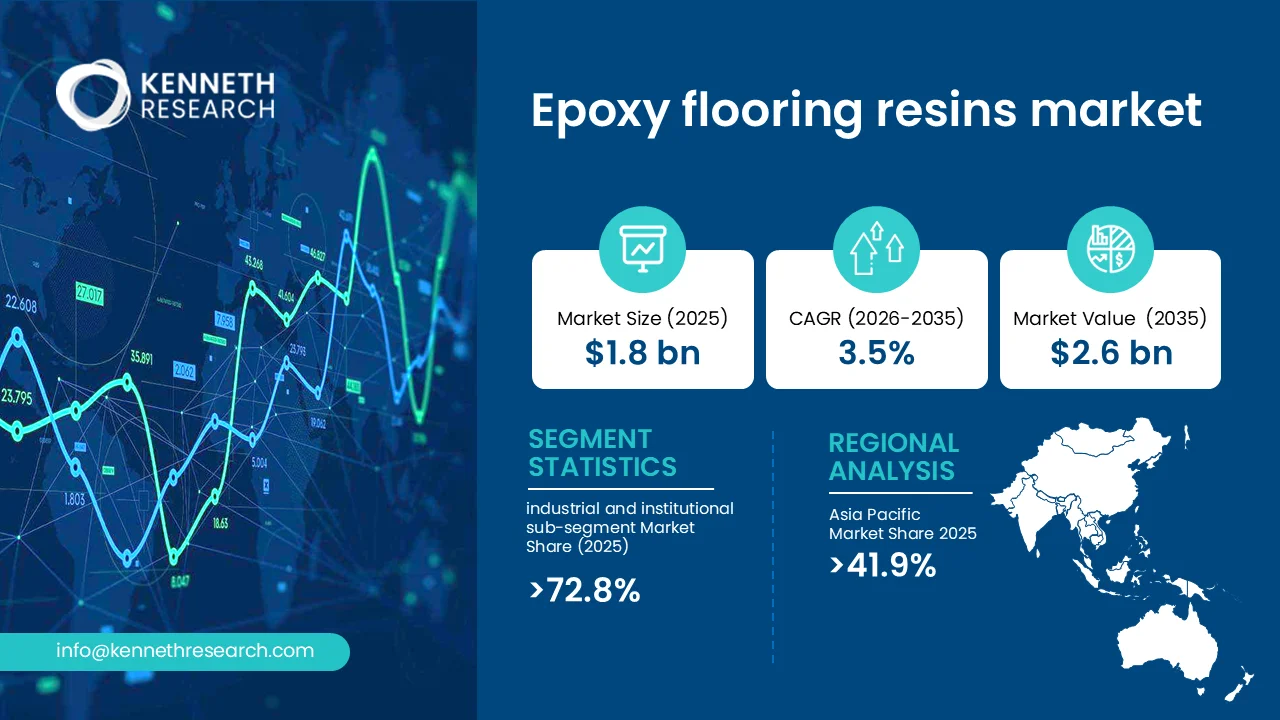
Epoxy flooring resins market size was valued at USD 1.8 billion in 2025 and is projected to reach USD 2.6 billion by the end of 2035, rising at a CAGR of 3.5% during the forecast period, i.e., 2026-2035. In 2026, the industry size of epoxy flooring resins is estimated at USD 1.9 billion.
The primary growth driver for the epoxy flooring resins market is expanding industrial manufacturing and infrastructure development, which increase demand for durable, chemical-resistant, and low-maintenance flooring systems. India's Economic Survey 2023–24 reported 9.5% industrial sector growth, reinforcing investments in manufacturing facilities that require high-performance epoxy flooring solutions.
The epoxy flooring resins market comprises thermosetting resin systems formulated to produce seamless, durable, and high-performance floor coatings for concrete and other substrates. These resin systems are typically combined with curing agents, pigments, fillers, and performance additives to create flooring solutions capable of withstanding heavy mechanical loads, chemical exposure, abrasion, moisture, and frequent cleaning. Depending on application requirements, epoxy flooring resins can be used in self-leveling, mortar, anti-static, decorative, and protective flooring systems.
A defining characteristic of epoxy flooring resins is their strong adhesion, excellent compressive strength, chemical resistance, and long service life, making them suitable for demanding operational environments. Their versatility enables deployment across manufacturing plants, warehouses, logistics hubs, healthcare facilities, educational institutions, commercial buildings, food processing units, and pharmaceutical production sites where hygiene, safety, and durability are essential.
From an industrial perspective, epoxy flooring resins support facility performance by protecting structural concrete, reducing maintenance requirements, improving workplace safety through slip-resistant finishes, and complying with stringent operational and sanitation standards. As industrial modernization and infrastructure development continue globally, epoxy flooring resin systems remain an essential component of high-performance flooring applications.
Key Epoxy flooring resins Market Insights Summary:
Key Takeaways: Market Trends & Insights
- The global Epoxy flooring resins market is projected to grow from USD 1.9 billion in 2026 to USD 2.6 billion by 2035, registering a 3.5% CAGR driven by expanding industrial infrastructure and manufacturing modernization
- The Industrial and Institutional end-use sector remains the largest segment, accounting for 72.8% of the market in 2025, supported by sustained demand from manufacturing plants, warehouses, healthcare facilities, and institutional buildings
- Asia Pacific led the global market with a 41.9% share in 2025, underpinned by robust manufacturing ecosystems and continuous industrial and infrastructure investments across China and India
- The Direct/Contractor distribution channel is expected to witness significant growth as industrial customers increasingly prefer technically supported project execution, customized flooring solutions, and professional installation services
- Future market opportunities will be reinforced by rising investments in industrial facilities, logistics hubs, commercial infrastructure, and regulated sectors requiring durable, seamless, and chemically resistant epoxy flooring systems
Market Drivers
- Expansion of industrial and advanced manufacturing infrastructure
- Rising demand for high-performance flooring in regulated industries
- Increasing investments in warehouse, logistics, and distribution center development
- Growing preference for durable, low-maintenance, and chemically resistant flooring solutions across commercial and institutional facilities
Challenges
- Raw material supply volatility and fluctuating petrochemical input costs
- Complex surface preparation and installation requirements requiring skilled application
Epoxy flooring resins market Overview & Supply Chain
Global adoption of epoxy flooring resins is increasing as industrial operators prioritize durable, chemically resistant, and low-maintenance flooring solutions that improve operational efficiency and workplace safety. The market is also benefiting from investments in manufacturing modernization, logistics infrastructure, healthcare facilities, and food processing plants, where seamless flooring supports hygiene compliance and equipment longevity. Sustainability initiatives are further encouraging longer-life flooring systems that reduce maintenance cycles and resource consumption.
The epoxy flooring resins value chain begins with the sourcing of petrochemical-derived raw materials, including epoxy resins, curing agents, reactive diluents, pigments, mineral fillers, and specialty additives supplied by chemical manufacturers. These inputs are formulated into flooring systems through controlled blending, quality testing, and packaging processes that ensure consistent mechanical strength, chemical resistance, and application performance. Finished products are distributed through direct sales teams, specialized coating distributors, industrial contractors, and regional construction material suppliers, with technical support often accompanying large commercial or industrial projects. Installation quality is a critical component of the value chain, making certified flooring contractors important stakeholders alongside resin producers and formulation specialists. End users include manufacturing facilities, warehouses, healthcare institutions, educational campuses, commercial buildings, food and beverage processors, and logistics centers. Additional stakeholders comprise engineering consultants, architects, construction firms, facility management companies, regulatory bodies, and maintenance service providers that influence product selection, compliance, installation standards, and lifecycle performance.
Epoxy flooring resins market: Growth Drivers & Challenges
Growth Drivers:
- Expansion of industrial and advanced manufacturing infrastructure: The expansion of industrial production facilities and advanced manufacturing infrastructure is a major driver for the epoxy flooring resins market. Manufacturers are increasingly investing in production plants, warehouses, logistics hubs, electronics facilities, and pharmaceutical units that require flooring systems capable of resisting chemicals, abrasion, heavy equipment movement, and continuous operations. Epoxy flooring resins help improve workplace safety, reduce maintenance downtime, and extend the operational life of concrete surfaces, making them a preferred choice for industrial environments. The continued modernization of manufacturing facilities also increases demand for seamless flooring solutions that support automation and stringent hygiene standards. According to Eurostat, production in construction increased by 1.3% in the EU in November 2024 compared with October 2024, indicating continued construction activity that supports installation of industrial flooring systems across new and upgraded facilities.
- Rising demand for high-performance flooring in regulated industries: Growing quality and compliance requirements across regulated industries are accelerating the adoption of epoxy flooring resin systems. Sectors such as pharmaceuticals, healthcare, food and beverage processing, biotechnology, and electronics manufacturing require flooring that supports contamination control, ease of cleaning, chemical resistance, and long-term durability. Epoxy flooring addresses these operational requirements by creating seamless surfaces that reduce dust accumulation and withstand frequent sanitation procedures. The increasing implementation of automated material handling systems and precision manufacturing equipment further strengthens the need for floors with superior mechanical performance and minimal maintenance. Looking ahead, stricter operational standards, greater emphasis on worker safety, and continuous investment in technologically advanced production environments will encourage wider deployment of specialized epoxy flooring systems across both new facilities and modernization projects.
Challenges:
- Volatility in petrochemical-based raw material supply and pricing: Epoxy flooring resins rely heavily on petrochemical-derived feedstocks and specialized curing agents whose availability and pricing are influenced by fluctuations in crude oil markets, refinery operations, regional supply constraints, and global trade dynamics. Sudden changes in raw material costs make it difficult for manufacturers to maintain stable production expenses and long-term pricing agreements with distributors and contractors. This uncertainty affects procurement planning, inventory management, and project budgeting, particularly for large industrial flooring installations where material costs represent a significant share of total expenditure. Commercially, producers may experience compressed profit margins or face resistance when attempting to pass higher costs to customers in competitive bidding environments. Looking ahead, companies are expected to strengthen supply chain diversification, pursue alternative sourcing strategies, and invest in formulation optimization to reduce exposure to feedstock price volatility.
- Complex surface preparation and installation requirements: The performance of epoxy flooring systems depends heavily on proper substrate preparation, environmental conditions, and skilled application practices. Concrete moisture, surface contamination, temperature fluctuations, and inadequate curing can compromise adhesion and reduce the long-term durability of installed flooring. These technical requirements increase project complexity and make installation quality a critical determinant of product performance. Commercially, contractors must invest in specialized equipment, workforce training, and rigorous quality assurance processes, which can increase project costs and extend installation schedules. End users may also hesitate to adopt epoxy flooring where operational downtime during installation is difficult to accommodate. In the future, manufacturers are likely to focus on faster-curing formulations, simplified application technologies, and enhanced installer training programs to improve project efficiency while maintaining consistent flooring performance.
Epoxy flooring resins market Size and Forecast:
| Report Attribute | Details |
|---|---|
| Base Year |
2025 |
| Forecast Year |
2026-2035 |
| CAGR |
3.5% |
| Base Year Market Size (2025) |
USD 1.8 billion |
| Forecast Year Market Size (2035) |
USD 2.6 billion |
| Regional Scope |
|
Epoxy flooring resins market Segmentation Analysis:
End-Use Sector Segment Analysis
In the end-use sector segment, the industrial and institutional sub-segment is anticipated to capture the largest market share of 72.8% by the end of 2025.
The industrial and institutional segment dominates the epoxy flooring resins market because facilities in manufacturing, logistics, healthcare, education, and public infrastructure require flooring systems that can withstand heavy mechanical loads, chemical exposure, continuous foot traffic, and rigorous cleaning protocols. These environments prioritize long service life, low maintenance requirements, and operational safety, making epoxy resin flooring a preferred solution for both new construction and renovation projects. Growing investments in industrial modernization and institutional infrastructure further strengthen demand, while manufacturers continue to introduce formulations with improved abrasion resistance, faster curing, and enhanced environmental performance to meet evolving customer requirements. On the supply side, well-established distribution networks, experienced installation contractors, and standardized application practices enable efficient deployment across large-scale projects.
Distribution Channel Segment Analysis
The direct/contractor is projected to grow as the second-largest segment in the epoxy flooring resins market due to four converging demand drivers.
The direct/contractor distribution channel is projected to experience strong growth as industrial and commercial customers increasingly seek integrated flooring solutions that combine technical product selection, customized formulation, and professional installation. Large manufacturing plants, warehouses, healthcare facilities, and institutional projects typically require project-specific flooring systems, making direct engagement between resin manufacturers, authorized contractors, and end users more effective than conventional distribution models. This channel also enables suppliers to provide on-site technical support, quality assurance, and lifecycle maintenance services, which are becoming increasingly important for complex flooring applications. On the supply side, manufacturers are expanding contractor certification programs and strengthening partnerships with specialized applicators to ensure consistent installation quality and regulatory compliance. According to the OECD, public procurement represents an average of 13% of GDP across OECD countries, highlighting the scale of government-funded infrastructure and institutional projects that frequently rely on direct procurement and contractor-led execution for specialized construction materials, including high-performance flooring systems.
Our in-depth analysis of the global epoxy flooring resins market includes the following segments:
|
Segment |
Sub-segment |
|
End-Use Sector |
|
|
Distribution Channel |
|
Epoxy flooring resins market Regional Insights:
Asia Pacific Market Trends & Insights:
Asia Pacific epoxy flooring resins market is projected to hold the largest revenue share of 41.9% by the end of 2025.
Countries across the region continue to invest in factories, warehouses, healthcare infrastructure, transportation hubs, and electronics production, all of which require durable, chemical-resistant flooring systems capable of supporting intensive industrial operations. Government-backed industrial development programs, expanding construction activity, and the presence of well-established chemical manufacturing ecosystems further strengthen regional supply capabilities. In addition, the availability of raw materials, large-scale production facilities, and experienced installation contractors enables efficient delivery of epoxy flooring solutions across diverse industrial applications.
China remains the region's largest manufacturing economy, supported by its extensive industrial base spanning chemicals, electronics, automotive, logistics, and heavy manufacturing. Continuous investment in industrial modernization and production efficiency sustains demand for durable flooring systems in both new and upgraded facilities.
India is emerging as a significant growth market, driven by expanding manufacturing capacity, industrial corridors, warehousing development, and public infrastructure projects. Government initiatives encouraging domestic manufacturing and industrial investment are creating additional opportunities for epoxy flooring installations across production plants, healthcare institutions, educational campuses, and commercial developments. Together, China and India provide a strong foundation for Asia Pacific's leadership through large-scale industrial demand, expanding construction activity, and an increasingly sophisticated manufacturing ecosystem.
Middle East and Africa Market Trends & Insights:
The Middle East and Africa region is emerging as an important growth area for epoxy flooring resins due to rising industrial construction, logistics expansion, commercial real estate development, and increasing investment in healthcare and institutional infrastructure. Demand is being supported by the need for durable flooring systems capable of withstanding heavy traffic, chemical exposure, high temperatures, and intensive cleaning conditions common in industrial and public facilities. Governments across the Gulf Cooperation Council are prioritizing economic diversification, manufacturing development, and infrastructure modernization, creating opportunities for high-performance flooring materials in factories, warehouses, transportation facilities, and public buildings.
Saudi Arabia represents the largest opportunity within the region, driven by industrial diversification programs, new manufacturing investments, logistics corridor development, and major infrastructure projects that require robust flooring systems for production and storage environments. The expansion of industrial cities and warehousing facilities is increasing demand for epoxy flooring installations across both public and private sector projects.
The United Arab Emirates continues to experience strong demand from commercial real estate, healthcare infrastructure, aviation facilities, logistics parks, and advanced manufacturing developments. The country's emphasis on high-quality construction, operational efficiency, and premium facility standards supports the adoption of specialized epoxy flooring systems in institutional, industrial, and commercial applications.
Leading Companies Operating in the Global Epoxy flooring resins market:
Here is a list of upstream, downstream, and key players operating in the global epoxy flooring resins market competitive ecosystem:
- BASF SE (Germany)
- Company Overview
- Business Strategy
- Key Product Offerings
- Financial Performance
- Key Performance Indicators
- Risk Analysis
- Recent Development
- Regional Presence
- SWOT Analysis
- The Sherwin-Williams Company (United States)
- Stonhard (RPM International) (United States)
- Flowcrete (United Kingdom)
Recent Developments
- In August 2025, PT. Sika Indonesia published an Environmental Product Declaration (EPD) for Sikafloor®-264 HC, a two-part epoxy colored coating manufactured at its plant in Bogor, Indonesia . The EPD, verified according to ISO 14025 and EN 15804+A2 standards, confirms the product contains no substances listed on the ECHA candidate list exceeding 0.1% by mass, supporting its positioning as a sustainable solution for storage halls, maintenance workshops, and garages.
- In March 2025, BASF and Sika jointly launched Baxxodur® EC 151, a new amine-based epoxy hardener for flooring applications in production plants, storage halls, and parking decks . The innovation enables ultra-low VOC formulations with up to 90% less volatile organic compounds compared to conventional hardeners and allows for significantly greater use of mineral fillers, lowering costs and improving sustainability . The hardener also cures quickly at temperatures between 5 and 10 degrees Celsius—where conventional hardeners tend to "freeze"—with curing time reduced by up to two thirds, enabling coatings to be walked on shortly after application .
Frequently Asked Question
In 2025, the epoxy flooring resins market exceeded USD 1.8 billion.
The epoxy flooring resins market is projected to reach USD 2.6 billion by the end of 2035, expanding at a CAGR of 3.5% over the forecast period (2026-2035).
The major players in the market are BASF SE (Germany), The Sherwin-Williams Company (United States), Stonhard (RPM International) (United States), Flowcrete (United Kingdom), and others.
In the end-use sector segment, the industrial and institutional sub-segment is anticipated to capture the largest market share of 72.8% in the future and exhibit lucrative growth opportunities during 2026-2035. This growth trajectory is largely attributed to expanding industrial manufacturing and infrastructure development, which continue to increase demand for durable, chemical-resistant, and low-maintenance flooring systems.
Asia Pacific is projected to hold the largest market share of 41.9% by the end of 2025 and provide more business opportunities in the future. Continuous investments in manufacturing capacity, industrial infrastructure, and logistics development across China and India are fostering the region's dominance.
Why Choose Kenneth Research ?
-
Insight with Impact : We don’t just gather data — we uncover stories, trends, and opportunities that fuel business growth.
-
Experts Who Get It : Our team speaks your industry’s language and knows what really matters to your customers and market.
-
Custom-Built for You : Forget one-size-fits-all. We craft research and consulting solutions as unique as your business vision.
-
Partners, Not Just Providers : We work with you, not for you — collaborating closely to turn insights into smart, strategic moves.
-
Results That Speak : Our work powers brands, startups, and industry leaders alike — with a track record of ideas that work in the real world.
Report ID: 1121 |
Published Date: 20 Aug 2026 |
Report Format: |
Delivery Timeline: 48-72 Business Hours

Copyright © 2025 Kenneth Research. All rights reserved. Terms of Use | Privacy Policy
