Report ID: 1020 |
Published Date: 29 Jul 2026 |
Report Format: |
Delivery Timeline: 48-72 Business Hours
Epoxy Composite Market Outlook:
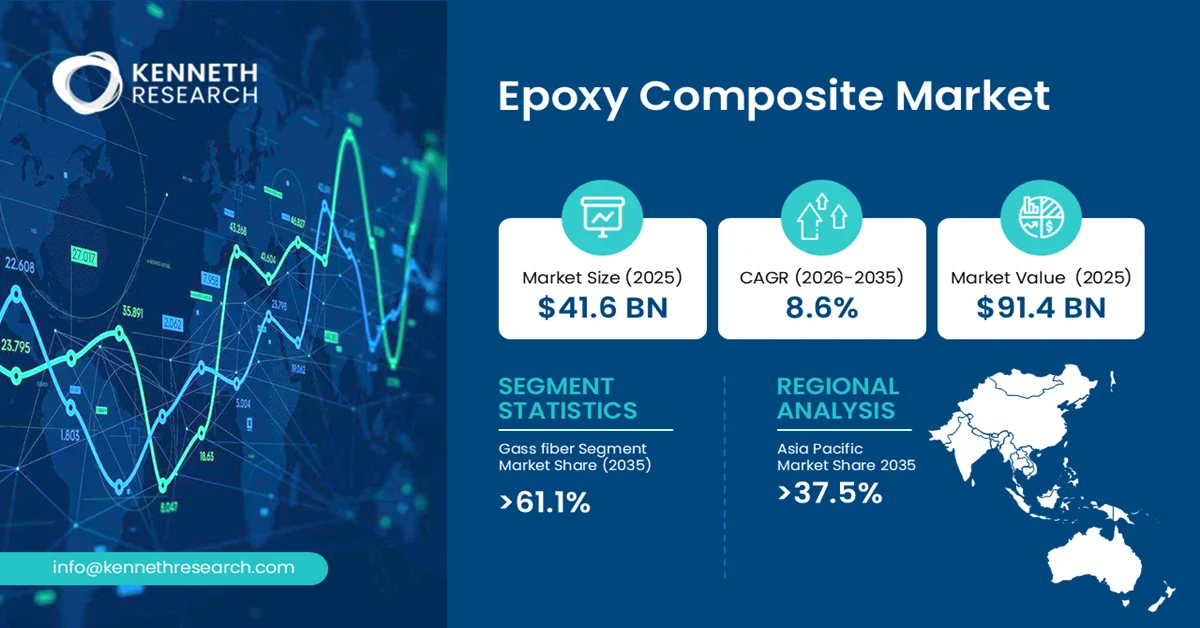
Epoxy Composite Market size was valued at USD 41.6 billion in 2025 and is projected to reach USD 91.4 billion by the end of 2035, rising at a CAGR of 8.6% during the forecast period, i.e., 2026-2035. In 2026, the industry size of epoxy composite is estimated at USD 43.2 billion.
The epoxy composite market is primarily driven by increasing demand for lightweight, high-strength materials across transportation, renewable energy, construction, and electrical applications. Manufacturers are adopting epoxy composites to improve structural performance, corrosion resistance, and durability while supporting energy efficiency, longer service life, and compliance with increasingly stringent environmental and performance standards.
The epoxy composite market comprises materials produced by combining epoxy resin matrices with reinforcing fibers such as glass, carbon, aramid, or natural fibers to create high-performance composite structures. These materials deliver a combination of mechanical strength, dimensional stability, chemical resistance, and excellent adhesion, making them suitable for demanding engineering applications. Epoxy composites can be manufactured using processes including filament winding, resin transfer molding, pultrusion, compression molding, and hand lay-up, depending on the intended end-use requirements. A key characteristic of epoxy composites is their high strength-to-weight ratio, enabling manufacturers to reduce component weight without compromising structural integrity. They also offer superior fatigue resistance, thermal stability, corrosion resistance, and electrical insulation properties compared with many conventional materials. These performance advantages contribute to extended product lifecycles and reduced maintenance requirements. Industrially, epoxy composites play a critical role across aerospace, automotive and transportation, wind energy, marine, electrical and electronics, construction, and industrial equipment sectors. Their ability to support lightweight design, improve operational efficiency, and enhance product reliability continues to strengthen their importance in advanced manufacturing and infrastructure development.
Key Epoxy Composite Market Insights Summary:
Key Takeaways: Market Trends & Insights
- In the Fiber Type segment, Glass Fiber accounted for more than 61.1% of the global epoxy composite market in 2025
- Asia Pacific dominated the global market with a 37.5% revenue share in 2025, supported by strong manufacturing and renewable energy investments
- The Automotive & Transportation segment is projected to witness the fastest growth during 2026–2035, driven by increasing adoption of lightweight composite materials
- The global epoxy composite market is expected to grow from USD 43.2 billion in 2026 to USD 91.4 billion by 2035, registering a CAGR of 8.6%
- Expanding applications in wind energy, aerospace, transportation, construction, and electrical & electronics continue to strengthen long-term demand for epoxy composite materials
Market Drivers
- Increasing adoption of epoxy composites in electrical and electronics applications due to their excellent insulation and thermal stability.
- Growing infrastructure modernization and construction activities requiring corrosion-resistant, durable composite materials.
- Rising demand for high-performance materials in marine and defense applications.
- Expanding research and development focused on recyclable, bio-based, and sustainable epoxy composite technologies.
Challenges
- High production costs and complex manufacturing processes
- Recycling challenges and end-of-life material management
Epoxy Composite Market Overview & Supply Chain
Global adoption of epoxy composites is accelerating as manufacturers seek materials that combine lightweight performance, high mechanical strength, corrosion resistance, and long-term durability. These properties make epoxy composites indispensable in wind energy, aerospace, automotive, electrical infrastructure, marine, and advanced construction applications, where efficiency and reliability are increasingly important. Policy support for renewable energy deployment and industrial decarbonization is also expanding demand for high-performance composite components, particularly wind turbine blades that rely extensively on epoxy-based composite systems. The International Energy Agency (IEA) reported that global renewable capacity additions increased by almost 50% to nearly 510 GW in 2023, marking the fastest growth rate in over two decades. This rapid expansion reinforces sustained demand for advanced composite materials capable of supporting large-scale clean energy infrastructure and other high-performance engineering applications.
The epoxy composite industry value chain begins with the procurement of epoxy resins, curing agents, reinforcing fibers, fillers, and performance additives sourced from chemical producers and specialty material suppliers. These inputs are processed by composite manufacturers using production techniques such as resin transfer molding, filament winding, pultrusion, compression molding, and hand lay-up to produce application-specific components with precise mechanical and thermal characteristics. After manufacturing, products undergo quality testing, machining, finishing, and certification before being supplied through distributors, original equipment manufacturers (OEMs), and specialized industrial suppliers. End users span aerospace, automotive and transportation, wind energy, marine, electrical and electronics, construction, industrial equipment, and defense sectors. The value chain also includes equipment manufacturers, resin formulators, fiber producers, engineering firms, certification bodies, logistics providers, research organizations, and aftermarket service providers, all of which contribute to continuous product innovation, regulatory compliance, and commercialization.
Epoxy Composite Market: Growth Drivers & Challenges
Growth Drivers:
- Accelerating Investments in Renewable Energy Infrastructure and Advanced Composite Manufacturing: The transition toward low-carbon energy systems is significantly increasing demand for epoxy composites, particularly in wind energy where high-strength, lightweight materials are essential for manufacturing longer and more efficient turbine blades. Epoxy composites provide excellent fatigue resistance, corrosion protection, and structural integrity, enabling higher energy output while reducing maintenance costs over the operational life of renewable energy assets. Governments are also supporting domestic manufacturing capabilities for advanced materials to strengthen clean-energy supply chains and industrial competitiveness. In 2023, the U.S. Department of Energy (DOE) announced a USD 30 million funding opportunity to advance composite materials and manufacturing technologies for large wind turbines, reinforcing the strategic importance of advanced composites in next-generation renewable energy infrastructure. Such initiatives are expected to stimulate innovation, expand production capacity, and create long-term opportunities for epoxy composite manufacturers serving global energy markets.
- Rising Adoption of Lightweight Materials Across Transportation and Industrial Manufacturing: Manufacturers across automotive, aerospace, rail, marine, and industrial equipment sectors are increasingly integrating epoxy composites to reduce structural weight while maintaining superior mechanical performance. The material's excellent adhesion, dimensional stability, chemical resistance, and durability enable engineers to replace conventional metals in demanding applications without compromising safety or reliability. Continuous improvements in automated composite manufacturing, resin formulations, and processing technologies are also reducing production complexity and improving scalability for high-volume applications. As industries pursue greater energy efficiency, lower emissions, and enhanced product longevity, demand for advanced composite materials is expected to broaden beyond traditional aerospace and wind energy sectors. This transition will encourage further investment in manufacturing technologies, application development, and high-performance engineered components, strengthening long-term growth prospects for the epoxy composite industry.
Challenges:
- High Production Costs and Complex Manufacturing Processes: The production of epoxy composites involves premium raw materials, specialized reinforcing fibers, precision processing equipment, and stringent quality control procedures, resulting in considerably higher manufacturing costs than conventional engineering materials. Fabrication techniques such as resin transfer molding, filament winding, and autoclave curing require skilled labor, controlled processing environments, and significant capital investment, limiting widespread adoption among cost-sensitive industries. These cost barriers can delay purchasing decisions, particularly in applications where price competitiveness outweighs performance advantages. Commercially, manufacturers face pressure to balance product performance with affordability while maintaining consistent quality and production efficiency. Looking ahead, continued advances in automated manufacturing, process optimization, and scalable production technologies are expected to reduce production costs gradually; however, high initial investment requirements are likely to remain a significant constraint for new entrants and small-scale manufacturers.
- Recycling Challenges and End-of-Life Material Management: Epoxy composites are thermoset materials that form permanent cross-linked structures during curing, making them difficult to recycle using conventional mechanical or thermal recycling methods. As industries adopt stricter sustainability objectives and circular economy practices, managing end-of-life composite components has become a growing operational and environmental challenge. Limited recycling infrastructure and the technical complexity of recovering high-quality fibers increase disposal costs and create uncertainty for manufacturers and end users seeking sustainable material solutions. From a commercial perspective, these challenges can influence procurement decisions in sectors that prioritize lifecycle sustainability and regulatory compliance. Although chemical recycling technologies, resin innovations, and design-for-recycling approaches continue to advance, broad commercial deployment remains limited, meaning end-of-life management will continue to influence product development strategies and long-term investment decisions.
Epoxy Composite Market Size and Forecast:
| Report Attribute | Details |
|---|---|
| Base Year |
2025 |
| Forecast Year |
2026-2035 |
| CAGR |
8.6% |
| Base Year Market Size (2025) |
USD 41.6 billion |
| Forecast Year Market Size (2035) |
USD 91.4 billion |
| Regional Scope |
|
Epoxy Composite Market Segmentation Analysis:
Fiber Type Segment Analysis
In the fiber type segment, the glass fiber sub-segment is anticipated to capture the largest market share of more than 61.1% by the end of 2025.
The glass fiber segment dominates the epoxy composite market because it provides an optimal balance of mechanical strength, corrosion resistance, electrical insulation, and cost efficiency compared with other reinforcement materials. Its broad applicability across wind energy, electrical and electronics, construction, marine, and transportation industries has resulted in sustained global demand. Manufacturers increasingly prefer glass fiber-reinforced epoxy composites for large structural components due to their consistent performance, ease of processing, and compatibility with high-volume production methods. On the supply side, the well-established global manufacturing base for glass fibers, mature processing technologies, and stable raw material availability support large-scale commercial production while maintaining competitive costs. Demand is further reinforced by the expansion of renewable energy infrastructure, where glass fiber remains the primary reinforcement material for wind turbine blades. According to the International Energy Agency (IEA), wind and solar PV are projected to account for 95% of global renewable capacity additions through 2030, highlighting continued demand for composite-intensive renewable energy equipment that predominantly utilizes glass fiber-reinforced epoxy materials. Looking ahead, continued investments in clean energy, electrification, and durable infrastructure are expected to reinforce the segment's market leadership.
Automotive & Transportation Segment Analysis
The automotive & transportation is projected to grow as the second-largest segment in the epoxy composite market due to four converging demand drivers.
The automotive & transportation segment is projected to witness the fastest growth in the epoxy composite market as vehicle manufacturers increasingly prioritize lightweight materials to improve energy efficiency, extend electric vehicle driving range, and enhance structural performance. Epoxy composites provide an excellent combination of high strength, impact resistance, corrosion protection, and dimensional stability, making them suitable for structural panels, body components, battery enclosures, leaf springs, and interior applications. The rapid shift toward vehicle electrification is encouraging original equipment manufacturers to adopt advanced composite materials that reduce weight without compromising safety or durability. On the supply side, improvements in automated composite manufacturing, resin transfer molding, and high-volume processing technologies are making epoxy composites more commercially viable for mass-production vehicles. According to the International Energy Agency (IEA), global electric car sales reached nearly 14 million in 2023, representing around 18% of all cars sold worldwide, demonstrating the expanding market for lightweight materials in next-generation vehicles. As electrification and emission reduction strategies continue to advance globally, demand for epoxy composite components in transportation is expected to accelerate further.
Our in-depth analysis of the global epoxy composite market includes the following segments:
|
Segment |
Sub-segment |
|
Fiber Type |
|
|
End-Use |
|
Epoxy Composite Market Regional Insights:
Asia Pacific Market Trends & Insights:
Asia Pacific epoxy composite market is projected to hold the largest revenue share of 37.5% by the end of 2025.
It is the leading regional market. The region's dominance is underpinned by its extensive manufacturing ecosystem, strong industrial base, and growing investments in renewable energy, transportation, electronics, and infrastructure development. China, Japan, South Korea, and other regional economies have established integrated supply chains for epoxy resins, reinforcing fibers, and composite component manufacturing, enabling cost-efficient production at scale. Supportive industrial policies, continued investment in advanced manufacturing, and expanding clean energy projects have further strengthened regional demand for epoxy composites used in wind turbine blades, electrical equipment, lightweight transportation components, and industrial machinery. According to the International Energy Agency (IEA), China is expected to account for 60% of global renewable capacity expansion through 2030, reinforcing Asia Pacific's position as the world's largest manufacturing and consumption hub for advanced composite materials supporting renewable energy infrastructure.
Within the region, Japan plays a strategic role through its expertise in advanced materials, precision manufacturing, and high-value composite applications for aerospace, automotive, electronics, and industrial equipment. Continuous investments in research, process innovation, and premium engineered materials enable Japanese manufacturers to maintain technological leadership in high-performance epoxy composite solutions.
China remains the region's production powerhouse, supported by large-scale chemical manufacturing, integrated fiber production, and expanding downstream composite fabrication capabilities. Its strong domestic demand from renewable energy, transportation, construction, and electrical industries, combined with sustained industrial investment and export-oriented manufacturing, continues to reinforce regional supply leadership. Together, Japan's technological capabilities and China's manufacturing scale create a highly competitive ecosystem that is expected to sustain Asia Pacific's leadership in the global epoxy composite market throughout the forecast period.
North America Market Trends & Insights:
North America represents a strategically important region for the epoxy composite market, supported by strong demand from aerospace, automotive, wind energy, electrical and electronics, marine, and industrial manufacturing sectors. The region benefits from a mature advanced materials ecosystem, continuous investment in composite research, and the widespread adoption of lightweight engineering solutions across high-value industries. Government initiatives promoting domestic manufacturing, clean energy deployment, infrastructure modernization, and resilient supply chains are encouraging greater use of high-performance composite materials. In addition, manufacturers are investing in automated production technologies and next-generation resin systems to improve production efficiency and product performance. Increasing emphasis on sustainable manufacturing, advanced mobility solutions, and renewable energy infrastructure is expected to create new opportunities for epoxy composite suppliers, material developers, and component manufacturers throughout the forecast period.
The United States serves as the primary growth engine within North America, driven by its extensive aerospace and defense industry, expanding electric vehicle manufacturing, advanced wind energy projects, and strong innovation capabilities in composite materials. Collaboration among material suppliers, research institutions, and original equipment manufacturers continues to accelerate the commercialization of high-performance epoxy composite applications.
Canada complements regional growth through its growing renewable energy sector, transportation manufacturing, marine applications, and investments in advanced manufacturing technologies. The country's focus on clean industrial development, sustainable infrastructure, and research partnerships supports increasing adoption of epoxy composites across industrial and energy-related applications. Together, the United States and Canada strengthen North America's position as a leading center for innovation, advanced manufacturing, and high-value composite material development.
Leading Companies Operating in the Global Epoxy Composite Market:
Here is a list of upstream, downstream, and key players operating in the global epoxy composite market competitive ecosystem:
- Hexcel Corporation (United States)
- Company Overview
- Business Strategy
- Key Product Offerings
- Financial Performance
- Key Performance Indicators
- Risk Analysis
- Recent Development
- SGL Carbon (Germany)
- Toray Industries, Inc. (Japan)
- Teijin Limited (Japan)
- Gurit Holding AG (Switzerland)
- Alpha Technologies (United States)
Recent Developments
- In February 2025, Westlake Epoxy announced the launch of several advanced composite solutions at JEC World 2025. The new portfolio includes EpoVIVE™ products with reduced carbon footprint, EPIKOTE™ Resin MGS™ RIMR 135 and EPIKURE™ Curing Agent MGS™ RIMH 137 for infusion processes, and EPIKOTE™ Resin TRAC 06770 with EPIKURE™ Curing Agent TRAC 06150 for pultrusion applications. These innovations are designed to improve manufacturing efficiency, enhance mechanical performance, and support sustainability objectives across wind energy, transportation, and industrial composite applications.
- In March 2025, BASF and Sika commercially launched a new amine building block developed jointly for curing epoxy resins. The innovation is designed to enhance processing performance while supporting more efficient, durable, and sustainable epoxy resin formulations for composite applications. The collaboration strengthens the companies' advanced materials portfolios and supports the growing demand for high-performance epoxy systems across construction, transportation, and industrial manufacturing.
Frequently Asked Question
In 2025, the epoxy composite market exceeded USD 41.6 billion.
The epoxy composite market is projected to reach USD 91.4 billion by the end of 2035, expanding at a CAGR of 8.6% over the forecast period (2026-2035).
The major players in the market are Hexcel Corporation, SGL Carbon, Toray Industries, Inc., Teijin Limited, Gurit Holding AG, Alpha Technologies, and others.
In the Fiber Type segment, the Glass Fiber sub-segment is anticipated to capture the largest market share of more than 61.1% in the future and exhibit lucrative growth opportunities during 2026–2035. This growth trajectory is largely attributed to its widespread adoption in renewable energy, transportation, electrical, and industrial applications due to its high strength, durability, and cost-effectiveness.
Asia Pacific is projected to hold the largest market share of 37.5% by the end of 2035 and provide more business opportunities in the future. Continuous investments in advanced manufacturing, renewable energy, and industrial infrastructure across Japan and China are fostering the region's dominance.
Why Choose Kenneth Research ?
-
Insight with Impact : We don’t just gather data — we uncover stories, trends, and opportunities that fuel business growth.
-
Experts Who Get It : Our team speaks your industry’s language and knows what really matters to your customers and market.
-
Custom-Built for You : Forget one-size-fits-all. We craft research and consulting solutions as unique as your business vision.
-
Partners, Not Just Providers : We work with you, not for you — collaborating closely to turn insights into smart, strategic moves.
-
Results That Speak : Our work powers brands, startups, and industry leaders alike — with a track record of ideas that work in the real world.
Report ID: 1020 |
Published Date: 29 Jul 2026 |
Report Format: |
Delivery Timeline: 48-72 Business Hours

Copyright © 2025 Kenneth Research. All rights reserved. Terms of Use | Privacy Policy
