Report ID: 1019 |
Published Date: 29 Jul 2026 |
Report Format: |
Delivery Timeline: 48-72 Business Hours
Epoxy Adhesives Market Outlook:
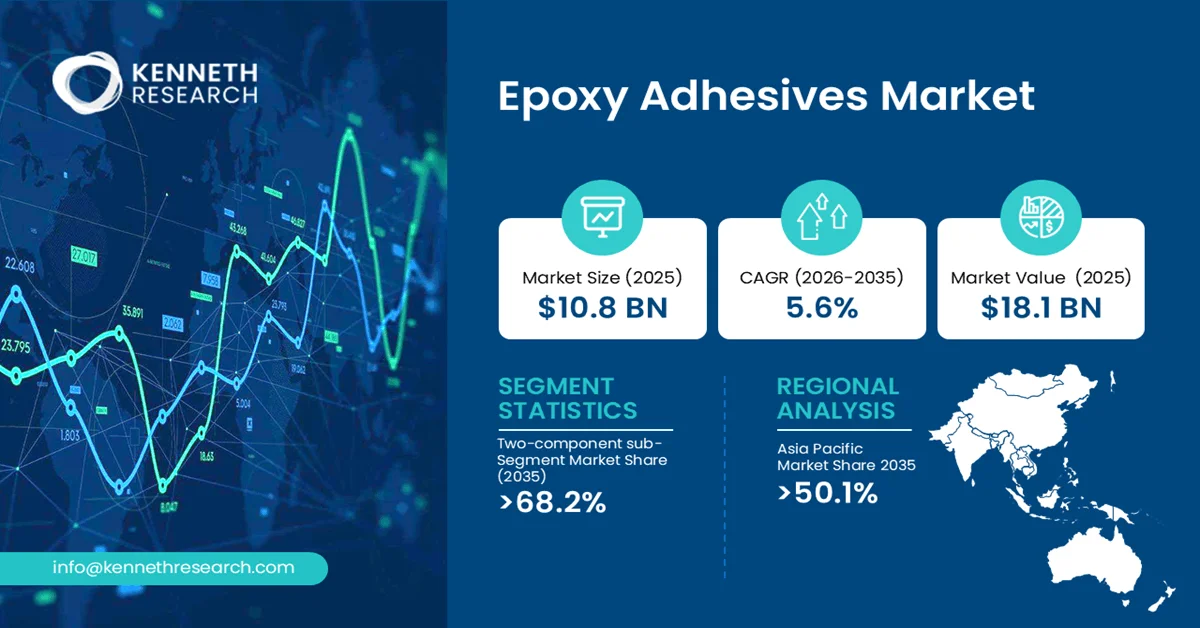
Epoxy Adhesives Market size was valued at USD 10.8 billion in 2025 and is projected to reach USD 18.1 billion by the end of 2035, rising at a CAGR of 5.6% during the forecast period, i.e., 2026-2035. In 2026, the industry size of epoxy adhesives is estimated at USD 11.7 billion.
The primary growth driver for the epoxy adhesives market is rising demand for lightweight, high-strength bonding solutions across automotive, electronics, construction, and renewable energy industries. The global transition toward electric vehicles and advanced manufacturing is accelerating adoption of epoxy adhesives due to their superior durability, chemical resistance, and structural performance.
The epoxy adhesives market comprises the global production, distribution, and application of epoxy resin-based bonding materials used to create durable, high-strength joints across industrial and commercial applications. These adhesives are formulated using epoxy resins and curing agents, available as one-component and two-component systems, and are designed to bond metals, composites, ceramics, glass, plastics, and other substrates. Their excellent mechanical strength, chemical resistance, thermal stability, and long-term durability make them suitable for demanding operating environments where conventional fastening methods may be inadequate.
Epoxy adhesives are widely utilized in structural and semi-structural bonding applications requiring high load-bearing capacity, environmental resistance, and dimensional stability. They support manufacturing processes by enabling lightweight assembly, reducing mechanical fasteners, improving corrosion resistance, and enhancing product reliability. The market serves diverse industries, including automotive, aerospace, electronics, construction, marine, wind energy, and industrial equipment manufacturing. As manufacturers increasingly adopt advanced materials and automated production technologies, epoxy adhesives continue to play a critical role in improving assembly efficiency, extending product lifespan, and supporting high-performance engineering applications across modern industrial value chains.
Key Epoxy Adhesives Market Insights Summary:
Key Takeaways: Market Trends & Insights
- The two-component segment dominated the epoxy adhesives market with a 68.2% share in 2025, driven by its superior structural bonding performance across industrial applications.
- The automotive end-use industry accounted for 34.0% of the market in 2025, supported by increasing adoption of lightweight and electric vehicle manufacturing.
- Asia Pacific held the largest regional share of 50.1% in 2025, led by robust manufacturing activity in China and Japan.
- The market is projected to grow from USD 10.8 billion in 2025 to USD 18.1 billion by 2035, registering a 5.6% CAGR during 2026-2035.
- Rising demand for high-strength structural bonding, lightweight materials, and advanced manufacturing technologies is expected to create sustained growth opportunities across the epoxy adhesives industry.
Market Drivers
- Increasing infrastructure development and demand for durable construction bonding solutions
- Growing investments in renewable energy projects, particularly wind turbine manufacturing
- Rising electric vehicle manufacturing and lightweight vehicle design
- Expanding adoption of high-performance composite materials
Challenges
- Volatility in petrochemical-based raw material supply and pricing
- Increasing regulatory pressure on chemical formulations and environmental compliance
Epoxy Adhesives Market Overview & Supply Chain
The adoption of epoxy adhesives is increasing globally as manufacturers seek high-strength, lightweight, and durable bonding solutions that enhance product performance while reducing assembly complexity. These adhesives have become indispensable in automotive, electronics, renewable energy, aerospace, and construction applications because they enable the bonding of dissimilar materials without compromising structural integrity. Their excellent resistance to chemicals, moisture, and temperature fluctuations also supports long service life in demanding operating environments. The accelerating transition toward electric mobility further reinforces demand, as battery packs, power electronics, and lightweight vehicle structures require reliable adhesive technologies. According to the International Energy Agency (IEA), global electric car sales exceeded 17 million in 2024, with more than 20% of all new cars sold worldwide being electric, underscoring the expanding manufacturing base that increasingly relies on advanced epoxy adhesive solutions for structural assembly and component integration.
The epoxy adhesives value chain begins with the procurement of raw materials, including epoxy resins, curing agents, hardeners, fillers, additives, and performance modifiers sourced primarily from petrochemical and specialty chemical manufacturers. These inputs are formulated through controlled blending, compounding, and quality-testing processes to produce one-component and two-component adhesive systems tailored for specific industrial applications. Manufacturers invest in product development, regulatory compliance, and application-specific performance testing to meet customer requirements for strength, durability, and environmental resistance. Finished products are distributed through direct sales networks, specialty chemical distributors, industrial suppliers, and regional channel partners serving domestic and international markets. End users span automotive manufacturers, electronics producers, aerospace companies, construction contractors, marine equipment manufacturers, renewable energy developers, and industrial machinery producers. Major stakeholders include raw material suppliers, adhesive formulators, contract manufacturers, logistics providers, distributors, OEMs, regulatory authorities, certification bodies, and research institutions that collectively support innovation, product quality, and supply chain resilience.
Epoxy Adhesives Market: Growth Drivers & Challenges
Growth Drivers:
- Rising Electric Vehicle Manufacturing and Lightweight Vehicle Design: The rapid expansion of electric vehicle (EV) manufacturing is a major growth driver for the epoxy adhesives market. Automakers are increasingly replacing conventional mechanical fasteners and welding with advanced adhesive bonding to reduce vehicle weight, improve structural rigidity, and enhance battery safety. Epoxy adhesives provide high mechanical strength, vibration resistance, thermal stability, and compatibility with mixed-material assemblies such as aluminum, composites, and engineered plastics. These characteristics support efficient battery pack assembly, body-in-white manufacturing, and electronic component integration. As EV production capacity continues to expand globally, epoxy adhesive manufacturers are expected to develop formulations with faster curing times, improved thermal management, and greater compatibility with automated production systems.
- Expanding Adoption of High-Performance Composite Materials: The growing use of advanced composite materials across industrial sectors is accelerating demand for epoxy adhesives capable of delivering durable structural bonding. Industries including aerospace, wind energy, marine, construction, and industrial equipment increasingly rely on lightweight composite components to improve energy efficiency, corrosion resistance, and operational performance. Conventional joining methods often create stress concentrations or increase component weight, whereas epoxy adhesives distribute loads more evenly and preserve material integrity. This enables manufacturers to design complex assemblies while reducing maintenance requirements and improving product reliability. Continuous advances in adhesive chemistry, including enhanced impact resistance, chemical durability, and environmental performance, are further broadening application opportunities. As industrial manufacturers continue adopting multi-material designs and automated production technologies, demand for specialized epoxy adhesive solutions is expected to increase across both mature and emerging manufacturing sectors.
Challenges:
- Volatility in Petrochemical-Based Raw Material Supply and Pricing: Epoxy adhesive manufacturers face persistent challenges from fluctuations in the availability and pricing of key raw materials such as epoxy resins, curing agents, solvents, and specialty additives, many of which are derived from petrochemical feedstocks. Supply disruptions caused by geopolitical uncertainties, energy price volatility, transportation bottlenecks, and production outages can significantly affect manufacturing costs and procurement planning. For adhesive formulators, unpredictable input costs reduce pricing stability and complicate long-term supply agreements with industrial customers. End-use industries, particularly automotive, electronics, and construction, may delay procurement decisions or seek alternative bonding technologies when price volatility becomes significant. Looking ahead, manufacturers are expected to strengthen supplier diversification, regional sourcing strategies, and inventory management while investing in bio-based and alternative resin technologies to improve supply chain resilience and reduce dependence on conventional petrochemical inputs.
- Increasing Regulatory Pressure on Chemical Formulations and Environmental Compliance: The epoxy adhesives industry is experiencing growing regulatory scrutiny regarding the use of hazardous chemicals, emissions, workplace safety, and end-of-life environmental impacts. Manufacturers must continuously reformulate products to comply with evolving regional and international regulations governing chemical substances, labeling requirements, occupational exposure limits, and sustainability standards. These compliance obligations require extensive product testing, certification, documentation, and research investments, extending product development timelines and increasing operational costs. Smaller manufacturers often face greater commercial challenges due to limited regulatory and research resources, affecting their ability to compete with larger industry participants. In the future, regulatory expectations are likely to become more stringent, encouraging greater investment in low-emission formulations, safer curing technologies, recyclable materials, and environmentally responsible manufacturing processes while reshaping competitive dynamics across the global epoxy adhesives market.
Epoxy Adhesives Market Size and Forecast:
| Report Attribute | Details |
|---|---|
| Base Year |
2025 |
| Forecast Year |
2026-2035 |
| CAGR |
5.6% |
| Base Year Market Size (2025) |
USD 10.8 billion |
| Forecast Year Market Size (2035) |
USD 18.1 billion |
| Regional Scope |
|
Epoxy Adhesives Market Segmentation Analysis:
Type Segment Analysis
In the type segment, the two-component sub-segment is anticipated to capture the largest market share of 68.2% by the end of 2025.
Its superior structural strength, excellent chemical resistance, and ability to create durable bonds across metals, composites, plastics, and engineered materials. The segment is widely adopted in automotive, aerospace, industrial equipment, electronics, and construction applications where high mechanical performance and long-term reliability are essential. Manufacturers increasingly prefer two-component formulations because they offer controlled curing, high load-bearing capacity, and compatibility with automated production processes. On the supply side, adhesive producers continue to introduce formulations with improved curing speed, enhanced thermal stability, and better adhesion to lightweight materials, supporting broader industrial adoption. A key demand indicator comes from the International Energy Agency (IEA), which states that global EV battery demand grew to over 950 GWh in 2024, 25% higher than in 2023, reflecting expanding vehicle production and battery assembly activities that increasingly require high-performance structural epoxy adhesives. Looking ahead, continued electrification, lightweight vehicle manufacturing, and advanced composite adoption are expected to further strengthen demand for two-component epoxy adhesive systems.
Automotive Segment Analysis
The automotive is projected to grow as the second-largest segment in the epoxy adhesives market due to four converging demand drivers.
The automotive segment is projected to witness strong growth in the epoxy adhesives market as vehicle manufacturers increasingly adopt lightweight materials, electrified powertrains, and advanced structural bonding technologies. Epoxy adhesives are widely used in body structures, battery packs, composite assemblies, and interior components because they provide high mechanical strength, excellent fatigue resistance, and the ability to bond dissimilar materials while reducing overall vehicle weight. The shift toward electric vehicles and automated manufacturing processes is further accelerating demand for high-performance adhesive solutions that improve safety, durability, and production efficiency. On the supply side, adhesive manufacturers are introducing fast-curing and thermally stable formulations specifically designed for high-volume automotive production lines and battery assembly applications. Looking ahead, continued investments in vehicle electrification, lightweight engineering, and advanced manufacturing technologies are expected to sustain robust growth for the automotive end-use segment.
Our in-depth analysis of the global epoxy adhesives market includes the following segments:
|
Segment |
Sub-segment |
|
Type |
|
|
End-Use Industry |
|
|
Curing Mechanism |
|
|
Type of Enterprises |
|
Epoxy Adhesives Market Regional Insights:
Asia Pacific Trends & Insights:
Asia Pacific epoxy adhesives market is projected to hold the largest revenue share of 50.1% by the end of 2025.
Its extensive manufacturing base, strong industrialization, and growing demand from automotive, electronics, construction, and renewable energy industries. The region benefits from integrated chemical supply chains, abundant production capacity for resins and specialty chemicals, and sustained investments in advanced manufacturing. Government initiatives promoting electric mobility, infrastructure development, and domestic manufacturing continue to reinforce demand for high-performance adhesive technologies used in structural bonding and lightweight assemblies. In addition, t he presence of major automotive and electronics manufacturing hubs enables widespread adoption of epoxy adhesives across high-volume production processes.
China serves as the region's principal growth engine owing to its leadership in automotive manufacturing, electronics production, battery manufacturing, and industrial infrastructure development. The country's large-scale investment in electric vehicles, renewable energy, and advanced manufacturing creates sustained demand for structural epoxy adhesives across multiple end-use sectors.
Japan complements regional leadership through its technologically advanced automotive, electronics, and precision manufacturing industries, where high-performance adhesive solutions are extensively used to improve product reliability, reduce component weight, and enable precision assembly. Continuous innovation in materials engineering, coupled with the presence of globally recognized manufacturing companies, supports the adoption of specialized epoxy adhesive formulations. Together, China and Japan strengthen Asia Pacific's position as the leading regional market by combining large-scale manufacturing capacity with advanced technology development and strong industrial demand.
North America Market Trends & Insights:
North America represents a strategically important region for the epoxy adhesives market, driven by strong demand from the automotive, aerospace, electronics, construction, and industrial manufacturing sectors. The region continues to witness increasing adoption of advanced adhesive technologies as manufacturers prioritize lightweight product designs, automated assembly processes, and enhanced structural performance. Growing investments in electric vehicle production, battery manufacturing, renewable energy infrastructure, and modernization of transportation systems are creating sustained opportunities for epoxy adhesive suppliers. Government policies supporting domestic manufacturing, clean energy deployment, and infrastructure renewal further encourage the use of high-performance bonding materials in critical applications. Additionally, the presence of established chemical manufacturers, advanced research capabilities, and robust quality standards fosters continuous product innovation. Future opportunities are expected to emerge from increasing adoption of composite materials, expansion of semiconductor manufacturing, and the development of next-generation industrial equipment requiring durable and high-strength adhesive solutions.
The United States leads regional demand due to its extensive automotive, aerospace, defense, electronics, and industrial manufacturing industries. Ongoing investments in electric mobility, advanced manufacturing technologies, and infrastructure development continue to support the adoption of high-performance epoxy adhesives across diverse applications.
Canada complements regional growth through its expanding automotive supply chain, construction activities, renewable energy projects, and industrial equipment manufacturing. The country's emphasis on sustainable infrastructure, clean technology, and advanced materials research is encouraging wider utilization of structural adhesive solutions. Together, the United States and Canada strengthen North America's position as a major market for epoxy adhesives by combining technological innovation, industrial diversification, and long-term manufacturing investment.
Leading Companies Operating in the Global Epoxy Adhesives Market:
Here is a list of upstream, downstream, and key players operating in the global epoxy adhesives market competitive ecosystem:
- Huntsman Corporation (United States)
- Company Overview
- Business Strategy
- Key Product Offerings
- Financial Performance
- Key Performance Indicators
- Risk Analysis
- Recent Development
- H.B. Fuller (United States)
- 3M Company (United States)
- Sika AG (South Africa)
- DuPont (United States)
Recent Developments
- In May 2024, H.B. Fuller acquired ND Industries Inc., expanding its engineering adhesives portfolio. The acquisition added ND Industries' specialty adhesive technologies, including epoxy, cyanoacrylate, UV-curable, and anaerobic products for automotive, electronics, aerospace, and industrial applications.
- In July 2024, Henkel completed Phase III expansion of its Kurkumbh manufacturing facility in India, including a new Loctite production plant to increase capacity for adhesives serving automotive, electronics, industrial, and other manufacturing sectors. The investment strengthens Henkel's supply capabilities for high-performance adhesive technologies, including epoxy-based industrial solutions.
Frequently Asked Question
In 2025, the epoxy adhesives market exceeded USD 10.8 billion.
The epoxy adhesives market is projected to reach USD 18.1 billion by the end of 2035, expanding at a CAGR of 5.6% over the forecast period (2026-2035).
The major players in the market are 3M Company, Henkel AG & Co. KGaA, H.B. Fuller Company, Sika AG, Master Bond Inc., Permabond LLC, DELO Industrie Klebstoffe GmbH & Co. KGaA, Parson Adhesives India Pvt. Ltd., and others.
In the Type segment, the Two-component sub-segment is anticipated to capture the largest market share of 68.2% in the future and exhibit lucrative growth opportunities during 2026-2035. This growth trajectory is largely attributed to the increasing adoption of high-strength structural bonding solutions in automotive, aerospace, electronics, and industrial manufacturing applications.
Asia Pacific is projected to hold the largest market share of 50.1% by the end of 2035 and provide more business opportunities in the future. Continuous investments in electric vehicle manufacturing, electronics production, and advanced industrial infrastructure across China and Japan are fostering the region's dominance.
Why Choose Kenneth Research ?
-
Insight with Impact : We don’t just gather data — we uncover stories, trends, and opportunities that fuel business growth.
-
Experts Who Get It : Our team speaks your industry’s language and knows what really matters to your customers and market.
-
Custom-Built for You : Forget one-size-fits-all. We craft research and consulting solutions as unique as your business vision.
-
Partners, Not Just Providers : We work with you, not for you — collaborating closely to turn insights into smart, strategic moves.
-
Results That Speak : Our work powers brands, startups, and industry leaders alike — with a track record of ideas that work in the real world.
Report ID: 1019 |
Published Date: 29 Jul 2026 |
Report Format: |
Delivery Timeline: 48-72 Business Hours

Copyright © 2025 Kenneth Research. All rights reserved. Terms of Use | Privacy Policy
