Report ID: 1422 |
Published Date: 25 Sep 2026 |
Report Format: |
Delivery Timeline: 48-72 Business Hours
Energy Management System Market Outlook:
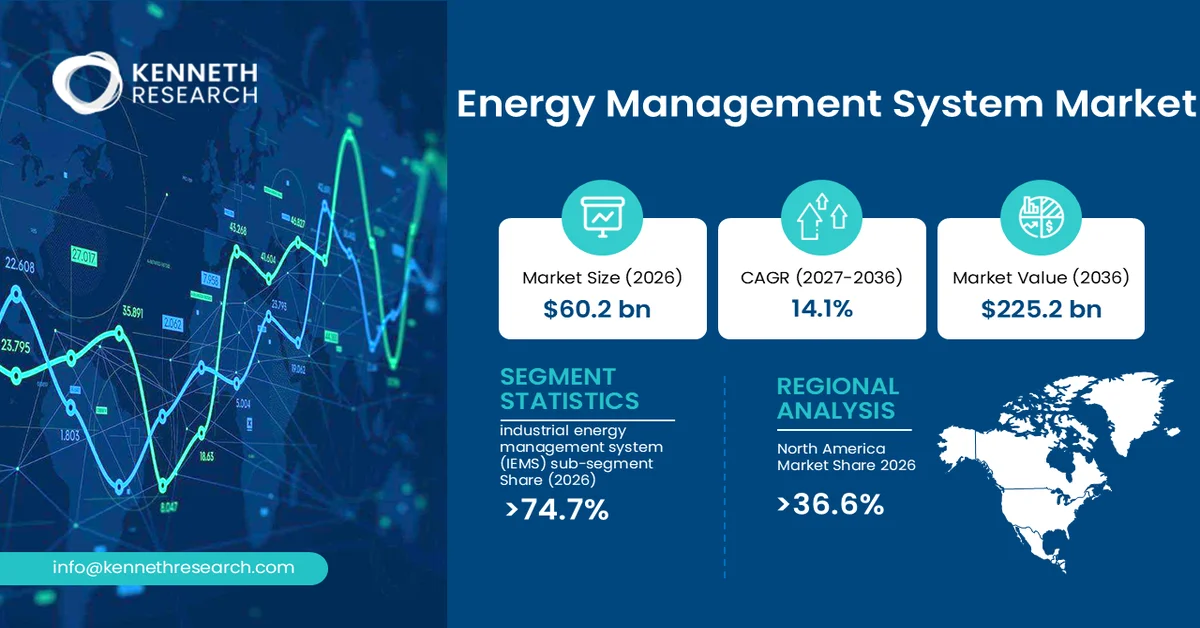
Energy Management System Market size was valued at USD 60.2 billion in 2026 and is projected to reach USD 225.2 billion by the end of 2036, expanding at a CAGR of 14.1% during the forecast period, i.e., 2027–2036. In 2027, the industry size of the global energy management system market is estimated at USD 68.7 billion.
The primary growth driver for the energy management system market is rising industrial demand for systematic energy efficiency, cost control, and decarbonization. Digital monitoring, metering, analytics, and structured management practices enable manufacturers to identify energy-saving opportunities and sustain improvements.
The energy management system market comprises technologies, software, equipment, and structured management practices used by organizations to monitor, analyze, control, and continuously improve energy performance. These systems combine energy data collection with analytical and operational capabilities, allowing users to understand consumption patterns, identify significant energy uses, detect inefficiencies, and support informed decisions regarding energy efficiency and resource optimization.
Key characteristics include real-time or periodic energy monitoring, metering, data aggregation, performance analysis, automated controls, reporting, and integration with operational systems. Modern solutions can incorporate sensors, connected devices, software platforms, analytics, and supervisory controls to provide a coordinated view of energy use across facilities or production environments.
Key Energy Management System Market Insights Summary:
Key Takeaways: Market Trends & Insights
- Energy Management System Market reached USD 60.2 billion in 2026 and is projected to reach USD 225.2 billion by 2036, expanding at a CAGR of 14.1%
- Industrial Energy Management System held a 74.7% market share in 2026, making it the leading segment by type
- North America accounted for a 36.6% market share in 2026, maintaining its position as the dominant regional market
- The market is projected to increase from USD 68.7 billion in 2027 to USD 225.2 billion by 2036
- Hardware is identified as the second and fastest analysis segment within the component category
Market Drivers
- Rising industrial energy-efficiency and cost-optimization requirements
- Digitalization of energy monitoring and industrial operations
- Integration of renewable energy and demand-side flexibility
- Expansion of smart manufacturing and connected industrial infrastructure
Challenges
- Integration complexity across legacy industrial infrastructure
- Cybersecurity and data-governance risks
Energy Management System Market Overview & Supply Chain
The primary growth driver for the energy management system market is rising industrial demand for systematic energy efficiency, cost control, and decarbonization. Digital monitoring, metering, analytics, and structured management practices enable manufacturers to identify energy-saving opportunities and sustain improvements.
The energy management system market comprises technologies, software, equipment, and structured management practices used by organizations to monitor, analyze, control, and continuously improve energy performance. These systems combine energy data collection with analytical and operational capabilities, allowing users to understand consumption patterns, identify significant energy uses, detect inefficiencies, and support informed decisions regarding energy efficiency and resource optimization.
Key characteristics include real-time or periodic energy monitoring, metering, data aggregation, performance analysis, automated controls, reporting, and integration with operational systems. Modern solutions can incorporate sensors, connected devices, software platforms, analytics, and supervisory controls to provide a coordinated view of energy use across facilities or production environments.
Energy Management System Market: Growth Drivers & Challenges
Growth Drivers
- Rising focus on industrial energy efficiency and cost optimization: Industrial organizations are increasingly adopting energy management systems to systematically monitor consumption, identify inefficiencies, optimize processes, and integrate energy performance into operational decision-making. This shift is driven by persistent pressure to control production costs while improving resilience against energy-price volatility and supply constraints.
- Digitalization of energy monitoring and industrial operations: Rapid digitalization is expanding the capabilities of energy management systems beyond conventional metering and reporting. Connected sensors, industrial Internet of Things infrastructure, cloud platforms, advanced analytics, and artificial intelligence enable organizations to collect and interpret energy data continuously across facilities and production processes. This improves the ability to detect inefficient operating conditions, coordinate energy-consuming equipment, and integrate energy performance with broader operational objectives.
Challenges
- Integration complexity across legacy industrial infrastructure: A major restraint is the difficulty of integrating modern energy management systems with heterogeneous legacy equipment, proprietary industrial controls, and fragmented facility architectures. Many industrial sites operate machinery acquired across different technology generations, creating inconsistent communication protocols, data formats, and control interfaces. Retrofitting these environments can require specialized engineering, additional gateways, system reconfiguration, and operational downtime.
- Cybersecurity and data governance risks: The increasing connectivity of energy management systems creates a broader cybersecurity and data-governance challenge. Systems that connect meters, sensors, building controls, industrial equipment, cloud platforms, and enterprise networks can introduce additional access points and dependencies. Weak segmentation, inadequate authentication, outdated connected equipment, or poorly governed interfaces can expose operational data and potentially disrupt energy-related controls.
Energy Management System Market Size and Forecast:
| Report Attribute | Details |
|---|---|
| Base Year |
2026 |
| Forecast Period |
2027-2036 |
| CAGR |
14.1% |
| Base Year Market Size (2026) |
USD 60.2 Billion |
| Forecast Year Market Size (2036) |
USD 225.2 Billion |
| Regional Scope |
|
Energy Management System Market Segmentation Analysis:
Type Segment Analysis
In the type segment, industrial energy management system (IEMS) sub-segment is anticipated to capture the largest market share of 74.7% by the end of 2026.
Industrial Energy Management System (IEMS) dominates because industrial facilities have highly energy-intensive processes, complex equipment networks, and persistent requirements to control operating costs and improve energy efficiency. Demand is reinforced by manufacturers’ efforts to optimize production processes, monitor equipment performance, integrate energy data, and support decarbonization initiatives. The International Energy Agency reports that industry accounted for nearly 40% of global final energy consumption in 2024, highlighting the scale of energy use that industrial operators must manage and optimize. Adoption is also moving toward digitally enabled systems incorporating connected sensors, automated controls, analytics, and artificial intelligence, allowing energy management to become more closely integrated with production operations. On the supply side, vendors are increasingly combining monitoring hardware, software analytics, control capabilities, and integration services into broader industrial solutions.
Component Segment Analysis
The hardware is projected to grow as the second-largest segment in the energy management system market due to four converging demand drivers.
Hardware is projected to grow rapidly within the component category because energy management increasingly depends on physical infrastructure capable of capturing, communicating, and controlling energy-related data. Smart meters, sensors, controllers, gateways, and monitoring devices provide the measurement layer required for analytics and automated optimization, making hardware foundational to system deployment. Demand is supported by industrial digitalization, modernization of aging equipment, distributed energy integration, and the need for more granular visibility into energy consumption. The International Energy Agency reported that the stock of connected appliances, devices, and sensors was expected to reach 9 billion in 2021, with most representing measuring devices such as sensors and smart meters.
Our in-depth analysis of the energy management system market includes the following segments:
|
Segment |
Sub-segment |
|
Component |
|
|
Type |
|
|
Deployment Mode |
|
|
End-Use Industry |
|
Energy Management System Market Regional Insights:
North America Trends & Insights:
North America energy management system market is projected to hold the largest revenue share of 36.6% by the end of 2026.
It is supported by a mature industrial base, high digital-technology adoption, substantial energy infrastructure, and sustained investment in efficiency and automation.
The United States represents the region’s principal demand center, supported by extensive manufacturing activity, energy-intensive industries, technology investment, and federal and state efficiency initiatives.
Canada complements regional demand through industrial operations, resource-intensive sectors, electrification initiatives, and investments in energy efficiency and digital infrastructure. Across both markets, organizations are increasingly integrating energy management with industrial automation, building systems, distributed energy resources, and enterprise platforms. Going forward, North American adoption should benefit from continued industrial digitalization, grid modernization, decarbonization programs, and greater integration of real-time energy data into operational decision-making.
Asia Pacific Trends & Insights:
Asia Pacific represents a strong secondary market for energy management systems because rapid industrialization, expanding manufacturing capacity, urbanization, and rising electricity requirements are increasing the need for more efficient energy use. The region combines mature industrial economies with rapidly developing manufacturing hubs, creating opportunities across factories, commercial facilities, utilities, and infrastructure.
China is a major demand center because of its extensive manufacturing base and policy emphasis on industrial efficiency, energy conservation, and emissions reduction. Its industrial policies increasingly encourage modernization of energy-intensive facilities and more systematic energy-performance management.
Japan offers a mature opportunity supported by established energy-efficiency regulation and sophisticated industrial infrastructure. Its Top Runner program continues to promote higher efficiency across energy-consuming products, supporting demand for technologies that measure and optimize energy performance.
Leading Companies Operating in the Global Energy Management System Market:
Here is a list of upstream, downstream, and key players operating in energy management system market competitive ecosystem:
- Schneider Electric SE (France)
- Company Overview
- Business Strategy
- Key Product Offerings
- Financial Performance
- Key Performance Indicators
- Risk Analysis
- Recent Development
- Regional Presence
- SWOT Analysis
- Johnson Controls International Plc (Ireland)
- Eaton Corporation plc (Ireland)
- ENGIE SA (France)
Recent Developments
- In August 2026, Johnson Controls unveiled AI-powered OpenBlue platform expansions, introducing Energy & Comfort Intelligence to optimize building airside energy use.The AI-enabled feature reduced airside energy use by nearly 10% at DATEV by autonomously executing thousands of dynamic, data-based commands per equipment. The platform also includes OBI, an agentic AI assistant that surfaces insights and automates workflows like work orders, while new automated onboarding cuts implementation times by up to 95%. Enhanced cybersecurity is provided through OpenBlue Airwall’s zero-trust architecture.
- In June 2026, Schneider Electric released two next-generation innovations advancing its EcoStruxure™ Foxboro™ Software Defined Automation (SDA) system at the Energy Projects Conference & Expo.The new Automation Processor 310 (AP310) and Edge Communication Node (ECN) combine a cybersecure edge control core with software-defined, multi-role hardware, decoupling hardware and function to enable scalable, resilient operations that are open, agile, and lifecycle efficient for energy infrastructure projects.
Frequently Asked Question
In 2026, the energy management system market exceeded USD 60.2 billion.
The energy management system market is projected to reach USD 225.2 billion by the end of 2036, expanding at a CAGR of 14.1% over the forecast period (2027-2036).
The major players in the market are Schneider Electric SE (France), Johnson Controls International Plc (Ireland), Eaton Corporation plc (Ireland), ENGIE SA (France), and others.
In the Type segment, the Industrial Energy Management System (IEMS) sub-segment is anticipated to capture the largest market share of 74.7% in the future and exhibit lucrative growth opportunities during 2027-2036. This growth trajectory is largely attributed to rising industrial demand for systematic energy efficiency and cost optimization.
North America is projected to hold the largest market share of 36.6% by the end of 2036 and provide more business opportunities in the future. Continuous investments in industrial digitalization, energy efficiency, grid modernization, and decarbonization are fostering the region's dominance.
Why Choose Kenneth Research ?
-
Insight with Impact : We don’t just gather data — we uncover stories, trends, and opportunities that fuel business growth.
-
Experts Who Get It : Our team speaks your industry’s language and knows what really matters to your customers and market.
-
Custom-Built for You : Forget one-size-fits-all. We craft research and consulting solutions as unique as your business vision.
-
Partners, Not Just Providers : We work with you, not for you — collaborating closely to turn insights into smart, strategic moves.
-
Results That Speak : Our work powers brands, startups, and industry leaders alike — with a track record of ideas that work in the real world.
Report ID: 1422 |
Published Date: 25 Sep 2026 |
Report Format: |
Delivery Timeline: 48-72 Business Hours

Copyright © 2025 Kenneth Research. All rights reserved. Terms of Use | Privacy Policy
