Report ID: 1387 |
Published Date: 24 Sep 2026 |
Report Format: |
Delivery Timeline: 48-72 Business Hours
Energy Efficient Glass Market Outlook:
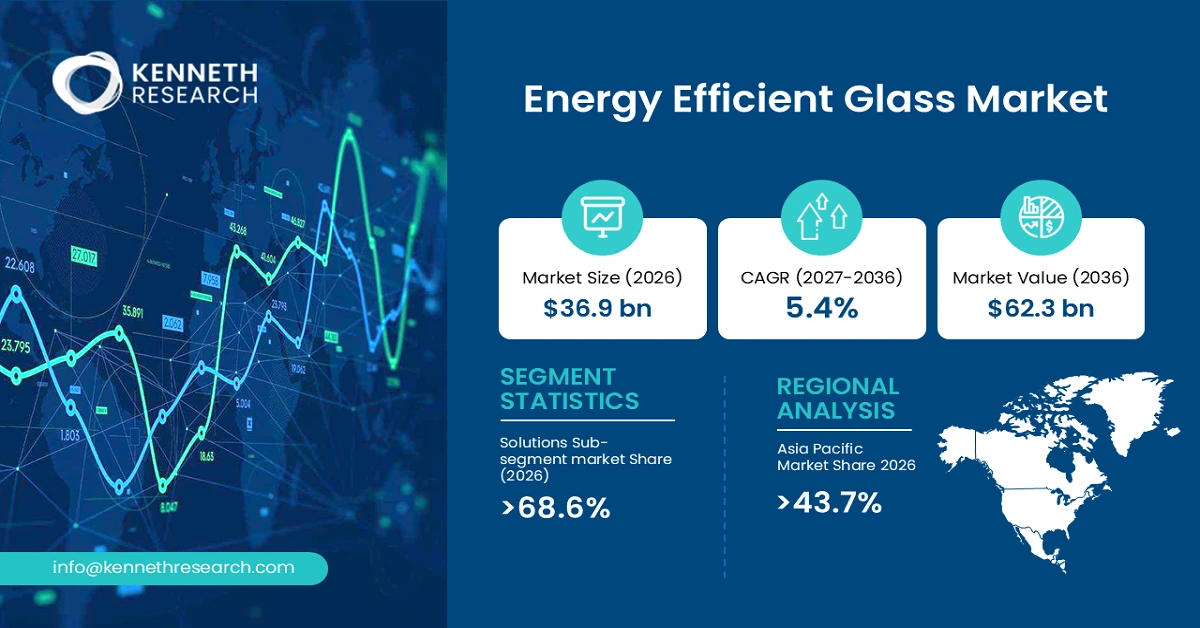
Energy Efficient Glass Market size was valued at USD 36.9 billion in 2026 and is projected to reach USD 62.3 billion by the end of 2036, expanding at a CAGR of 5.4% during the forecast period, i.e., 2027–2036. In 2027, the industry size of the energy efficient glass is estimated at USD 38.8 billion.
A primary growth driver is the push to reduce building energy losses through higher-performance glazing. The U.S. Department of Energy notes that windows can account for 30–40% of winter heat loss in homes, strengthening demand for technologies that improve insulation, control solar heat gain, and support lower building energy consumption.
Energy efficient glass is a category of architectural and specialty glazing engineered to improve the thermal and solar performance of buildings while retaining the functional benefits of transparent or translucent surfaces. Products can incorporate multiple panes, insulating gas spaces, low-emissivity surfaces, solar-control treatments, or other performance-oriented configurations.
Key characteristics include reduced heat transfer, controlled solar radiation, improved indoor thermal comfort, and better management of daylight. Depending on the specification, energy efficient glass can help limit unwanted heat gain in warm conditions and heat loss in colder conditions. Coatings and glazing configurations can also influence visible-light transmission, glare, and the interaction between façades and building systems.
Key Energy Efficient Glass Market Insights Summary:
Key Takeaways: Market Trends & Insights
- The energy efficient glass market is valued at USD 36.9 Billion in 2026
- The energy efficient glass market is projected to reach USD 62.3 Billion by 2036, expanding at a CAGR of 5.4% from 2027 to 2036
- Building and Construction dominates the End-Use segment with a 68.6% market share in 2026
- Asia Pacific leads the energy efficient glass market with a 43.7% market share in 2026
- Soft Coat is identified as the second and fastest analysis segment within the Coating category
Market Drivers
- Rising demand for high-performance building envelopes
- Expansion of energy-efficiency regulations and retrofit activity
- Growing adoption of advanced low-emissivity coating technologies
- Increasing emphasis on occupant comfort, daylight management, and building sustainability
Challenges
- High upfront cost and complex installation requirements
- Performance trade-offs and specification complexity
Energy Efficient Glass Market Overview & Supply Chain
Adoption of energy efficient glass is increasing globally as building owners, developers, and policymakers place greater emphasis on reducing building energy demand, improving occupant comfort, and upgrading the performance of existing building envelopes. High-performance glazing supports these objectives by controlling heat transfer, solar heat gain, and daylight while maintaining the functional and architectural benefits of glass. Regulatory efficiency requirements and building-retrofit initiatives are also strengthening the relevance of advanced glazing in both new construction and renovation projects.
The supply chain for energy efficient glass begins with raw-material inputs, primarily silica-based glass-forming materials, along with additives and processing chemicals required for glass production and functional coatings. Manufacturers melt, form, temper, coat, laminate, and assemble glass into performance-oriented glazing configurations, with insulating units integrating spacers, sealants, and, where applicable, gas-filled cavities. Coating specialists and glass processors are important upstream and midstream participants, particularly for low-emissivity and solar-control products. Distribution then moves through glass processors, fabricators, wholesalers, façade contractors, window manufacturers, and building-material distributors. End users include residential developers, commercial property owners, contractors, architects, institutional facilities, and industrial projects.
Energy Efficient Glass Market: Growth Drivers & Challenges
Growth Drivers
- Rising Demand for High-Performance Building Envelopes: Buildings are increasingly being designed and upgraded around energy-performance objectives, making high-performance glazing an important component of the building envelope. Energy-efficient glass helps control heat transfer and solar gain, reducing the load placed on heating, ventilation, and air-conditioning systems while maintaining daylight access and occupant comfort. This creates a direct commercial incentive for developers, architects, and building owners to specify advanced glazing in both new construction and renovation projects.
- Expansion of Energy-Efficiency Regulations and Retrofit Activity: Stronger energy-efficiency policies are encouraging construction stakeholders to improve the thermal performance of building envelopes, creating a favorable environment for advanced glazing solutions. Building codes increasingly address windows and glazing alongside insulation, roofs, walls, and HVAC systems, encouraging developers to consider glass performance earlier in the design process.
Challenges
- High Upfront Cost and Complex Installation Requirements: The initial cost of energy-efficient glass can be higher than conventional glazing because advanced products often require specialized coatings, multilayer configurations, insulated units, and tighter manufacturing tolerances. The cost challenge extends beyond the glass itself: high-performance systems may require compatible frames, sealants, spacers, and installation practices to preserve thermal and solar-control performance.
- Performance Trade-Offs and Specification Complexity: Selecting energy-efficient glass involves balancing thermal insulation, solar control, visible light transmission, glare management, aesthetics, and climate-specific performance. A configuration optimized for one building orientation or climate may not deliver the same benefits elsewhere, making product selection more technically demanding than choosing conventional glazing. Architects, façade consultants, developers, and contractors therefore need to coordinate glass specifications with the building envelope, HVAC strategy, orientation, and occupant requirements.
Energy Efficient Glass Market Size and Forecast:
| Report Attribute | Details |
|---|---|
| Base Year |
2026 |
| Forecast Year |
2027-2036 |
| CAGR |
5.4% |
| Base Year Market Size (2026) |
USD 36.9 Billion |
| Forecast Year Market Size (2036) |
USD 62.3 Billion |
| Regional Scope |
|
Energy Efficient Glass Market Segmentation Analysis:
End-Use Segment Analysis
In the end-use segment, building and construction sub-segment is anticipated to capture the largest market share of 68.6% by the end of 2026.
Building and construction leads the energy-efficient glass market because glazing is integral to both new-build façades and renovation projects, where developers increasingly prioritize thermal performance, solar control, daylighting, and occupant comfort. Demand is supported by stricter building-efficiency objectives and the need to reduce heating and cooling loads without compromising architectural design. Adoption is also moving toward high-performance insulated glazing, low-emissivity configurations, and other advanced window technologies. On the supply side, government-backed R&D is encouraging manufacturers to improve thermal performance while addressing cost and manufacturability constraints. The future outlook remains favorable as retrofit programs, energy-performance requirements, and electrification strategies increase the value of efficient building envelopes.
Coating Segment Analysis
The soft coat is projected to grow as the second-largest segment in the energy efficient glass market due to four converging demand drivers.
Soft coat is projected to grow as building owners and façade designers increasingly seek glazing that combines strong thermal insulation with selective control of solar radiation and daylight. The coating is deposited after glass production and can deliver high-performance low-emissivity characteristics, making it suitable for insulated glazing units used in energy-conscious buildings. Adoption is supported by renovation activity as well as new construction, particularly where existing façades require improved thermal performance without major structural changes. A recent U.S. Department of Energy project provides a direct public-sector demand signal: the Forrestal Federal Building Windows Upgrade project covers more than 86,000 square feet of windows and specifies double-pane, low-e secondary windows. Supply-side development is also improving product selection through advances in coating performance, durability, and glazing-system integration.
Our in-depth analysis of the Energy Efficient Glass market includes the following segments:
|
Segment |
Sub-segment |
|
Coating |
|
|
Glazing |
|
|
End Use |
|
Energy Efficient Glass Market Regional Insights:
Asia Pacific Market Trends & Insights:
Asia Pacific energy efficient glass market is projected to hold the largest revenue share of 43.7% by the end of 2026.
It is supported by its large construction base, expanding urban infrastructure, and increasing investment in energy-efficient building systems. The region combines substantial glass manufacturing capacity with strong downstream consumption across commercial, residential, institutional, and infrastructure projects.
China remains the principal regional manufacturing and consumption hub, supported by extensive construction activity, domestic glass production, and government-backed building-efficiency initiatives.
Japan represents a mature but technologically advanced market, where renovation, energy conservation, and high-performance building requirements support demand for sophisticated glazing. Together, both countries strengthen Asia Pacific's position through complementary advantages: China's scale and manufacturing ecosystem and Japan's emphasis on advanced building technologies. Over the medium term, expanding green-building requirements and efficiency-focused renovation should reinforce regional adoption.
North America Market Trends & Insights:
North America is supported by sustained demand for high-performance building envelopes, commercial renovations, institutional construction, and energy-focused upgrades to existing properties. Industrial activity spans advanced glazing manufacturing, façade engineering, building retrofits, and energy-management services, creating a mature ecosystem for specification and installation.
The United States remains the principal country market, supported by federal building-efficiency standards, commercial construction activity, and continued investment in building decarbonization.
Canada offers complementary opportunities through its national green-building strategy, which explicitly supports efficient retrofits, higher-performance building codes, and technologies including high-performance windows. Together, the two markets provide a strong base for suppliers targeting both new construction and modernization of existing building stock.
Leading Companies Operating in the Energy Efficient Glass Market:
Here is a list of upstream, downstream, and key players operating in energy efficient glass market competitive ecosystem:
- Saint-Gobain Glass (France)
- Company Overview
- Business Strategy
- Key Product Offerings
- Financial Performance
- Key Performance Indicators
- Risk Analysis
- Recent Development
- Regional Presence
- SWOT Analysis
- Guardian Glass (United States)
- Vitro Architectural Glass (Mexico)
- Flat Glass Group Co., Ltd. (China)
- Cardinal Glass Industries (United States)
Recent Developments
- In January 2026, Vitro Architectural Glass launched Solarban Champane™ low-e glass, featuring a breakthrough coating technology that produces champagne tones without tinted glass. The warm-neutral, low-reflectivity glass delivers the trusted energy efficiency of Solarban® solar control, low-e glass, making it ideal for contemporary architecture seeking both visual appeal and superior solar control. The product is manufactured exclusively at Vitro's Wichita Falls, Texas facility.
- In December 2025, Vitro Architectural Glass announced that Sungate ThermL™ glass, VacuMax™ Vacuum Insulating Glass, and BirdSmart® glass won 2025 Product Innovation Awards. Sungate ThermL™ is a fourth-surface low-e coating that improves U-values by 20% or more without changing visual characteristics. VacuMax™ VIG provides a 79% improvement in U-values with R-values up to R20, delivering thermal insulation performance three to five times better than conventional IGUs and ideal for retrofit projects.
Frequently Asked Question
In 2026, the energy efficient glass market exceeded USD 36.9 Billion.
The energy efficient glass market is projected to reach USD 62.3 Billion by the end of 2036, expanding at a CAGR of 5.4% over the forecast period (2027-2036).
The major players in the market are Saint-Gobain Glass (France), Guardian Glass (United States), Vitro Architectural Glass (Mexico), Flat Glass Group Co., Ltd. (China), Cardinal Glass Industries (United States), and others.
In the End-Use segment, the Building and Construction sub-segment is anticipated to capture the largest market share of 68.6% in 2026 and exhibit lucrative growth opportunities during 2027-2036. This growth trajectory is largely attributed to rising demand for high-performance building envelopes.
Asia Pacific is projected to hold the largest market share of 43.7% in 2026 and provide more business opportunities in the future. Continuous investments in energy-efficient construction and advanced building technologies across China and Japan are fostering the region's dominance.
Why Choose Kenneth Research ?
-
Insight with Impact : We don’t just gather data — we uncover stories, trends, and opportunities that fuel business growth.
-
Experts Who Get It : Our team speaks your industry’s language and knows what really matters to your customers and market.
-
Custom-Built for You : Forget one-size-fits-all. We craft research and consulting solutions as unique as your business vision.
-
Partners, Not Just Providers : We work with you, not for you — collaborating closely to turn insights into smart, strategic moves.
-
Results That Speak : Our work powers brands, startups, and industry leaders alike — with a track record of ideas that work in the real world.
Report ID: 1387 |
Published Date: 24 Sep 2026 |
Report Format: |
Delivery Timeline: 48-72 Business Hours

Copyright © 2025 Kenneth Research. All rights reserved. Terms of Use | Privacy Policy
