Report ID: 1405 |
Published Date: 25 Sep 2026 |
Report Format: |
Delivery Timeline: 48-72 Business Hours
Endobronchial Ultrasound Biopsy Device Market Outlook:
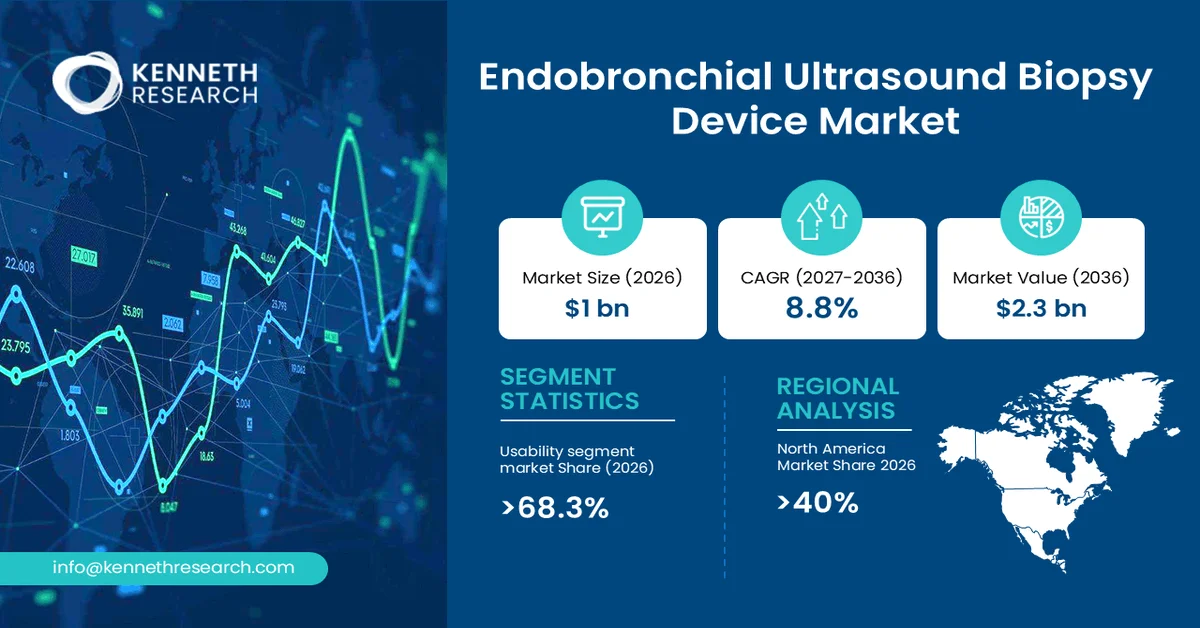
Endobronchial Ultrasound Biopsy Device Market size was valued at USD 1 billion in 2026 and is projected to reach USD 2.3 billion by the end of 2036, rising at a CAGR of 8.8% during the forecast period, i.e., 2027-2036. In 2027, the industry size of the endobronchial ultrasound biopsy device is estimated at USD 1.1 billion.
The primary growth driver for the endobronchial ultrasound biopsy device market is the increasing need for minimally invasive and accurate diagnosis and staging of lung cancer.
The endobronchial ultrasound biopsy device market comprises medical devices used with endobronchial ultrasound systems to obtain tissue or cytological samples from pulmonary lesions, mediastinal lymph nodes, and other areas within or adjacent to the airways for diagnostic evaluation and cancer staging. These devices are designed to facilitate minimally invasive sampling during bronchoscopy and commonly include specialized biopsy needles and associated accessories compatible with ultrasound-guided procedures.
Key characteristics include precise needle positioning, tissue acquisition capability, compatibility with endobronchial ultrasound bronchoscopes, and suitability for repeated clinical procedures depending on the device configuration.
Key Endobronchial Ultrasound Biopsy Device Market Insights Summary:
Key Takeaways: Market Trends & Insights
- Endobronchial ultrasound biopsy device market is projected to grow from USD 1 billion in 2026 to USD 2.3 billion by 2036 at a CAGR of 8.8%.
- North America accounted for the largest regional share at 40% in 2026, supported by advanced pulmonary diagnostic infrastructure and increasing adoption of minimally invasive lung cancer diagnosis and staging technologies.
- Reusable devices are expected to remain the leading Application segment with a 68.3% market share in 2026, supported by their suitability for repeated clinical procedures and established integration into bronchoscopic workflows.
- Lung cancer diagnosis and staging will continue to represent a significant End User segment as healthcare providers increasingly adopt targeted tissue-sampling technologies for pulmonary lesion assessment and mediastinal lymph-node evaluation.
Market Drivers
- Rising lung cancer burden and demand for accurate diagnosis
- Increasing adoption of minimally invasive diagnostic procedures
- Technological advancements in biopsy needle and ultrasound-guided systems
- Growing investment in advanced pulmonary diagnostic infrastructure
Challenges
- High device costs and complex manufacturing requirements
- Limited availability of specialized expertise and infrastructure
Endobronchial Ultrasound Biopsy Device Market Overview & Supply Chain
The global adoption of endobronchial ultrasound biopsy devices is being supported by the growing use of minimally invasive bronchoscopic procedures for pulmonary diagnosis and mediastinal assessment. These devices integrate with endobronchial ultrasound systems to facilitate targeted tissue sampling from lesions and lymph nodes, supporting diagnostic decision-making and lung cancer staging. Technological improvements in ultrasound visualization, biopsy needle design, and procedural precision are strengthening their clinical relevance.
The supply chain begins with sourcing medical-grade metals, polymers, plastics, and other specialized materials required for biopsy needles, sheaths, handles, and supporting components. Specialized medical-device manufacturers process these inputs through precision forming, machining, molding, assembly, and quality-control operations, followed where applicable by sterilization and packaging. Manufacturers must maintain stringent production controls to ensure dimensional accuracy, mechanical performance, sterility, and compatibility with associated ultrasound and bronchoscopy systems.
Endobronchial Ultrasound Biopsy Device Market: Growth Drivers & Challenges
Growth Drivers:
- Rising lung cancer burden and demand for accurate diagnosis: The growing global burden of lung cancer is increasing the need for accurate tissue sampling and staging technologies. The substantial disease burden is supporting demand for diagnostic approaches that can help clinicians obtain tissue samples from pulmonary lesions and mediastinal lymph nodes with greater procedural precision. Endobronchial ultrasound-guided biopsy enables targeted sampling during minimally invasive bronchoscopy and can support diagnostic evaluation and staging.
- Increasing adoption of minimally invasive diagnostic procedures: The increasing preference for minimally invasive diagnostic procedures is supporting the adoption of endobronchial ultrasound biopsy devices across hospitals and specialized diagnostic centers. Compared with more invasive tissue-acquisition approaches, ultrasound-guided bronchoscopic biopsy can provide clinicians with a targeted method for sampling lesions and lymph nodes while integrating imaging and tissue acquisition within the same procedural workflow. Advances in needle design, device ergonomics, ultrasound visualization, and compatibility with bronchoscopic platforms are improving procedural usability and supporting broader clinical adoption.
Challenges:
- High device costs and complex manufacturing requirements: The development and production of endobronchial ultrasound biopsy devices require specialized materials, precision engineering, stringent quality controls, and compatibility with advanced bronchoscopic and ultrasound systems. These requirements can increase manufacturing complexity and raise overall device costs. Manufacturers must maintain consistent needle dimensions, mechanical reliability, sampling performance, and sterility while complying with medical-device regulatory requirements across different markets.
- Limited availability of specialized expertise and infrastructure: The effective use of endobronchial ultrasound biopsy devices depends on access to appropriate imaging and bronchoscopy infrastructure as well as healthcare professionals trained in ultrasound-guided pulmonary procedures. Variations in hospital capabilities, specialist availability, and procedural experience can limit adoption, particularly in healthcare settings where advanced respiratory diagnostic services are less established. Training requirements can also increase implementation costs for healthcare providers and extend the time required for wider integration into clinical workflows.
Endobronchial Ultrasound Biopsy Device Market Size and Forecast:
| Report Attribute | Details |
|---|---|
| Base Year |
2026 |
| Forecast Period |
2027-2036 |
| CAGR |
8.8% |
| Base Year Market Size (2026) |
USD 1 billion |
| Forecast Year Market Size (2036) |
USD 2.3 billion |
| Regional Scope |
|
Endobronchial Ultrasound Biopsy Device Market Segmentation Analysis:
Usability Segment Analysis
In the usability segment, the reusable sub-segment is anticipated to capture the largest market share of 68.3% by the end of 2026.
Reusable endobronchial ultrasound biopsy devices are gaining adoption because they can support repeated clinical procedures and integrate into established bronchoscopic workflows. Their continued use is supported by demand from hospitals and specialized pulmonary care facilities that perform endobronchial ultrasound-guided tissue sampling for diagnostic evaluation and lung cancer staging. Reusable devices can also provide healthcare providers with consistent procedural familiarity and compatibility with existing EBUS systems, supporting their integration into routine diagnostic practices. In addition, ongoing improvements in device design, needle performance, imaging compatibility, and procedural ergonomics are strengthening their usability.
Application Type Segment Analysis
In the application segment, the lung cancer diagnosis and staging sub-segment is supported by the increasing need for precise tissue sampling and disease assessment across specialized healthcare facilities. Endobronchial ultrasound-guided biopsy enables clinicians to obtain samples from pulmonary lesions and mediastinal lymph nodes while supporting minimally invasive diagnostic and staging workflows. According to the U.S. Centers for Disease Control and Prevention, 228,058 new lung cancer cases were reported in the United States in 2023, while nearly half of lung cancers diagnosed during 2019–2023 were identified at a distant stage. The prevalence of advanced-stage diagnoses reinforces the need for effective diagnostic and staging approaches that can help determine disease extent and guide treatment planning.
Our in-depth analysis of the global endobronchial ultrasound biopsy device market includes the following segments:
|
Segment |
Sub-segment |
|
Product Type |
|
|
By Usability |
|
|
Application |
|
|
End User |
|
Endobronchial Ultrasound Biopsy Device Market Regional Insights:
North America Market Trends & Insights:
The North America region is anticipated to dominate the endobronchial ultrasound biopsy device market, capturing a market share of 40% by the end of 2026.
The region benefits from advanced pulmonary and oncology care infrastructure, established adoption of minimally invasive diagnostic technologies, and strong availability of specialized bronchoscopy services.
In the U.S., the availability of specialized hospitals, cancer centers, pulmonary specialists, and advanced bronchoscopy facilities supports adoption of endobronchial ultrasound-guided biopsy devices.
Canada also offers opportunities through its established healthcare system and continued focus on lung cancer diagnosis and management. Government of Canada data identify lung cancer as a major contributor to cancer mortality, supporting continued demand for pulmonary diagnostic services and technologies.
Asia-Pacific Market Trends & Insights:
The Asia-Pacific region is expected to present significant growth opportunities for the endobronchial ultrasound biopsy device market, supported by expanding healthcare infrastructure, increasing adoption of advanced pulmonary diagnostic technologies, and rising investment in specialized hospital services. Growing awareness of minimally invasive diagnostic procedures is encouraging healthcare providers to incorporate image-guided bronchoscopy and tissue-sampling technologies into pulmonary care.
In Japan, established healthcare infrastructure and strong demand for sophisticated diagnostic equipment provide a foundation for adoption of endobronchial ultrasound biopsy devices
China represents another important opportunity, supported by continued expansion of hospital capabilities, increasing availability of specialized respiratory services, and greater adoption of advanced medical technologies.
Leading Companies Operating in the Global Endobronchial Ultrasound Biopsy Device Market:
Here is a list of upstream, downstream, and key players operating in the global endobronchial ultrasound biopsy device market competitive ecosystem:
- Olympus (Japan)
- Company Overview
- Business Strategy
- Key Product Offerings
- Financial Performance
- Key Performance Indicators
- Risk Analysis
- Recent Development
- Regional Presence
- SWOT Analysis
- Boston Scientific (U.S)
- Cook Medical (U.S)
- Fujifilm Corporation (Japan)
- Medi-Globe (Germany)
Recent Developments
- August 2026 –Olympus entered an exclusive global distribution agreement with Endocision for a portable, single-use flexible respiratory cryocatheter system.
- 2025 –Boston Scientific continued to expand its pulmonary biopsy portfolio, including the Expect Pulmonary EBUS-TBNA Needle and Acquire Pulmonary EBUS Fine Needle Biopsy Device. The products are designed for tissue acquisition using endobronchial ultrasound bronchoscopes, supporting the company's position in minimally invasive pulmonary diagnostics.
Frequently Asked Question
In 2026, the endobronchial ultrasound biopsy device market exceeded USD 1 billion.
The endobronchial ultrasound biopsy device market is projected to reach USD 2.3 billion by the end of 2036, expanding at a CAGR of 8.8% over the forecast period (2027-2036).
The major players in the market are Olympus, Boston Scientific, Cook Medical, Medtronic, and CONMED, and others.
In the Application segment, the Reusable sub-segment is anticipated to capture the largest market share of 68.3% in the future and exhibit lucrative growth opportunities during 2027–2036.
North America is projected to hold the largest market share of 40% by the end of 2036 and provide more business opportunities in the future.
Why Choose Kenneth Research ?
-
Insight with Impact : We don’t just gather data — we uncover stories, trends, and opportunities that fuel business growth.
-
Experts Who Get It : Our team speaks your industry’s language and knows what really matters to your customers and market.
-
Custom-Built for You : Forget one-size-fits-all. We craft research and consulting solutions as unique as your business vision.
-
Partners, Not Just Providers : We work with you, not for you — collaborating closely to turn insights into smart, strategic moves.
-
Results That Speak : Our work powers brands, startups, and industry leaders alike — with a track record of ideas that work in the real world.
Report ID: 1405 |
Published Date: 25 Sep 2026 |
Report Format: |
Delivery Timeline: 48-72 Business Hours

Copyright © 2025 Kenneth Research. All rights reserved. Terms of Use | Privacy Policy
