Report ID: 1393 |
Published Date: 25 Sep 2026 |
Report Format: |
Delivery Timeline: 48-72 Business Hours
Enameled Pans Market Outlook:
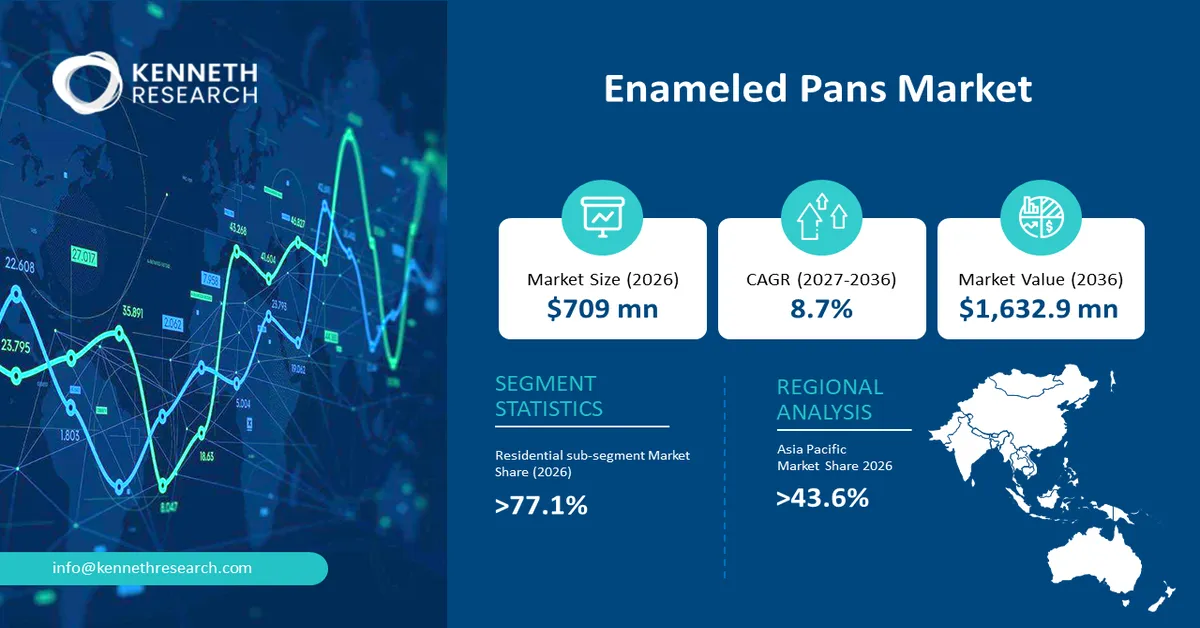
Enameled Pans Market size was valued at USD 709 million in 2026 and is projected to reach USD 1,632.9 million by the end of 2036, rising at a CAGR of 8.7% during the forecast period, i.e., 2027-2036. In 2027, the industry size of the enameled pans is estimated at USD 770.7 million.
The primary growth driver for the enameled pans market is rising consumer demand for durable, versatile, and aesthetically appealing cookware suitable for everyday food preparation.
The enameled pans market comprises cookware products manufactured from a metal base and coated with a layer of enamel to provide a durable, non-reactive, and visually appealing cooking surface. Enameled pans are commonly produced using materials such as cast iron or steel and are available in different shapes, capacities, colors, and configurations for preparing, cooking, serving, or storing food. Key characteristics include resistance to corrosion, ease of cleaning, compatibility with various cooking methods, and the ability to withstand repeated household use when properly maintained.
Key Enameled Pans Market Insights Summary:
Key Takeaways: Market Trends & Insights
- The global enameled pans market is driven by increasing demand for durable, versatile, and aesthetically appealing cookware across residential and selected food-service applications.
- The Residential segment dominates the market, supported by everyday household cooking requirements and consumer preference for durable, easy-to-maintain, and multifunctional cookware.
- Hypermarket/Supermarket remains an important distribution channel because of broad consumer reach, physical product visibility, promotional opportunities, and integration with omnichannel retail strategies.
- Asia-Pacific leads the market, supported by strong cookware manufacturing ecosystems and substantial residential demand, particularly across Japan and China.
Market Drivers
- Rising demand for durable and versatile cookware
- Expansion of premium and design-oriented cookware
- Growing household interest in convenient cooking and easy-clean surfaces
- Increasing product innovation across enamel finishes, designs, and cookware formats
Challenges
- High Manufacturing Costs and Production Complexity
- Competition From Alternative Cookware Materials
Enameled Pans Market Overview & Supply Chain
The global adoption of enameled pans is supported by continued demand for durable cookware across household kitchens, food-service environments, and hospitality applications. Their combination of corrosion resistance, smooth surfaces, heat tolerance, ease of cleaning, and aesthetic variety makes them relevant to both functional and design-oriented cookware requirements. The market is also influenced by changes in cooking practices, household consumption patterns, kitchen modernization, and the broader transition toward cleaner cooking technologies.
The supply chain for enameled pans begins with the sourcing of metal inputs, including steel and cast iron, along with enamel-forming materials, coatings, handles, lids, and packaging components. Metal suppliers provide the underlying material, which is cut, stamped, cast, formed, and prepared for surface treatment. During manufacturing, enamel coatings are applied and fired to create the finished cooking surface, followed by trimming, handle or lid assembly, inspection, cleaning, and packaging. Manufacturers may operate integrated production facilities or source selected components from specialized suppliers.
Enameled Pans Market: Growth Drivers & Challenges
Growth Drivers:
- Growing demand for durable and versatile cookware: Increasing consumer preference for durable cookware that can support multiple cooking methods is driving demand for enameled pans. Enameled surfaces combine the thermal characteristics of metal cookware with a smooth, non-reactive coating that simplifies cleaning and reduces maintenance requirements. This makes enameled pans suitable for frying, simmering, braising, roasting, and serving, supporting their use across diverse household cooking routines. Product innovation is further strengthening this demand by improving ergonomics, enamel finishes, compatibility with different cooktops, and aesthetic appeal.
- Expansion of premium and design-oriented cookware: The growing emphasis on kitchen aesthetics and premium home-cooking experiences is creating additional opportunities for enameled pans. Consumers increasingly consider cookware as both a functional kitchen product and part of the overall dining and kitchen environment. Manufacturers are responding through broader color ranges, distinctive finishes, ergonomic designs, and cookware collections designed for direct kitchen-to-table use.
Challenges:
- High manufacturing costs and production complexity: Enameled pans require multiple production stages, including metal forming, surface preparation, enamel application, firing, finishing, and quality inspection. Maintaining consistent coating thickness, adhesion, color, and surface integrity can increase manufacturing complexity compared with simpler uncoated cookware. Enamel defects such as chipping, cracking, uneven finishes, or surface imperfections can result in product rejection and material losses, placing pressure on manufacturers to maintain stringent process controls.
- Competition from alternative cookware materials: Enameled pans face competition from stainless steel, non-stick coated cookware, aluminum, ceramic, and other cookware materials that offer different combinations of price, weight, cooking performance, and maintenance requirements. Consumers may select alternatives based on specific cooking preferences, such as lightweight handling, rapid heating, non-stick performance, or lower purchase prices. This competitive environment can limit the ability of enameled-pan manufacturers to increase prices, particularly in mass-market channels.
Enameled Pans Market Size and Forecast:
| Report Attribute | Details |
|---|---|
| Base Year |
2026 |
| Forecast Period |
2027-2036 |
| CAGR |
8.7% |
| Base Year Market Size (2026) |
USD 709 million |
| Forecast Year Market Size (2036) |
USD 1632.9 million |
| Regional Scope |
|
Enameled Pans Market Segmentation Analysis:
Application Type Segment Analysis
In the application segment, the residential sub-segment is anticipated to capture the largest market share of 77.1% by the end of 2026.
Residential demand is supported by the recurring need for cookware for everyday meal preparation, household cooking, food storage, and serving. Enameled pans are particularly relevant to residential users because they combine durability, ease of maintenance, aesthetic variety, and compatibility with multiple cooking applications. Demand is also being supported by consumers seeking cookware with longer usable lifespans and products that can transition between cooking and serving. Going forward, product differentiation, durability, visual appeal, and multifunctionality are expected to remain important factors shaping residential adoption.
Distribution Channel Segment Analysis
In the distribution channel segment, the hypermarket/supermarket sub-segment is anticipated to capture the largest market share by the end of 2026. Hypermarkets and supermarkets provide manufacturers with broad consumer reach and established retail infrastructure, making them important channels for cookware products. Their physical store networks allow consumers to examine pan construction, enamel finishes, sizes, handles, and overall design before purchase, while promotional campaigns and organized product displays can increase product visibility. The channel also benefits from consumers' ability to purchase cookware alongside groceries, household goods, and other kitchen products during routine shopping trips. For manufacturers, partnerships with large-format retailers can support geographic expansion, inventory movement, and brand exposure.
Our in-depth analysis of the global enameled pans market includes the following segments:
|
Segment |
Sub-segment |
|
Application |
|
|
Distribution Channel |
|
Enameled Pans Market Regional Insights:
Asia-Pacific Market Trends & Insights:
The Asia-Pacific region is anticipated to dominate the enameled pans market, capturing a market share of 43.6% by the end of 2026.
The region benefits from a large residential consumer base, established cookware manufacturing capabilities, expanding organized retail networks, and strong demand for household kitchen products. The presence of major manufacturing centers also supports access to metal inputs, enamel-processing capabilities, component suppliers, packaging providers, and distribution infrastructure.
Japan represents an important market within Asia-Pacific because of its established cookware manufacturing industry, high household demand for functional kitchen products, and strong consumer emphasis on product quality, durability, and design. Manufacturers can differentiate enameled pans through precise finishing, ergonomic construction, compact product formats, and visually distinctive designs suited to Japanese kitchens. The country's mature retail infrastructure, specialty cookware stores, department stores, supermarkets, and e-commerce platforms provides multiple routes to consumers.
China is a major production and consumption center for cookware within the Asia-Pacific region. Its extensive manufacturing ecosystem provides access to metal processing, enamel coating, component production, packaging, and large-scale distribution capabilities.
North America Market Trends & Insights:
The North America region represents an important market for enameled pans, supported by established cookware retail networks, strong household demand for durable kitchen products, and growing consumer interest in versatile cookware that can transition from stovetop to oven and serving applications. The region benefits from well-developed specialty retail, supermarket, hypermarket, and e-commerce channels, enabling manufacturers to reach consumers through both physical and digital purchasing platforms.
In the U.S., demand is supported by a large and mature household cookware market, extensive retail infrastructure, and strong adoption of premium and specialty kitchen products. Manufacturers are increasingly able to use direct-to-consumer and e-commerce channels alongside traditional retailers to broaden market reach.
Canada presents opportunities through its established retail ecosystem and consumer interest in durable, multifunctional cookware. Across both countries, future growth opportunities are linked to premium product development, design differentiation, omnichannel distribution, and continued replacement demand for long-lasting cookware.
Leading Companies Operating in the Enameled Pans Market:
Here is a list of upstream, downstream, and key players operating in the global enamelled pans market competitive ecosystem:
- Le Creuset (France)
- Company Overview
- Business Strategy
- Key Product Offerings
- Financial Performance
- Key Performance Indicators
- Risk Analysis
- Recent Development
- Regional Presence
- SWOT Analysis
- STAUB (ZWILLING) (Germany)
- Lodge Cast Iron (U.S)
- Tramontina (Brazil)
- Victoria Cookware (Colmbia)
Recent Developments
- September 2025: Tramontina introduced the Mesa 10 Inch Enameled Cast Iron Skillet, featuring a porcelain enameled interior that resists sticking and rust without requiring seasoning.
Frequently Asked Question
In 2026, the enameled pans market exceeded USD 709 million.
The enameled pans market is projected to reach USD 1,632.9 million by the end of 2036, expanding at a CAGR of 8.7% over the forecast period (2027–2036).
The major players in the market are Le Creuset, STAUB (ZWILLING), Lodge Cast Iron, Tramontina, and Victoria Cookware, and others.
In the application segment, the residential sub-segment is anticipated to capture the largest market share of 77.1% in the future and exhibit lucrative growth opportunities during 2027-2036.
Asia-Pacific is projected to hold the largest market share of 43.6% by the end of 2026 and provide more business opportunities in the future.
Why Choose Kenneth Research ?
-
Insight with Impact : We don’t just gather data — we uncover stories, trends, and opportunities that fuel business growth.
-
Experts Who Get It : Our team speaks your industry’s language and knows what really matters to your customers and market.
-
Custom-Built for You : Forget one-size-fits-all. We craft research and consulting solutions as unique as your business vision.
-
Partners, Not Just Providers : We work with you, not for you — collaborating closely to turn insights into smart, strategic moves.
-
Results That Speak : Our work powers brands, startups, and industry leaders alike — with a track record of ideas that work in the real world.
Report ID: 1393 |
Published Date: 25 Sep 2026 |
Report Format: |
Delivery Timeline: 48-72 Business Hours

Copyright © 2025 Kenneth Research. All rights reserved. Terms of Use | Privacy Policy
