Report ID: 1392 |
Published Date: 25 Sep 2026 |
Report Format: |
Delivery Timeline: 48-72 Business Hours
Embedded Device Management Market Outlook:
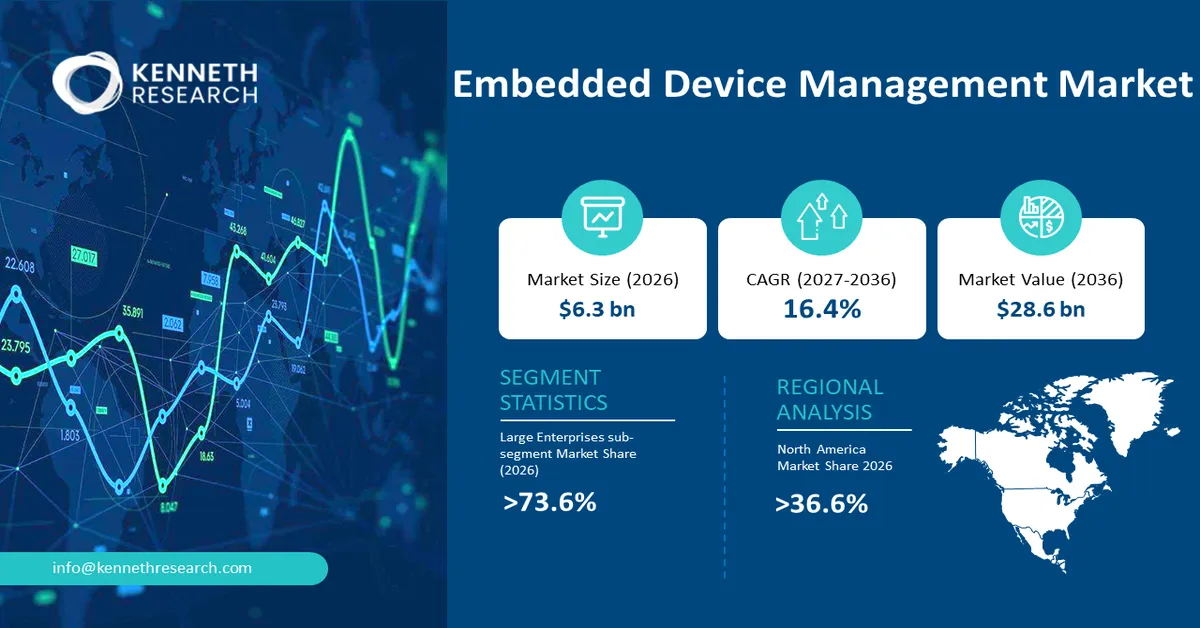
Embedded Device Management Market size was valued at USD 6.3 billion in 2026 and is projected to reach USD 28.6 billion by the end of 2036, rising at a CAGR of 16.4% during the forecast period, i.e., 2027-2036. In 2027, the industry size of the embedded device management is estimated at USD 7.3 billion.
The primary growth driver for the embedded device management market is the rapid expansion of connected devices across industrial, automotive, healthcare, and consumer applications.
The embedded device management market comprises software platforms, tools, and associated technologies used to monitor, configure, secure, update, and maintain embedded devices throughout their operational lifecycles. These solutions enable organizations to remotely manage connected hardware deployed across diverse environments, including industrial equipment, automotive systems, medical devices, consumer electronics, telecommunications infrastructure, and smart-building applications.
Key characteristics include centralized device monitoring, remote diagnostics, firmware and software management, configuration control, security administration, performance monitoring, and lifecycle management. Depending on deployment requirements, embedded device management platforms can operate through cloud-based, on-premises, or hybrid architectures and may incorporate analytics, automation, authentication, and connectivity capabilities.
Key Embedded Device Management Market Insights Summary:
Key Takeaways: Market Trends & Insights
- The embedded device management market is projected to grow from USD 6.3 billion in 2026 to USD 28.6 billion by 2036, expanding at a 16.4% CAGR during 2027-2036.
- North America is anticipated to remain the dominant region, accounting for 36.6% of the market in 2026, supported by strong connected-device adoption, digital infrastructure, and cybersecurity initiatives.
- Large Enterprises represent the leading organization-size segment, capturing 73.6% of the market in 2026, supported by extensive connected-device fleets and demand for centralized lifecycle management.
- Hardware is the second leading segment under Component, supported by increasing deployment of connected embedded systems requiring processing, connectivity, monitoring, and control capabilities.
Market Drivers
- Rising deployment of connected and software-driven embedded devices
- Growing emphasis on embedded device security and lifecycle optimization
- Increasing adoption of industrial IoT and edge computing
- Expansion of remote monitoring, diagnostics, and automated software updates
Challenges
- High Complexity of Managing Heterogeneous Device Fleets
- Cybersecurity Risks and Data Protection Requirements
Embedded Device Management Market Overview & Supply Chain
The adoption of embedded device management solutions is increasing globally as connected embedded systems become more distributed across industrial, automotive, telecommunications, consumer electronics, and other applications. Organizations require centralized capabilities to provision devices, monitor operational status, manage software and firmware, enforce security policies, and maintain device performance throughout the lifecycle. The growing cybersecurity requirements associated with connected devices are also strengthening the importance of structured management frameworks.
The embedded device management value chain begins with hardware and software inputs, including processors, memory, communication interfaces, embedded operating systems, firmware, device-management agents, security technologies, and connectivity modules. Device manufacturers integrate these components into embedded products and incorporate management functionality during development and production. Management-platform providers subsequently deliver provisioning, monitoring, diagnostics, configuration, security, and update capabilities through cloud, on-premises, or hybrid architectures.
Embedded Device Management Market: Growth Drivers & Challenges
Growth Drivers:
- Rising deployment of connected and software-driven embedded devices: The expanding deployment of connected embedded devices across manufacturing, automotive, telecommunications, energy, healthcare, and consumer applications is increasing the need for centralized device management. Connected equipment generates continuous operational data and requires reliable mechanisms for provisioning, configuration, monitoring, diagnostics, and software or firmware updates. As enterprises deploy more heterogeneous embedded systems, management platforms can reduce manual intervention, improve visibility, standardize configurations, and support remote maintenance. Over the longer term, greater adoption of industrial IoT, connected vehicles, smart infrastructure, and edge computing is expected to expand demand for scalable lifecycle-management capabilities.
- Growing emphasis on embedded device security and lifecycle optimization: Increasing cybersecurity exposure across connected embedded systems is encouraging organizations to adopt comprehensive management capabilities rather than treating device administration as an isolated operational function. Embedded devices may remain deployed for extended periods, making secure configuration, credential management, vulnerability monitoring, patching, and controlled software updates important throughout their lifecycles. Management platforms can provide centralized policy enforcement and help organizations maintain consistent security practices across geographically dispersed device fleets. This requirement is particularly relevant for industrial and critical-use environments where unmanaged devices can create operational disruption as well as cybersecurity risks.
Challenges:
- High complexity of managing heterogeneous device fleets: A major restraint is the complexity associated with managing embedded devices that use different hardware architectures, operating systems, communication protocols, firmware versions, and security configurations. Organizations operating large fleets may need to integrate multiple management environments rather than relying on a standardized architecture. This increases deployment complexity, requires specialized technical expertise, and can raise integration and maintenance costs.
- Cybersecurity risks and data protection requirements: Cybersecurity represents another significant challenge because embedded device management platforms provide access to distributed devices, software configurations, credentials, and operational data. Weak authentication, outdated firmware, insecure communication channels, or poorly managed access privileges can create vulnerabilities across connected environments. Organizations must therefore implement strong identity management, encryption, vulnerability monitoring, secure update mechanisms, and access controls without disrupting device availability.
Embedded Device Management Market Size and Forecast:
| Report Attribute | Details |
|---|---|
| Base Year |
2026 |
| Forecast Period |
2027-2036 |
| CAGR |
16.4% |
| Base Year Market Size (2026) |
USD 6.3 billion |
| Forecast Year Market Size (2036) |
USD 28.6 billion |
| Regional Scope |
|
Embedded Device Management Market Segmentation Analysis:
Organization Size Type Segment Analysis
In the organization size segment, the Large Enterprises sub-segment is anticipated to capture the largest market share of 73.6% by the end of 2026.
Large enterprises typically operate extensive embedded-device environments across multiple facilities, production lines, connected assets, and operational systems, creating strong demand for centralized management capabilities. These organizations require scalable platforms for device provisioning, monitoring, configuration, security administration, diagnostics, and software or firmware updates. Their greater technology budgets and established IT infrastructure also support the deployment of sophisticated embedded device management solutions.
Component Type Segment Analysis
In the component segment, the hardware sub-segment is projected to experience strong growth as embedded device management increasingly depends on capable and connected physical infrastructure. Hardware components provide the underlying processing, connectivity, sensing, control, and communication capabilities required for embedded devices to operate and interact with management platforms. Demand is supported by the increasing deployment of connected equipment across manufacturing, automotive, healthcare, consumer electronics, energy, and other applications. As device fleets become more sophisticated, manufacturers are incorporating enhanced processing capabilities, connectivity interfaces, security features, and management functionality into embedded hardware.
Our in-depth analysis of the global embedded device management market includes the following segments:
|
Segment |
Sub-segment |
|
By Component |
|
|
Device Type |
|
|
Deployment Mode |
|
|
End User |
|
|
Organization Size |
|
Embedded Device Management Market Regional Insights:
North America Market Trends & Insights:
North America is anticipated to dominate the embedded device management market, accounting for 36.6% of the market in 2026.
The region benefits from a mature digital infrastructure, extensive deployment of connected industrial and enterprise systems, and strong demand for secure management of distributed embedded devices.
In the U.S., demand is supported by widespread adoption of connected technologies across manufacturing, government, telecommunications, transportation, and other digitally enabled industries. Regulatory and cybersecurity initiatives are also encouraging organizations to establish stronger device identification, configuration, and lifecycle-management capabilities.
Canada is similarly expanding connected-device deployment across critical infrastructure, including transportation, energy, utilities, manufacturing, healthcare, and communications. Government initiatives identify the increasing number of connected devices and the need for improved monitoring, maintenance, and security.
Asia-Pacific Market Trends & Insights:
Asia-Pacific is emerging as an important growth region for the embedded device management market, supported by expanding IoT deployment, industrial digitalization, smart manufacturing, telecommunications infrastructure, and connected-device adoption. Government initiatives across the region are encouraging enterprises to integrate IoT, edge computing, and digital technologies into industrial operations.
In Japan, the combination of advanced manufacturing capabilities, industrial automation, and government-backed digital transformation initiatives creates opportunities for embedded device management providers.
China represents another major opportunity because its government is promoting mobile IoT integration with artificial intelligence, industrial manufacturing, smart transportation, energy, healthcare, and consumer applications. The country's initiatives are encouraging broader deployment of connected terminals and IoT platforms, increasing the need for centralized management and security capabilities.
Leading Companies Operating in the Embedded Device Management Market:
Here is a list of upstream, downstream, and key players operating in the global embedded device management market competitive ecosystem:
- Amazon Web Services (U.S)
- Company Overview
- Business Strategy
- Key Product Offerings
- Financial Performance
- Key Performance Indicators
- Risk Analysis
- Recent Development
- Regional Presence
- SWOT Analysis
- Bosch (Germany)
- Microsoft (U.S)
- Siemens Digital Industries Software (Germany)
- Cisco Systems (U.S)
Recent Developments
- July 2025 - Siemens announced collaboration with Microsoft to integrate its Building X digital building platform with Azure IoT Operations. The integration enables centralized management of IoT data from building systems and supports automated device onboarding and monitoring.
- March 2025 - AWS launched a preview of managed integrations for AWS IoT Device Management on March 4, 2025. The new service helps developers streamline cloud onboarding of IoT devices and unify device control across multiple brands and protocols.
Frequently Asked Question
In 2026, the embedded device management market exceeded USD 6.3 billion.
The embedded device management market is projected to reach USD 28.6 billion by the end of 2036, expanding at a CAGR of 16.4% over the forecast period (2027-2036).
The major players in the market are Amazon Web Services, Bosch, Microsoft, Siemens Digital Industries Software, and others.
In the organization size segment, the large enterprises sub-segment is anticipated to capture the largest market share of 73.6% in the future and exhibit lucrative growth opportunities during 2027-2036.
North America is projected to hold the largest market share of 36.6% by the end of 2026 and provide more business opportunities in the future.
Why Choose Kenneth Research ?
-
Insight with Impact : We don’t just gather data — we uncover stories, trends, and opportunities that fuel business growth.
-
Experts Who Get It : Our team speaks your industry’s language and knows what really matters to your customers and market.
-
Custom-Built for You : Forget one-size-fits-all. We craft research and consulting solutions as unique as your business vision.
-
Partners, Not Just Providers : We work with you, not for you — collaborating closely to turn insights into smart, strategic moves.
-
Results That Speak : Our work powers brands, startups, and industry leaders alike — with a track record of ideas that work in the real world.
Report ID: 1392 |
Published Date: 25 Sep 2026 |
Report Format: |
Delivery Timeline: 48-72 Business Hours

Copyright © 2025 Kenneth Research. All rights reserved. Terms of Use | Privacy Policy
