Report ID: 1370 |
Published Date: 21 Sep 2026 |
Report Format: |
Delivery Timeline: 48-72 Business Hours
Electronics and Electrical Ceramics Market Outlook:
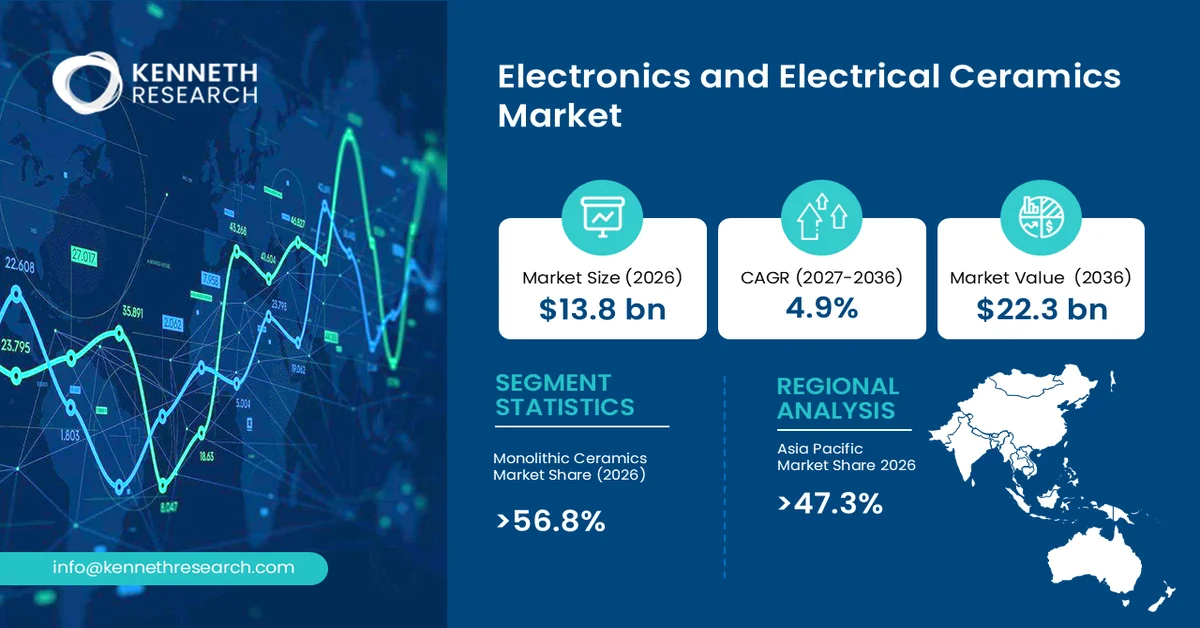
Electronics and Electrical Ceramics Market size was valued at USD 13.8 billion in 2026 and is projected to reach USD 22.3 billion by 2036, expanding at a CAGR of 4.9% during 2027–2036. The market is estimated at USD 14.5 billion in 2027.
The growing integration of electronics across semiconductors, power systems, telecommunications, automotive electronics, energy technologies, and other high-performance applications is driving demand for advanced ceramic materials with controlled electrical, thermal, mechanical, and dielectric properties.
The electronics and electrical ceramics market comprises ceramic materials, components, and engineered ceramic structures used in electronic and electrical applications. These materials are selected for properties such as electrical insulation, dielectric behavior, thermal stability, mechanical strength, chemical resistance, and dimensional stability.
Monolithic ceramics are particularly important because advanced monolithic ceramics can include oxide and non-oxide compositions engineered for specific performance requirements. Government materials research also identifies ceramics as suitable for electronic substrates and electronic packaging, reinforcing their role as functional materials within modern electronic systems.
Key Electronics and Electrical Ceramics Market Insights Summary:
Electronics and Electrical Ceramics Market - Key Takeaways
- The electronics and electrical ceramics market was valued at USD 13.8 billion in 2026 and is projected to reach USD 22.3 billion by 2036, expanding at a CAGR of 4.9%.
- Monolithic Ceramics was the leading product type, accounting for 56.8% in 2026.
- Alumina Ceramics represents the second segment analysis under the Material category.
- Asia-Pacific dominated the market with a 47.3% share in 2026, supported by strong electronics manufacturing and ceramic technology capabilities in Japan and China.
Market Drivers
- Growing demand for advanced semiconductor packaging
- Rising need for thermal management in power electronics
- Increasing miniaturization and performance requirements of electronic devices
- Expansion of high-reliability ceramic applications across automotive, telecommunications, and industrial electronics
Challenges
- Complexity of Ceramic Processing and Quality Control
- High Manufacturing and Processing Requirements
Electronics and Electrical Ceramics Market - Market Overview & Supply Chain
The electronics and electrical ceramics market comprises specialized ceramic materials and components used in electronic and electrical systems where electrical insulation, thermal stability, dielectric performance, mechanical strength, and dimensional reliability are required. These materials are incorporated into electronic substrates, insulators, packaging components, capacitive elements, connectors, and other precision components.
The supply chain begins with the extraction and processing of ceramic raw materials, followed by powder preparation, formulation, shaping, sintering, machining, metallization, and component manufacturing. Manufacturers then integrate finished ceramic components into electronic assemblies and electrical equipment. Alumina is particularly relevant because it combines electrical insulation characteristics with mechanical and thermal properties required in demanding applications.
Electronics and Electrical Ceramics Market - Growth Drivers & Challenges
Growth Drivers
- Growing Demand for Advanced Semiconductor Packaging: The increasing adoption of advanced semiconductor packaging is creating strong opportunities for electronic ceramics used as substrates, insulating layers, and packaging structures. Ceramic materials provide electrical insulation, dimensional stability, and thermal-management capabilities that are important for increasingly compact and high-performance electronic systems.
- Rising Need for Thermal Management in Power Electronics: The increasing power density of electronic systems is driving demand for ceramics capable of combining electrical insulation with efficient heat management. Alumina, aluminum nitride, and silicon nitride ceramics are increasingly relevant as substrate materials in power-electronics packaging because they can support heat dissipation while electrically isolating semiconductor devices. This trend is particularly important for electric vehicles, renewable-energy converters, industrial power systems, and other high-power applications.
Challenges
- Complexity of Ceramic Processing and Quality Control: Ceramic manufacturing requires tight control over powder characteristics, forming, sintering, dimensional accuracy, and defects. Variations during processing can affect the performance and reliability of finished components, creating challenges for manufacturers seeking consistent production at commercial scale.
- High Manufacturing and Processing Requirements: Advanced ceramic components can require specialized equipment, controlled processing environments, precision machining, and carefully managed sintering processes. NIST identifies cost and certification as among the barriers affecting broader commercialization of ceramic additive manufacturing.
Electronics and Electrical Ceramics Market Size and Forecast:
| Report Attribute | Details |
|---|---|
| Base Year |
2026 |
| Forecast Year |
2027-2036 |
| CAGR |
4.9% |
| Base Year Market Size (2026) |
USD 13.8 billion |
| Forecast Year Market Size (2036) |
USD 22.3 billion |
| Regional Scope |
|
Electronics and Electrical Ceramics Market - Segment Analysis
Product Type Segment Analysis
Monolithic Ceramics dominated the electronics and electrical ceramics market, accounting for 56.8% of the market in 2026. Their strong position is supported by their suitability for electronic substrates, packaging, insulating components, and other applications requiring electrical and thermal stability.
Monolithic ceramics are manufactured as continuous ceramic structures rather than composite or layered constructions, allowing manufacturers to engineer material properties for specific electronic applications. Demand for monolithic ceramics is further supported by the need for reliable materials in increasingly compact and performance-intensive electronic systems. Their combination of electrical insulation, dimensional stability, and resistance to demanding operating conditions makes them valuable across electronics and electrical applications.
Material Segment Analysis
Alumina Ceramics represent the second segment analysis under the material category. Alumina is widely used in electronic and electrical applications because of its combination of electrical insulation, thermal stability, mechanical strength, and dimensional reliability.
The material is used in applications including electronic substrates, insulating components, seals, and other components requiring dependable performance under demanding operating conditions. Increasing demand for reliable substrates and insulating components in advanced electronics is expected to support alumina ceramics across the market. At the same time, improvements in ceramic processing and sintering technologies are helping manufacturers pursue better dimensional control and application-specific performance.
Our in-depth analysis of the global electronics and electrical ceramics market includes the following segments:
|
Segment |
Sub-segment |
|
Material Type |
|
|
Product Type |
|
|
End User |
|
Electronics and Electrical Ceramics Market - Regional Analysis
Asia-Pacific Market Trends & Insights:
Asia-Pacific dominated the electronics and electrical ceramics market, accounting for 47.3% of the market in 2026, with Japan and China serving as key countries. The region benefits from its strong electronics manufacturing ecosystem, established ceramic-component production capabilities, and continued investment in advanced electronic technologies.
Japan has a well-established research and industrial base for electro-ceramics. The National Institute for Materials Science (NIMS) conducts research on dielectric, conductive, magnetic, and optical ceramics used in electronic devices and electrical facilities, supporting continued innovation in advanced ceramic materials.
China also represents a major electronics manufacturing hub. China's Ministry of Industry and Information Technology reported that the country's electronic information manufacturing sector recorded 11.8% year-on-year growth in value added in 2024, while integrated-circuit output increased by 22.2%. This expanding electronics manufacturing base supports demand for specialized ceramic materials and components used across electronic systems.
North America Market Trends & Insights:
North America represents the secondary regional market, with the U.S. and Canada serving as key countries. The region benefits from expanding semiconductor manufacturing, advanced electronics production, and efforts to strengthen domestic technology supply chains.
In the U.S., the CHIPS for America program supports semiconductor manufacturing, research, and development, including activities involving materials and substrates. This creates opportunities for ceramic materials used in semiconductor packaging, substrates, insulation, and related electronic applications.
Canada also maintains an established electronics and materials ecosystem. Statistics Canada reported that in 2024, $5.6 billion of Canadian alumina and aluminum production and processing value added was associated with U.S. demand, demonstrating the importance of North American cross-border materials supply chains.
Electronics and Electrical Ceramics Market - Competitive Landscape
Here is a list of upstream, downstream, and key players operating in the global electronics and electrical ceramics market competitive ecosystem:
- Murata Manufacturing (Japan)
- Company Overview
- Business Strategy
- Key Product Offerings
- Financial Performance
- Key Performance Indicators
- Risk Analysis
- Recent Development
- Regional Presence
- SWOT Analysis
- TDK (Japan)
- KYOCERA (Japan)
Recent Developments
- December 2025 — Murata Manufacturing announced the launch and mass production of a new multilayer ceramic capacitor (MLCC) featuring high-voltage performance and C0G characteristics. The product is designed for applications including electric-vehicle onboard chargers and high-performance power supplies.
- April 2025 — TDK expanded its CGA series with new multilayer ceramic capacitors for automotive applications, adding higher-capacitance products with a 100-V rating. The company positioned the products for automotive electronic applications requiring high capacitance and reliability.
Frequently Asked Question
In 2026, the electronics and electrical ceramics market exceeded USD 13.8 billion.
The electronics and electrical ceramics market is projected to reach USD 22.3 billion by the end of 2036, expanding at a CAGR of 4.9% over the forecast period (2027-2036).
The major players in the market are Murata Manufacturing, TDK, KYOCERA, MARUWA, CoorsTek, Vishay Intertechnology, Rogers Corporation, and others.
In the product type segment, the monolithic ceramics sub-segment is anticipated to capture the largest market share of 56.8% in the future and exhibit lucrative growth opportunities during 2027-2036.
Asia-Pacific is projected to hold the largest market share of 47.3% by the end of 2026 and provide more business opportunities in the future.
Why Choose Kenneth Research ?
-
Insight with Impact : We don’t just gather data — we uncover stories, trends, and opportunities that fuel business growth.
-
Experts Who Get It : Our team speaks your industry’s language and knows what really matters to your customers and market.
-
Custom-Built for You : Forget one-size-fits-all. We craft research and consulting solutions as unique as your business vision.
-
Partners, Not Just Providers : We work with you, not for you — collaborating closely to turn insights into smart, strategic moves.
-
Results That Speak : Our work powers brands, startups, and industry leaders alike — with a track record of ideas that work in the real world.
Report ID: 1370 |
Published Date: 21 Sep 2026 |
Report Format: |
Delivery Timeline: 48-72 Business Hours

Copyright © 2025 Kenneth Research. All rights reserved. Terms of Use | Privacy Policy
