Report ID: 1385 |
Published Date: 24 Sep 2026 |
Report Format: |
Delivery Timeline: 48-72 Business Hours
Electronic Stethoscope Market Outlook:
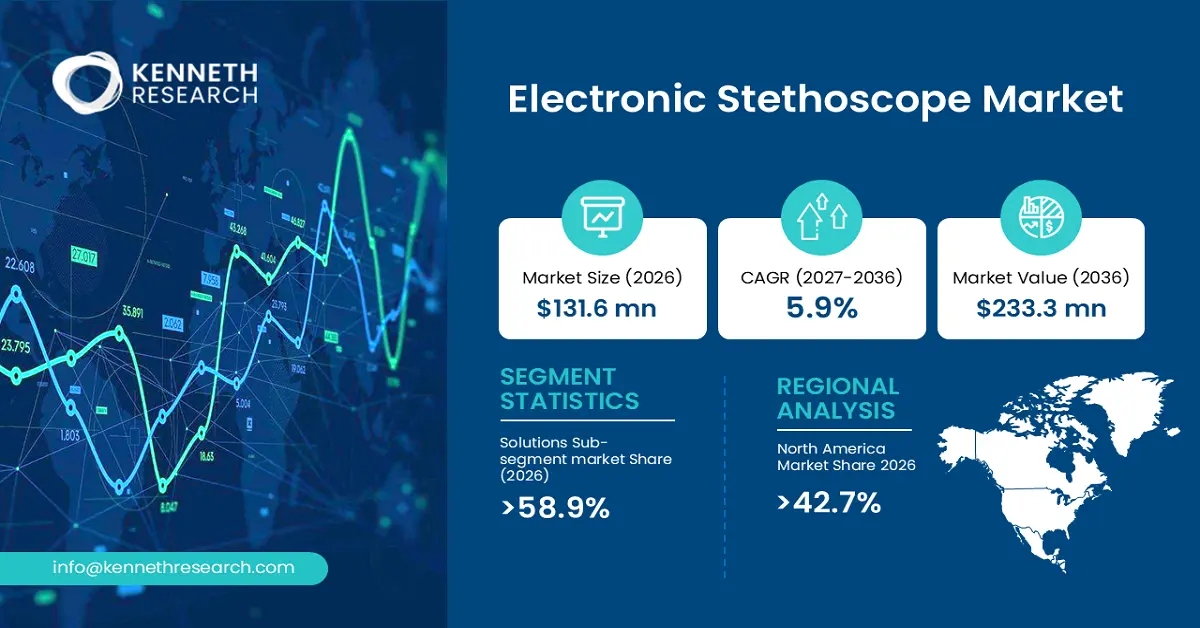
Electronic Stethoscope Market size was valued at USD 131.6 million in 2026 and is projected to reach USD 233.3 million by the end of 2036, rising at a CAGR of 5.9% during the forecast period, i.e., 2027–2036. In 2027, the industry size of the electronic stethoscope is estimated at USD 139.3 million.
The primary growth driver for the electronic stethoscope market is the increasing adoption of digital healthcare technologies that enable enhanced auscultation, sound amplification, recording, and electronic transmission of heart and lung sounds.
The electronic stethoscope market comprises digitally enabled auscultation devices designed to capture, amplify, process, record, and transmit physiological sounds, particularly heart and lung sounds. Unlike conventional acoustic stethoscopes, electronic models use microphones, electronic sensors, signal-processing technologies, and amplification systems to improve sound clarity and support visualization or digital storage of auscultation data. Depending on the product design, these devices may incorporate noise reduction, Bluetooth or other wireless connectivity, mobile-device integration, recording functions, and software-based sound analysis.
Key Electronic Stethoscope Market Insights Summary:
Electronic Stethoscope Market - Key Takeaways
- The Electronic Stethoscope Market is projected to grow from USD 131.6 million in 2026 to USD 233.3 million by 2036, expanding at a CAGR of 5.9% during the forecast period.
- North America is expected to remain the dominant regional market, accounting for 42.7% of the market in 2026, supported by advanced healthcare infrastructure and digital healthcare adoption.
- Digital electronic stethoscopes represent the largest product type segment, holding a 58.9% market share in 2026 due to their enhanced amplification, recording, connectivity, and digital auscultation capabilities.
- Hospitals and clinics constitute the leading end-user segment, driven by extensive clinical use of electronic auscultation devices across diagnosis, monitoring, and digitally enabled healthcare workflows.
- Market expansion is supported by increasing digitalization of healthcare, telemedicine adoption, demand for enhanced auscultation, connected medical devices, and integration of electronic stethoscopes with broader digital clinical systems.
Market Drivers
- Rising adoption of digital and telehealth-enabled healthcare
- Growing demand for enhanced auscultation and clinical efficiency
- Increasing integration of connected medical devices
- Expansion of remote patient monitoring and digitally enabled clinical workflows
Challenges
- High Cost of Advanced Electronic Stethoscopes
- Connectivity, Interoperability, and Regulatory Complexity
Electronic Stethoscope Market Overview & Supply Chain
The electronic stethoscope market is gaining relevance as healthcare systems increasingly integrate digital technologies into clinical assessment, remote care, and connected healthcare workflows. Electronic stethoscopes support the digitization of auscultation by enabling physicians to amplify, record, process, and transmit physiological sounds, making them relevant to telemedicine and digitally enabled clinical environments.
The supply chain begins with sourcing electronic components, acoustic sensors, microphones, batteries, circuit boards, connectivity modules, housings, and other precision materials required for device assembly. Manufacturers integrate these inputs into complete electronic stethoscopes through acoustic engineering, digital signal processing, amplification, connectivity, and software integration. Production may also involve calibration, quality testing, regulatory compliance, and validation of acoustic performance before commercialization.
Electronic Stethoscope Market: Growth Drivers & Challenges
Growth Drivers
- Rising Adoption of Digital and Telehealth-Enabled Healthcare: The increasing integration of digital technologies into healthcare delivery is driving demand for electronic stethoscopes with recording, amplification, noise reduction, wireless connectivity, and remote auscultation capabilities. These features allow physiological sounds to be captured and shared digitally, supporting clinical documentation, remote consultations, medical education, and collaboration between healthcare professionals. Electronic stethoscopes can therefore benefit from healthcare providers' continued investment in connected-care technologies, particularly where remote examination and digital transmission of auscultation data can complement conventional clinical workflows.
- Growing Demand for Enhanced Auscultation and Clinical Efficiency: Healthcare professionals are increasingly seeking diagnostic tools that improve the clarity, usability, and portability of auscultation. Electronic stethoscopes can amplify faint physiological sounds, reduce environmental noise, record examinations, and facilitate digital sharing, providing advantages over traditional acoustic devices in demanding clinical environments. Hospitals and clinics can use these capabilities to support physician collaboration, training, remote specialist input, and longitudinal documentation.
Challenges
- High Cost of Advanced Electronic Stethoscopes: Advanced electronic stethoscopes incorporate microphones, digital signal processing, amplification systems, wireless connectivity, batteries, and software-enabled features, making them more complex and expensive than conventional acoustic devices. The higher acquisition cost can restrict adoption among smaller clinics, independent practitioners, and healthcare facilities operating under tight procurement budgets.
- Connectivity, Interoperability, and Regulatory Complexity: The integration of electronic stethoscopes into digital healthcare environments creates challenges related to connectivity, interoperability, data management, and regulatory compliance. Devices may need to communicate reliably with smartphones, clinical software, telehealth platforms, and electronic health-record systems while maintaining consistent audio quality and secure handling of patient information. Differences in healthcare IT infrastructures can make integration difficult across facilities and markets.
Electronic Stethoscope Market Size and Forecast:
| Report Attribute | Details |
|---|---|
| Base Year |
2026 |
| Forecast Year |
2026-2037 |
| CAGR |
5.9% |
| Base Year Market Size (2026) |
USD 131.6 million |
| Forecast Year Market Size (2037) |
USD 233.3 million |
| Regional Scope |
|
Electronic Stethoscope Market: Segment Analysis
Product Type Segment Analysis
In the product type segment, the digital electronic stethoscopes sub-segment is anticipated to capture the largest market share of 58.9% by the end of 2026.
Demand is supported by the ability of digital electronic stethoscopes to amplify, record, process, and transmit auscultation sounds, providing greater functionality than conventional acoustic devices. Their compatibility with connected healthcare workflows also supports adoption across hospitals, clinics, telemedicine, and medical education. Regulatory activity further demonstrates the commercialization of digitally enabled stethoscope technologies. In 2022, the U.S. Food and Drug Administration cleared digital stethoscope products designed for general-purpose auscultation, hearing-impaired users, and telemedicine applications, demonstrating the expanding range of applications for electronic auscultation devices. As healthcare providers increasingly incorporate digital technologies into clinical workflows, manufacturers are expected to emphasize improved acoustic performance, wireless connectivity, artificial-intelligence-enabled analysis, portability, and interoperability.
End user Segment Analysis
In the end user segment, the Hospitals and Clinics sub-segment is anticipated to capture the largest market share. Demand is supported by the extensive use of stethoscopes for routine patient assessment, diagnosis, monitoring, and clinical decision-making across hospital and outpatient environments. Electronic models offer additional functionality through amplified sound, recording, noise reduction, and digital transmission, making them increasingly relevant to technology-enabled clinical workflows. Government healthcare data also demonstrates the continuing role of hospitals as major settings for medical-device use.
Our in-depth analysis of the electronic stethoscope market includes the following segments:
|
Segment |
Sub-segment |
|
Product Type |
|
|
Technology Type |
|
|
By Connectivity |
|
|
End user |
|
Electronic Stethoscope Market Regional Insights:
North America Market Trends & Insights:
North America is anticipated to dominate the electronic stethoscope market, accounting for 42.7% of the market share by the end of 2026.
The region benefits from advanced healthcare infrastructure, high adoption of medical technologies, established hospital networks, and increasing integration of digital tools into clinical workflows. Government-backed digital-health initiatives and investments in healthcare information infrastructure further support the integration of electronically captured clinical data.
The U.S. is expected to remain the leading country within North America due to its mature medical-device ecosystem, extensive hospital infrastructure, and strong adoption of connected healthcare technologies. Electronic stethoscopes can support telemedicine, remote specialist consultation, digital documentation, and technology-enabled clinical assessment.
Canada is also expected to contribute to regional growth through healthcare modernization and increasing use of digital technologies. The country's healthcare institutions can benefit from electronic stethoscopes that facilitate remote auscultation, clinical collaboration, and digital transmission of physiological sounds.
Asia-Pacific Market Trends & Insights:
Asia-Pacific is expected to remain an important growth market for electronic stethoscopes, supported by expanding healthcare infrastructure, digitalization of clinical services, increasing adoption of connected medical technologies, and the modernization of hospitals and outpatient facilities.
Japan offers opportunities for electronic stethoscope manufacturers through its technologically advanced healthcare system and continued development of medical digitalization.
China is also expected to contribute significantly to regional demand as healthcare institutions adopt digital and intelligent technologies. Government initiatives encourage digitalization, remote medical services, information sharing, and the use of intelligent diagnostic technologies, supporting opportunities for connected electronic stethoscopes in hospitals and primary-care settings.
Leading Companies Operating in the Electronic Stethoscope Market:
Here is a list of upstream, downstream, and key players operating in the electronic stethoscope market competitive ecosystem:
- 3M Littmann (U.S.)
- Company Overview
- Business Strategy
- Key Product Offerings
- Financial Performance
- Key Performance Indicators
- Risk Analysis
- Recent Development
- Regional Presence
- SWOT Analysis
- Eko Health (U.S.)
- Thinklabs (U.S.)
Recent Developments
- April 2025 —Eko Health launched its CORE 500 Digital Stethoscope and Eko+ membership in Canada following Health Canada approval. The device combines digital auscultation with ECG visualization, noise cancellation, and connectivity to Eko's software platform.
Frequently Asked Question
In 2026, the electronic stethoscope market exceeded USD 131.6 million.
The electronic stethoscope market is projected to reach USD 233.3 million by the end of 2036, expanding at a CAGR of 5.9% over the forecast period (2027-2036).
The major players in the market are 3M Littmann, Eko Health, Thinklabs, HD Medical, TytoCare, and others.
In the product type segment, the digital electronic stethoscopes sub-segment is anticipated to capture the largest market share of 58.9% in the future and exhibit lucrative growth opportunities during 2027-2036.
North America is projected to hold the largest market share of 42.7% by the end of 2026 and provide more business opportunities in the future.
Why Choose Kenneth Research ?
-
Insight with Impact : We don’t just gather data — we uncover stories, trends, and opportunities that fuel business growth.
-
Experts Who Get It : Our team speaks your industry’s language and knows what really matters to your customers and market.
-
Custom-Built for You : Forget one-size-fits-all. We craft research and consulting solutions as unique as your business vision.
-
Partners, Not Just Providers : We work with you, not for you — collaborating closely to turn insights into smart, strategic moves.
-
Results That Speak : Our work powers brands, startups, and industry leaders alike — with a track record of ideas that work in the real world.
Report ID: 1385 |
Published Date: 24 Sep 2026 |
Report Format: |
Delivery Timeline: 48-72 Business Hours

Copyright © 2025 Kenneth Research. All rights reserved. Terms of Use | Privacy Policy
