Report ID: 1462 |
Published Date: 29 Sep 2026 |
Report Format: |
Delivery Timeline: 48-72 Business Hours
Electronic Filtration Market Outlook:
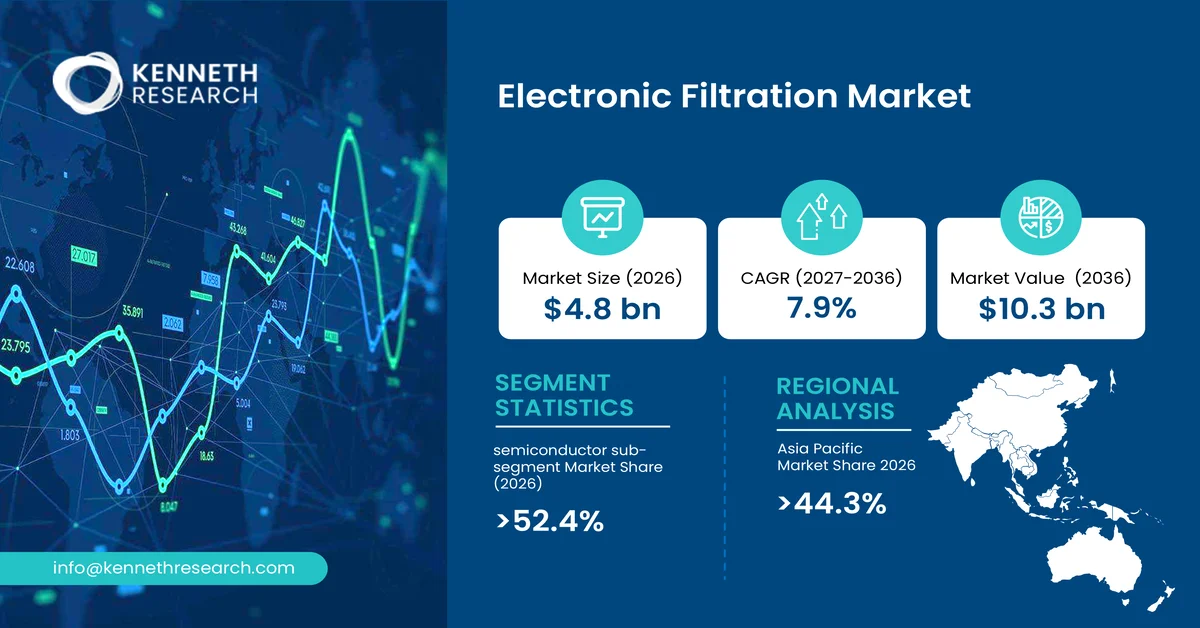
Electronic filtration market size was valued at USD 4.8 billion in 2026 and is projected to reach USD 10.3 billion by the end of 2036, rising at a CAGR of 7.9% during the forecast period, i.e., 2027–2036. In 2027, the industry size of the electronic filtration market is estimated at USD 5.2 billion.
Expansion of semiconductor manufacturing is a key growth driver for the electronic filtration market because advanced fabrication requires stringent contamination control across cleanrooms, process gases, chemicals, and ultrapure-water systems.
The electronic filtration market comprises filtration and purification technologies used to remove particulate, chemical, microbial, and other contaminants from air, gases, liquids, and process fluids used in electronics and semiconductor manufacturing. These systems are designed to maintain the high-purity conditions required across sensitive production environments and to prevent contaminants from affecting materials, equipment, and finished electronic components.
Key characteristics include high-efficiency particle removal, chemical and molecular filtration, liquid filtration, gas purification, and contamination-control capabilities. Product configurations can include air filters, liquid filters, membrane-based systems, chemical filters, and related purification technologies. Their selection depends on the contaminant type, required purity, process chemistry, operating conditions, and manufacturing environment.
Key Electronic Filtration Market Insights Summary:
Key Takeaways: Market Trends & Insights
- The electronic filtration market is valued at USD 4.8 billion in 2026 and is projected to reach USD 10.3 billion by 2036
- The electronic filtration market is expected to expand at a CAGR of 7.9% from 2027 to 2036
- The Semiconductor segment leads the market with a 52.4% share in 2026 within the End-use category
- Asia Pacific dominates the electronic filtration market with a 44.3% share in 2026
- Air Filters represent the second and fastest-growing segment within the Product Type category, supported by increasing contamination-control requirements across advanced manufacturing environments
Market Drivers
- Semiconductor manufacturing capacity expansion
- Increasing contamination-control requirements
- Growth of advanced semiconductor and electronics manufacturing
- Expansion of high-purity process environments
Challenges
- High qualification and validation requirements
- Complex operating conditions and maintenance requirements
Electronic Filtration Market Overview & Supply Chain
Adoption of electronic filtration solutions is increasing globally as semiconductor, electronics, and advanced manufacturing facilities require tighter contamination control across cleanrooms, process gases, chemicals, and fluid-handling systems. Increasing semiconductor manufacturing activity is strengthening demand for filtration technologies that protect sensitive processes and improve manufacturing consistency. The technology also has growing relevance to energy efficiency and sustainable manufacturing because filtration and purification systems form part of the environmental and process-control infrastructure used in high-precision production.
The electronic filtration market supply chain begins with raw materials and specialized inputs, including polymers, membranes, fibers, resins, metals, adsorbent media, filtration substrates, housings, seals, and chemicals used in purification media. Component and material suppliers provide these inputs to filtration manufacturers, which engineer, fabricate, assemble, test, and qualify filtration products for specific semiconductor and electronics applications. Manufacturing activities can include membrane formation, media treatment, pleating, module assembly, housing fabrication, and contamination-control testing. Distribution is conducted through direct sales, specialized industrial distributors, equipment integrators, and application-focused suppliers, depending on customer requirements and geographic coverage. End users include semiconductor fabrication facilities, electronics manufacturers, display producers, and other high-purity manufacturing operations.
Electronic Filtration Market - Growth Drivers & Challenges
Growth Drivers
- Semiconductor Manufacturing Capacity Expansion: Expansion of semiconductor manufacturing capacity is strengthening demand for electronic filtration systems because fabrication facilities require stringent control of airborne particles, molecular contaminants, process chemicals, gases, and ultrapure fluids. New fabs and capacity expansions increase the number of controlled production environments that require filtration and purification equipment throughout manufacturing operations.
- Increasing Contamination-Control Requirements: Growing process complexity is increasing the importance of contamination control across semiconductor and electronics manufacturing. Smaller process geometries, advanced packaging, high-performance computing components, and increasingly sensitive electronic devices can require tightly controlled manufacturing conditions. Filtration systems therefore play a strategic role in maintaining air cleanliness and protecting process fluids, gases, chemicals, and production equipment from contaminants.
Challenges
- High Qualification and Validation Requirements: Electronic filtration products used in semiconductor and other high-purity manufacturing environments must meet demanding contamination-control, chemical-compatibility, particle-retention, and process-performance requirements. The root cause is the sensitivity of advanced manufacturing processes to trace contaminants and the potential consequences of filtration failure. Suppliers therefore face lengthy product qualification, application testing, material compatibility assessment, and customer validation procedures before a product can be adopted.
- Complex Operating Conditions and Maintenance Requirements: Electronic filtration systems frequently operate across demanding conditions involving aggressive chemicals, high-purity gases, temperature variation, pressure differences, and stringent cleanliness requirements. The root cause is the diversity of process environments in electronics and semiconductor manufacturing, where filtration materials must remain stable without introducing additional contaminants. These requirements increase system-design complexity and can raise costs associated with material selection, equipment integration, monitoring, replacement, and maintenance.
Electronic Filtration Market Size and Forecast:
| Report Attribute | Details |
|---|---|
| Base Year |
2026 |
| Forecast Year |
2027-2036 |
| CAGR |
7.9% |
| Base Year Market Size (2026) |
USD 4.8 billion |
| Forecast Year Market Size (2036) |
USD 10.3 billion |
| Regional Scope |
|
Electronic Filtration Market - Segment Analysis
End-Use Segment Analysis
In the end-use segment, semiconductor sub-segment is anticipated to capture the largest market share of 52.4% by the end of 2026.
The semiconductor segment dominates because semiconductor fabrication requires rigorous contamination control across cleanrooms, process gases, chemicals, and ultrapure fluids. Demand is being reinforced by expansion of advanced manufacturing capacity, AI-related chip requirements, and government-backed efforts to strengthen domestic semiconductor supply chains. The U.S. Department of Commerce reported that the CHIPS Program Office had allocated more than $32 billion in proposed funding across 16 states to build domestic semiconductor factories, demonstrating continued investment in fabrication infrastructure. This expansion directly supports demand for filtration systems used to maintain controlled manufacturing conditions and protect sensitive processes. On the supply side, filtration manufacturers are developing increasingly specialized products capable of handling demanding chemical, gas, and particulate-removal applications.
Product Type Segment Analysis
The air filters is projected to grow as the second-largest segment in the electronic filtration market due to four converging demand drivers.
Air filters are projected to grow as manufacturers increasingly prioritize particulate and airborne-contaminant control across semiconductor facilities, electronics production, and other controlled industrial environments. Demand is supported by greater attention to indoor air quality, contamination prevention, and filtration efficiency, while advanced manufacturing facilities increasingly require dependable air-cleaning infrastructure. Government guidance is also reinforcing adoption: the U.S. Department of Energy states that manufacturers of covered air cleaners have been required to comply with federal energy-conservation standards since December 31, 2023, creating a formal performance framework for the product category. Supply-side development is consequently shifting toward higher-efficiency filtration, improved airflow performance, and products designed to balance contaminant removal with energy consumption.
Our in-depth analysis of the Electronic Filtration market includes the following segments:
|
Segment |
Sub-segment |
|
Product Type |
|
|
Filtration Technologies |
|
|
Filter Material |
|
|
End-Use |
|
Electronic Filtration Market - Regional Analysis
Asia Pacific Market Trends & Insights:
Asia Pacific electronic filtration is projected to hold the largest revenue share of 44.3% by the end of 2026.
It is supported by its concentration of semiconductor and electronics manufacturing, expanding fabrication capacity, established component supply chains, and continued investment in advanced production infrastructure. Regional demand is reinforced by contamination-control requirements across semiconductor fabs and other high-purity manufacturing environments.
China represents a major regional manufacturing base, with strong electronics production and continued semiconductor capacity development. Its scale of integrated-circuit production creates broad downstream requirements for filtration and contamination-control technologies.
Japan contributes through advanced semiconductor materials, equipment, and next-generation chip initiatives. Its government is actively supporting semiconductor investment; Japan’s Ministry of Economy, Trade and Industry approved additional support for Rapidus in 2024 for next-generation semiconductor manufacturing and advanced back-end processes. Together, these country-level developments reinforce Asia Pacific’s position as a major demand center for electronic filtration technologies.
North America Market Trends & Insights:
North America is supported by expanding semiconductor and advanced electronics activity, supply-chain localization, and government efforts to strengthen domestic manufacturing capabilities. In the United States, the CHIPS and Science Act is supporting the development of semiconductor fabrication, advanced packaging, research, and associated supply-chain infrastructure, creating opportunities for filtration suppliers serving controlled manufacturing environments.
The United States represents the region's principal semiconductor manufacturing and investment hub, with government-backed programs supporting fabrication, advanced packaging, supply-chain development, and research infrastructure. This industrial expansion can create downstream requirements for high-purity air, gas, chemical, and liquid filtration.
Canada has a more specialized semiconductor ecosystem, with strengths spanning compound semiconductors, photonics, sensors, and advanced packaging. Its government has also continued supporting domestic capabilities through programs targeting manufacturing and commercialization. These complementary industrial profiles provide opportunities for filtration suppliers across both high-volume manufacturing and specialized semiconductor applications.
Electronic Filtration Market Competitive Landscape
Here is a list of upstream, downstream, and key players operating in electronic filtration market competitive ecosystem:
- Pall Corporation (United States)
- Company Overview
- Business Strategy
- Key Product Offerings
- Financial Performance
- Key Performance Indicators
- Risk Analysis
- Recent Development
- Regional Presence
- SWOT Analysis
- Donaldson Company, Inc. (United States)
- Advantech (Japan)
- HAWK Filtration Technology (China)
Recent Developments
- In March 2026, Pall Corporation showcased its advanced semiconductor filtration solutions at SEMICON CHINA 2026 in Shanghai. The company highlighted sub-1nm filtration technologies and its “Asia-Pacific Iron Triangle” supply chain layout spanning Beijing, Japan, and Singapore to serve semiconductor customers with filtration solutions for advanced process nodes.
Frequently Asked Question
In 2026, the electronic filtration market exceeded USD 4.8 billion.
The electronic filtration market is projected to reach USD 10.3 billion by the end of 2036, expanding at a CAGR of 7.9% over the forecast period (2027-2036).
The major players in the market are Pall Corporation, Donaldson Company, Inc., Advantec, HAWK Filtration Technology, and others.
In the End-use segment, the Semiconductor sub-segment is anticipated to capture the largest market share of 52.4% in the future and exhibit lucrative growth opportunities during 2027-2036. This growth trajectory is largely attributed to expansion of semiconductor manufacturing capacity.
Asia Pacific is projected to hold the largest market share of 44.3% by the end of 2036 and provide more business opportunities in the future. Continuous semiconductor manufacturing and electronics production activity in China and Japan is fostering the region's dominance.
Why Choose Kenneth Research ?
-
Insight with Impact : We don’t just gather data — we uncover stories, trends, and opportunities that fuel business growth.
-
Experts Who Get It : Our team speaks your industry’s language and knows what really matters to your customers and market.
-
Custom-Built for You : Forget one-size-fits-all. We craft research and consulting solutions as unique as your business vision.
-
Partners, Not Just Providers : We work with you, not for you — collaborating closely to turn insights into smart, strategic moves.
-
Results That Speak : Our work powers brands, startups, and industry leaders alike — with a track record of ideas that work in the real world.
Report ID: 1462 |
Published Date: 29 Sep 2026 |
Report Format: |
Delivery Timeline: 48-72 Business Hours

Copyright © 2025 Kenneth Research. All rights reserved. Terms of Use | Privacy Policy
