Report ID: 1383 |
Published Date: 24 Sep 2026 |
Report Format: |
Delivery Timeline: 48-72 Business Hours
Electronic Adhesives Market Outlook:
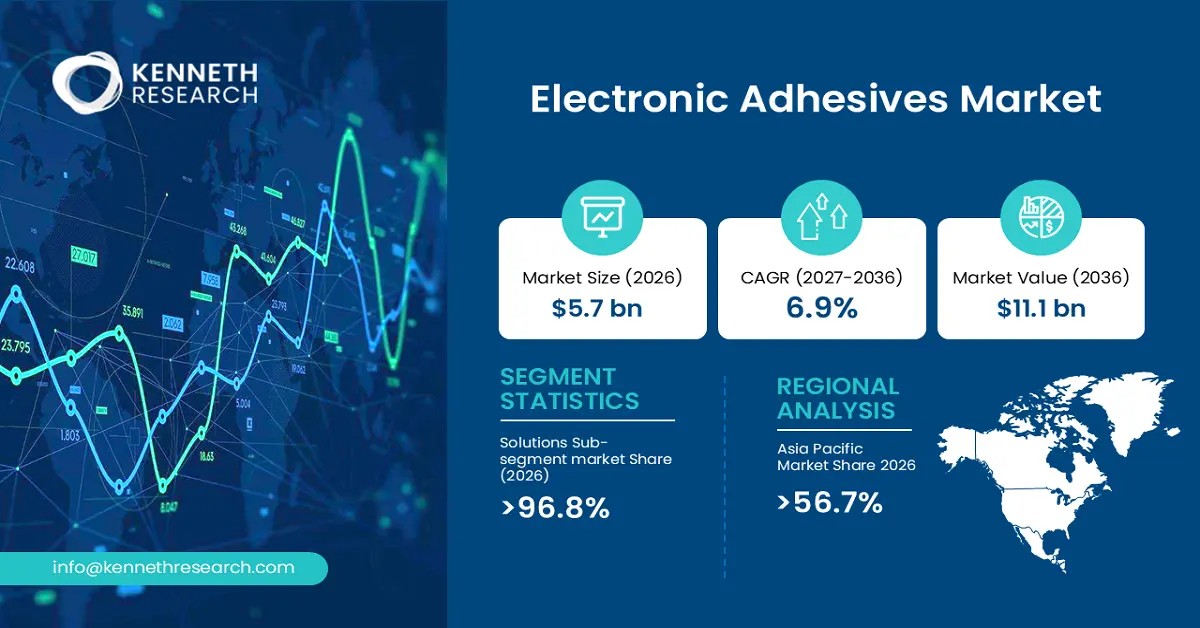
Electronic Adhesives Market size was valued at USD 5.7 billion in 2026 and is projected to reach USD 11.1 billion by the end of 2036, rising at a CAGR of 6.9% during the forecast period, i.e., 2027–2036. In 2027, the industry size of the electronic adhesives is estimated at USD 6.1 billion.
The primary growth driver is expanding semiconductor and electronic-component manufacturing investment, which increases demand for materials that enable reliable assembly, protection, thermal management, and miniaturized interconnections.
Electronic adhesives are bonding materials formulated for electronic assemblies, components, and semiconductor-related applications. They join, secure, seal, insulate, or protect parts while supporting electrical, mechanical, thermal, and environmental requirements.
The market encompasses formulations selected for electrical insulation or conductivity, controlled curing, dimensional stability, thermal resistance, chemical resistance, moisture protection, and compatibility with automated manufacturing. Common resin chemistries include epoxies, silicones, acrylics, polyurethanes, and other engineered polymer systems, while products may be supplied in liquid, paste, film, or application-specific forms.
Key Electronic Adhesives Market Insights Summary:
Key Takeaways: Market Trends & Insights
- Electronic Adhesives Market is valued at USD 5.7 billion in 2026
- Electronic Adhesives Market is projected to reach USD 11.1 billion by 2036 at a CAGR of 6.9% from 2027 to 2036
- Liquid adhesives dominate the Form segment with a 96.8% market share in 2026
- Asia Pacific leads the regional landscape with a 56.7% market share in 2026
- Silicone is identified as the second and fastest-growing segment under the Resin Type category
Market Drivers
- Advanced semiconductor packaging
- Electronic device miniaturization and functional integration
- Growth of automotive and electric-vehicle electronics
- Expansion of high-performance computing, telecommunications, and connected devices
Challenges
- Volatility in Raw Material Costs and Supply Availability
- Stringent Qualification Requirements and Process Compatibility
Electronic Adhesives Market Overview & Supply Chain
Adoption of electronic adhesives is increasing as electronics manufacturers pursue smaller form factors, higher component density, greater reliability, and more sophisticated semiconductor packaging. Adhesives provide structural bonding, electrical insulation, encapsulation, thermal management, and environmental protection across increasingly complex electronic assemblies. Their relevance is reinforced by government-backed efforts to expand semiconductor manufacturing and advanced packaging capabilities.
The electronic adhesives value chain begins with raw-material suppliers providing polymer resins, curing agents, modifiers, fillers, solvents, additives, and functional materials required to engineer application-specific formulations. Adhesive manufacturers then compound, disperse, filter, package, and quality-test these inputs to achieve targeted viscosity, curing behavior, adhesion, dielectric performance, thermal characteristics, and environmental resistance. Specialized formulation and process-development capabilities differentiate suppliers serving demanding semiconductor and electronic-assembly applications. Distribution typically involves direct sales to large electronics manufacturers and semiconductor companies, complemented by regional distributors, specialty chemical channels, and technical sales partners serving smaller customers. End users include semiconductor packaging companies, printed-circuit-board assemblers, consumer-electronics manufacturers, automotive electronics producers, telecommunications equipment manufacturers, industrial electronics companies, and medical-device manufacturers.
Electronic Adhesives Market:Growth Drivers & Challenges
Growth Drivers
- Expansion of Advanced Semiconductor Packaging: The increasing deployment of advanced semiconductor packaging is strengthening demand for electronic adhesives used in die attach, encapsulation, substrate bonding, thermal management, and component assembly. As chip architectures become more complex, adhesive materials must provide reliable bonding while supporting miniaturization, heat dissipation, electrical insulation, and long-term mechanical stability. This creates opportunities for formulations based on silicone and other high-performance resin systems that can withstand demanding processing and operating conditions.
- Miniaturization and Increasing Functional Integration: Electronic device miniaturization is encouraging manufacturers to integrate more functions into progressively smaller assemblies, increasing the importance of adhesives as structural and functional materials. Adhesives can enable precise component placement, protect sensitive assemblies from environmental stresses, provide electrical insulation, and reduce dependence on conventional mechanical fastening.
Challenges
- Volatility in Raw Material Costs and Supply Availability: Electronic adhesives depend on specialty polymers, resins, curing agents, fillers, additives, and other chemically derived inputs whose availability can be affected by feedstock disruptions, production outages, energy costs, and changes in chemical manufacturing capacity. The root cause is the industry's reliance on specialized upstream suppliers, particularly for high-purity materials that require tightly controlled specifications. Cost volatility can raise formulation and procurement expenses for adhesive manufacturers while making long-term pricing commitments more difficult.
- Stringent Qualification Requirements and Process Compatibility: Electronic adhesives face demanding qualification requirements because failures in bonding, thermal management, insulation, or encapsulation can compromise the reliability of sophisticated electronic assemblies. The root cause is the need for adhesives to remain compatible with substrates, components, dispensing equipment, curing conditions, and downstream manufacturing processes while maintaining consistent performance throughout the product lifecycle. Introducing a new formulation can therefore require extensive testing and process validation rather than an immediate material substitution.
Electronic adhesives Market Size and Forecast:
| Report Attribute | Details |
|---|---|
| Base Year |
2026 |
| Forecast Year |
2027-2036 |
| CAGR |
6.9% |
| Base Year Market Size (2025) |
USD 5.7 Billion |
| Forecast Year Market Size (2036) |
USD 11.1 Billion |
| Regional Scope |
|
Electronic Adhesives Market Segment Analysis:
Form Segment Analysis
In the form segment, liquid sub-segment is anticipated to capture the largest market share of 96.8% by the end of 2026.
Liquid adhesives dominate the form segment because electronics manufacturers favor dispensable materials that can be applied precisely across complex assemblies, including semiconductor packages, circuit boards, sensors, and miniaturized components. Their process flexibility supports automated dispensing, rapid production, and bonding across irregular geometries, making liquid formulations well suited to high-volume electronics manufacturing. Adoption is also supported by advanced packaging, where adhesives can contribute to bonding, encapsulation, thermal management, and protection of densely integrated components. Government-backed investment is reinforcing this demand environment: in 2024, the U.S. Department of Commerce announced a funding opportunity of up to $1.6 billion to accelerate domestic semiconductor advanced-packaging technologies, explicitly covering process integration, thermal management, connector technologies, chiplets, and electronic design automation.
Resin Type Segment Analysis
The silicone is projected to grow as the second-largest segment in the electronic adhesives market due to four converging demand drivers.
Silicone is projected to grow within the resin-type segment as electronic assemblies increasingly require materials that combine adhesion with thermal stability, flexibility, electrical insulation, and resistance to moisture and environmental stress. These properties make silicone particularly relevant for power electronics, battery systems, sensors, semiconductor packaging, and other applications where components experience repeated thermal cycling. Adoption is also supported by the expansion of electric-vehicle power electronics. The U.S. Department of Energy states that electric vehicles contain twice as many semiconductors by weight as conventional vehicles, increasing the need for materials that protect and manage increasingly electronics-intensive systems. On the supply side, silicone formulators are developing thermally conductive and electrically insulating systems that can be dispensed, cured, and integrated into automated manufacturing processes.
Our in-depth analysis of the Electronic Adhesives market includes the following segments:
|
Segment |
Sub-segment |
|
Resin Type |
|
|
Form |
|
|
Application |
|
|
End Use |
|
Electronic Adhesives Market Regional Insights:
Asia Pacific Market Trends & Insights:
Asia Pacific electronic adhesives is projected to hold the largest revenue share of 56.7% by the end of 2026.
Its leadership is underpinned by the concentration of semiconductor, consumer electronics, telecommunications, automotive-electronics, and component manufacturing across major Asian production hubs. China, Japan, South Korea, and other regional economies provide an integrated manufacturing ecosystem spanning electronic components, assembly, packaging, and finished devices, supporting both consumption and local sourcing of electronic adhesives.
China represents the principal manufacturing engine, supported by extensive electronics production, semiconductor capacity, and strong domestic demand.
Japan contributes advanced semiconductor materials, precision electronics, automotive components, and high-reliability manufacturing, supporting demand for specialized adhesive formulations. Together, these markets strengthen Asia Pacific’s production depth and technology capabilities. Looking ahead, continued semiconductor localization, electronics manufacturing investment, and automotive electrification should sustain regional adhesive consumption and encourage suppliers to expand local technical support and production capabilities.
North America Market Trends & Insights:
North America is supported by strong electronics demand, expanding semiconductor manufacturing, advanced packaging activity, and investment in automotive, aerospace, telecommunications, artificial intelligence, and data-center infrastructure. In the United States, the CHIPS and Science Act is encouraging domestic semiconductor production and strengthening the supporting ecosystem for advanced electronics manufacturing.
The country remains the region's principal electronics innovation and semiconductor manufacturing hub, with opportunities emerging from domestic production expansion, advanced packaging, AI infrastructure, automotive electronics, and defense-related systems. These applications favor specialized adhesives capable of meeting demanding reliability and processing requirements.
Canada is developing capabilities in semiconductor design, research, specialized manufacturing, and advanced packaging. Federal initiatives are supporting commercialization and strengthening connections between research organizations and industrial users, creating opportunities for adhesive suppliers serving microelectronics, telecommunications, automotive, and low-carbon technologies.
Leading Companies Operating in the Electronic Adhesives Market:
Here is a list of upstream, downstream, and key players operating in electronic adhesives market competitive ecosystem:
- Henkel AG & Co. KGaA (Germany)
- Company Overview
- Business Strategy
- Key Product Offerings
- Financial Performance
- Key Performance Indicators
- Risk Analysis
- Recent Development
- Regional Presence
- SWOT Analysis
- 3M Company (United States)
- Dow Inc. (United States)
- H.B. Fuller Company (United States)
- Huntsman Corporation (United States)
Recent Developments
- In August 2026, Henkel launched LOCTITE ABLESTIK CDF900, a next-generation conductive die attach film (cDAF) series at SEMICON Taiwan 2026. The material delivers thermal conductivity exceeding 8 W/m-K and is designed to address thermal and stress challenges in AI, 5G/6G telecommunications, and high-performance computing applications.
Frequently Asked Question
In 2026, the electronic adhesives market exceeded USD 5.7 billion.
The electronic adhesives market is projected to reach USD 11.1 billion by the end of 2036, expanding at a CAGR of 6.9% over the forecast period (2027-2036).
The major players in the market are Henkel AG & Co. KGaA (Germany), 3M Company (United States), Dow Inc. (United States), H.B. Fuller Company (United States), and Huntsman Corporation (United States), and others.
In the Form segment, the Liquid sub-segment is anticipated to capture the largest market share of 96.8% in the future and exhibit lucrative growth opportunities during 2027-2036. This growth trajectory is largely attributed to the increasing adoption of liquid adhesives in advanced semiconductor packaging and electronic assembly.
Asia Pacific is projected to hold the largest market share of 56.7% by the end of 2026 and provide more business opportunities in the future. Continuous investments in semiconductor manufacturing, electronics production, and advanced packaging across China and Japan are fostering the region's dominance.
Why Choose Kenneth Research ?
-
Insight with Impact : We don’t just gather data — we uncover stories, trends, and opportunities that fuel business growth.
-
Experts Who Get It : Our team speaks your industry’s language and knows what really matters to your customers and market.
-
Custom-Built for You : Forget one-size-fits-all. We craft research and consulting solutions as unique as your business vision.
-
Partners, Not Just Providers : We work with you, not for you — collaborating closely to turn insights into smart, strategic moves.
-
Results That Speak : Our work powers brands, startups, and industry leaders alike — with a track record of ideas that work in the real world.
Report ID: 1383 |
Published Date: 24 Sep 2026 |
Report Format: |
Delivery Timeline: 48-72 Business Hours

Copyright © 2025 Kenneth Research. All rights reserved. Terms of Use | Privacy Policy
