Report ID: 1423 |
Published Date: 29 Sep 2026 |
Report Format: |
Delivery Timeline: 48-72 Business Hours
Electromyography devices market Outlook:
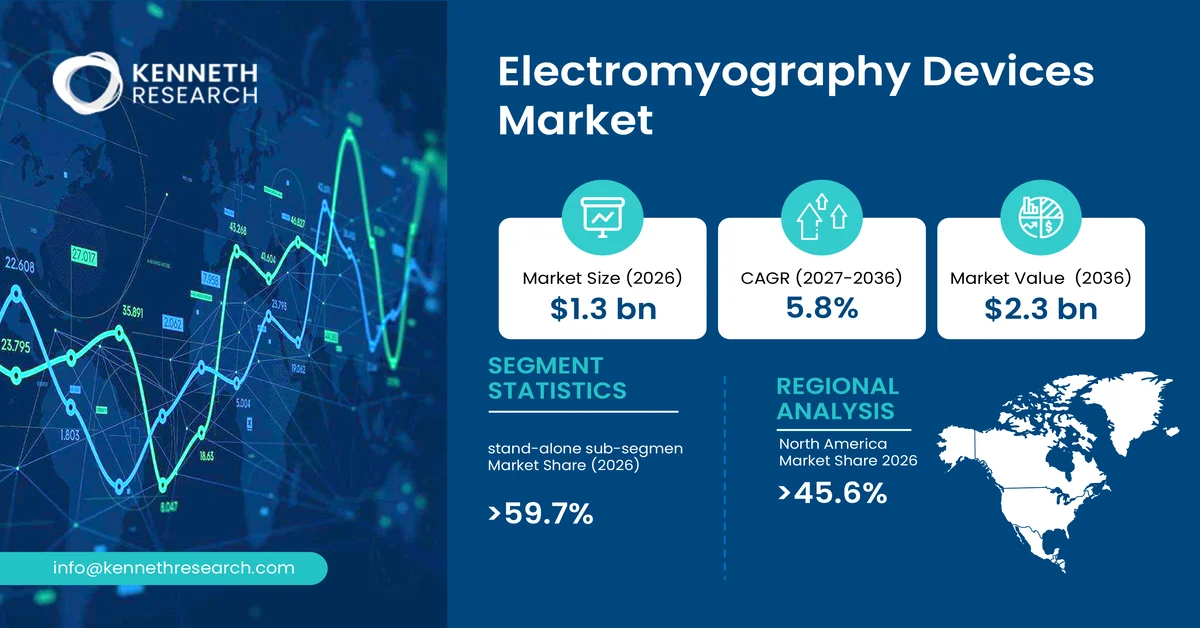
Electromyography devices market size was valued at USD 1.3 billion in 2026 and is projected to reach USD 2.3 billion by the end of 2036, rising at a CAGR of 5.8% during the forecast period, i.e., 2027–2036. In 2027, the industry size of the electromyography devices market is estimated at USD 1.4 billion.
The growing global burden of neurological conditions is a key growth driver for the electromyography devices market, increasing the need for timely neurological assessment and electrodiagnostic testing. WHO reported that more than 3 billion people were living with a neurological condition in 2021, reinforcing demand for diagnostic technologies that evaluate nerve and muscle function.
Electromyography devices are medical diagnostic systems used to record and analyze the electrical activity generated by skeletal muscles and associated peripheral nerves. These systems generally support electromyography examinations through sensors, electrodes, amplifiers, signal-processing components, displays, and specialized software that enable clinicians to evaluate neuromuscular function. Electromyography can help identify abnormalities associated with nerve damage, muscle disorders, spinal nerve-root compression, and motor-neuron disorders.
A typical electromyography examination may involve recording electrical signals from muscles at rest and during voluntary movement. The resulting signals provide clinicians with physiological information that can contribute to lesion localization, characterization of neuromuscular abnormalities, and differential diagnosis. The technology is therefore closely integrated with neurological and electrodiagnostic workflows.
Key Electromyography Devices Market Insights Summary:
Key Takeaways: Market Trends & Insights
- The electromyography devices market is valued at USD 1.3 billion in 2026 and is projected to reach USD 2.3 billion by 2036
- The market is expected to expand at a CAGR of 5.8% during 2027–2036
- The stand-alone modality segment accounts for 59.7% of the market share in 2026, making it the leading segment
- Neuromuscular disorder diagnosis is identified as the second and fastest-growing analysis segment by application
- North America leads the market with a 45.6% share in 2026, supported by established neurological care infrastructure in the United States and Canada
Market Drivers
- Rising neurological disease burden
- Advancement of digital and intelligent diagnostic technologies
- Expansion of neuromuscular disorder diagnostic capabilities
- Increasing adoption of portable and connected electrodiagnostic systems
Challenges
- High equipment complexity and skilled-operator dependence
- Regulatory, compliance, and product-development complexity
Electromyography Devices Market Overview & Supply Chain
Global adoption of electromyography devices is increasing as healthcare systems strengthen neurological diagnosis, monitoring, rehabilitation, and electrodiagnostic capabilities. The technology is particularly relevant because electromyography provides clinicians with objective information on neuromuscular function and supports assessment of peripheral nerve and muscle abnormalities. Its industrial relevance is reinforced by the growing neurological disease burden and increasing emphasis on diagnostic capacity.
The value chain for the electromyography devices market begins with specialized inputs, including electronic components, electrodes, conductive materials, sensors, cables, circuit boards, housings, displays, batteries, and software components. Component suppliers and specialized medical-device manufacturers provide these inputs to equipment producers, which integrate signal-acquisition hardware, amplification systems, processing capabilities, user interfaces, and diagnostic software into finished systems. Manufacturing activities include component assembly, calibration, electrical and functional testing, software integration, quality assurance, packaging, and regulatory compliance. Distribution typically involves direct sales, specialized medical-equipment distributors, healthcare procurement organizations, and service networks.
Electromyography Devices Market - Growth Drivers & Challenges
Growth Drivers
- Rising Neurological Disease Burden: The expanding burden of neurological disorders is strengthening demand for diagnostic technologies capable of evaluating nerve and muscle function. This broad disease burden supports greater utilization of electrodiagnostic procedures, particularly where clinicians need physiological evidence to distinguish between nerve, muscle, and neuromuscular-junction abnormalities. Electromyography devices are therefore positioned as important diagnostic infrastructure across neurology, rehabilitation, and specialized clinical settings.
- Advancement of Digital and Intelligent Diagnostic Technologies: Technological advancement is another important growth driver as electromyography systems evolve from conventional signal-acquisition equipment toward digitally enabled diagnostic platforms. Improvements in sensor technology, signal processing, software interfaces, data storage, connectivity, and analytical capabilities can enhance the usability of electrodiagnostic examinations while supporting more consistent interpretation of complex physiological signals.
Challenges
- High Equipment Complexity and Skilled-Operator Dependence: Electromyography examinations require specialized clinical expertise to position electrodes correctly, acquire high-quality signals, select appropriate testing protocols, and interpret physiological results. This dependence on trained personnel can constrain adoption where healthcare facilities face shortages of neurologists, neurophysiology specialists, or trained technicians. The root issue is not solely device complexity; diagnostic accuracy can also depend on operator technique and clinical interpretation.
- Regulatory, Compliance, and Product-Development Complexity: Electromyography devices operate within medical-device regulatory frameworks that require manufacturers to demonstrate appropriate safety, performance, quality, and clinical suitability before commercial deployment. The underlying challenge is that requirements can differ across jurisdictions, creating additional development, documentation, testing, registration, and post-market obligations for companies seeking international expansion.
Electromyography Devices Market Size and Forecast:
| Report Attribute | Details |
|---|---|
| Base Year |
2026 |
| Forecast Year |
2027-2036 |
| CAGR |
5.8% |
| Base Year Market Size (2026) |
USD 1.3 billion |
| Forecast Year Market Size (2036) |
USD 2.3 billion |
| Regional Scope |
|
Electromyography Devices Market - Segment Analysis
Modality Segment Analysis
In the modality segment, stand-alone sub-segment is anticipated to capture the largest market share of 59.7% by the end of 2026.
The stand-alone modality segment leads because conventional standalone electromyography systems provide the comprehensive signal acquisition, real-time waveform visualization, and analysis capabilities required for routine electrodiagnostic examinations. Demand is supported by their broad applicability across neurology, neuromuscular medicine, rehabilitation, and specialty diagnostic facilities. The U.S. Centers for Medicare & Medicaid Services specifies that electrodiagnostic studies should be performed and interpreted on site and in real time, reinforcing the clinical value of dedicated systems capable of immediate waveform review. Standalone platforms also benefit from established clinical workflows, dedicated hardware configurations, and compatibility with nerve-conduction testing, making them suitable for repeated diagnostic use rather than highly specialized applications.
Application Segment Insights
The neuromuscular disorder diagnosis is projected to grow as the second-largest segment in the electromyography devices market due to four converging demand drivers.
Neuromuscular disorder diagnosis is positioned for growth as clinicians increasingly require objective electrodiagnostic assessment to distinguish peripheral nerve, muscle, and neuromuscular-junction abnormalities. The National Institute of Neurological Disorders and Stroke identifies electromyography as a diagnostic test for nerve and muscle disorders, spinal nerve-root compression, and motor-neuron disorders, supporting its continuing role within neurological diagnostic pathways. Adoption is also supported by the diagnostic breadth of electromyography, which can complement clinical examination and guide subsequent investigations. A 2021 PubMed-indexed study reported that EMG remained important in the initial evaluation of neuromuscular disorders, demonstrating its continuing clinical utility. As healthcare providers strengthen specialized neurology and neurophysiology services, demand for systems capable of detailed signal acquisition and interpretation should expand.
Our in-depth analysis of the electromyography devices market includes the following segments:
|
Segment |
Sub-segment |
|
Product Type |
|
|
Modality |
|
|
Application |
|
|
End-User |
|
Electromyography Devices Market - Regional Analysis
North America Market Trends & Insights:
North America electromyography devices market is projected to hold the largest revenue share of 45.6% by the end of 2026.
It is supported by established neurological care infrastructure, strong clinical adoption of electrodiagnostic testing, and continued investment in advanced diagnostic technologies.
Within the region, the United States represents the principal demand center, supported by extensive specialist infrastructure, reimbursement mechanisms, research activity, and established medical-device procurement systems.
Canada provides a complementary market, underpinned by publicly funded healthcare delivery and expanding neurological diagnostic requirements. Together, both countries support regional demand through hospital-based diagnostics, specialist clinics, rehabilitation services, and research institutions. For suppliers, North America remains strategically important for product launches, clinical validation, technology partnerships, and development of digitally connected electromyography platforms.
Asia Pacific Market Trends & Insights:
Asia Pacific presents a favorable environment for electromyography device adoption as healthcare systems expand neurological services, strengthen diagnostic infrastructure, and pursue greater access to advanced medical technologies. Demand is supported by increasing investment in hospital capabilities, specialist services, rehabilitation, and technology-enabled diagnostics. Government initiatives are also strengthening the regional clinical ecosystem.
China represents a major opportunity because national healthcare policy emphasizes neurological-care capacity, medical-center development, clinical-discipline strengthening, and medical-technology innovation.
Japan offers a mature healthcare environment with established clinical infrastructure and continued development of technology-enabled medical diagnostics. Its regulatory and research ecosystem can support adoption of sophisticated diagnostic technologies and collaboration between healthcare institutions and device developers. Together, China and Japan provide complementary opportunities: China through healthcare-capacity expansion and infrastructure development, and Japan through technologically advanced clinical environments and established medical-device expertise.
Electromyography Devices Market Competitive Landscape
Here is a list of upstream, downstream, and key players operating in electromyography devices market competitive ecosystem:
- Nihon Kohden Corporation (Japan)
- Company Overview
- Business Strategy
- Key Product Offerings
- Financial Performance
- Key Performance Indicators
- Risk Analysis
- Recent Development
- Regional Presence
- SWOT Analysis
- Natus Medical Incorporated (United States)
- Delsys Incorporated (United States)
- Noraxon U.S.A. Inc. (United States)
- EB Neuro S.p.A. (Italy)
Recent Developments
- In March 2026, Delsys Incorporated released Trigno Discover 2.1.0.7, introducing Trigno Analytics. This is an advanced EMG analysis environment designed to transform raw EMG signals into research and performance-ready insights. It provides structured analytics pipelines supporting Symmetry, Amplitude, Cyclical, and Co-Activation analysis, with template-driven reports, KPI summaries, and exportable PDF outputs. The release also added post-trial signal transforms, feature tooltips, and a consolidated firmware update tool.
Frequently Asked Question
In 2026, the electromyography devices market exceeded USD 1.3 billion.
The electromyography devices market is projected to reach USD 2.3 billion by the end of 2036, expanding at a CAGR of 5.8% over the forecast period (2027–2036).
The major players in the market are Nihon Kohden Corporation, Natus Medical Incorporated, Delsys Incorporated, Noraxon U.S.A. Inc., EB Neuro S.p.A., and others.
In the modality segment, the stand-alone sub-segment is anticipated to capture the largest market share of 59.7% in the future and exhibit lucrative growth opportunities during 2027–2036. This growth trajectory is largely attributed to its broad applicability across neurology, rehabilitation, and specialized diagnostic settings.
North America is projected to hold the largest market share of 45.6% by the end of 2026 and provide more business opportunities in the future. Established neurological care infrastructure and strong diagnostic capabilities in the United States and Canada are fostering the region's dominance.
Why Choose Kenneth Research ?
-
Insight with Impact : We don’t just gather data — we uncover stories, trends, and opportunities that fuel business growth.
-
Experts Who Get It : Our team speaks your industry’s language and knows what really matters to your customers and market.
-
Custom-Built for You : Forget one-size-fits-all. We craft research and consulting solutions as unique as your business vision.
-
Partners, Not Just Providers : We work with you, not for you — collaborating closely to turn insights into smart, strategic moves.
-
Results That Speak : Our work powers brands, startups, and industry leaders alike — with a track record of ideas that work in the real world.
Report ID: 1423 |
Published Date: 29 Sep 2026 |
Report Format: |
Delivery Timeline: 48-72 Business Hours

Copyright © 2025 Kenneth Research. All rights reserved. Terms of Use | Privacy Policy
