Report ID: 1394 |
Published Date: 25 Sep 2026 |
Report Format: |
Delivery Timeline: 48-72 Business Hours
Electricity Transmission Infrastructure Market Outlook:
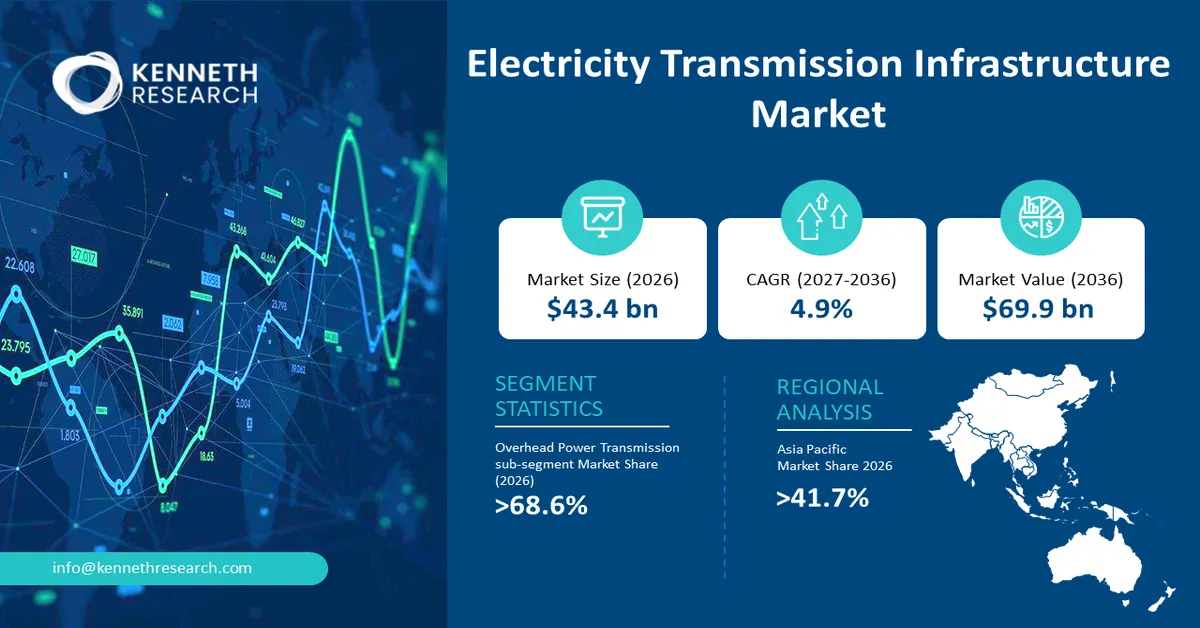
Electricity Transmission Infrastructure Market size was valued at USD 43.4 billion in 2026 and is projected to reach USD 69.9 billion by the end of 2036, expanding at a CAGR of 4.9% during the forecast period, i.e., 2027-2036. In 2027, the industry size of the electricity transmission infrastructure is estimated at USD 45.4 billion.
Electricity transmission infrastructure market growth is primarily driven by the accelerating integration of renewable generation into power systems.
Electricity transmission infrastructure market comprises the equipment, systems, facilities, and engineering services used to transport bulk electricity from generating facilities to substations and major distribution networks over high-voltage transmission systems. The market encompasses overhead and underground transmission lines, towers and conductors, substations, transformers, switchgear, protection and control equipment, high-voltage direct-current systems, and associated grid-monitoring and automation technologies.
A defining characteristic of the market is its role in maintaining reliable, efficient, and controllable long-distance electricity transfer. Transmission assets must accommodate changing power flows, integrate variable renewable generation, support interregional electricity exchange, and strengthen system resilience. Modernization increasingly involves higher-capacity conductors, advanced transformers, digital monitoring, and technologies that improve network utilization.
Key Electricity Transmission Infrastructure Market Insights Summary:
Key Takeaways: Market Trends & Insights
- The electricity transmission infrastructure market is valued at USD 43.4 billion in 2026 and is projected to reach USD 69.9 billion by 2036
- The electricity transmission infrastructure market is expected to expand at a CAGR of 4.9% during 2027-2036
- Overhead Power Transmission leads the Transmission Line Type segment with a 68.6% market share in 2026
- Asia Pacific dominates the electricity transmission infrastructure market with a 41.7% market share in 2026
- Transformers including Power and Distribution represent the second and fastest analysis segment within the Product Type category
Market Drivers
- Renewable Energy Integration
- Electrification and Rising Electricity Demand
- Grid Modernization and Digitalization
- Transmission Resilience and Reliability Investments
Challenges
- Lengthy Permitting, Land Acquisition, and Project Approvals
- High Capital Intensity and Supply-Chain Complexity
Electricity Transmission Infrastructure Market Overview & Supply Chain
Adoption of energy efficient glass is increasing globally as building owners, developers, and policymakers place greater emphasis on reducing building energy demand, improving occupant comfort, and upgrading the performance of existing building envelopes. High-performance glazing supports these objectives by controlling heat transfer, solar heat gain, and daylight while maintaining the functional and architectural benefits of glass. Regulatory efficiency requirements and building-retrofit initiatives are also strengthening the relevance of advanced glazing in both new construction and renovation projects.
The electricity transmission infrastructure market value chain begins with raw-material and component suppliers that provide aluminium and copper conductors, electrical steel, insulation materials, structural steel, cables, and other specialised inputs. Manufacturers convert these materials into transmission towers, conductors, transformers, substations, switchgear, protection systems, monitoring equipment, and related technologies. Engineering, procurement, and construction companies then integrate these components into transmission projects through route planning, civil works, installation, testing, and commissioning. Distribution is primarily conducted through utility procurement programmes, competitive tenders, framework agreements, and direct contracts with transmission developers and system operators. End users include transmission utilities, grid operators, electricity providers, renewable-energy developers, industrial consumers, and government-backed infrastructure programmes.
Electricity Transmission Infrastructure Market: Growth Drivers & Challenges
Growth Drivers:
- Expansion of renewable power and grid connectivity: The accelerating deployment of renewable electricity generation is a major growth driver for the electricity transmission infrastructure market because new generation assets are frequently located far from established demand centres. Transmission networks are therefore required to move electricity across longer distances, connect renewable projects to load centres, improve interregional power exchange, and reduce constraints that can delay generation projects.
- Electrification and increasing grid reliability requirements: Growing electricity consumption across transportation, buildings, industry, data infrastructure, and other applications is increasing pressure on existing transmission networks. Electrification changes both the volume and geographic distribution of electricity demand, requiring utilities and system operators to reinforce networks, improve capacity utilization, and develop new transmission corridors. At the same time, aging infrastructure, extreme-weather exposure, congestion, and increasingly complex power flows are encouraging investment in resilient and digitally enabled networks.
Challenges:
- Lengthy permitting, land acquisition, and project approvals: A major restraint for the electricity transmission infrastructure market is the prolonged process of obtaining permits, securing rights-of-way, completing environmental assessments, and negotiating land access. Transmission projects often cross multiple jurisdictions and involve residential communities, agricultural areas, protected environments, and other infrastructure corridors, creating complex approval requirements. The root cause is the need to balance grid expansion with environmental protection, community interests, land-use policies, and regulatory oversight.
- High capital intensity and supply-chain complexity: High upfront investment requirements and complex procurement structures can constrain expansion of the electricity transmission infrastructure market, particularly for projects involving long-distance lines, substations, advanced transformers, and specialised grid equipment. The root cause is the engineering complexity of transmission assets and the need to coordinate multiple components, contractors, technical standards, and regulatory requirements within a single project.
Electricity Transmission Infrastructure Market Size and Forecast:
| Report Attribute | Details |
|---|---|
| Base Year |
2026 |
| Forecast Period |
2027-2036 |
| CAGR |
4.9% |
| Base Year Market Size (2026) |
USD 43.4 billion |
| Forecast Year Market Size (2036) |
USD 69.9 billion |
| Regional Scope |
|
Electricity Transmission Infrastructure Market Segmentation Analysis:
Transmission Line Type Segment Analysis
In the transmission line type segment, overhead power transmission sub-segment is anticipated to capture the largest market share of 68.6% by the end of 2026.
Overhead power transmission dominates the electricity transmission infrastructure market because it provides a practical solution for moving high-voltage electricity across long distances while supporting large-scale grid expansion. Its adoption is reinforced by renewable-energy development, increasing electricity demand, interregional power transfers, and the need to connect generation resources located away from major consumption centres. From the supply side, established manufacturing capabilities for towers, conductors, insulators, and related equipment support comparatively standardized project execution and facilitate large-scale network deployment. Utilities and transmission operators also benefit from established maintenance practices and proven operating architectures, reinforcing continued preference for overhead configurations where land and permitting conditions allow. The U.S. Department of Energy states that it plans to expand long-distance transmission capacity by 16% by 2030, including building 7,500 miles of new transmission lines, underscoring continuing infrastructure requirements.
Product Type Segment Analysis
The transformers including power and distribution is projected to grow as the second-largest segment in the electricity transmission infrastructure market due to four converging demand drivers.
Transformers including power and distribution are projected to grow as grid expansion, renewable-energy integration, electrification, data-centre development, and replacement of aging equipment increase requirements for voltage transformation across transmission and distribution networks. Their critical role in stepping voltage up for efficient long-distance transmission and down for end-user delivery makes transformers indispensable to both new infrastructure and grid modernization. Adoption is also being reinforced by utilities replacing aging assets while accommodating changing load profiles and distributed generation. The U.S. Department of Energy reported in 2024 that about 55% of in-service distribution transformers are older than 33 years, indicating a substantial installed base approaching advanced age and supporting replacement demand. Manufacturers are responding through capacity expansion, efficiency improvements, and development of equipment suited to evolving grid requirements.
Our in-depth analysis of the Electricity Transmission Infrastructure market includes the following segments:
|
Segment |
Sub-segment |
|
Product Type |
|
|
Transmission Line Type |
|
|
Technology |
|
|
Application |
|
Electricity Transmission Infrastructure Market Regional Insights:
Asia Pacific Market Trends & Insights:
Asia Pacific electricity transmission infrastructure market is projected to hold the largest revenue share of 41.7% by the end of 2026.
It is supported by extensive electricity-system expansion, rapid renewable-energy deployment, industrialization, and large-scale investment in transmission networks. The region combines substantial electricity consumption with geographically dispersed generation resources, creating sustained requirements for high-voltage lines, substations, transformers, and interregional transmission infrastructure.
China remains the region’s principal transmission-infrastructure market, supported by large-scale renewable deployment, extensive interregional power transfers, and continued development of high-voltage transmission networks.
India is likewise strengthening its transmission backbone to accommodate rising electricity demand and renewable generation. Both countries are expected to remain key contributors to regional demand as transmission planning increasingly prioritizes renewable-energy evacuation, system resilience, and long-distance power transfer.
North America Market Trends & Insights:
North America represents an important market for transmission infrastructure as utilities address rising electricity demand, aging grid assets, renewable-energy integration, industrial reshoring, and the growing electricity requirements of data centres. In the United States, federal policy is increasingly focused on expanding interregional transmission, improving grid resilience, and accelerating permitting and project development.
The United States remains the principal demand centre, supported by large-scale transmission modernization, increasing industrial electricity requirements, renewable-resource integration, and federal programmes designed to facilitate new infrastructure.
Canada is strengthening its transmission ecosystem through investments that support cleaner electricity, electrification, and greater grid flexibility. Its policy direction also emphasizes interregional transmission development and cooperation between federal and provincial authorities. Together, the two countries provide a broad opportunity base for transmission equipment manufacturers, engineering companies, utilities, and infrastructure investors.
Leading Companies Operating in the Electricity Transmission Infrastructure Market:
Here is a list of upstream, downstream, and key players operating in electricity transmission infrastructure market competitive ecosystem:
- National Grid plc (United Kingdom)
- Company Overview
- Business Strategy
- Key Product Offerings
- Financial Performance
- Key Performance Indicators
- Risk Analysis
- Recent Development
- Regional Presence
- SWOT Analysis
- LS Electric (South Korea)
- Hitachi Energy (Switzerland)
- TBEA Co., Ltd. (China)
- Fuji Electric (Japan)
Recent Developments
- In September 2026, National Grid plc published refined proposals for the Weston Marsh to East Leicestershire electricity upgrade project in the UK. The project would include approximately 60 km of new overhead line between Weston Marsh in Lincolnshire and near Wartnaby in Leicestershire, two new substations, and around 66 km of upgrades to existing overhead line network. An eight-week consultation ran from 8 September to 3 November 2026, with feedback to inform National Grid's application for a Development Consent Order. The project forms part of The Great Grid Upgrade, the largest overhaul of the grid in a generation.
- In May 2026, Hitachi Energy signed a Memorandum of Understanding with Volvo Construction Equipment to collaborate on developing end-to-end approaches for zero-emission construction sites. The collaboration focuses on system-level requirements including power supply, charging solutions, energy management, and operational integration. This partnership supports the deployment of electric construction equipment enabled by clean power supply and energy management systems.
Frequently Asked Question
In 2026, the electricity transmission infrastructure market exceeded USD 43.4 billion.
The electricity transmission infrastructure market is projected to reach USD 69.9 billion by the end of 2036, expanding at a CAGR of 4.9% over the forecast period (2027-2036).
The major players in the market are National Grid plc (United Kingdom), LS Electric (South Korea), Hitachi Energy (Switzerland), TBEA Co., Ltd. (China), Fuji Electric (Japan), and others.
In the Transmission Line Type segment, the Overhead Power Transmission sub-segment is anticipated to capture the largest market share of 68.6% in the future and exhibit lucrative growth opportunities during 2027-2036. This growth trajectory is largely attributed to increasing renewable energy integration and the need to connect geographically dispersed generation resources with major consumption centres.
Asia Pacific is projected to hold the largest market share of 41.7% by the end of 2026 and provide more business opportunities in the future. Continuous investments in transmission networks, renewable-energy integration, and grid expansion in China and India are fostering the region's dominance.
Why Choose Kenneth Research ?
-
Insight with Impact : We don’t just gather data — we uncover stories, trends, and opportunities that fuel business growth.
-
Experts Who Get It : Our team speaks your industry’s language and knows what really matters to your customers and market.
-
Custom-Built for You : Forget one-size-fits-all. We craft research and consulting solutions as unique as your business vision.
-
Partners, Not Just Providers : We work with you, not for you — collaborating closely to turn insights into smart, strategic moves.
-
Results That Speak : Our work powers brands, startups, and industry leaders alike — with a track record of ideas that work in the real world.
Report ID: 1394 |
Published Date: 25 Sep 2026 |
Report Format: |
Delivery Timeline: 48-72 Business Hours

Copyright © 2025 Kenneth Research. All rights reserved. Terms of Use | Privacy Policy
