Report ID: 1327 |
Published Date: 09 Sep 2026 |
Report Format: |
Delivery Timeline: 48-72 Business Hours
Electric Vehicle Battery Market Outlook:
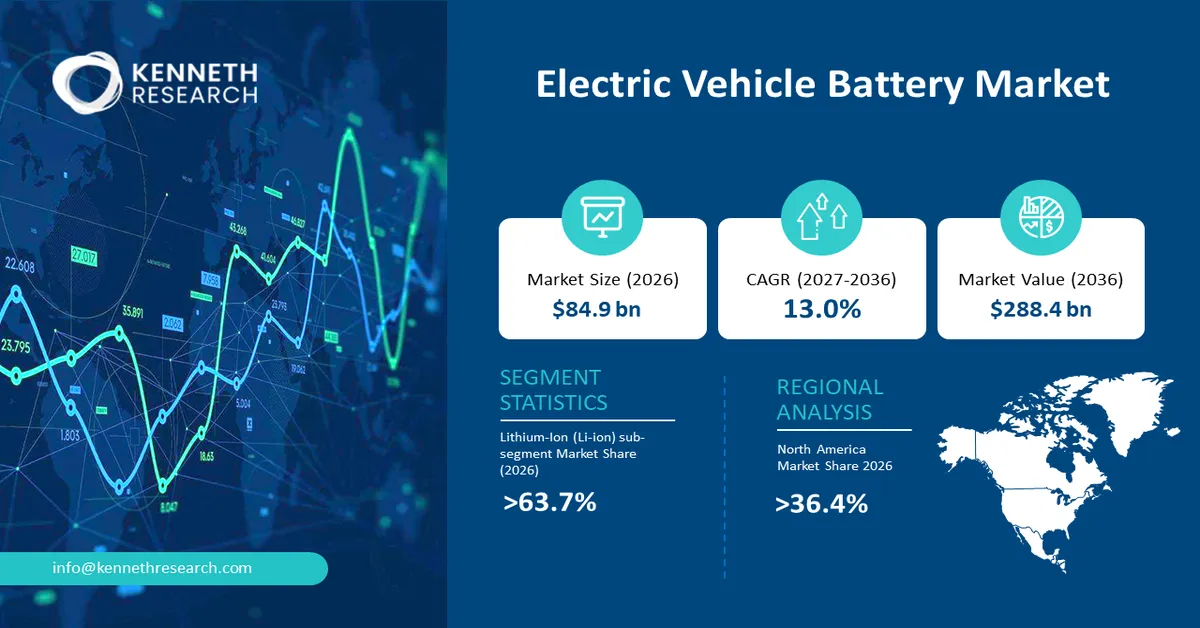
Electric Vehicle Battery Market size was valued at USD 84.9 billion in 2026 and is projected to reach USD 288.4 billion by the end of 2036, rising at a CAGR of 13.0% during the forecast period, i.e., 2027-2036. In 2027, the industry size of the global electric vehicle battery is estimated at USD 96.0 billion.
The primary growth driver is accelerating electric vehicle adoption, which directly increases demand for traction batteries. The International Energy Agency reports that global electric vehicle battery demand exceeded 750 GWh in 2023, rising 40% from 2022, with electric cars responsible for 95% of this growth.
electric vehicle battery market refers to the industry encompassing batteries designed, manufactured, integrated, supplied, and deployed to store and deliver electrical energy for electric vehicles. These batteries serve as the primary onboard energy-storage system for battery electric vehicles and support propulsion in other electrified vehicle configurations.
The market is characterized by rechargeable battery technologies, cell and module manufacturing, battery-pack integration, thermal management, electronic controls, safety systems, and chemistry-specific performance characteristics. Battery chemistry influences energy density, power delivery, charging behaviour, durability, safety, material requirements, and overall vehicle economics. Manufacturers therefore compete across technology development, production efficiency, lifecycle performance, and supply-chain resilience.
Key Electric Vehicle Battery Market Insights Summary:
Key Takeaways: Market Trends & Insights
- EV battery deployment reached 1.2 TWh in 2025, highlighting continued expansion in electric mobility
- Electric vehicle battery market is valued at USD 84.9 billion in 2026 and is projected to reach USD 288.4 billion by 2036, reflecting a 13.0% CAGR from 2027 to 2036
- Lithium-Ion (Li-ion) is the leading battery chemistry segment, holding a 63.7% share in 2026, supported by established manufacturing capabilities and broad automotive adoption
- Passenger Cars represent the fastest-growing vehicle-type segment as automakers expand electric model portfolios and consumers increasingly adopt electrified mobility
- North America leads the market with a 36.4% share in 2026, supported by battery manufacturing investment and expanding electric vehicle supply chains across the United States and Canada
Market Drivers
- Domestic battery manufacturing and supply-chain localization
- Advancements in battery technology and manufacturing efficiency
- Expansion of electric vehicle adoption across passenger and commercial transportation
- Government policies supporting vehicle electrification and battery supply-chain development
Challenges
- Critical-mineral supply concentration
- Recycling economics and end-of-life management
Electric Vehicle Battery Market Overview & Supply Chain
Electric vehicle adoption is increasing globally as automakers expand electrified model portfolios, governments strengthen decarbonization policies, and battery technology improves vehicle economics and usability. The transition is also becoming increasingly relevant to energy and manufacturing systems because batteries connect automotive production with electricity demand, critical-mineral processing, advanced materials, electronics, and charging infrastructure.
The electric vehicle battery market value chain begins with extraction and processing of lithium, nickel, cobalt, graphite, manganese, and other battery-related materials, alongside production of active materials, electrolytes, separators, current collectors, and other inputs. Battery manufacturers then convert these materials into cells through electrode preparation, assembly, formation, and testing, followed by module and pack integration with thermal-management, battery-management, safety, and electronic-control systems. Distribution involves transportation of cells, modules, and finished packs to automakers and vehicle assembly facilities, with logistics requirements shaped by hazardous-material handling and supply-chain localization. End users include passenger-vehicle owners, commercial fleets, public-transport operators, and other electric-mobility users.
Electric Vehicle Battery Market: Growth Drivers & Challenges
Growth Drivers:
- Domestic battery manufacturing and supply-chain localization: Government-backed investment in domestic battery manufacturing is strengthening the supply base and encouraging localization across the electric vehicle battery industry. Over the longer term, continued government support for domestic production is likely to encourage investment in cell manufacturing, battery components, advanced materials, and manufacturing equipment, strengthening regional battery ecosystems and creating opportunities for technology providers and industrial suppliers.
- Advancements in battery technology and manufacturing efficiency: Continuous improvements in battery chemistry, cell architecture, thermal management, charging performance, energy density, safety, and manufacturing processes are supporting the expansion of the electric vehicle battery industry. Battery technology directly influences vehicle range, charging convenience, weight, durability, operating economics, and overall vehicle performance, making technological advancement a critical competitive factor for automakers and battery suppliers.
Challenges:
- Critical-mineral supply concentration: The electric vehicle battery industry remains exposed to concentrated upstream supply chains for lithium, nickel, cobalt, graphite, and other critical materials. The root cause is the uneven geographic distribution of mineral resources, refining capacity, and processing infrastructure, combined with lengthy development timelines for new mining and refining projects. This concentration can increase procurement risk for battery manufacturers and create exposure to geopolitical disruptions, trade restrictions, logistics interruptions, and changes in commodity economics.
- Recycling economics and end-of-life management: Battery recycling faces structural challenges because collection networks, processing infrastructure, traceability systems, and commercially viable recycling models are still developing across many markets. The economic difficulty is particularly pronounced where battery chemistries contain fewer high-value recoverable materials or where transportation and dismantling requirements raise processing costs.
Electric Vehicle Battery Market Size and Forecast:
| Report Attribute | Details |
|---|---|
| Base Year |
2026 |
| Forecast Period |
2027-2036 |
| CAGR |
13.0% |
| Base Year Market Size (2026) |
USD 84.9 billion |
| Forecast Year Market Size (2036) |
USD 288.4 billion |
| Regional Scope |
|
Electric Vehicle Battery Market Segmentation Analysis:
Battery Type & Chemistry Segment Analysis
In the battery type & chemistry segment, Lithium-Ion (Li-ion) sub-segment is anticipated to capture the largest market share of 63.7% by the end of 2026.
Lithium-ion (Li-ion) batteries dominate the electric vehicle battery market because they provide a strong combination of energy density, power capability, cycle life, charging performance, and manufacturing maturity. Their established ecosystem of cell producers, materials suppliers, equipment manufacturers, automakers, and recycling companies creates substantial supply-side advantages and supports continued integration into electric vehicle platforms. Demand is reinforced by the expansion of battery-electric and plug-in hybrid vehicles, while ongoing improvements in cell design, electrode materials, thermal management, and manufacturing processes continue to enhance performance. Government-backed research also confirms the technology’s established position: the European Commission’s Joint Research Centre reports that Li-ion batteries dominate the mobility sector, with NMC chemistry alone used in around half of electric vehicles sold in 2023.
Vehicle Type Segment Analysis
The passenger cars sector is projected to grow as the second-largest segment in the electric vehicle battery market due to four converging demand drivers.
Passenger cars are projected to remain a high-growth sub-segment because electrification is moving beyond early adopters and becoming increasingly embedded in mainstream automotive purchasing. Demand is supported by expanding electric-model availability, improving affordability, tighter emissions policies, and consumer interest in lower operating costs. The International Energy Agency reports that electric car sales reached more than 20 million globally in 2025, confirming continued expansion of electrified passenger mobility. Automakers are responding by expanding dedicated electric platforms, broadening model portfolios, and integrating increasingly capable battery systems across compact cars, sedans, crossovers, and SUVs.
Our in-depth analysis of the electric vehicle battery market includes the following segments:
|
Segment |
Sub-segment |
|
Battery Type & Chemistry |
|
|
Vehicle Type |
|
|
Material Type |
|
|
Propulsion |
|
|
Battery Capacity |
|
|
Battery Form |
|
Electric Vehicle Battery Market Regional Insights:
North America Market Trends & Insights:
North America electric vehicle battery market is projected to hold the largest revenue share of 36.4% by the end of 2026.
It is supported by expanding battery manufacturing, established automotive capabilities, critical-mineral resources, and substantial public and private investment. The United States is strengthening domestic battery production through industrial incentives, supply-chain policies, and closer integration between cell manufacturing and vehicle assembly.
Within North America, the United States represents the principal manufacturing and consumption center, supported by major automakers, battery producers, federal incentives, and growing integration between vehicle assembly and battery production.
Canada complements this ecosystem through its critical-mineral resources, clean electricity advantages, battery-material processing capabilities, and expanding manufacturing base. Government policy is encouraging development across mining, processing, battery production, vehicle assembly, and recycling, strengthening cross-border supply-chain integration. Canada’s federal government has also introduced targeted incentives for EV assembly, battery production, and cathode active materials, reinforcing its role within the broader North American battery ecosystem.
Asia Pacific Market Trends & Insights:
Asia Pacific is a major strategic hub for the electric vehicle battery industry, supported by strong electric-mobility demand, extensive battery manufacturing capabilities, established electronics and automotive supply chains, and substantial investment in localized production. China remains the region's principal industrial powerhouse, with extensive capabilities spanning upstream materials, cathode and anode production, cells, battery packs, and electric vehicles. Its integrated supply chain supports cost competitiveness and rapid manufacturing scale-up, while domestic automakers and battery producers continue expanding electrification applications.
Japan has a more technology-oriented position, leveraging expertise in automotive engineering, battery materials, manufacturing equipment, and advanced cell development. Government policy is emphasizing investment in innovative battery technologies, including support for the commercialization of all-solid-state batteries.
Leading Companies Operating in the Global Electric Vehicle Battery Market:
Here is a list of upstream, downstream, and key players operating in electric vehicle battery market competitive ecosystem:
- CATL (Contemporary Amperex Technology Co. Ltd.) (China)
- Company Overview
- Business Strategy
- Key Product Offerings
- Financial Performance
- Key Performance Indicators
- Risk Analysis
- Recent Development
- Regional Presence
- SWOT Analysis
- CALB Co., Ltd. (China)
- Gotion High-tech Co., Ltd. (China)
- Eve Energy Co., Ltd. (China)
Recent Developments
- In June 2026, Eve Energy announced plans to launch its all-solid-state batteries in 2026, positioning itself to compete in the next-generation battery technology race. This follows the company's release of the Omnicell cylindrical battery, demonstrating Eve Energy's multi-track strategy across both fast-charging liquid electrolyte and solid-state technologies.
Frequently Asked Question
In 2026, the electric vehicle battery market exceeded USD 84.9 billion.
The electric vehicle battery market is projected to reach USD 288.4 billion by the end of 2036, expanding at a CAGR of 13.0% over the forecast period (2027-2036).
The major players in the market are CATL (Contemporary Amperex Technology Co. Ltd.), CALB Co., Ltd., Gotion High-tech Co., Ltd., Eve Energy Co., Ltd., and others.
In the Battery Type & Chemistry segment, the Lithium-Ion (Li-ion) sub-segment is anticipated to capture the largest market share of 63.7% in the future and exhibit lucrative growth opportunities during 2027-2036. This growth trajectory is largely attributed to continued advancements in battery technology and manufacturing efficiency.
North America is projected to hold the largest market share of 36.4% by the end of 2026 and provide more business opportunities in the future. Continuous investments in battery manufacturing, critical-mineral supply chains, and electric vehicle production in the United States and Canada are fostering the region's dominance.
Why Choose Kenneth Research ?
-
Insight with Impact : We don’t just gather data — we uncover stories, trends, and opportunities that fuel business growth.
-
Experts Who Get It : Our team speaks your industry’s language and knows what really matters to your customers and market.
-
Custom-Built for You : Forget one-size-fits-all. We craft research and consulting solutions as unique as your business vision.
-
Partners, Not Just Providers : We work with you, not for you — collaborating closely to turn insights into smart, strategic moves.
-
Results That Speak : Our work powers brands, startups, and industry leaders alike — with a track record of ideas that work in the real world.
Report ID: 1327 |
Published Date: 09 Sep 2026 |
Report Format: |
Delivery Timeline: 48-72 Business Hours

Copyright © 2025 Kenneth Research. All rights reserved. Terms of Use | Privacy Policy
