Report ID: 1371 |
Published Date: 15 Sep 2026 |
Report Format: |
Delivery Timeline: 48-72 Business Hours
Electric Commercial Vehicle Traction Motor Market Outlook:
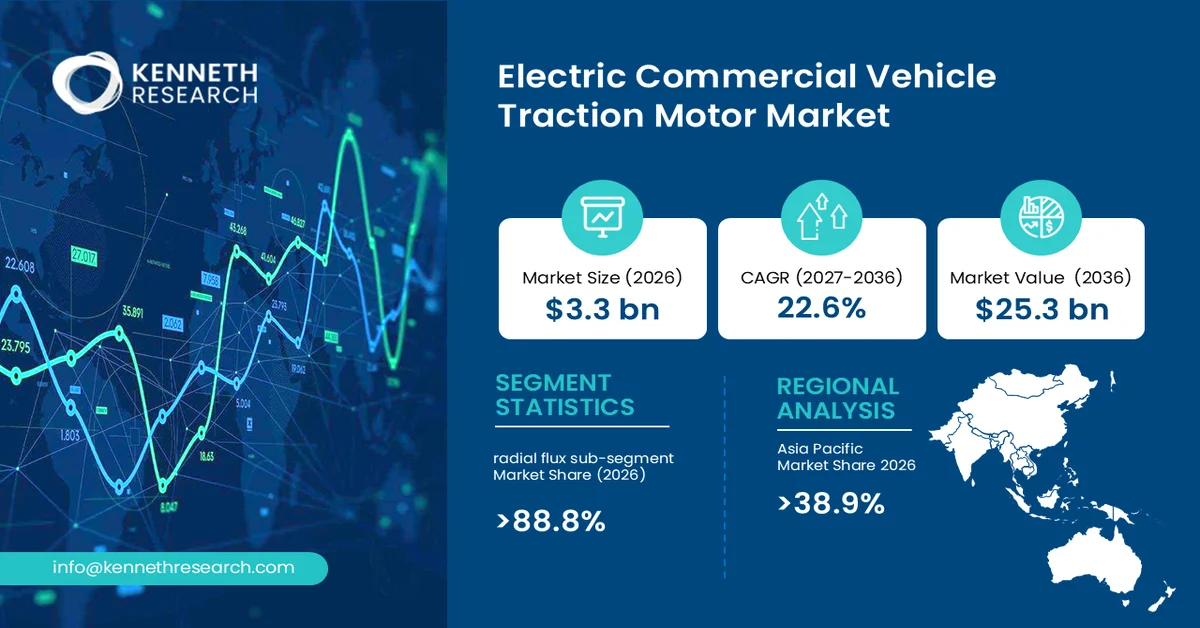
Electric Commercial Vehicle Traction Motor Market size was valued at USD 3.3 billion in 2026 and is projected to reach USD 25.3 billion by the end of 2036, rising at a CAGR of 22.6% during the forecast period, i.e., 2027–2036. In 2027, the industry size of the electric commercial vehicle traction motor market is estimated at USD 4.0 billion.
The primary growth driver is the accelerating electrification of commercial road transport, supported by increasingly stringent emissions policies and government-backed zero-emission vehicle initiatives. Rising deployment of electric trucks and buses is consequently increasing OEM demand for efficient, high-performance traction motors and integrated electric powertrain technologies.
The electric commercial vehicle traction motor market comprises motors engineered to convert electrical energy from a vehicle’s battery or other onboard electrical power source into mechanical torque that propels commercial vehicles. These motors form a core component of electric powertrains used in applications such as electric buses, delivery vehicles, medium-duty trucks, heavy-duty trucks, and other commercial transportation platforms.
Key characteristics include high torque output, energy efficiency, compact packaging, thermal-management capability, durability, and the ability to operate reliably across demanding commercial duty cycles. Motor architectures can vary according to vehicle requirements, powertrain configuration, operating conditions, and drivetrain design. Common engineering considerations include electromagnetic performance, cooling, power density, control integration, and compatibility with associated power-electronics systems.
Key Electric Commercial Vehicle Traction Motor Market Insights Summary:
Key Takeaways: Market Trends & Insights
- Electric commercial vehicle traction motor market was valued at USD 3.3 Billion in 2026 and is projected to reach USD 25.3 Billion by 2036, reflecting a CAGR of 22.6% during 2027–2036
- Radial Flux dominated the Design segment with an 88.8% market share in 2026, supported by established manufacturing processes, reliability, and compatibility with commercial electric powertrains
- Single Speed Drive is identified as the second/fastest analysis segment within the Transmission category, benefiting from simpler drivetrain architecture and efficient integration with electric traction systems
- Asia Pacific led regional demand with a 38.9% market share in 2026, supported by strong electric-vehicle manufacturing ecosystems and electrification activity across China and Japan
Market Drivers
- Fleet total-cost-of-ownership optimization
- Expansion of charging and electric commercial-vehicle infrastructure
- Policy-driven deployment of zero-emission commercial fleets
- Advancement of integrated electric powertrain architectures
Challenges
- Rare-Earth Material and Component Supply Vulnerability
- High Engineering and Validation Complexity for Commercial Duty Cycles
Electric Commercial Vehicle Traction Motor Market Overview & Supply Chain
Adoption of electric commercial vehicles is increasing globally as fleet operators, manufacturers, and policymakers pursue lower-emission transportation, improved energy efficiency, and reduced dependence on conventional fuels. Electrification is also accelerating through advances in batteries, charging infrastructure, power electronics, and electric-drive systems, making traction motors increasingly important to commercial vehicle performance and operating economics. Regulatory pressure on road-transport emissions further reinforces investment in electric buses and trucks, while government incentives and zero-emission procurement programs support fleet transition.
The electric commercial vehicle traction motor value chain begins with raw-material and component inputs, including electrical steel, copper, permanent-magnet materials, aluminum, bearings, insulation systems, and semiconductor-enabled control components. Material suppliers and specialized component manufacturers feed motor producers, who undertake electromagnetic design, machining, winding, magnet assembly, rotor and stator production, balancing, thermal-management integration, and end-of-line testing. Traction motor manufacturers then supply complete powertrain systems or motor assemblies to commercial vehicle OEMs and system integrators. Distribution channels include direct OEM relationships, tiered automotive suppliers, specialized drivetrain integrators, and aftermarket channels. End users comprise fleet operators, logistics companies, public-transport agencies, municipalities, and commercial vehicle owners.
Electric Commercial Vehicle Traction Motor Market - Growth Drivers & Challenges
Growth Drivers
- Accelerating Electrification of Medium- and Heavy-Duty Fleets: The transition from internal-combustion commercial fleets toward electric powertrains is directly expanding the addressable requirement for traction motors. Fleet electrification increases demand for motors that combine high torque, energy efficiency, thermal robustness, and dependable operation under frequent stop-start and high-load conditions. The effect extends across buses, delivery vehicles, regional-haul trucks, and other commercial platforms, encouraging OEMs and drivetrain suppliers to optimize motor architecture, control systems, cooling, and power density.
- Advances in High-Efficiency Electric Powertrain Technology: Continuous improvements in electric-drive engineering are strengthening the role of traction motors within commercial vehicle platforms. Manufacturers are pursuing greater power density, improved thermal management, optimized electromagnetic designs, compact packaging, and more sophisticated motor-control strategies to satisfy demanding duty cycles.
Challenges
- Rare-Earth Material and Component Supply Vulnerability: A major restraint is the dependence of high-performance traction-motor designs on specialized permanent-magnet materials whose processing and manufacturing supply chains are geographically concentrated. Disruptions in mining, refining, magnet production, trade policy, or cross-border logistics can therefore affect motor component availability and procurement continuity. For commercial vehicle OEMs and Tier-1 suppliers, this creates risks around production scheduling, qualification of alternative materials, inventory planning, and technology selection.
- High Engineering and Validation Complexity for Commercial Duty Cycles: Traction motors for commercial vehicles face demanding requirements that make development and qualification more complex than those of many lower-duty electric applications. Motors must consistently manage high torque, repeated acceleration, payload variation, thermal stress, vibration, environmental exposure, and extended operating cycles while maintaining efficiency and reliability.
Electric Commercial Vehicle Traction Motor Market Size and Forecast:
| Report Attribute | Details |
|---|---|
| Base Year |
2026 |
| Forecast Year |
2027-2036 |
| CAGR |
22.6% |
| Base Year Market Size (2026) |
USD 3.3 billion |
| Forecast Year Market Size (2036) |
USD 25.3 billion |
| Regional Scope |
|
Electric Commercial Vehicle Traction Motor Market - Segment Analysis
Design Segment Analysis
In the design segment, radial flux sub-segment is anticipated to capture the largest market share of 88.8% by the end of 2026.
Radial flux motors dominate the design landscape because their established architecture offers a practical balance of torque generation, efficiency, manufacturability, and packaging for commercial electric vehicles. Their mature production ecosystem allows manufacturers to leverage established stator, rotor, winding, and cooling processes, reducing integration complexity and supporting scalable OEM programs. Demand is reinforced by the expanding deployment of electric trucks and buses, where traction systems must deliver dependable performance under variable loads and frequent operating cycles. The International Energy Agency reported that electric trucks represented 9% of global truck sales in 2025, demonstrating continued expansion of the vehicle platforms that require traction motors.
Transmission Segment Insights
The single speed drive is projected to grow as the second-largest segment in the electric commercial vehicle traction motor market due to four converging demand drivers.
Single speed drive is projected to grow as commercial EV powertrains increasingly capitalize on the broad operating characteristics of electric traction motors, which can deliver strong low-speed torque without the multi-gear shifting requirements of conventional drivetrains. This architecture can simplify transmission construction, reduce mechanical complexity, lower maintenance requirements, and support compact powertrain integration. Its suitability is particularly relevant to urban delivery, bus, and regional commercial applications where predictable routes and repeated acceleration favor straightforward propulsion systems. The expanding range of electric commercial vehicle offerings is strengthening supplier opportunities for standardized single-speed transmission assemblies and integrated e-axle solutions. The IEA reports that the number of battery-electric heavy-duty vehicle models available globally reached almost 800 in 2024, indicating broader OEM adoption and increasing diversity of electric commercial platforms.
Our in-depth analysis of the electric commercial vehicle traction motor market includes the following segments:
|
Segment |
Sub-segment |
|
Vehicle Type |
|
|
Power Output |
|
|
Motor Type |
|
|
Design |
|
|
Transmission |
|
Electric Commercial Vehicle Traction Motor Market - Regional Analysis
Asia Pacific Market Trends & Insights:
Asia Pacific electric commercial vehicle traction motor market is projected to hold the largest revenue share of 38.9% by the end of 2026.
It is supported by extensive electric-vehicle manufacturing ecosystems, large commercial-vehicle fleets, expanding battery and power-electronics supply chains, and active government support for transport electrification.
China is the principal country-level contributor, supported by its integrated EV manufacturing base, commercial-vehicle production capabilities, battery ecosystem, and policy-led electrification.
Japan represents another important market, supported by established automotive manufacturers, engineering expertise, and ongoing development of electrified commercial transportation technologies. Together, China and Japan provide complementary strengths across high-volume manufacturing, component supply, vehicle engineering, and technology development, reinforcing Asia Pacific's regional leadership and supporting continued investment in electric traction systems.
North America Market Trends & Insights:
North America represents an important growth opportunity for electric commercial vehicle traction motors, supported by increasing fleet decarbonization efforts, expanding zero-emission freight initiatives, and investment in charging infrastructure.
The United States is the leading country-level contributor within North America, benefiting from a large freight transportation ecosystem, established vehicle manufacturing capabilities, technology development, and federal investment in clean heavy-duty transportation. The U.S. Environmental Protection Agency has also introduced funding mechanisms supporting zero-emission heavy-duty vehicles, associated infrastructure, and workforce development, reinforcing opportunities across the supply chain.
Canada complements this market through targeted zero-emission trucking programs, commercial-vehicle testing, regulatory modernization, and deployment projects. Its Zero-Emission Trucking Program brings together governments, industry, and research stakeholders to evaluate heavy-duty zero-emission vehicles under Canadian operating conditions.
Electric Commercial Vehicle Traction Motor Market Competitive Landscape
Here is a list of upstream, downstream, and key players operating in electric commercial vehicle traction motor market competitive ecosystem:
- Magna International Inc. (Canada)
- Company Overview
- Business Strategy
- Key Product Offerings
- Financial Performance
- Key Performance Indicators
- Risk Analysis
- Recent Development
- Regional Presence
- SWOT Analysis
- Nidec Corporation (Japan)
- ZF Friedrichshafen AG (Germany)
- Valeo SA (France)
Recent Developments
- In July 2026, Magna International secured an 800-volt electric drive program award with Chery in China, to be produced at its new Wuhu facility. The 250kW 800V 2-speed eDrive system is built on Magna's modular electrification portfolio and designed for high performance and scalability across battery electric vehicle applications. This follows the start of production of Magna's DHD Duo dedicated hybrid drive system with Chery on the Jetour G700, highlighting Magna's ability to industrialize complex high-voltage propulsion systems at scale.
- In May 2026, ZF Friedrichshafen presented its comprehensive commercial vehicle electrification portfolio at Transpotec Logitec in Milan, including the TraXon 2 Hybrid and CeTrax 2 dual. The TraXon 2 Hybrid module enables CO₂ reductions of up to 47% in long-haul transport and 73% in distribution transport, according to VECTO simulations. The CeTrax 2 dual central drive supports zero-emission long-distance operation, while the A134 driven axle meets higher torque demands of hybrid and electric drivetrains.
Frequently Asked Question
In 2026, the electric commercial vehicle traction motor market exceeded USD 3.3 billion.
The electric commercial vehicle traction motor market is projected to reach USD 25.3 billion by the end of 2036, expanding at a CAGR of 22.6% over the forecast period (2027-2036).
The major players in the market are Magna International Inc. (Canada), Nidec Corporation (Japan), ZF Friedrichshafen AG (Germany), Valeo SA (France), and others.
In the Design segment, the Radial Flux sub-segment is anticipated to capture the largest market share of 88.8% in the future and exhibit lucrative growth opportunities during 2027-2036. This growth trajectory is largely attributed to its established manufacturing ecosystem and suitability for efficient, high-torque commercial vehicle applications.
Asia Pacific is projected to hold the largest market share of 38.9% by the end of 2026 and provide more business opportunities in the future. Strong electric-vehicle manufacturing capabilities and continued electrification investments in China and Japan are fostering the region's dominance.
Why Choose Kenneth Research ?
-
Insight with Impact : We don’t just gather data — we uncover stories, trends, and opportunities that fuel business growth.
-
Experts Who Get It : Our team speaks your industry’s language and knows what really matters to your customers and market.
-
Custom-Built for You : Forget one-size-fits-all. We craft research and consulting solutions as unique as your business vision.
-
Partners, Not Just Providers : We work with you, not for you — collaborating closely to turn insights into smart, strategic moves.
-
Results That Speak : Our work powers brands, startups, and industry leaders alike — with a track record of ideas that work in the real world.
Report ID: 1371 |
Published Date: 15 Sep 2026 |
Report Format: |
Delivery Timeline: 48-72 Business Hours

Copyright © 2025 Kenneth Research. All rights reserved. Terms of Use | Privacy Policy
