Report ID: 1120 |
Published Date: 20 Aug 2026 |
Report Format: |
Delivery Timeline: 48-72 Business Hours
Elastomeric Coating Market Outlook:
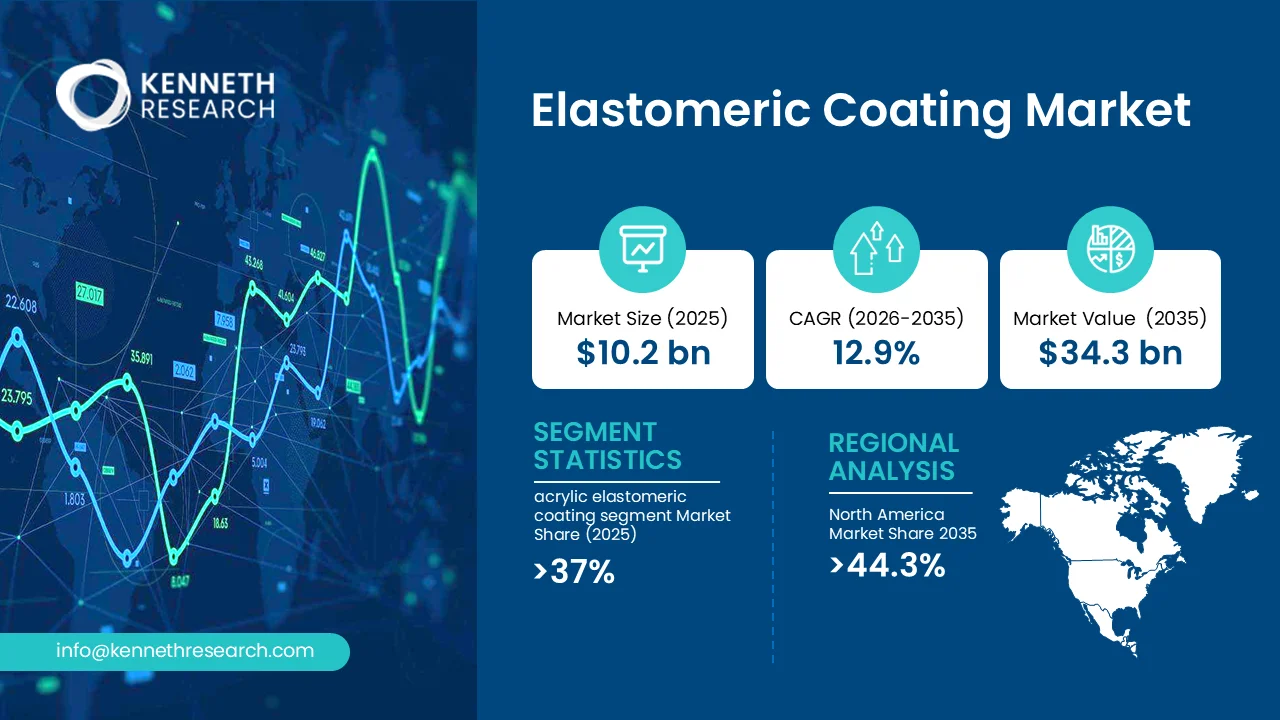
Elastomeric Coating Market size was valued at USD 10.2 billion in 2025 and is projected to reach USD 34.3 billion by the end of 2035, rising at a CAGR of 12.9% during the forecast period, i.e., 2026-2035. In 2026, the industry size of the elastomeric coating is estimated at USD 11.5 billion.
Rising investments in commercial, industrial, and residential infrastructure are accelerating demand for elastomeric coatings that provide waterproofing, crack-bridging, UV resistance, and long-term substrate protection. Growing emphasis on extending asset life while improving energy efficiency and lowering maintenance costs continues to strengthen adoption across construction and infrastructure refurbishment projects.
The elastomeric coating market comprises high-performance protective coatings formulated with flexible polymeric binders that create durable, seamless membranes capable of stretching and recovering without losing adhesion or protective performance. These coatings are commonly applied to concrete, masonry, metal, stucco, and other building substrates to protect surfaces from moisture ingress, ultraviolet radiation, thermal cycling, weathering, and minor structural movement. Their ability to bridge hairline cracks while maintaining waterproof integrity distinguishes them from conventional architectural coatings.
Elastomeric coatings are widely utilized across new construction, renovation, and maintenance projects, particularly for roofs, exterior walls, façades, industrial facilities, warehouses, and public infrastructure where long-term durability is essential. Depending on performance requirements, formulations are designed to deliver enhanced flexibility, weather resistance, chemical resistance, and solar reflectivity, supporting improved building longevity and operational efficiency. Industrial relevance continues to increase as governments and infrastructure owners prioritize resilient buildings, sustainable asset management, and lifecycle cost optimization. Expanding investments in transportation networks, commercial facilities, manufacturing plants, and urban development further reinforce the importance of elastomeric coatings as a critical component of modern protective building envelope systems.
Key Elastomeric Coating Market Insights Summary:
Key Takeaways: Market Trends & Insights
- Elastomeric Coating Market is projected to grow from USD 10.2 billion in 2025 to USD 34.3 billion by 2035, registering a CAGR of 12.9% during the forecast period.
- North America is projected to remain the leading regional market, accounting for 44.3% of the global market by 2035, supported by extensive infrastructure modernization, stringent building performance regulations, and sustained investment in commercial and industrial construction across the U.S. and Canada.
- Acrylic Elastomeric Coating is expected to remain the leading Type segment with a 37% market share, driven by its superior weather resistance, crack-bridging capability, UV stability, and widespread adoption in exterior walls, roofs, and masonry protection applications.
- Roof Coating is anticipated to experience robust growth as increasing emphasis on waterproofing, reflective roofing systems, preventive maintenance, and lifecycle asset management encourages wider adoption across commercial, industrial, and institutional buildings.
- The market is benefiting from growing investments in resilient infrastructure, energy-efficient building envelopes, sustainable construction practices, and continuous innovation in high-performance, low-VOC elastomeric coating technologies.
Market Drivers
- Growing adoption of cool-roof technologies to improve building energy performance and reduce urban heat island effects.
- Continuous advancements in water-based, low-VOC, and high-durability coating formulations that support evolving environmental and performance regulations.
- Increasing investment in transportation, industrial, and logistics infrastructure requiring long-lasting protective building envelope solutions.
- Rising demand for lifecycle cost optimization through preventive maintenance and durable waterproofing systems across residential and commercial construction.
Challenges
- Volatility in specialty raw material supply and pricing
- Performance variability caused by application and environmental conditions
Elastomeric Coating Market Overview & Supply Chain
The global adoption of elastomeric coatings is accelerating as governments, infrastructure owners, and private developers prioritize durable, weather-resistant building envelopes capable of reducing maintenance requirements and extending asset service life. Advancements in polymer technology have improved crack-bridging performance, UV resistance, water impermeability, and compatibility with diverse substrates, making these coatings increasingly suitable for commercial buildings, industrial facilities, transportation infrastructure, and institutional projects. Sustainability regulations and energy-efficiency initiatives are also encouraging the use of reflective and long-lasting protective coatings in both new construction and renovation activities. Supporting this trend, the Government of India’s Economic Survey 2023–24 reported a capital expenditure allocation of ₹11,11,111 crore (3.4% of GDP) for infrastructure in FY2024–25, reinforcing continued investment in construction assets that require high-performance protective coating systems.
The elastomeric coating value chain begins with the procurement of specialty raw materials, including acrylics, silicones, polyurethanes, pigments, fillers, rheology modifiers, additives, solvents, and performance-enhancing chemicals supplied by specialty chemical manufacturers. These materials undergo formulation, dispersion, quality testing, and blending to produce coatings tailored for specific environmental and substrate performance requirements. Manufacturers distribute finished products through direct industrial sales, authorized distributors, building material suppliers, coating specialists, and retail networks serving contractors and construction professionals. Applicators, engineering firms, roofing contractors, and facility maintenance providers play a critical role in product selection and field application, ensuring compliance with project specifications and performance standards. End users include residential developers, commercial property owners, industrial manufacturers, infrastructure agencies, institutional facilities, and public sector organizations. The broader ecosystem also involves raw material suppliers, formulation technology providers, testing laboratories, certification bodies, logistics providers, architects, consultants, and regulatory authorities that collectively support product development and market adoption.
Elastomeric Coating Market: Growth Drivers & Challenges
Growth Drivers:
- Rising investments in building energy efficiency and sustainable infrastructure: The increasing emphasis on energy-efficient and climate-resilient buildings is a major driver for the elastomeric coating market. Governments are strengthening building performance standards and encouraging the adoption of materials that improve durability, reduce heat gain, and minimize lifecycle maintenance costs. Elastomeric coatings contribute to these objectives by providing waterproof protection, crack-bridging capability, and reflective surfaces that enhance building envelope performance. Their ability to extend roof and façade service life also supports circular construction practices by reducing premature repairs and material replacement. As infrastructure owners seek to optimize long-term operational expenditure, demand for advanced protective coatings continues to expand across commercial, institutional, and industrial assets. This trend is expected to intensify as sustainability certifications and resilient infrastructure programs become increasingly integrated into public procurement and private construction strategies worldwide. Supporting this transition, the International Energy Agency (IEA) reported that investment in energy efficiency reached approximately USD 660 billion in 2024, reflecting continued global prioritization of efficient buildings and infrastructure.
- Expansion of building renovation and asset maintenance activities: The growing focus on preserving existing infrastructure is creating sustained demand for elastomeric coatings across developed and emerging economies. Aging commercial buildings, industrial facilities, warehouses, educational institutions, and public infrastructure require cost-effective solutions that restore weather resistance without extensive structural replacement. Elastomeric coatings offer an attractive maintenance option by accommodating substrate movement, preventing moisture penetration, and protecting surfaces from environmental degradation. Their compatibility with multiple construction materials enables facility owners to modernize aging assets while minimizing operational disruption. Increasing adoption of predictive maintenance strategies and lifecycle asset management is further encouraging specification of high-performance coating systems. Future demand is expected to benefit from continued urban redevelopment, modernization of public infrastructure, and stricter performance requirements for building envelopes, positioning elastomeric coatings as an integral component of long-term infrastructure preservation and sustainable asset management.
Challenges:
- Volatility in specialty raw material supply and pricing: Elastomeric coating manufacturers remain highly dependent on specialty polymers, performance additives, pigments, and functional chemicals sourced through complex global supply networks. Disruptions arising from feedstock availability, transportation bottlenecks, geopolitical developments, or fluctuations in petrochemical markets can significantly affect production planning and procurement costs. Since many infrastructure and construction projects are executed under fixed-price contracts, manufacturers often face limited flexibility to immediately pass higher input costs on to customers, compressing profit margins. Extended lead times may also delay project execution and influence contractor purchasing decisions. Commercially, companies are increasingly investing in supplier diversification, regional sourcing strategies, and inventory optimization to reduce procurement risks. Over the long term, organizations with resilient supply chains, backward integration, and stronger supplier partnerships are expected to gain a competitive advantage while improving business continuity and delivery reliability.
- Performance variability caused by application and environmental conditions: The effectiveness of elastomeric coatings depends not only on product formulation but also on proper surface preparation, environmental conditions during application, and adherence to recommended installation practices. Variations in substrate cleanliness, moisture levels, curing temperatures, humidity, or application thickness can compromise adhesion, flexibility, and long-term weather resistance. Inconsistent installation quality may result in premature coating degradation, increasing maintenance requirements and reducing customer confidence. Commercially, manufacturers often incur additional costs through technical support, applicator training, warranty management, and field inspections to ensure consistent project outcomes. These requirements can increase overall project complexity, particularly in large infrastructure and industrial applications. Looking ahead, wider adoption of standardized application protocols, digital inspection technologies, and certified contractor programs is expected to improve installation consistency and strengthen long-term market acceptance.
Elastomeric Coating Market Size and Forecast:
| Report Attribute | Details |
|---|---|
| Base Year |
2025 |
| Forecast Year |
2026-2035 |
| CAGR |
12.9% |
| Base Year Market Size (2025) |
USD 10.2 billion |
| Forecast Year Market Size (2035) |
USD 34.3 billion |
| Regional Scope |
|
Elastomeric Coating Market Segmentation Analysis:
Type Segment Analysis
The acrylic elastomeric coating segment, accounting for 37% of the market in 2025, leads the elastomeric coating market owing to its combination of durability, weather resistance, UV stability, and cost-effectiveness across a wide range of construction applications.
Acrylic formulations are extensively specified for roofs, exterior walls, concrete structures, and masonry surfaces because they offer excellent crack-bridging capability while maintaining long-term flexibility under varying climatic conditions. Their water-based composition also aligns with increasingly stringent environmental requirements, making them attractive for both new construction and refurbishment projects. On the supply side, well-established manufacturing processes, broad raw material availability, and extensive distribution networks enable consistent product availability and support widespread commercial adoption. Demand is further reinforced by the growing implementation of energy-efficient roofing systems. Supporting this trend, the U.S. Department of Energy's Federal Energy Management Program (FEMP) notes that cool roofs stay up to 60°F cooler than traditional black roofs during the summer, encouraging the use of reflective roof coatings, including acrylic elastomeric systems, in public and commercial buildings. Looking ahead, continued emphasis on sustainable buildings, lifecycle asset protection, and resilient infrastructure is expected to strengthen the segment's market leadership.
Application Segment Analysis
The roof coating application segment is projected to witness robust growth as building owners increasingly prioritize preventive maintenance, waterproofing, and energy-efficient roofing systems over complete roof replacement. Elastomeric roof coatings provide seamless protection against moisture intrusion, ultraviolet radiation, temperature fluctuations, and substrate movement, enabling longer roof service life while reducing maintenance frequency. Growing adoption is particularly evident across commercial, industrial, institutional, and logistics facilities where uninterrupted operations make cost-effective roof restoration an attractive alternative to extensive reconstruction. On the supply side, manufacturers continue expanding portfolios with water-based, reflective, and high-performance formulations that comply with evolving environmental regulations and diverse roofing substrates. Contractor awareness, wider distribution networks, and improvements in application technologies are also supporting broader market penetration. Supporting the increasing demand for roof coating solutions, the U.S. Environmental Protection Agency (EPA) states that cool roofs can reduce peak cooling demand by 11–27% in air-conditioned residential buildings, reinforcing the value of reflective roof coating systems for energy-efficient buildings. Looking ahead, continued emphasis on climate resilience, sustainable construction, and lifecycle asset management is expected to accelerate adoption of elastomeric roof coatings across both new construction and renovation projects.
Our in-depth analysis of the global elastomeric coating market includes the following segments:
|
Segment |
Subsegment |
|
Type |
|
|
Application |
|
Elastomeric Coating Market Regional Insights:
North America Market Trends & Insights:
North America is projected to account for 44.3% of the global elastomeric coating market by 2035, supported by a mature construction industry, stringent building performance standards, and sustained investment in commercial, industrial, and public infrastructure.
The region has witnessed strong adoption of elastomeric coatings due to increasing demand for waterproofing, energy-efficient roofing systems, and long-life protective building envelopes capable of withstanding diverse climatic conditions. Regulatory emphasis on sustainable construction, building rehabilitation, and resilient infrastructure continues to encourage the use of advanced coating technologies across both new developments and renovation projects. The presence of leading coating manufacturers, well-established contractor networks, and a sophisticated building materials supply chain further reinforces regional leadership. Supporting the region's demand outlook, the U.S. Census Bureau reported that construction spending during December 2024 reached a seasonally adjusted annual rate of USD 2,192.2 billion, highlighting the scale of construction activity that supports demand for protective coating systems.
The United States remains the primary revenue contributor within North America due to extensive investments in commercial buildings, industrial facilities, logistics infrastructure, institutional projects, and building renovation activities. Increasing adoption of reflective roof coatings, sustainable building materials, and lifecycle asset management practices continues to strengthen demand across both public and private sectors. Continuous product innovation and widespread availability of certified applicators further support market expansion.
Canada also represents an important market, driven by infrastructure modernization, commercial real estate development, and growing emphasis on durable building envelope solutions capable of improving weather resistance in harsh climatic conditions. Government initiatives supporting sustainable infrastructure, together with increasing renovation of aging residential and institutional buildings, are encouraging greater specification of elastomeric coating systems across roofing and exterior wall applications.
Europe Market Trends & Insights:
Asia Pacific is expected to remain one of the fastest-growing regions for elastomeric coatings, supported by rapid urbanization, expanding industrial activity, and continuous investment in residential, commercial, and infrastructure development. Demand is being driven by the increasing need for durable waterproofing solutions, high-performance exterior protection, and energy-efficient building materials capable of withstanding diverse climatic conditions across the region. Governments are strengthening building quality standards, promoting sustainable construction practices, and investing in transportation, manufacturing, logistics, and public infrastructure, all of which create favorable conditions for elastomeric coating adoption. Rising awareness of lifecycle asset management and preventive maintenance is encouraging property owners to utilize advanced coating technologies that reduce maintenance frequency while extending the service life of roofs and building façades. Expanding local manufacturing capabilities, broader availability of specialty raw materials, and increasing technical expertise among contractors are expected to further enhance regional growth opportunities over the coming years.
Japan represents a technologically advanced market where demand is supported by stringent building quality requirements, infrastructure rehabilitation, and a strong focus on resilient construction materials. The country's emphasis on long-lasting building envelopes, weather-resistant roofing systems, and continuous modernization of commercial and public facilities encourages the adoption of premium elastomeric coating solutions.
China remains a major growth engine owing to its extensive construction sector, large-scale industrial expansion, and ongoing urban redevelopment projects. Domestic manufacturers continue to expand production capabilities while improving product quality and environmental compliance. Increasing renovation of aging buildings, combined with sustained investment in industrial parks, logistics facilities, transportation infrastructure, and energy-efficient construction, is expected to reinforce demand for elastomeric coatings across diverse application areas.
Leading Companies Operating in the Global Elastomeric Coating Market:
Here is a list of upstream, downstream, and key players operating in the global elastomeric coating market competitive ecosystem:
- The Sherwin-Williams Company(United States)
- Company Overview
- Business Strategy
- Key Product Offerings
- Financial Performance
- Key Performance Indicators
- Risk Analysis
- Recent Development
- Regional Presence
- SWOT Analysis
- PPG Industries, Inc. (United States)
- Sika AG(Switzerland)
- Nippon Paint Holdings Co., Ltd.(Japan)
Recent Developments
- January 2025: Sika expanded its roofing and waterproofing portfolio by introducing Sikalastic®-701 SF, Sikalastic®-702, and Sikalastic®-702 THX, two-component cold-applied liquid resins for roofing and waterproofing systems.
- February 2025: Sika launched the SikaShield® branded modified bitumen roofing range and introduced the innovative SikaShield® HB79 hybrid membrane to the U.S. market.
- August 2024: PPG introduced PPG PITT-THERM® 909, a silicone-based spray-on insulation coating designed for high-temperature oil, gas, petrochemical, and infrastructure applications.
Frequently Asked Question
In 2025, the elastomeric coating market exceeded USD 10.2 billion.
The elastomeric coating market is projected to reach USD 34.3 billion by the end of 2035, expanding at a CAGR of 12.9% over the forecast period (2026-2035).
The major players in the market are The Sherwin-Williams Company, PPG Industries, Inc., Sika AG, BASF Coatings, Nippon Paint Holdings Co., Ltd., DAW SE (Caparol), Sto SE & Co. KGaA, and others.
In the type segment, the acrylic elastomeric coating sub-segment is anticipated to capture the largest market share of 37% in the future and exhibit lucrative growth opportunities during 2026-2035. This growth trajectory is largely attributed to its excellent weather resistance, crack-bridging capability, and increasing adoption in energy-efficient and sustainable building envelope applications.
North America is projected to hold the largest market share of 44.3% by the end of 2035 and provide more business opportunities in the future. Continuous investments in commercial construction, infrastructure modernization, and sustainable building renovation across the U.S. and Canada are fostering the region's dominance.
Why Choose Kenneth Research ?
-
Insight with Impact : We don’t just gather data — we uncover stories, trends, and opportunities that fuel business growth.
-
Experts Who Get It : Our team speaks your industry’s language and knows what really matters to your customers and market.
-
Custom-Built for You : Forget one-size-fits-all. We craft research and consulting solutions as unique as your business vision.
-
Partners, Not Just Providers : We work with you, not for you — collaborating closely to turn insights into smart, strategic moves.
-
Results That Speak : Our work powers brands, startups, and industry leaders alike — with a track record of ideas that work in the real world.
Report ID: 1120 |
Published Date: 20 Aug 2026 |
Report Format: |
Delivery Timeline: 48-72 Business Hours

Copyright © 2025 Kenneth Research. All rights reserved. Terms of Use | Privacy Policy
