Report ID: 1304 |
Published Date: 10 Sep 2026 |
Report Format: |
Delivery Timeline: 48-72 Business Hours
E-Fuels Market Outlook:
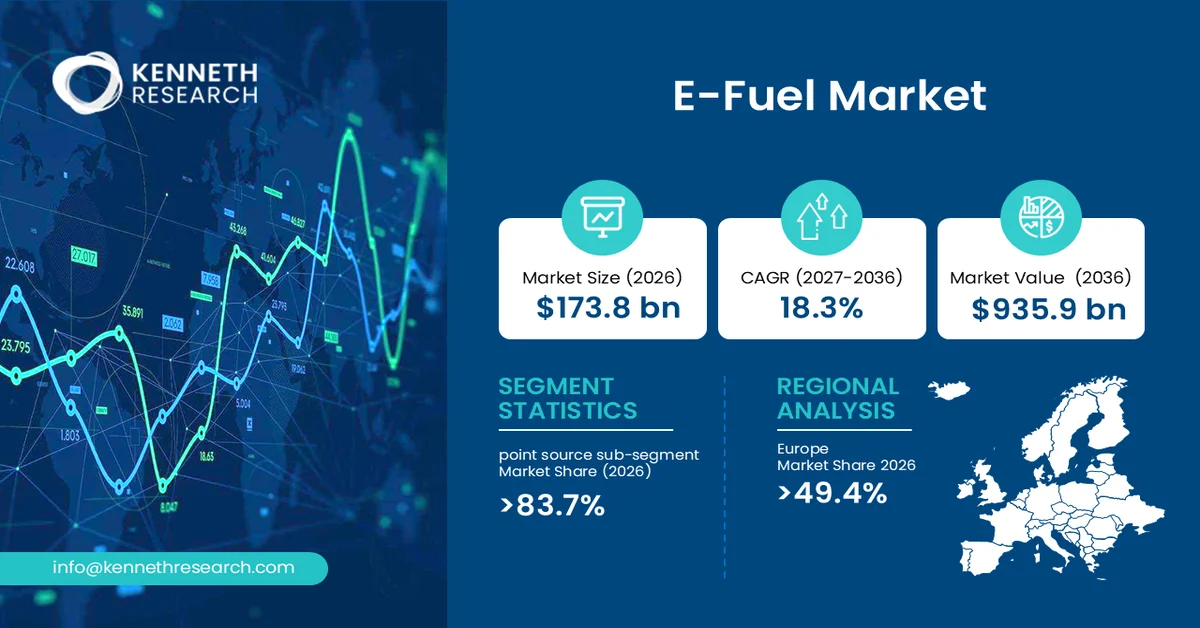
E-Fuels Market size was valued at USD 173.8 billion in 2026 and is projected to reach USD 935.9 billion by the end of 2036, rising at a CAGR of 18.3% during the forecast period, i.e., 2027–2036. In 2027, the industry size of the global e-fuels is estimated at USD 206.2 billion.
The primary growth driver for the e-fuels market is accelerating decarbonization of hard-to-electrify transport, particularly aviation and maritime operations. Government policies, renewable-power expansion, and support for hydrogen-based fuel pathways are strengthening demand for synthetic fuels, while compatibility with existing fuel systems improves industrial attractiveness for transition-focused energy and transport operators.
The e-fuels market comprises fuels produced by synthesizing hydrogen with carbon-based inputs, generally using electricity as the principal energy input. Depending on the production pathway, outputs can include synthetic methane, methanol, kerosene, gasoline, and diesel. The European Commission’s Joint Research Centre describes e-fuels as gaseous and liquid fuels produced using hydrogen and CO2 as raw materials, with electricity serving mainly as the energy input.
A defining characteristic is the integration of renewable electricity, hydrogen production, carbon capture or utilization, and fuel synthesis into a connected production chain. This enables manufacturers to create fuel molecules that can serve applications where direct electrification is technically difficult or operationally constrained. The technology therefore links power-sector decarbonization with fuel production and industrial carbon management.
Key E-Fuel Market Insights Summary:
Key Takeaways: Market Trends & Insights
- E-fuels Market is valued at USD 173.8 Billion in 2026 and is projected to reach USD 935.9 Billion by 2036
- The E-fuels Market is expected to expand at a CAGR of 18.3% from 2027 to 2036
- Point Source leads the E-Fuel Carbon Source segment with an 83.7% market share in 2026
- Liquid is identified as the second and fastest-growing sub-segment under the State category
- Europe dominates the regional landscape with a 49.4% market share in 2026, supported by Germany and France
Market Drivers
- Government-backed decarbonization programs and technology commercialization
- Rising demand for low-carbon fuels in hard-to-electrify transport
- Expansion of renewable hydrogen and carbon-capture infrastructure
- Increasing integration of e-fuels across aviation, maritime, and industrial applications
Challenges
- High production costs and dependence on low-cost renewable energy
- Fragmented supply infrastructure and feedstock availability
E-Fuels Market Overview & Supply Chain
Global adoption of the e-fuels market is increasing as governments and industrial stakeholders seek scalable decarbonization options for transport segments where direct electrification remains challenging. E-fuels can leverage renewable electricity, electrolytic hydrogen and captured carbon to produce energy-dense fuels compatible with established fuel infrastructure.
The e-fuels market value chain begins with sourcing low-carbon electricity, water and suitable carbon inputs, including captured carbon dioxide from industrial or biogenic sources. Renewable electricity powers electrolysis to produce hydrogen, which is subsequently combined with carbon-based inputs through synthesis pathways to manufacture fuels such as e-methanol, e-kerosene and other synthetic hydrocarbons. Production facilities therefore integrate renewable-power assets, electrolyzers, carbon-capture systems, synthesis equipment, processing units and quality-control infrastructure. Following production, fuels move through storage terminals, pipelines, tankers, ports, airports and other established fuel-distribution networks, depending on the end-use application. End users include airlines, shipping operators, fuel distributors, industrial companies and energy-intensive businesses.
E-Fuels Market: Growth Drivers & Challenges
Growth Drivers
- Government-backed decarbonization programs and technology commercialization: Government-led decarbonization initiatives are accelerating investment in synthetic fuels by reducing technology, financing, and commercialization barriers. Policies targeting aviation, maritime transport, and other difficult-to-electrify sectors create a clearer demand pathway for fuels produced from renewable electricity, hydrogen, and captured carbon. This mechanism supports market growth by encouraging pilot projects, research partnerships, infrastructure development, and procurement commitments across the value chain.
- Rising demand for low-carbon fuels in hard-to-electrify transport: The limited practicality of direct electrification for long-distance aviation and maritime operations is creating an important structural opportunity for e-fuels. These fuels can retain the energy-density and handling characteristics required by existing fuel-based transport systems while enabling pathways based on low-emission hydrogen and carbon sources.
Challenges
- High production costs and dependence on low-cost renewable energy: The principal commercial restraint is the cost structure of e-fuel production, particularly its dependence on competitively priced renewable electricity and electrolytic hydrogen. Because hydrogen is a fundamental feedstock, developers must secure reliable access to renewable power while also achieving sufficient electrolyzer utilization to spread capital expenditure across production.
- Fragmented supply infrastructure and feedstock availability: E-fuel projects require coordinated access to renewable electricity, hydrogen production, carbon dioxide sources, transportation infrastructure, storage, and fuel distribution. These assets often have different development timelines, ownership structures, permitting requirements, and geographic footprints, creating significant integration risk.
E-Fuels Market Size and Forecast:
| Report Attribute | Details |
|---|---|
| Base Year |
2026 |
| Forecast Period |
2027-2036 |
| CAGR |
18.3% |
| Base Year Market Size (2026) |
USD 173.8 Billion |
| Forecast Year Market Size (2036) |
USD 935.9 Billion |
| Regional Scope |
|
E-Fuels Market Segmentation Analysis:
E-Fuel Carbon Source Segment Analysis
In the e-fuel carbon source segment, point source sub-segment is anticipated to capture the largest market share of 83.7% by the end of 2026.
Point source carbon sources dominate the e-fuel carbon-source segment because they provide concentrated CO₂ streams from industrial and energy facilities, making capture, purification, and integration with downstream fuel synthesis more practical than dilute atmospheric sources. Demand is supported by the decarbonization of sectors such as cement, chemicals, refining, and power generation, where captured CO₂ can be converted into synthetic fuels rather than treated solely as a waste stream. The European Commission identifies captured CO₂ from industrial and energy-production facilities as a key pathway for carbon utilization, including applications in synthetic fuels. The availability of established industrial emitters also supports supply-side development by allowing capture equipment and CO₂ transport infrastructure to be colocated with existing facilities. Eurostat reported that EU manufacturing and electricity, gas, steam, and air-conditioning supply each generated 745 million tonnes of CO₂-equivalent greenhouse-gas emissions in 2022, highlighting substantial industrial emission sources relevant to carbon-management applications.
State Segment Analysis
The liquid sector is projected to grow as the second-largest segment in the e-fuels market due to four converging demand drivers.
The liquid sub-segment is projected to grow because liquid e-fuels can integrate more readily with established fuel logistics, storage systems, engines, and distribution networks, reducing the infrastructure disruption associated with decarbonization. Demand is particularly relevant in aviation and maritime transport, where high energy-density liquid fuels remain difficult to replace through direct electrification. Industry adoption is increasingly focused on fuel pathways that can operate within existing transportation ecosystems, while producers are developing renewable hydrogen and carbon-conversion routes suitable for liquid fuel synthesis.
Our in-depth analysis of the e-fuels market includes the following segments:
|
Segment |
Sub-segment |
|
Product Type |
|
|
Production Method |
|
|
Technology |
|
|
End Use |
|
|
State |
|
|
Carbon Capture |
|
|
E-Fuel Carbon Source |
|
E-Fuels Market - Regional Analysis
Europe Market Trends & Insights:
Europe e-fuels market is projected to hold the largest revenue share of 49.4% by the end of 2026.
Its dominance is supported by a comparatively mature decarbonization framework, established energy infrastructure, and growing investment in renewable hydrogen and synthetic-fuel value chains. European producers benefit from access to renewable electricity, industrial carbon sources, established fuel logistics, and major aviation and maritime markets.
Germany is a key country market, supported by industrial capacity, renewable-energy deployment, and policy attention toward hydrogen-based fuels.
France offers complementary advantages through its electricity system, industrial base, and transport decarbonization priorities. Together, both countries can support European production capacity, technology deployment, and downstream demand, while their established industrial ecosystems create opportunities for integrated e-fuel projects and cross-border supply chains.
Asia Pacific Market Trends & Insights:
Asia Pacific is emerging as an important e-fuels market opportunity, supported by expanding industrial activity, growing energy-transition requirements, and increasing interest in hydrogen-derived fuels for transportation and industrial applications. Government initiatives are increasingly moving beyond hydrogen production toward integrated applications, including green methanol, green ammonia, sustainable aviation fuel, and other synthetic fuels.
China is positioned as a major supply-chain and technology hub, with strong industrial capabilities across hydrogen equipment, renewable energy, and fuel-related manufacturing. Its policy direction is increasingly focused on expanding hydrogen applications and green-fuel production.
Japan is taking a complementary approach centered on technology development, international supply chains, and deployment of e-fuels for aviation, maritime transport, and other hard-to-electrify applications. Its government-backed initiatives are supporting commercialization pathways and cross-border partnerships, creating opportunities for Japanese companies to participate across technology, project development, and fuel supply chains.
Leading Companies Operating in the Global E-Fuels Market:
Here is a list of upstream, downstream, and key players operating in e-fuels market competitive ecosystem:
- HIF Global LLC (United States)
- Business Strategy
- Key Product Offerings
- Financial Performance
- Key Performance Indicators
- Risk Analysis
- Recent Development
- Regional Presence
- SWOT Analysis
- INERATEC GmbH (Germany)
- Twelve Benefit Corporation (United States)
- Norsk e-Fuel AS (Norway)
Recent Developments
- In November 2025, HIF Global became the world's first to receive ISCC EU RFNBO certification for e-gasoline produced at its Haru Oni facility in Chile, confirming the fuel is renewable, traceable, and achieves over 70% emissions reduction compared to fossil fuels. The facility combines wind energy with electrolysis to produce green hydrogen, which is reacted with captured CO₂ to generate synthetic methanol and e-gasoline.
- In February 2025, Norsk e-Fuel partnered with Prime Capital and RES to develop "Project Alby" in Ånge, Sweden, planning to produce a minimum of 80,000 tons of e-fuel annually. The project will use the Power-to-Liquid process to convert water and captured CO₂ into e-kerosene, marking Norsk e-Fuel's expansion into Sweden following earlier projects in Norway and Finland.
Frequently Asked Question
In 2026, the e-fuels market exceeded USD 173.8 billion.
The e-fuels market is projected to reach USD 935.9 billion by the end of 2036, expanding at a CAGR of 18.3% over the forecast period (2027-2036).
The major players in the market are HIF Global LLC, INERATEC GmbH, Twelve Benefit Corporation, and Norsk e-Fuel AS, and others.
In the E-Fuel Carbon Source segment, the Point Source sub-segment is anticipated to capture the largest market share of 83.7% in the future and exhibit lucrative growth opportunities during 2027-2036. This growth trajectory is largely attributed to the availability of concentrated CO₂ streams from industrial facilities, which supports practical carbon capture and integration into e-fuel production.
Europe is projected to hold the largest market share of 49.4% by the end of 2036 and provide more business opportunities in the future. Continuous investments in renewable hydrogen, e-fuel production, and decarbonization infrastructure across Germany and France are fostering the region's dominance.
Why Choose Kenneth Research ?
-
Insight with Impact : We don’t just gather data — we uncover stories, trends, and opportunities that fuel business growth.
-
Experts Who Get It : Our team speaks your industry’s language and knows what really matters to your customers and market.
-
Custom-Built for You : Forget one-size-fits-all. We craft research and consulting solutions as unique as your business vision.
-
Partners, Not Just Providers : We work with you, not for you — collaborating closely to turn insights into smart, strategic moves.
-
Results That Speak : Our work powers brands, startups, and industry leaders alike — with a track record of ideas that work in the real world.
Report ID: 1304 |
Published Date: 10 Sep 2026 |
Report Format: |
Delivery Timeline: 48-72 Business Hours

Copyright © 2025 Kenneth Research. All rights reserved. Terms of Use | Privacy Policy
