Report ID: 1391 |
Published Date: 25 Sep 2026 |
Report Format: |
Delivery Timeline: 48-72 Business Hours
Drone Chips Market Outlook:
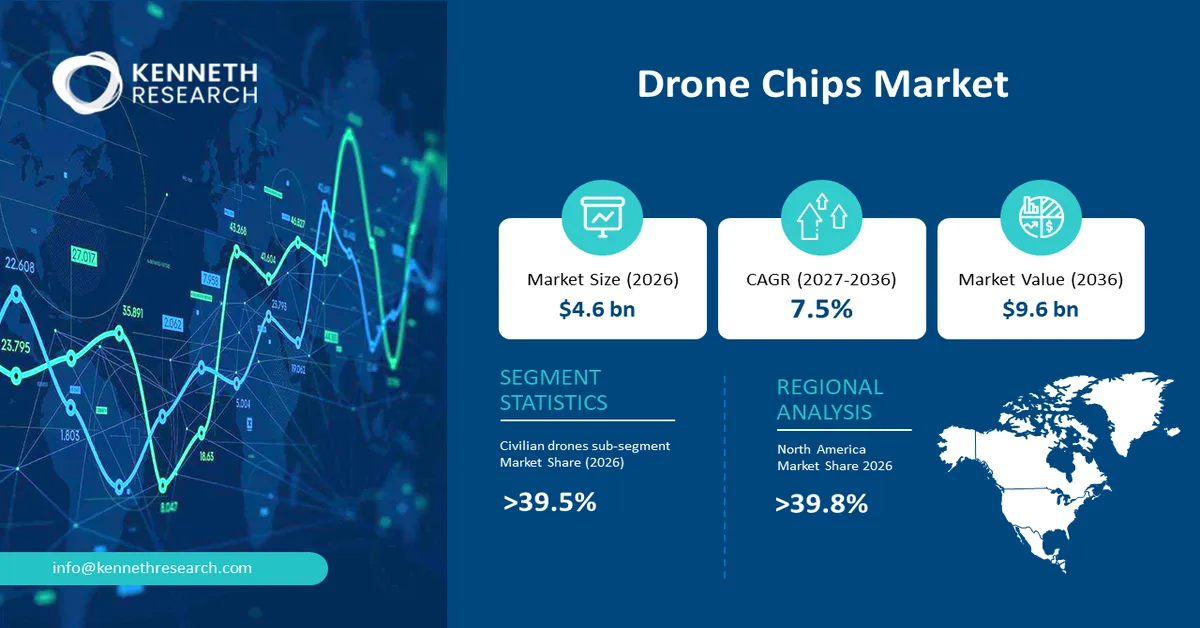
Drone Chips Market size was valued at USD 4.6 billion in 2026 and is projected to reach USD 9.6 billion by the end of 2036, rising at a CAGR of 7.5% during the forecast period, i.e., 2027-2036. In 2027, the industry size of the global drone chips market is estimated at USD 5.0 billion.
The primary growth driver for the drone chips market is the expanding adoption of sophisticated unmanned aircraft operations, including autonomous navigation, beyond-visual-line-of-sight missions, traffic management, and commercial delivery.
The drone chips market comprises semiconductor components designed, developed, and integrated specifically for unmanned aerial vehicles and their associated electronic systems. These chips provide the computational and control capabilities required for flight management, navigation, sensing, communications, image processing, power management, and autonomous or remotely supervised operation.
Key components include processors, microcontrollers, system-on-chip solutions, memory devices, communication chips, sensor-processing units, and specialized control chips. Depending on drone architecture and mission requirements, these semiconductor solutions can support functions such as stabilization, obstacle detection, positioning, data transmission, payload management, and real-time decision-making. The Federal Aviation Administration describes unmanned aircraft operations as encompassing increasingly complex activities, including package delivery and UAS traffic management, while its technical documentation identifies varying levels of automation ranging from manual control to autonomous operation.
Key Drone Chips Market Insights Summary:
Key Takeaways: Market Trends & Insights
- Civilian drones accounted for 39.5% of the drone chips market by application in 2026
- North America held 39.8% of the drone chips market in 2026, supported by established aerospace, semiconductor, software, and drone manufacturing capabilities
- The drone chips market is projected to reach USD 9.6 billion by 2036, expanding at a CAGR of 7.5% from 2027 to 2036
- Master control chips are projected to grow as drones become more autonomous, connected, and operationally complex
- Asia Pacific is emerging as an important growth region, supported by commercial drone deployment, advanced electronics manufacturing, and government initiatives for low-altitude aviation ecosystems
Market Drivers
- Expansion of autonomous and BVLOS drone operations
- Increasing adoption of drones for infrastructure and industrial inspection
- Growing integration of artificial intelligence, edge computing, and advanced sensing
- Rising use of drones across logistics, agriculture, emergency response, and energy applications
Challenges
- Semiconductor supply-chain complexity
- Power, thermal, and performance constraints
Drone Chips Market Overview & Supply Chain
Adoption of drone technologies is increasing globally as organizations seek faster, safer, and more cost-efficient methods for inspection, surveying, logistics, emergency response, agriculture, infrastructure monitoring, and other specialized operations. Advances in autonomy, sensing, connectivity, edge computing, and battery technologies are expanding the operational capabilities of unmanned aircraft, while evolving aviation frameworks are supporting broader commercial integration.
The drone chips market value chain begins with raw-material and semiconductor input suppliers providing silicon wafers, specialty chemicals, metals, substrates, packaging materials, and electronic components. Chip designers then develop processors, microcontrollers, memory, communication, sensing, power-management, and control architectures according to drone performance requirements. Semiconductor fabrication facilities manufacture integrated circuits, followed by assembly, packaging, testing, and quality assurance. Component distributors and specialized electronics suppliers subsequently channel chips into drone manufacturers and original equipment manufacturers, often through global technology supply networks.
Drone Chips Market: Growth Drivers & Challenges
Growth Drivers:
- Advanced commercial and autonomous drone operations: The expansion of commercial and autonomous drone operations is increasing demand for higher-performance semiconductor architectures. As drones move beyond basic remotely piloted functions toward navigation, sensing, communications, obstacle avoidance, and autonomous mission execution, chipsets must process larger volumes of data with low latency and high energy efficiency. This creates opportunities for processors, master control chips, sensor-processing units, communication chips, and power-management components.
- Expansion of mission-critical industrial applications: The diversification of drone applications across infrastructure, energy, agriculture, emergency response, logistics, and public services is creating another structural growth driver. Drones increasingly perform tasks where conventional inspection or transportation methods can be slower, more hazardous, or operationally restrictive. These missions require dependable flight-control systems, imaging and sensing capabilities, secure communications, navigation, and real-time processing, increasing the technological content of each aircraft.
Challenges:
- Semiconductor supply-chain complexity: The drone chips market faces supply-chain complexity because semiconductor production depends on specialized fabrication, packaging, testing, substrates, and electronic-material ecosystems distributed across multiple jurisdictions. Drone manufacturers often require components with specific processing, power-efficiency, communication, sensing, and environmental-performance characteristics, limiting the ease with which one chip can be substituted for another.
- Power, thermal, and performance constraints: Drone chip design is constrained by the need to balance computational performance with limited onboard power and thermal-management capabilities. Unlike many stationary electronic systems, airborne platforms must operate within strict weight, battery, and space constraints, meaning additional processing capability can create competing demands for energy efficiency and heat dissipation.
Drone Chips Market Size and Forecast:
| Report Attribute | Details |
|---|---|
| Base Year |
2026 |
| Forecast Period |
2027-2036 |
| CAGR |
7.5% |
| Base Year Market Size (2026) |
USD 4.6 billion |
| Forecast Year Market Size (2036) |
USD 9.6 billion |
| Regional Scope |
|
Drone Chips Market Segmentation Analysis:
Application Segment Analysis
In the application segment, civilian drones sub-segment is anticipated to capture the largest market share of 39.5% by the end of 2026.
Civilian drones dominate the application segment because commercial, industrial, public-service, and consumer use cases increasingly depend on compact aircraft capable of reliable navigation, imaging, communications, and automated flight functions. Demand is supported by infrastructure inspection, surveying, agriculture, emergency response, media, logistics, and environmental monitoring, where drones can improve operational flexibility and reduce exposure to hazardous environments. The semiconductor content of these platforms is consequently expanding, particularly across flight-control processors, sensing, connectivity, power-management, and image-processing components. Regulatory maturation is also supporting adoption by establishing clearer operating requirements for more complex missions. The UK Civil Aviation Authority reported 2,947 active Specific Category Operational Authorisation holders as of September 2024, indicating an established base of operators conducting activities requiring regulatory authorization.
Type Segment Insights
The master control chips is projected to grow as the second-largest segment in the drone chips market due to four converging demand drivers.
Master control chips are projected to grow as drone platforms become more autonomous, connected, and operationally complex. These chips coordinate core aircraft functions, including flight stabilization, navigation, sensor inputs, communication interfaces, and mission execution, making them central to reliable drone performance. Demand is being reinforced by the transition toward advanced operations that require more sophisticated onboard control and processing capabilities. Transport Canada reported 12,095 Advanced Pilot Certificates for drones, representing a 29% increase from the previous year, indicating strengthening participation in more capable drone operations. As operators adopt drones for inspection, surveying, logistics, public safety, and other demanding applications, manufacturers increasingly require integrated control architectures capable of handling multiple functions with low latency and efficient power consumption.
Our in-depth analysis of the Drone Chips market includes the following segments:
|
Segment |
Sub-segment |
|
Type |
|
|
Application |
|
Drone Chips Market Regional Insights:
North America Market Trends & Insights:
North America drone chips market is projected to hold the largest revenue share of 39.8% by the end of 2026.
It is supported by a mature drone ecosystem, strong technology investment, established aerospace capabilities, and comparatively advanced regulatory frameworks. The United States provides substantial demand through commercial, industrial, public-safety, infrastructure, and defense-related drone applications, while its semiconductor and aerospace industries strengthen the regional supply base.
The United States remains the principal demand and technology center, supported by major aerospace, semiconductor, software, and drone manufacturers alongside continued development of advanced operating frameworks.
Canada contributes through aerospace engineering, specialized industrial applications, and regulatory development supporting increasingly sophisticated remotely piloted aircraft operations. Together, both countries provide manufacturers with a combination of technology expertise, end-user demand, investment capacity, and regulatory infrastructure. Future regional development should favor higher-performance control chips, edge-processing architectures, sensing components, and communications solutions as drone operations become increasingly automated and commercially integrated.
Asia Pacific Market Trends & Insights:
Asia Pacific is emerging as an important growth region for the drone chips market, supported by expanding commercial drone deployment, advanced electronics manufacturing capabilities, and increasing integration of unmanned aircraft into logistics, infrastructure, agriculture, public services, and industrial operations.
China represents a major manufacturing and consumption center, supported by a large electronics ecosystem, domestic drone production capabilities, semiconductor development, and government-backed low-altitude-economy initiatives. Its emphasis on intelligent aircraft, integrated circuits, flight-control systems, and networked communications can stimulate demand for increasingly sophisticated drone chips.
Japan offers a complementary opportunity through its advanced robotics, electronics, automotive, and aerospace capabilities. Its regulatory framework for Level 4 unmanned-aircraft operations can encourage applications requiring greater autonomy, reliable control, and advanced onboard processing.
Leading Companies Operating in the Drone Chips Market:
Here is a list of upstream, downstream, and key players operating in drone chips market competitive ecosystem:
- Qualcomm (United States)
- Company Overview
- Business Strategy
- Key Product Offerings
- Financial Performance
- Key Performance Indicators
- Risk Analysis
- Recent Development
- Regional Presence
- SWOT Analysis
- STMicroelectronics (Switzerland)
- Texas Instruments (United States)
- Broadcom (United States)
- Infineon Technologies (Germany)
Recent Developments
- In January 2026, Qualcomm announced the Dragonwing Q-8750 and Q-7790 processors at CES, explicitly targeting drones. The Q-8750 delivers 77 TOPS of AI performance, supports on-device large language models up to 11 billion parameters, and enables concurrent processing from up to 12 physical cameras.
- In June 2025, STMicroelectronics announced that its STM32H5 microcontroller and NanoEdge AI Studio were adopted by Nidec's ESC for drones. The AI-powered solution monitors motor current values in real time to detect anomalies and prevent crashes, improving drone flight safety without additional hardware components.
Frequently Asked Question
In 2026, the drone chips market exceeded USD 4.6 billion.
The drone chips market is projected to reach USD 9.6 billion by the end of 2036, expanding at a CAGR of 7.5% over the forecast period (2027-2036).
The major players in the market are Qualcomm (United States), STMicroelectronics (Switzerland), Texas Instruments (United States), Broadcom (United States), Infineon Technologies (Germany), and others.
In the Application segment, the Civilian Drones sub-segment is anticipated to capture the largest market share of 39.5% in the future and exhibit lucrative growth opportunities during 2027-2036. This growth trajectory is largely attributed to increasing adoption of drones across commercial and industrial applications.
North America is projected to hold the largest market share of 39.8% by the end of 2026 and provide more business opportunities in the future. Continuous technological development and expanding drone applications across the United States and Canada are fostering the region's dominance
Why Choose Kenneth Research ?
-
Insight with Impact : We don’t just gather data — we uncover stories, trends, and opportunities that fuel business growth.
-
Experts Who Get It : Our team speaks your industry’s language and knows what really matters to your customers and market.
-
Custom-Built for You : Forget one-size-fits-all. We craft research and consulting solutions as unique as your business vision.
-
Partners, Not Just Providers : We work with you, not for you — collaborating closely to turn insights into smart, strategic moves.
-
Results That Speak : Our work powers brands, startups, and industry leaders alike — with a track record of ideas that work in the real world.
Report ID: 1391 |
Published Date: 25 Sep 2026 |
Report Format: |
Delivery Timeline: 48-72 Business Hours

Copyright © 2025 Kenneth Research. All rights reserved. Terms of Use | Privacy Policy
