Report ID: 1284 |
Published Date: 28 Sep 2026 |
Report Format: |
Delivery Timeline: 48-72 Business Hours
Digital Camera Market Outlook:
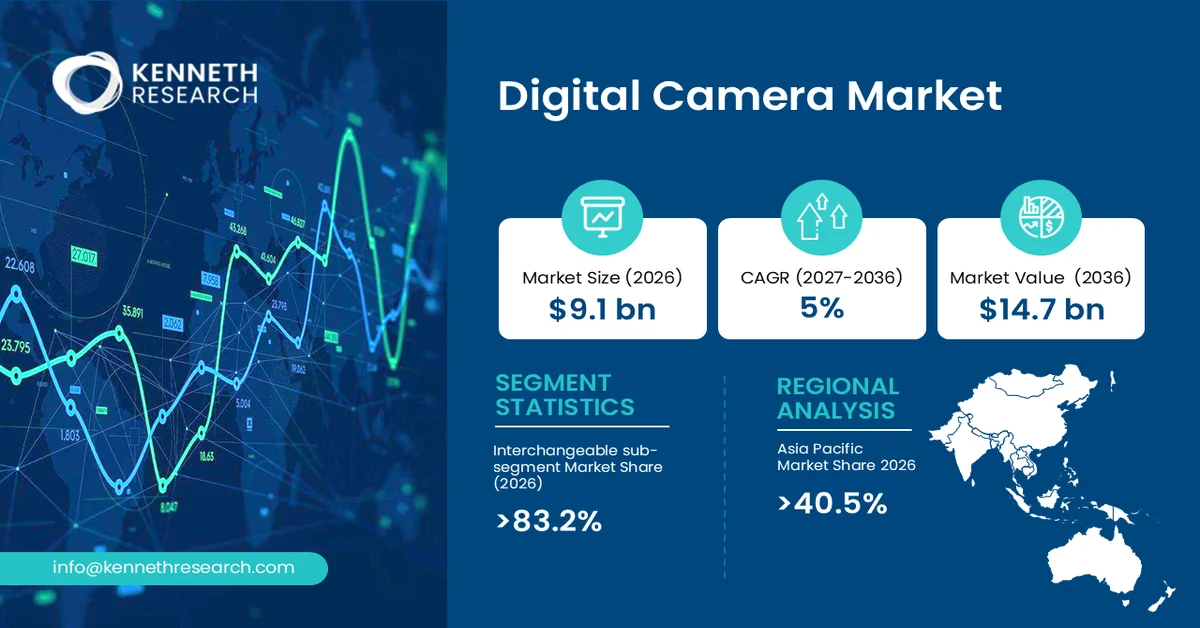
Digital Camera Market size was valued at USD 9.1 billion in 2026 and is projected to reach USD 14.7 billion by the end of 2036, rising at a CAGR of 5% during the forecast period, i.e., 2027–2036. In 2027, the industry size of the digital camera is estimated at USD 9.6 billion.
The primary growth driver for the digital camera market is the continued demand for high-quality imaging and professional-grade photography and videography.
Digital cameras are electronic imaging devices that capture photographs and video by converting incoming light into digital image data through an image sensor. The market includes cameras with interchangeable and built-in lenses, including mirrorless and single-lens reflex configurations, together with associated imaging electronics, processors, displays, storage interfaces, autofocus systems, and connectivity features.
The digital camera market encompasses the design, manufacturing, distribution, and use of dedicated digital imaging equipment across professional photography, commercial content creation, media and entertainment, sports, wildlife photography, travel, education, and enthusiast applications. Interchangeable-lens systems provide users with the flexibility to select lenses according to focal length, aperture, subject, and shooting conditions, while mirrorless architectures increasingly combine compact form factors with advanced imaging and video capabilities.
Key Digital Camera Market Insights Summary:
Key Takeaways: Market Trends & Insights
- Digital camera market projected to grow from USD 9.1 billion in 2026 to USD 14.7 billion by 2036 at a 5% CAGR.
- Asia-Pacific accounted for the largest regional share at 40.5% in 2026, supported by Japan’s advanced imaging ecosystem, China’s large electronics-manufacturing base, and expanding demand for professional and creator-focused photography equipment.
- Interchangeable is expected to remain the leading Lens Type segment with a 83.2% market share in 2026, supported by optical flexibility, specialized lens availability, and strong demand from professional and enthusiast photographers.
- Mirrorless cameras are positioned for continued growth under Camera Type, driven by compact form factors, advanced autofocus, high-quality video capabilities, image stabilization, and expanding interchangeable-lens ecosystems.
Market Drivers
- Rising demand for interchangeable-lens imaging systems.
- Increasing adoption of mirrorless camera architectures.
- Growing professional and enthusiast demand for high-performance photography and videography.
- Continued innovation in image sensors, autofocus, stabilization, and computational imaging.
Challenges
- Intense competition from smartphone imaging.
- High product development and ecosystem costs.
Digital Camera Market: Market Overview & Supply Chain
Global adoption of digital cameras remains supported by professional photography, content creation, media production, commercial imaging, and specialized visual documentation. Technological improvements in image sensors, autofocus, stabilization, high-resolution video, and wireless connectivity are helping dedicated cameras retain relevance despite competition from smartphones. Japan remains particularly important to the global imaging ecosystem because of its strong concentration of camera and image-sensor manufacturing capabilities. Japan’s Ministry of Economy, Trade and Industry (METI) continues to track digital still-camera production through its Current Survey of Production, which covers manufactured electronic and precision products and provides monthly production, shipment, and inventory data.
The digital camera market value chain begins with image sensors, processors, memory components, optical glass, lenses, shutters, displays, batteries, electronic circuitry, housings, and connectivity components. Semiconductor and optical-component manufacturers supply these inputs to camera manufacturers, which undertake product design, optical assembly, sensor integration, firmware development, image processing, calibration, testing, and final quality control. Finished cameras and lenses are then distributed through authorized dealers, specialty photography retailers, electronics stores, online platforms, and professional imaging distributors.
Digital Camera Market: Growth Drivers & Challenges
Growth Drivers
- Rising Demand for Interchangeable-Lens Imaging Systems: The continued shift toward interchangeable-lens digital cameras is strengthening demand for advanced optical and imaging technologies. Professional photographers, videographers, content creators, and enthusiasts increasingly value systems that allow lens selection according to subject, focal length, lighting conditions, and creative requirements. The Camera & Imaging Products Association (CIPA) reported that global shipments of interchangeable-lens digital cameras reached 7,001,965 units in 2025, while mirrorless cameras accounted for the majority of this category and maintained consistent demand for photography and video applications.
- Increasing Adoption of Mirrorless Camera Architectures: The growing adoption of mirrorless architecture is another major market growth driver. Mirrorless cameras eliminate the traditional optical mirror mechanism, allowing manufacturers to develop compact bodies while incorporating large sensors, interchangeable lenses, electronic viewfinders, advanced autofocus, and sophisticated video capabilities. This architecture is particularly attractive to professional and enthusiast users seeking a balance between portability and high-end imaging performance. The technology is also encouraging manufacturers to expand dedicated lens ecosystems and develop faster processors, improved stabilization, and AI-assisted subject recognition.
Challenges
- Intense Competition from Smartphone Imaging: The digital camera market faces persistent competition from smartphones, which increasingly provide advanced computational photography, high-resolution sensors, optical zoom, stabilization, and AI-assisted image processing in compact devices. For casual users, smartphones can eliminate the need to carry a dedicated camera, particularly for everyday photography and social-media content. This places pressure on manufacturers to clearly differentiate dedicated cameras through superior optical performance, interchangeable lenses, ergonomics, low-light capabilities, professional video functionality, and specialized imaging features. The challenge is particularly relevant to entry-level camera products, where the performance gap with premium smartphones can appear less significant to consumers.
- High Product Development and Ecosystem Costs: Advanced digital cameras require continuous investment in image sensors, processors, autofocus systems, stabilization, electronic viewfinders, firmware, optical technologies, and compatible lenses. The need to improve multiple technologies simultaneously can increase research, engineering, testing, and manufacturing complexity. Interchangeable-lens systems also require manufacturers to maintain extensive lens ecosystems and accessory compatibility, creating additional inventory and development requirements. These pressures can make product refresh cycles commercially demanding, particularly when customers expect substantial improvements in imaging performance with each generation.
Digital Camera Market Size and Forecast:
| Report Attribute | Details |
|---|---|
| Base Year |
2026 |
| Forecast Year |
2027-2036 |
| CAGR |
5% |
| Base Year Market Size (2026) |
USD 9.1 billion |
| Forecast Year Market Size (2036) |
USD 14.7 billion |
| Regional Scope |
|
Digital Camera Market: Segment Analysis
Lens Type Segment Analysis
In the Lens Type segment, the Interchangeable sub-segment is anticipated to capture the largest market share of 83.2% in 2026. Its dominance is supported by the flexibility to use specialized lenses for portraiture, wildlife, sports, commercial photography, filmmaking, and other professional applications. Interchangeable-lens systems also allow users to upgrade optical capabilities without replacing the camera body, strengthening their long-term value proposition for professional and enthusiast users. The supply ecosystem is supported by continued investment in interchangeable-lens cameras and dedicated lens technologies. The Camera & Imaging Products Association (CIPA) maintains dedicated production and shipment statistics for interchangeable lenses, reflecting their continuing importance within the imaging industry.
Camera Type Segment Analysis
In the Camera Type segment, the Mirrorless sub-segment is projected to witness strong growth throughout the forecast period. Mirrorless cameras are gaining preference among professional photographers, videographers, and advanced enthusiasts because they combine interchangeable-lens flexibility with compact body designs, electronic viewfinders, advanced autofocus, image stabilization, and strong video capabilities. The technology is also well suited to hybrid creators who require both high-quality still photography and video production from a single system.
The supply side is strengthening as major imaging manufacturers continue expanding mirrorless bodies and dedicated lens ecosystems. CIPA’s latest industry data shows that mirrorless cameras account for the majority of interchangeable-lens digital-camera shipments, demonstrating the continuing structural shift toward mirrorless architectures.
Our in-depth analysis of the global digital camera market includes the following segments:
|
Segment |
Sub-segment |
|
Lens Type |
|
|
Camera Type |
|
|
End User |
|
|
Sensor Size |
|
Digital Camera Market – Regional Analysis
Asia-Pacific Market Trends & Insights:
Asia-Pacific accounted for 40.5% of the digital camera market in 2026, making it the dominant regional market. The region benefits from a highly developed camera manufacturing ecosystem, strong optical and semiconductor capabilities, established professional photography markets, and rising demand for advanced imaging equipment. Japan and China are particularly important because they combine large consumer markets with extensive camera, lens, and imaging-component production capabilities. Government-backed industrial activity also supports the regional ecosystem.
Japan remains a major center for digital-camera technology, with globally established imaging companies, advanced optical engineering, and a mature professional and enthusiast photography base. The country's manufacturing infrastructure also supports the development of high-performance interchangeable-lens systems and related components.
China represents an increasingly important demand and production market, supported by its large electronics-manufacturing ecosystem and expanding creator and consumer-imaging activities. CIPA's latest shipment data also shows strong growth in shipments to China, reinforcing its importance within the regional camera industry.
North America Market Trends & Insights:
North America represents a significant market for digital cameras, supported by established professional photography, film and video production, media, advertising, and creative industries. Demand is increasingly concentrated around high-performance interchangeable-lens systems, particularly among professional photographers, videographers, content creators, and advanced enthusiasts seeking superior optical performance and specialized lenses. The U.S. Bureau of Labor Statistics reported that photographers held 151,200 jobs in 2024, demonstrating the scale of the professional imaging ecosystem and its continued relevance to dedicated camera equipment.
The U.S. is the principal contributor to regional demand, supported by its large creative economy, established professional photography sector, media and entertainment industries, and strong presence of advanced imaging users. The U.S. Census Bureau specifically classifies digital camera manufacturing within its manufacturing industry structure, reflecting the established industrial role of camera equipment.
Canada provides additional opportunities through its photography, broadcasting, film-production, advertising, and creative-service industries. Both countries offer favorable conditions for premium interchangeable-lens cameras, mirrorless systems, professional lenses, and advanced video equipment.
Digital Camera Market: Competitive Landscape
Here is a list of upstream, downstream, and key players operating in the global digital camera market competitive ecosystem:
- Canon Inc. (Japan)
- Company Overview
- Business Strategy
- Key Product Offerings
- Financial Performance
- Key Performance Indicators
- Risk Analysis
- Recent Development
- Regional Presence
- SWOT Analysis
- Sony Corporation (Japan)
- Nikon Corporation (Japan)
Recent Developments
- February 2026: Canon announced that its interchangeable-lens digital cameras maintained the No. 1 global market share position for the 23rd consecutive year through 2025
- April 2025: Nikon released the Z5II, a full-frame mirrorless camera featuring the EXPEED 7 image-processing engine, deep-learning-powered subject detection, and high-speed autofocus.
Frequently Asked Question
In 2026, the digital camera market exceeded USD 9.1 billion.
The digital camera market is projected to reach USD 14.7 billion by the end of 2036, expanding at a CAGR of 5% over the forecast period (2027–2036).
The major players in the market are Canon Inc., Sony Corporation, Nikon Corporation, Fujifilm Holdings Corporation, Panasonic Holdings Corporation, Leica Camera AG, and others.
In the Lens Type segment, the Interchangeable sub-segment is anticipated to capture the largest market share of 83.2% in the future and exhibit lucrative growth opportunities during 2027–2036.
Asia-Pacific is projected to hold the largest market share of 40.5% by the end of 2026 and provide more business opportunities in the future.
Why Choose Kenneth Research ?
-
Insight with Impact : We don’t just gather data — we uncover stories, trends, and opportunities that fuel business growth.
-
Experts Who Get It : Our team speaks your industry’s language and knows what really matters to your customers and market.
-
Custom-Built for You : Forget one-size-fits-all. We craft research and consulting solutions as unique as your business vision.
-
Partners, Not Just Providers : We work with you, not for you — collaborating closely to turn insights into smart, strategic moves.
-
Results That Speak : Our work powers brands, startups, and industry leaders alike — with a track record of ideas that work in the real world.
Report ID: 1284 |
Published Date: 28 Sep 2026 |
Report Format: |
Delivery Timeline: 48-72 Business Hours

Copyright © 2025 Kenneth Research. All rights reserved. Terms of Use | Privacy Policy
