Report ID: 1399 |
Published Date: 25 Sep 2026 |
Report Format: |
Delivery Timeline: 48-72 Business Hours
Diesel Engine for Power Generation Market Outlook:
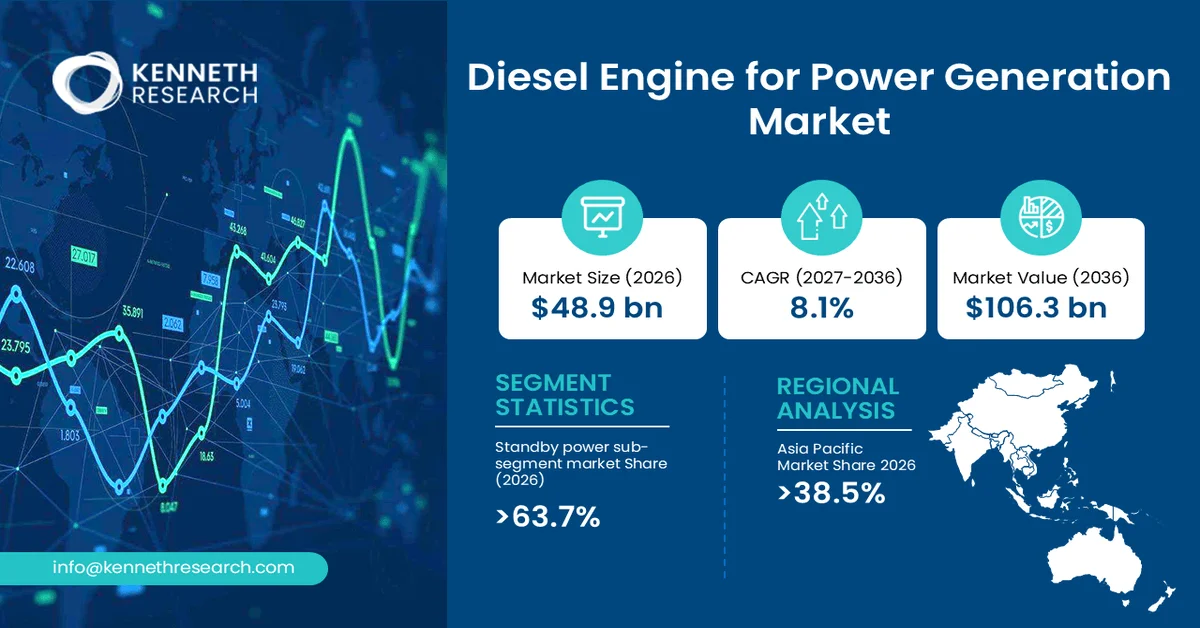
Diesel Engine for Power Generation Market size was valued at USD 48.9 billion in 2026 and is projected to reach USD 106.3 billion by the end of 2036, rising at a CAGR of 8.1% during the forecast period, i.e., 2027-2036. In 2027, the industry size of the diesel engine for power generation is estimated at USD 52.6 billion.
The primary growth driver is the need for reliable backup electricity amid grid-performance challenges. India’s Ministry of Power reported aggregate technical and commercial losses of about 17% in FY2022, reinforcing the need for dependable standby generation across facilities where interruptions can disrupt production, services, and essential operations.
Diesel engine for power generation refers to equipment that converts diesel-fuel energy into mechanical power through internal combustion and drives an electrical generator to produce electricity. These systems are engineered for dependable operation across standby, prime, and other distributed-power requirements. Key characteristics include robust engine construction, rapid start capability, controllable electrical output, fuel-based autonomy, and integration with automatic transfer and monitoring systems. Configurations vary by rated power, operating duty, installation environment, emissions requirements, and load profile, enabling deployment from commercial facilities to industrial sites and infrastructure assets.
The technology remains industrially relevant because it can provide an independent electricity source when utility supply is unavailable or inadequate, helping maintain essential loads and operational continuity. Government guidance from the U.S. Department of Energy describes standby generators as self-contained systems that automatically begin supplying electricity when the primary grid source becomes unavailable and emphasizes routine operation and maintenance for reliable outage performance.
Key Diesel Engine for Power Generation Market Insights Summary:
Key Takeaways: Market Trends & Insights
- Diesel Engine for Power Generation Market is projected 48.9 billion in 2026, reaching 106.3 billion by 2036 at an 8.1% CAGR
- Standby power leads the application segment with a 63.7% share in 2026, driven by demand for reliable backup electricity
- The 1,001kW–2,000kW range is projected to grow as industrial and critical infrastructure facilities require higher-capacity power systems
- Asia Pacific dominates with a 38.5% share in 2026, supported by strong demand from China and India
- North America remains a key secondary region, supported by data centres, healthcare, industrial facilities, telecommunications and critical infrastructure
Market Drivers
- Rising demand for reliable backup power in data centers and critical infrastructure
- Expansion of distributed and industrial power requirements
- Growth of digital monitoring and intelligent generator controls
- Increasing need for resilient electricity supply in remote and infrastructure-constrained locations
Challenges
- Stringent emissions requirements and environmental compliance
- Volatility in fuel costs and operating economics
Diesel Engine for Power Generation Market Overview & Supply Chain
Adoption of diesel engine for power generation is increasing as industries, infrastructure operators, and critical facilities prioritize dependable electricity amid rising electrification and expanding power requirements. Diesel generator systems remain relevant because they can provide dispatchable backup power where grid interruptions could affect production, digital infrastructure, healthcare services, construction activities, and essential operations. The technology is also evolving through improved engine controls, automated transfer systems, remote monitoring, fuel-efficiency improvements, and emissions-management technologies.
The value chain begins with sourcing core inputs including iron and steel, aluminum, copper, electronic components, fuel-system components, lubricants, batteries, control systems, and other engineered materials required for engine and generator assembly. Engine manufacturers and generator-set integrators then convert these inputs into complete power-generation systems through machining, engine assembly, alternator integration, control-panel installation, testing, and system configuration. Distribution involves original equipment manufacturers, authorized dealers, electrical-equipment distributors, system integrators, engineering-procurement-construction contractors, and specialized power-equipment suppliers.
Diesel Engine for Power Generation Market: Growth Drivers & Challenges
Growth Drivers:
- Rising demand for reliable backup power in data centers and critical infrastructure: The expansion of data centers, digital infrastructure, healthcare facilities, manufacturing plants, and other electricity-dependent operations is strengthening demand for dependable backup generation. Diesel generator systems provide rapid-start, dispatchable power when grid supply is interrupted, making them particularly valuable where downtime can cause operational, financial, or safety consequences.
- Expansion of distributed and industrial power requirements: Growing electrification across industrial, commercial, construction, telecommunications, and infrastructure applications is increasing the need for localized and flexible electricity solutions. Diesel generation can operate independently of the utility network, allowing businesses to maintain essential loads during outages, manage temporary power requirements, or support operations in locations where grid infrastructure is limited. Its established supply ecosystem, broad serviceability, fuel availability, and ability to deliver power across diverse operating environments make the technology practical for distributed generation requirements.
Challenges:
- Stringent emissions requirements and environmental compliance: Tightening emissions standards are creating technical and commercial pressure for diesel generator manufacturers and operators. The root cause is the increasing regulatory focus on nitrogen oxides, particulate matter, carbon emissions, and other pollutants associated with combustion-based power generation. Meeting these requirements can require advanced after-treatment systems, electronic engine controls, optimized combustion technologies, and more sophisticated monitoring infrastructure.
- Volatility in fuel costs and operating economics: Dependence on diesel fuel exposes generator operators to fluctuations in fuel procurement costs, transportation expenses, storage requirements, and local fuel availability. This creates an important commercial challenge because generator economics depend not only on equipment acquisition but also on the cost and availability of fuel throughout the operating lifecycle.
Diesel Engine for Power Generation Market Size and Forecast:
| Report Attribute | Details |
|---|---|
| Base Year |
2026 |
| Forecast Period |
2027-2036 |
| CAGR |
8.1% |
| Base Year Market Size (2026) |
USD 48.9 billion |
| Forecast Year Market Size (2036) |
USD 106.3 billion |
| Regional Scope |
|
Diesel Engine for Power Generation Market Segmentation Analysis:
Application Segment Analysis
In the application segment, standby power sub-segment is anticipated to capture the largest market share of 63.7% by the end of 2026.
Standby power dominates the application segment because facilities increasingly require an independent electricity source when utility supply is disrupted. Hospitals, data centers, manufacturing plants, commercial buildings, telecommunications infrastructure, and public facilities prioritize continuity of critical loads, making automatic-start diesel generator systems a well-established resilience solution. The International Energy Agency notes that backup power generators are necessary for data centers to achieve the extremely high reliability levels required by these facilities, supporting continued adoption in digitally intensive infrastructure. Demand is further supported by electrification, industrial expansion, severe-weather exposure, and grid reliability concerns. Supply-side maturity also benefits the segment: established engine manufacturers, service networks, standardized generator configurations, and readily available maintenance expertise reduce deployment barriers.
Power Range Segment Analysis
The 1,001kW–2,000kW is projected to grow as the second-largest segment in the diesel engine for power generation market due to four converging demand drivers.
The 1,001kW–2,000kW power range is projected to grow as commercial and industrial facilities increasingly require higher-capacity backup systems capable of supporting multiple critical loads simultaneously. Data centers, manufacturing complexes, healthcare facilities, infrastructure projects, and large commercial properties are strengthening demand for generator sets that can deliver substantial power while maintaining operational flexibility. The International Energy Agency reports that data centres consumed around 415 TWh of electricity globally in 2024, underscoring the increasing scale of electricity requirements associated with digital infrastructure.
Our in-depth analysis of the diesel engine for power generation market includes the following segments:
|
Segment |
Sub-segment |
|
Power Range |
|
|
Distribution Channel |
|
|
Application |
|
|
End-Use |
|
Diesel Engine for Power Generation Market Regional Insights:
Asia Pacific Market Trends & Insights:
Asia Pacific diesel engine for power generation is projected to hold the largest revenue share of 38.5% by the end of 2026.
Regional leadership is supported by extensive industrial activity, expanding commercial infrastructure, growing electricity requirements, and continued investment in power-generation capacity across major economies.
China remains a major regional demand center because of its large industrial base, extensive manufacturing activity, and continued investment in electricity infrastructure.
India is also an important growth market, supported by industrialization, infrastructure expansion, data-driven services, and increasing electrification. Together, these countries strengthen the region’s equipment demand and provide manufacturers with opportunities across standby, industrial, and distributed-power applications. Regulatory efforts focused on grid development, emissions management, and energy-system modernization are also influencing equipment selection. Going forward, regional demand should increasingly favor efficient, digitally monitored, and application-specific generator systems capable of supporting critical infrastructure and industrial operations.
North America Market Trends & Insights:
North America remains an important market for diesel engine for power generation because businesses and infrastructure operators require dependable electricity during grid disturbances, extreme weather, planned maintenance, and periods of constrained supply. The region’s industrial base, data infrastructure, healthcare facilities, commercial buildings, and critical public services support continued demand for standby and distributed-generation equipment.
In the United States, demand is supported by extensive industrial activity, critical infrastructure, data centers, healthcare, telecommunications, and construction applications. Federal resource-adequacy initiatives are encouraging utilities and facility operators to strengthen reliability while accommodating changing load profiles.
In Canada, opportunities are particularly relevant to remote communities, industrial sites, and facilities requiring dependable backup electricity. Canada's finalized Clean Electricity Regulations recognize the importance of maintaining reliability and provide flexibility for electricity systems to respond to demand and operational conditions. These conditions should support demand for resilient generation technologies while encouraging manufacturers to improve efficiency, emissions performance, monitoring, and integration with broader energy systems.
Leading Companies Operating in the Global Diesel Engine for Power Generation Market
Here is a list of upstream, downstream, and key players operating in diesel engine for power generation market competitive ecosystem:
- Cummins Inc. (United States)
- Company Overview
- Business Strategy
- Key Product Offerings
- Financial Performance
- Key Performance Indicators
- Risk Analysis
- Recent Development
- Regional Presence
- SWOT Analysis
- Generac Power Systems, Inc. (United States)
- AKSA Power Generation Company (Turkey)
- MAN Energy Solutions SE (Germany)
Recent Developments
- In June 2026, Generac Power Systems announced a global supply agreement with a leading hyperscale data center operator to supply backup power generators. The agreement was awarded following a rigorous qualification process including factory visits and performance audits. Generac also recently acquired Enercon and partnered with EPC Power to strengthen its data center energy solutions.
- In January 2026, AKSA Power Generation participated as a co-organizer in the 2026 green energy and emergency power equipment technology exchange conference in Changzhou, China. Mr. Yahya, AKSA's APAC Operations VGM, delivered a speech on "AKSA Power Generation Set Solutions," presenting the company's full life-cycle solution covering application consulting, design, manufacturing, installation, and after-sales service.
Frequently Asked Question
In 2026, the diesel engine for power generation market exceeded USD 48.9 billion.
The diesel engine for power generation market is projected to reach USD 106.3 billion by the end of 2036, expanding at a CAGR of 8.1% over the forecast period (2027-2036).
The major players in the market are Cummins Inc., Generac Power Systems, Inc., AKSA Power Generation Company, and MAN Energy Solutions SE.
In the application segment, the standby power sub-segment is anticipated to capture the largest market share of 63.7% in the future and exhibit lucrative growth opportunities during 2027-2036. This growth trajectory is largely attributed to increasing demand for reliable backup power across critical infrastructure and industrial facilities.
Asia Pacific is projected to hold the largest market share of 38.5% by the end of 2026 and provide more business opportunities in the future. Continuous investments in industrial infrastructure, electricity systems, manufacturing, and critical-power applications across China and India are fostering the region's dominance.
Why Choose Kenneth Research ?
-
Insight with Impact : We don’t just gather data — we uncover stories, trends, and opportunities that fuel business growth.
-
Experts Who Get It : Our team speaks your industry’s language and knows what really matters to your customers and market.
-
Custom-Built for You : Forget one-size-fits-all. We craft research and consulting solutions as unique as your business vision.
-
Partners, Not Just Providers : We work with you, not for you — collaborating closely to turn insights into smart, strategic moves.
-
Results That Speak : Our work powers brands, startups, and industry leaders alike — with a track record of ideas that work in the real world.
Report ID: 1399 |
Published Date: 25 Sep 2026 |
Report Format: |
Delivery Timeline: 48-72 Business Hours

Copyright © 2025 Kenneth Research. All rights reserved. Terms of Use | Privacy Policy
