Report ID: 1463 |
Published Date: 29 Sep 2026 |
Report Format: |
Delivery Timeline: 48-72 Business Hours
Dermatology Imaging Devices Market Outlook:
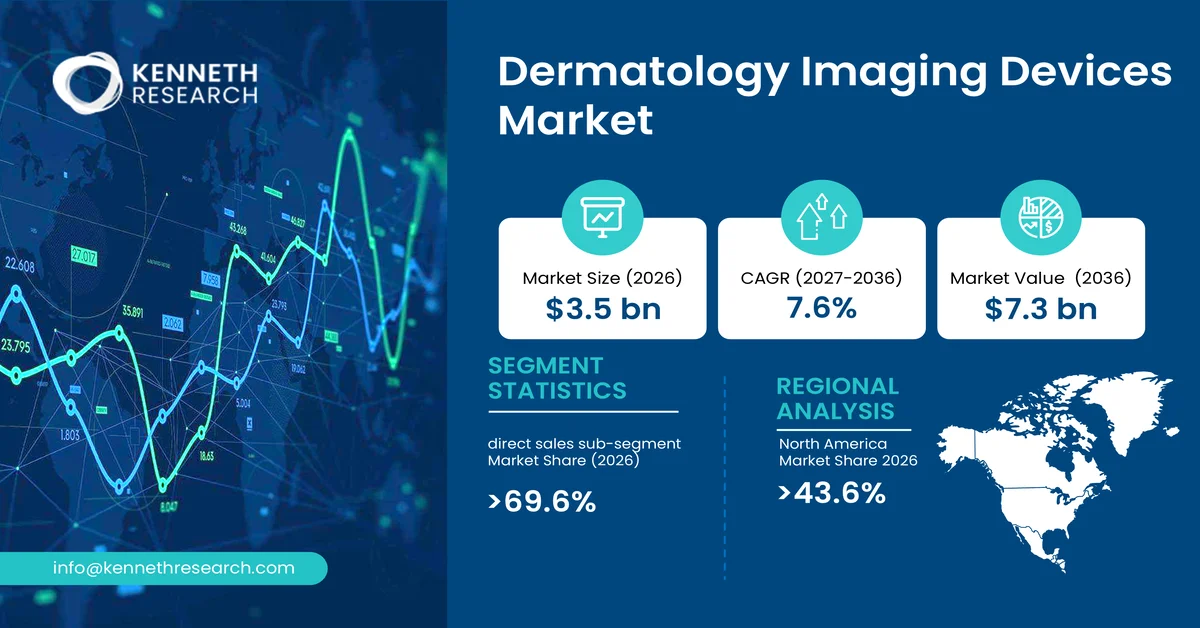
Dermatology imaging devices market size was valued at USD 3.5 billion in 2026 and is projected to reach USD 7.3 billion by the end of 2036, rising at a CAGR of 7.6% during the forecast period, i.e., 2027–2036. In 2027, the industry size of the dermatology imaging devices market is estimated at USD 3.8 billion.
The rising burden of skin cancer is a key growth driver for dermatology imaging devices, increasing demand for technologies that support earlier lesion assessment, documentation, monitoring, and clinical decision-making.
The dermatology imaging devices market comprises medical imaging technologies used to capture, magnify, visualize, document, and analyze skin, lesions, pigmentation, vascular structures, and other dermatological abnormalities. These devices support dermatologists and other healthcare professionals in clinical examination, disease assessment, longitudinal monitoring, treatment planning, and research.
Key technologies include dermoscopy, digital photography, total-body photography, reflectance confocal microscopy, multispectral and hyperspectral imaging, optical coherence tomography, and other specialized optical or image-based systems. Device configurations range from handheld and portable instruments to integrated or standalone systems designed for clinical environments. Advanced platforms may combine specialized illumination, magnification, image capture, digital storage, measurement, and computer-assisted analysis.
Key Dermatology Imaging Devices Market Insights Summary:
Key Takeaways: Market Trends & Insights
- 2026 market value of USD 3.5 billion, increasing to USD 7.3 billion by 2036 at a CAGR of 7.6%
- Direct Sales leads the Distribution Channel segment with a 69.6% market share in 2026
- North America dominates the regional landscape with a 43.6% market share in 2026
- Standalone Systems represent the second key segment under Portability, supported by demand for dedicated dermatology imaging workflows
- The United States and Canada remain the key countries supporting North America's leadership, while Germany and France anchor the secondary European market
Market Drivers
- Rising skin cancer burden and increasing need for lesion assessment
- Integration of artificial intelligence and digital imaging workflows
- Expansion of teledermatology and remote dermatological assessment
- Advancement of portable, high-resolution, and multimodal imaging technologies
Challenges
- High capital and implementation costs
- Clinical workflow integration and data management complexity
Dermatology Imaging Devices Market Overview & Supply Chain
Adoption of dermatology imaging devices is increasing globally as healthcare systems place greater emphasis on earlier detection, objective assessment, longitudinal monitoring, and digitally supported dermatological care. Imaging technologies such as dermoscopy, digital photography, reflectance confocal microscopy, multispectral imaging, and optical coherence tomography are increasingly relevant to clinical workflows because they enable enhanced visualization and documentation of cutaneous abnormalities.
The dermatology imaging devices value chain begins with specialized inputs, including optical components, image sensors, illumination systems, electronics, processors, housings, displays, connectivity components, and software. Component suppliers provide these inputs to device manufacturers, which integrate hardware, imaging technologies, software, and user interfaces into finished systems. Manufacturing encompasses component assembly, calibration, quality assurance, software validation, packaging, and regulatory compliance. Distribution typically operates through direct sales teams, specialized medical-device distributors, healthcare procurement organizations, and channel partners. End users include hospitals, dermatology clinics, diagnostic centers, outpatient facilities, academic institutions, and research organizations.
Dermatology Imaging Devices Market - Growth Drivers & Challenges
Growth Drivers
- Rising Skin Cancer Burden and Increasing Need for Lesion Assessment: The growing clinical burden of skin cancer is increasing demand for imaging technologies that enable detailed lesion visualization, documentation, and longitudinal monitoring. Dermatology imaging devices can enhance examination beyond unaided visual inspection, supporting clinicians in identifying suspicious lesions and tracking changes over time.
- Integration of Artificial Intelligence and Digital Imaging Workflows: The integration of artificial intelligence, image-analysis software, cloud connectivity, and digital patient records is expanding the functionality of dermatology imaging devices. Instead of serving solely as image-capture instruments, advanced systems can support standardized documentation, lesion comparison, image organization, workflow management, and computer-assisted assessment.
Challenges
- High Capital and Implementation Costs: The relatively high acquisition and implementation costs associated with advanced dermatology imaging systems can constrain adoption, particularly among smaller dermatology practices, outpatient facilities, and healthcare providers operating under restricted capital budgets. The cost burden extends beyond the imaging hardware to specialized optical components, software licenses, installation, calibration, maintenance, upgrades, staff training, and integration with existing clinical information systems.
- Clinical Workflow Integration and Data Management Complexity: Integration challenges can restrain adoption when dermatology imaging systems operate separately from electronic health records, diagnostic platforms, or existing clinical workflows. Imaging devices generate substantial visual information that must be captured, stored, retrieved, shared, and protected appropriately. Inadequate interoperability can require manual data transfer, duplicate documentation, or additional administrative steps, reducing workflow efficiency and discouraging routine use.
Dermatology Imaging Devices Market Size and Forecast:
| Report Attribute | Details |
|---|---|
| Base Year |
2026 |
| Forecast Year |
2027-2036 |
| CAGR |
7.6% |
| Base Year Market Size (2026) |
USD 3.5 billion |
| Forecast Year Market Size (2036) |
USD 7.3 billion |
| Regional Scope |
|
Dermatology Imaging Devices Market - Segment Analysis
Distribution Channel Segment Analysis
In the distribution channel segment, direct sales sub-segment is anticipated to capture the largest market share of 69.6% by the end of 2026.
Direct sales dominates the distribution-channel segment because dermatology imaging devices often require clinical demonstration, application-specific configuration, installation, training, and post-sale technical support. These requirements favor manufacturer-to-provider relationships, particularly when hospitals and specialist clinics evaluate equipment based on image quality, workflow compatibility, software capabilities, and service arrangements. On the supply side, direct sales can facilitate customization and feedback between providers and manufacturers, supporting product refinement. Going forward, direct distribution is likely to remain important for sophisticated systems, while digital purchasing and distributor partnerships may complement rather than replace manufacturer-led selling.
Portability Segment Analysis
The standalone systems is projected to grow as the second-largest segment in the dermatology imaging devices market due to four converging demand drivers.
Standalone systems are projected to expand as healthcare providers seek dedicated dermatology imaging platforms that can deliver specialized visualization without requiring integration into larger multifunctional equipment. Demand is supported by the need for consistent lesion documentation, image comparison, clinical assessment, and specialized imaging workflows across dermatology practices and outpatient settings. In the United States, the Agency for Healthcare Research and Quality recorded 1,700,807 weighted outpatient department visits to dermatology specialists in 2022, indicating a substantial clinical environment in which dedicated imaging capabilities can be utilized. Standalone configurations can offer focused functionality, simpler deployment, and greater flexibility for facilities that want dedicated imaging capacity. Supply-side innovation is also broadening available configurations, including systems incorporating digital capture, specialized illumination, image processing, and multimodal imaging.
Our in-depth analysis of the dermatology imaging devices market includes the following segments:
|
Segment |
Sub-segment |
|
Device Type |
|
|
Application |
|
|
Technology |
|
|
End User |
|
|
Portability |
|
|
Distribution Channel |
|
Dermatology Imaging Devices Market - Regional Analysis
North America Market Trends & Insights:
North America dermatology imaging devices is projected to hold the largest revenue share of 43.6% by the end of 2026.
The region also benefits from substantial investment in diagnostic technologies and a regulatory environment that supports the commercialization of innovative medical devices. Demand is reinforced by the clinical burden of dermatological conditions and the increasing emphasis on structured lesion assessment and monitoring.
United States remains the principal country within the region, supported by extensive specialist healthcare infrastructure, established medical-device development capabilities, and broad utilization of digital clinical technologies.
Canada provides a complementary market supported by public healthcare infrastructure, growing attention to skin-cancer prevention and detection, and expanding access to dermatological services. Together, both countries create a favorable environment for manufacturers supplying imaging platforms, software, and associated clinical technologies.
Europe Market Market Trends & Insights:
Europe represents a supportive environment for dermatology imaging devices, underpinned by established specialist healthcare systems, expanding digital-health infrastructure, and stronger emphasis on prevention and early disease detection.
Germany benefits from established dermatological infrastructure and formalized skin-cancer screening. The Federal Ministry of Health states that statutory skin-cancer screening includes standardized full-body inspection for adults from the specified eligibility age, supporting continued demand for structured examination and documentation technologies.
France offers opportunities through its participation in EU cancer and digital-health initiatives, including European programmes focused on strengthening digital capabilities, telemedicine, data exchange, and advanced diagnostic approaches.
Dermatology Imaging Devices Market Competitive Landscape
Here is a list of upstream, downstream, and key players operating in dermatology imaging devices market competitive ecosystem:
- Canfield Scientific, Inc. (United States)
- Company Overview
- Business Strategy
- Key Product Offerings
- Financial Performance
- Key Performance Indicators
- Risk Analysis
- Recent Development
- Regional Presence
- SWOT Analysis
- FotoFinder Systems GmbH (Germany)
- DermaSensor, Inc. (United States)
- Longport, Inc. (United States)
Recent Developments
- In March 2026, Canfield Scientific announced that its D2 Digital Dermatoscope won the DERM 2026 Award for Innovative Medical Dermatological Diagnostic Device. The D2 combines high-resolution imaging with advanced software for clinical, dermoscopy, and trichoscopy captures, seamlessly integrating with DermaGraphix and HairMetrix for efficient lesion surveillance and automated hair analysis. It enables workflow-guided follow-ups by linking close-up images directly to tagged lesions on a body map or 3D avatar.
- In June 2026, DermaSensor announced it received Class IIb CE Mark and began a collaboration with the NHS. The CE Mark enables commercialization across the European Economic Area. The collaboration with the NHS focuses on a feasibility study evaluating AI-assisted skin cancer assessment when used by GPs within the NHS setting. This marks the beginning of the company's global expansion following its FDA clearance and U.S. commercial launch.
Frequently Asked Question
In 2026, the dermatology imaging devices market exceeded USD 3.5 billion.
The dermatology imaging devices market is projected to reach USD 7.3 billion by the end of 2036, expanding at a CAGR of 7.6% over the forecast period (2027-2036).
The major players in the market are Canfield Scientific, Inc., FotoFinder Systems GmbH, DermaSensor, Inc., Longport, Inc., and others.
In the Distribution Channel segment, the Direct Sales sub-segment is anticipated to capture the largest market share of 69.6% in the future and exhibit lucrative growth opportunities during 2027-2036. This growth trajectory is largely attributed to the need for clinical demonstration, product configuration, installation, training, and post-sale technical support.
North America is projected to hold the largest market share of 43.6% by the end of 2036 and provide more business opportunities in the future. Continuous investments in advanced healthcare infrastructure, dermatological imaging technologies, and digital clinical workflows are fostering the region's dominance.
Why Choose Kenneth Research ?
-
Insight with Impact : We don’t just gather data — we uncover stories, trends, and opportunities that fuel business growth.
-
Experts Who Get It : Our team speaks your industry’s language and knows what really matters to your customers and market.
-
Custom-Built for You : Forget one-size-fits-all. We craft research and consulting solutions as unique as your business vision.
-
Partners, Not Just Providers : We work with you, not for you — collaborating closely to turn insights into smart, strategic moves.
-
Results That Speak : Our work powers brands, startups, and industry leaders alike — with a track record of ideas that work in the real world.
Report ID: 1463 |
Published Date: 29 Sep 2026 |
Report Format: |
Delivery Timeline: 48-72 Business Hours

Copyright © 2025 Kenneth Research. All rights reserved. Terms of Use | Privacy Policy
