Report ID: 1030 |
Published Date: 28 Jul 2026 |
Report Format: |
Delivery Timeline: 48-72 Business Hours
Dental Wax Market Outlook:
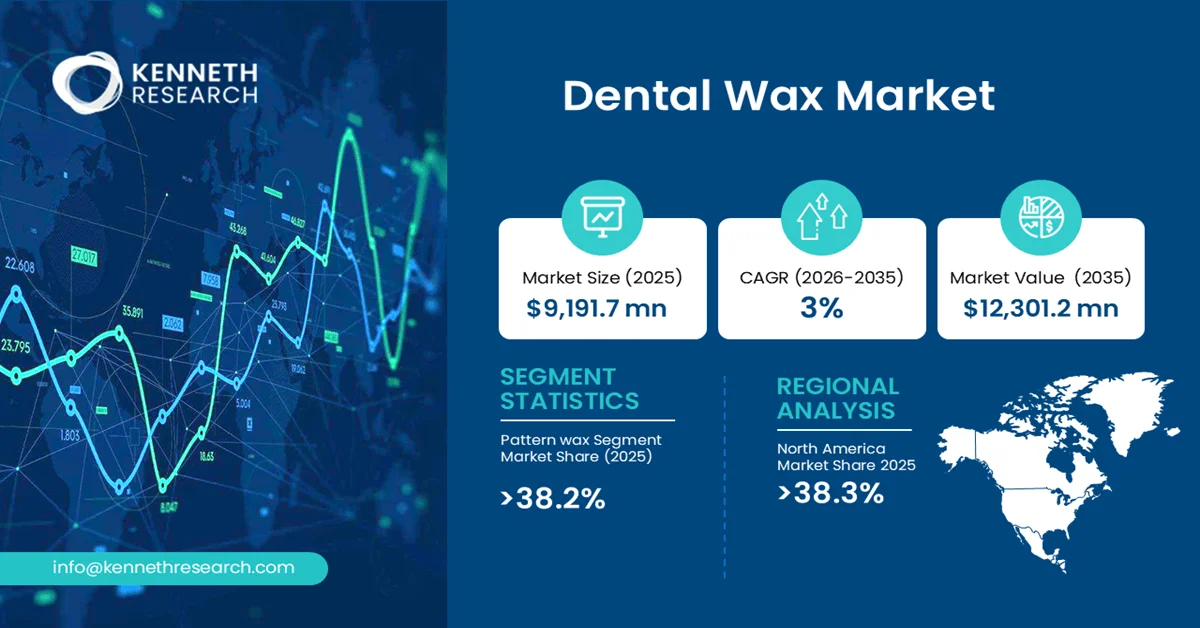
Dental Wax Market size was valued at USD 9,191.7 million in 2025 and is projected to reach USD 12,301.2 million by the end of 2035, rising at a CAGR of 3.0% during the forecast period, i.e., 2026-2035. In 2026, the industry size of the dental wax is estimated at USD 9,458.3 million.
Growing global demand for restorative, prosthetic, and cosmetic dental procedures is the primary driver of the dental wax market. The continued expansion of the oral healthcare workforce, including dentists and dental prosthetic technicians, is increasing the use of specialized waxes for impression taking, pattern fabrication, bite registration, and laboratory modeling.
The dental wax market comprises the production, distribution, and commercialization of specialized wax materials used across restorative dentistry, prosthodontics, orthodontics, dental laboratories, and educational institutions. These waxes are formulated to provide controlled melting characteristics, dimensional stability, workability, and carving precision, enabling accurate fabrication of crowns, bridges, dentures, removable partial dentures, orthodontic appliances, and other dental restorations. Common product categories include pattern wax, processing wax, impression wax, utility wax, and bite registration wax, each designed for specific clinical or laboratory applications.
Dental wax serves as an indispensable consumable throughout the dental workflow, supporting treatment planning, prosthetic modeling, casting preparation, occlusal registration, and appliance adaptation before definitive restoration manufacturing. Its compatibility with both conventional laboratory techniques and digitally assisted production workflows reinforces its importance across modern dental practices. Industrially, the market supports dental material manufacturers, prosthetic laboratories, academic institutions, and clinical service providers by enabling precision-driven restorative procedures while maintaining manufacturing efficiency and product consistency. As oral healthcare systems continue strengthening workforce capacity and prosthetic care capabilities, dental wax remains a foundational material supporting high-quality dental restoration and appliance fabrication.
Key Dental Wax Market Insights Summary:
Key Takeaways: Market Trends & Insights
- Dental Wax market is projected to grow from USD 9,458.3 million in 2026 to USD 12,301.2 million by 2035, registering a 3.0% CAGR
- Pattern Wax led the Type segment with a 38.2% share in 2025, supported by its extensive use in restorative and prosthetic dental applications
- Dentist Clinics are expected to witness strong growth as expanding outpatient dental services and increasing restorative procedures drive sustained demand for dental wax products
- North America accounted for 38.3% of the global market in 2025, led by advanced dental infrastructure and strong adoption across the United States and Canada
- Europe continues to present significant growth opportunities, with Germany and the United Kingdom strengthening regional demand through advanced dental laboratory capabilities and ongoing digital dentistry adoption
Market Drivers
- Increasing adoption of cosmetic and aesthetic dentistry worldwide
- Growing investments in dental laboratory modernization and automation
- Rising demand for orthodontic and prosthodontic treatments across aging populations
- Expansion of dental education and clinical training infrastructure
Challenges
- Supply shift toward fully digital dental manufacturing workflows
- Volatility in specialty raw material sourcing and production costs
Dental Wax Market Overview & Supply Chain
The adoption of dental wax is increasing globally as oral healthcare systems expand restorative and prosthetic treatment capacity while dental laboratories continue integrating precision-oriented manufacturing workflows. Dental wax remains an essential consumable for pattern fabrication, bite registration, impression correction, and appliance processing, making it indispensable in both conventional and digitally assisted dental production. Rising awareness of preventive and restorative oral care, together with advances in prosthodontics and orthodontics, is reinforcing demand for high-performance dental materials that deliver dimensional stability and consistent handling characteristics. This trend is further supported by international oral health initiatives. According to the World Health Organization's Global Oral Health Status Report, approximately 3.5 billion people worldwide are affected by oral diseases, underscoring the sustained need for dental diagnosis, restoration, and prosthetic interventions that rely on specialized dental materials, including dental wax.
The dental wax market value chain begins with the procurement of raw materials, including natural waxes such as beeswax and carnauba wax, synthetic waxes, paraffin, microcrystalline waxes, resins, pigments, and performance-enhancing additives sourced from specialty chemical suppliers. Manufacturers formulate these materials into application-specific products through controlled blending, refining, molding, extrusion, and quality testing processes to ensure dimensional stability, melting behavior, and biocompatibility. Finished products are distributed through dental material distributors, specialized dealers, e-commerce channels, and direct sales networks serving clinics and laboratories. End users include dentist clinics, dental laboratories, hospitals, academic institutions, and orthodontic centers that utilize dental wax throughout restorative, prosthetic, and orthodontic workflows. Major stakeholders across the ecosystem include raw material suppliers, dental material manufacturers, equipment providers, regulatory authorities, distributors, dental professionals, laboratory technicians, procurement organizations, and educational institutions, all contributing to product innovation, regulatory compliance, and consistent supply across the oral healthcare industry.
Dental Wax Market: Growth Drivers & Challenges
Growth Drivers:
- Expanding Global Focus on Oral Health and Restorative Care: Growing policy emphasis on oral healthcare and wider access to restorative dental services are creating sustained demand for essential dental consumables, including dental wax. As governments and healthcare systems strengthen preventive and restorative oral health programs, dental clinics and laboratories require reliable materials for prosthetic fabrication, occlusal registration, and appliance customization. This has encouraged manufacturers to develop application-specific wax formulations with improved handling, carving precision, and dimensional stability. The resulting increase in restorative workflows also supports investments in laboratory modernization and clinician training. Looking ahead, broader integration of oral healthcare into universal health coverage initiatives is expected to reinforce procurement of dental materials across both developed and emerging healthcare systems. According to the World Health Organization, approximately 3.5 billion people—around 45% of the global population—are affected by oral diseases, highlighting the continuing need for restorative dental procedures and associated materials.
- Advancements in Digital Prosthodontics and Dental Laboratory Workflows: The rapid evolution of digital dentistry is reshaping laboratory operations while maintaining the importance of dental wax in hybrid manufacturing environments. Although CAD/CAM systems and additive manufacturing have streamlined several production stages, wax continues to play a critical role in pattern creation, framework verification, casting preparation, and adjustment procedures where manual precision remains essential. Manufacturers are responding by introducing wax materials with enhanced thermal stability, cleaner burnout performance, and compatibility with modern fabrication techniques. These innovations improve workflow efficiency, reduce production errors, and support consistent restoration quality across dental laboratories. As laboratories increasingly combine digital design with conventional processing techniques, demand for specialized wax formulations is expected to remain resilient. Future developments emphasizing automation, material consistency, and interoperability with digital production systems will further strengthen the strategic role of dental wax in advanced restorative and prosthetic dentistry.
Challenges:
- Gradual Substitution by Fully Digital Dental Manufacturing Workflows: The increasing adoption of fully digital dental manufacturing presents a structural challenge for the dental wax market. Advanced CAD/CAM systems, intraoral scanners, and direct additive manufacturing technologies are reducing dependence on conventional wax-based modeling in selected restorative applications. While hybrid workflows continue to utilize dental wax, laboratories investing in end-to-end digital production increasingly eliminate intermediate wax pattern fabrication for certain prosthetic components. This transition influences procurement strategies, encouraging laboratories to allocate higher budgets toward digital equipment and software rather than traditional consumables. Commercially, manufacturers of dental wax must continuously innovate by developing products that complement digital fabrication instead of competing with it. Looking ahead, companies capable of positioning dental wax as a value-added material for hybrid workflows, quality verification, and specialized prosthetic applications will be better equipped to maintain relevance as digital dentistry continues expanding.
- Volatility in Specialty Raw Material Supply and Manufacturing Costs: Dental wax manufacturers depend on a combination of natural waxes, petroleum-derived waxes, specialty resins, pigments, and functional additives that require consistent quality and controlled processing characteristics. Fluctuations in raw material availability, evolving environmental compliance requirements, and changing production costs can disrupt manufacturing schedules and compress profit margins. Maintaining stringent quality standards while managing variable input costs becomes particularly challenging for suppliers serving highly regulated dental markets that demand product consistency and traceability. Commercially, prolonged cost pressures may reduce pricing flexibility, increase inventory management complexity, and affect competitiveness in price-sensitive regions. Over the long term, manufacturers are expected to diversify sourcing strategies, invest in formulation optimization, and strengthen supplier partnerships to improve supply chain resilience while maintaining the performance characteristics required for professional dental applications.
Dental Wax Market Size and Forecast:
| Report Attribute | Details |
|---|---|
| Base Year |
2025 |
| Forecast Year |
2026-2035 |
| CAGR |
3% |
| Base Year Market Size (2025) |
USD 9,191.7 million |
| Forecast Year Market Size (2035) |
USD 12,301.2 million |
| Regional Scope |
|
Dental Wax Market Segmentation Analysis:
Type Segment Analysis
In the type segment, the pattern wax sub-segment is anticipated to capture the largest market share of 38.2% by the end of 2025.
Pattern wax dominates the dental wax market because it is indispensable for fabricating accurate wax patterns used in crowns, bridges, inlays, onlays, removable partial dentures, and precision cast restorations. Its superior carving characteristics, dimensional stability, and clean burnout properties enable dental technicians to produce highly accurate restorations with minimal casting defects. Current demand is supported by the continued volume of restorative and prosthodontic procedures performed in dental laboratories, where pattern wax remains integral to both conventional lost-wax casting and hybrid digital workflows. On the supply side, manufacturers continue improving formulations to enhance thermal stability, handling consistency, and compatibility with modern laboratory processes, ensuring reliable performance across diverse clinical applications. Future demand is expected to remain resilient as dental laboratories increasingly combine digital design technologies with conventional casting techniques that continue to require precision wax patterns. Supporting this demand, the U.S. Centers for Disease Control and Prevention reported in its 2024 Oral Health Surveillance Report that adults aged 20 – 64 years with one or more decayed, missing, or filled permanent teeth had, on average, 6.0 filled teeth, demonstrating the substantial need for restorative dental procedures that rely on laboratory-fabricated restorations.
Application Segment Analysis
The dentist clinics is projected to grow as the second-largest segment in the dental wax market due to four converging demand drivers.
Dentist clinics are projected to experience sustained growth as they remain the primary point of care for preventive, restorative, cosmetic, and prosthetic dental treatments that require routine use of dental wax during clinical and laboratory workflows. Increasing patient preference for outpatient dental services, coupled with the expansion of private dental practices and integrated clinic-laboratory networks, is driving procurement of specialized wax products for bite registration, impression modification, temporary restorations, and prosthetic fabrication. Adoption trends also reflect greater utilization of hybrid treatment workflows, where digital scanning is complemented by conventional laboratory procedures that continue to depend on precision wax materials. On the supply side, manufacturers are introducing application-specific wax formulations with improved handling properties and workflow compatibility, enabling clinics to achieve consistent treatment outcomes. The long-term outlook remains favorable as investments in oral healthcare infrastructure and professional dental services continue expanding. Supporting this trend, the OECD reported that in 2022, EU countries had between 0.5 and 1.3 dentists per 1,000 population, reflecting the broad clinical infrastructure supporting ongoing demand for dental materials used in everyday patient care.
Our in-depth analysis of the global dental wax market includes the following segments:
|
Segment |
Sub-segment |
|
Type |
|
|
Application |
|
Dental Wax Market Regional Insights:
North America Market Trends & Insights:
North America dental wax market is projected to hold the largest revenue share of 38.3% by the end of 2025.
The region benefits from strong investment in dental technologies, consistent demand for high-quality dental consumables, and rigorous regulatory oversight that promotes product quality and patient safety. Manufacturers operating in North America also benefit from mature distribution networks, close collaboration with dental professionals, and continuous product innovation tailored to clinical and laboratory applications. The region's emphasis on preventive oral healthcare, combined with sustained investments in digital dentistry and prosthodontics, reinforces demand for specialized dental wax products used in restorative workflows. Additionally, favorable reimbursement mechanisms in selected treatment areas and a highly developed dental materials ecosystem support long-term market leadership.
The United States remains the primary contributor to regional demand due to its extensive network of dental clinics, prosthetic laboratories, and manufacturers of dental materials. Continued investments in digital dentistry and restorative care sustain procurement of high-performance wax products for conventional and hybrid laboratory workflows.
Canada complements regional growth through expanding access to dental services, increasing awareness of preventive oral healthcare, and modernization of dental practices and laboratory capabilities.
Europe Market Trends & Insights:
Europe represents a strategically important region for the dental wax market, supported by a mature oral healthcare ecosystem, advanced dental laboratory capabilities, and widespread adoption of restorative and prosthetic dentistry. Demand is driven by the region's strong emphasis on preventive oral care, increasing utilization of aesthetic dental procedures, and continued modernization of laboratory workflows that combine digital technologies with conventional fabrication techniques. Stringent regulatory frameworks governing dental materials encourage manufacturers to prioritize product quality, traceability, and compliance, fostering innovation in specialized wax formulations. Government-supported oral health programs, investments in healthcare infrastructure, and collaboration between academic institutions and dental manufacturers further strengthen the regional market environment. Looking ahead, opportunities are expected to emerge from the growing adoption of digital dentistry, expansion of same-day restorative solutions, and increasing demand for customized prosthetic devices, where hybrid manufacturing processes continue to require precision dental wax for selected laboratory applications.
Germany remains a leading contributor to regional demand due to its highly developed dental manufacturing industry, advanced prosthodontic laboratories, and strong presence of dental material producers. Continuous investment in research, laboratory automation, and precision restorative technologies supports sustained adoption of high-performance dental wax products across clinical and laboratory settings.
The United Kingdom contributes through its established network of dental practices, growing focus on preventive and restorative oral healthcare, and ongoing integration of digital technologies into dental service delivery. Increasing collaboration between dental laboratories, educational institutions, and material manufacturers is expected to support innovation while reinforcing demand for specialized wax products used in restorative, orthodontic, and prosthetic procedures.
Leading Companies Operating in the Global Dental Wax Market:
Here is a list of upstream, downstream, and key players operating in the global dental wax market competitive ecosystem:
- Kerr Dental (Kerr Corporation) (United States)
- Company Overview
- Business Strategy
- Key Product Offerings
- Financial Performance
- Key Performance Indicators
- Risk Analysis
- Recent Development
- Dentsply Sirona (United States)
- Coltene Whaledent AG (Switzerland)
- Renfert GmbH (Germany)
- Cavex (Netherlands)
- Planmeca (Finland)
Recent Developments
- In July 2022, Doc Brands, Inc. introduced OrthoDots CLEAR and OrVance Retainer Cleaner in professional dispensing packs. OrthoDots CLEAR is a moisture-activated silicone dental wax alternative designed to alleviate pain and irritation caused by braces, clear aligners, and other orthodontic devices, offering a modern alternative to traditional orthodontic wax.
- In September 2025, Kemdent launched its new Aesthetic Wax range for denture try-ins, available in four unique colours—burgundy, ivory, plum, and ruby. The wax offers excellent handling qualities and retains its shape during use, enabling clinicians to create natural-looking, stable wax denture try-ins that can be easily modified before final restoration fabrication.
Frequently Asked Question
In 2025, the dental wax market exceeded USD 9,191.7 million.
The dental wax market is projected to reach USD 12,301.2 million by the end of 2035, expanding at a CAGR of 3.0% over the forecast period (2026-2035).
The major players in the market are Kerr Dental (Kerr Corporation), Dentsply Sirona, Coltene Whaledent AG, Renfert GmbH, Cavex, Planmeca, and others.
In the Type segment, the Pattern Wax sub-segment is anticipated to capture the largest market share of 38.2% in the future and exhibit lucrative growth opportunities during 2026–2035. This growth trajectory is largely attributed to increasing demand for restorative and prosthetic dental procedures requiring precise pattern fabrication and laboratory workflows.
North America is projected to hold the largest market share of 38.3% by the end of 2035 and provide more business opportunities in the future. Continuous investments in advanced dental care infrastructure, prosthetic laboratory capabilities, and digital dentistry across the United States and Canada are fostering the region's dominance.
Why Choose Kenneth Research ?
-
Insight with Impact : We don’t just gather data — we uncover stories, trends, and opportunities that fuel business growth.
-
Experts Who Get It : Our team speaks your industry’s language and knows what really matters to your customers and market.
-
Custom-Built for You : Forget one-size-fits-all. We craft research and consulting solutions as unique as your business vision.
-
Partners, Not Just Providers : We work with you, not for you — collaborating closely to turn insights into smart, strategic moves.
-
Results That Speak : Our work powers brands, startups, and industry leaders alike — with a track record of ideas that work in the real world.
Report ID: 1030 |
Published Date: 28 Jul 2026 |
Report Format: |
Delivery Timeline: 48-72 Business Hours

Copyright © 2025 Kenneth Research. All rights reserved. Terms of Use | Privacy Policy
