Report ID: 1100 |
Published Date: 18 Aug 2026 |
Report Format: |
Delivery Timeline: 48-72 Business Hours
Dental Surgical Instruments Market Outlook:
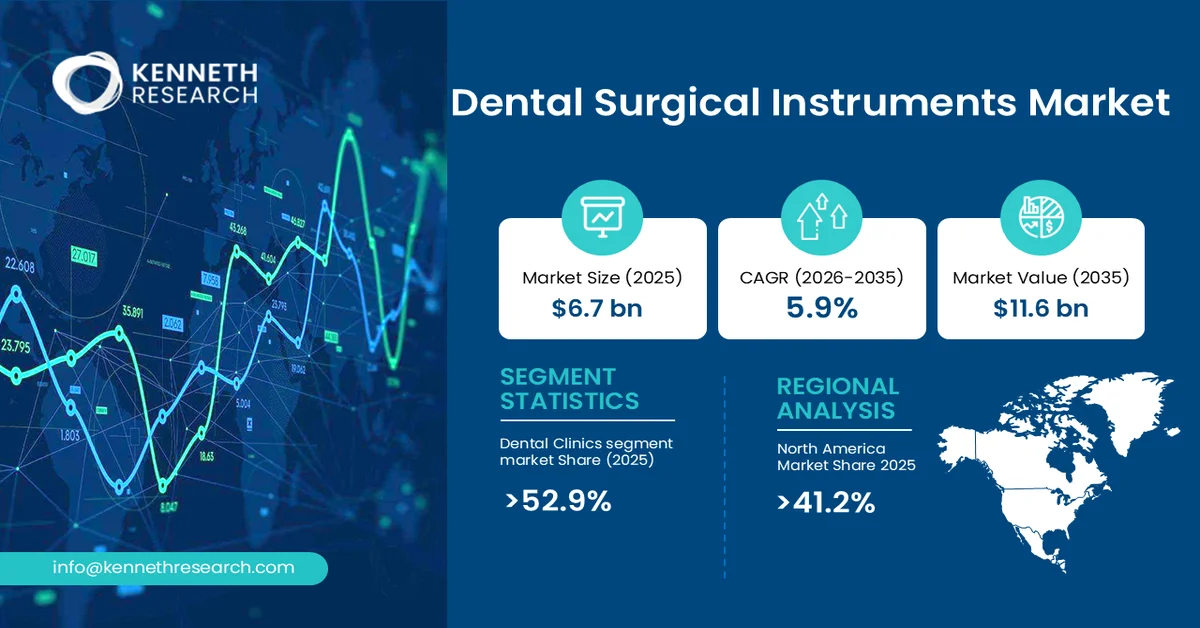
Dental Surgical Instruments Market size was valued at USD 6.7 billion in 2025 and is projected to reach USD 11.6 billion by the end of 2035, rising at a CAGR of 5.9% during the forecast period, i.e., 2026-2035. In 2026, the industry size of the dental surgical instruments is estimated at USD 6.9 billion.
The primary growth driver for the dental surgical instruments market is the increasing utilization of professional dental care driven by the persistent burden of oral diseases and expanding access to clinical treatment. Higher patient volumes across dental practices are accelerating demand for precision surgical instruments used in restorative, periodontal, implant, and oral surgery procedures.
The dental surgical instruments market comprises specialized manual and powered instruments used by dental professionals to diagnose, treat, restore, and surgically manage oral and maxillofacial conditions. These instruments include extraction forceps, elevators, dental mirrors, probes, scalers, curettes, surgical scissors, needle holders, retractors, bone files, chisels, implant surgical kits, and other precision devices designed for clinical accuracy and patient safety.
Dental surgical instruments are characterized by high-grade biocompatible materials, corrosion resistance, sterilization compatibility, ergonomic designs, and precision engineering to support minimally invasive and complex oral procedures. They are used across general dentistry, implantology, periodontics, endodontics, prosthodontics, orthodontics, and oral surgery, enabling clinicians to perform accurate tissue management, tooth extraction, implant placement, and reconstructive procedures.
The market is strategically important to the broader healthcare ecosystem because these instruments form the foundation of routine and advanced dental interventions performed in hospitals, dental clinics, and academic institutions. Growing emphasis on preventive oral healthcare, infection control, procedural efficiency, and improved clinical outcomes continues to reinforce the demand for technologically advanced and durable dental surgical instruments.
Key Dental Surgical Instruments Market Insights Summary:
Key Takeaways: Market Trends & Insights
- The dental surgical instruments market was valued at USD 6.7 billion in 2025 and is projected to reach USD 11.6 billion by 2035, registering a 5.9% CAGR during 2026-2035
- Dental Clinics led the end-user segment with a 52.9% share in 2025, supported by high procedural volumes and increasing adoption of advanced surgical instruments
- North America accounted for the largest regional share at 41.2% in 2025, driven by advanced healthcare infrastructure, strong regulatory standards, and widespread adoption of innovative dental technologies
- Implantology is projected to be one of the fastest-growing application segments, fueled by rising adoption of dental implants, digital treatment planning, and minimally invasive surgical procedures
- Growing investments in modern dental infrastructure, digital dentistry, and precision surgical technologies are strengthening long-term demand for high-performance dental surgical instruments across developed and emerging markets
Market Drivers
- Expansion of cosmetic and restorative dentistry procedures worldwide.
- Continuous innovation in high-performance materials and precision instrument manufacturing.
- Rising integration of digital dentistry and computer-guided surgical workflows.
- Growing emphasis on infection prevention and regulatory compliance in dental practices.
Challenges
- High compliance and product validation requirements.
- Pricing pressure from procurement consolidation and low-cost competition.
Dental Surgical Instruments Market Overview & Supply Chain
The adoption of dental surgical instruments is increasing globally as healthcare systems place greater emphasis on preventive oral healthcare, minimally invasive procedures, infection prevention, and expanded access to dental services. Advances in instrument metallurgy, ergonomic designs, precision manufacturing, and sterilization compatibility are improving procedural efficiency while supporting increasingly complex interventions such as implant placement and periodontal surgery. Regulatory initiatives promoting integration of oral health into broader healthcare policies are also strengthening long-term demand for high-quality surgical instruments. The World Health Organization reported in its 2024 Global Strategy and Action Plan on Oral Health that oral diseases affect an estimated 3.5 billion people worldwide, reinforcing the need for expanded oral healthcare infrastructure and modern dental treatment capabilities across both developed and emerging economies.
The dental surgical instruments industry begins with the procurement of premium raw materials such as stainless steel, titanium alloys, tungsten carbide, medical-grade polymers, and specialized coatings that ensure durability, corrosion resistance, and repeated sterilization performance. Component manufacturers transform these materials into precision-engineered instruments through forging, machining, grinding, polishing, and quality validation processes while complying with stringent medical device standards. Original equipment manufacturers integrate design innovation, ergonomic optimization, and regulatory compliance before distributing finished products through authorized distributors, dental equipment suppliers, procurement organizations, and digital sales channels. End users primarily include dental clinics, hospitals, ambulatory surgical centers, academic institutions, and specialty oral surgery practices. Key stakeholders across the value chain include raw material suppliers, component fabricators, contract manufacturers, medical device companies, regulatory authorities, logistics providers, distributors, dental professionals, procurement organizations, and healthcare institutions, all contributing to product quality, supply continuity, clinical safety, and procedural efficiency.
Dental Surgical Instruments Market - Growth Drivers & Challenges
Growth Drivers:
- Rising adoption of implant and minimally invasive dental procedures: The growing preference for implant-supported restorations and minimally invasive oral surgeries is a major catalyst for the dental surgical instruments market. Dental professionals increasingly rely on precision-engineered surgical instruments that improve procedural accuracy, reduce tissue trauma, and enhance patient recovery. This trend is encouraging manufacturers to develop specialized instrument kits, ergonomic hand instruments, and advanced implant placement systems that support predictable clinical outcomes. The expansion of digital workflows, including guided surgery and computer-assisted treatment planning, is further increasing demand for highly precise surgical instrumentation. From an industry perspective, the shift toward sophisticated restorative procedures is driving innovation in material selection, instrument durability, and sterilization compatibility. Looking ahead, continued integration of digital dentistry and implant-based treatment protocols is expected to reinforce demand for specialized surgical instruments across both mature and emerging healthcare markets. The U.S. FDA identifies endosseous dental implant accessories as a regulated medical device category under 21 CFR 872.3980, underscoring the expanding regulatory and clinical framework supporting implant-related instrumentation.
- Increasing investment in modern dental infrastructure and clinical efficiency: Healthcare providers and private dental organizations are investing in modern treatment facilities to improve procedural efficiency, infection control, and patient experience. These investments are accelerating the replacement of conventional instruments with ergonomically designed, corrosion-resistant, and precision-manufactured surgical tools capable of supporting high procedural volumes. Simultaneously, greater emphasis on standardized sterilization protocols and workflow optimization is encouraging clinics to procure premium-quality reusable instruments with extended service life. Manufacturers are responding through product innovation focused on lightweight materials, enhanced grip designs, and compatibility with advanced sterilization technologies. Over the long term, continued expansion of specialty dental practices, ambulatory oral surgery centers, and integrated dental care networks is expected to create sustained demand for technologically advanced surgical instruments that improve clinician productivity while maintaining high standards of procedural safety and treatment quality.
Challenges:
- High compliance and product validation requirements: The dental surgical instruments industry operates within a highly regulated environment where manufacturers must comply with stringent quality management systems, biocompatibility standards, sterilization validation, and medical device regulations before products reach the market. These requirements increase development timelines and necessitate continuous investment in documentation, testing, traceability, and post-market surveillance. For manufacturers, particularly small and mid-sized firms, the cost of maintaining regulatory compliance can reduce operational flexibility and slow the commercialization of innovative products. Healthcare providers may also experience delayed access to newly developed instruments when regulatory approvals extend product launch schedules. As regulatory expectations continue to evolve alongside patient safety and infection control requirements, companies will need to strengthen quality assurance capabilities, digital documentation systems, and global regulatory expertise to remain competitive while ensuring uninterrupted market access.
- Pricing pressure from procurement consolidation and low-cost competition: The market faces increasing pricing pressure as large healthcare networks, group purchasing organizations, and multi-location dental service organizations centralize procurement decisions and negotiate more aggressively with suppliers. At the same time, manufacturers compete against lower-cost alternatives that often target price-sensitive markets, making product differentiation more challenging. This environment compresses profit margins and encourages suppliers to balance competitive pricing with investments in product innovation, manufacturing precision, and customer support. Commercially, companies must justify premium pricing through superior instrument performance, durability, ergonomic design, and after-sales service rather than competing solely on cost. Looking ahead, sustained pricing competition is expected to accelerate manufacturing optimization, strategic partnerships, portfolio rationalization, and value-based selling approaches as vendors seek to preserve profitability while addressing diverse customer purchasing preferences.
Dental Surgical Instruments Market Size and Forecast:
| Report Attribute | Details |
|---|---|
| Base Year |
2025 |
| Forecast Year |
2026-2035 |
| CAGR |
5.9% |
| Base Year Market Size (2025) |
USD 6.7 billion |
| Forecast Year Market Size (2035) |
USD 11.6 billion |
| Regional Scope |
|
Dental Surgical Instruments Market - Segment Analysis
End User Segment Analysis
In the end user segment, the dental clinics sub-segment is anticipated to capture the largest market share of 52.9% by the end of 2025.
Dental clinics dominate the dental surgical instruments market because they perform the highest volume of routine and specialized oral procedures, ranging from tooth extractions and periodontal treatments to implant placement and restorative surgeries. Growing patient preference for outpatient dental care, shorter treatment times, and personalized clinical services continues to channel procedural demand toward independent and group dental practices. Clinics are also among the earliest adopters of precision surgical instruments that improve ergonomics, procedural efficiency, infection control, and compatibility with digital dentistry workflows. On the supply side, manufacturers increasingly develop specialized instrument portfolios tailored to clinic requirements, including reusable stainless-steel surgical sets, implant kits, and sterilization-compatible devices supported by distributor networks and after-sales services. This combination of high procedure volumes and continuous equipment replacement sustains the segment's leadership.
Application Segment Insights
The implantology segment is projected to experience strong growth as dental implants become an increasingly preferred solution for replacing missing teeth due to their long-term functionality, aesthetics, and preservation of jawbone integrity. Growing adoption of digital treatment planning, cone-beam computed tomography (CBCT), guided implant surgery, and computer-aided manufacturing is improving procedural precision and encouraging clinicians to expand implant-based services. Manufacturers are responding by introducing comprehensive implant surgical kits, precision drilling systems, and ergonomically designed instruments that enhance workflow efficiency and clinical outcomes. Supply-side investments in advanced biomaterials, surface technologies, and digitally integrated surgical solutions are further strengthening the availability of specialized implantology instruments across developed and emerging markets. Looking ahead, the convergence of digital dentistry, clinician training, and patient preference for durable tooth replacement solutions is expected to sustain the segment's growth trajectory. Supporting this trend, the U.S. National Institutes of Health (NIH) reported that nearly half of adults over age 30 have periodontal (gum) disease, a leading cause of tooth loss that contributes to the need for implant-based restorative procedures.
Our in-depth analysis of the global dental surgical instruments market includes the following segments:
|
Segment |
Sub-segment |
|
Product Type |
|
|
Application |
|
|
End User |
|
Dental Surgical Instruments Market - Regional Analysis
North America Market Trends & Insights:
North America dental surgical instruments market is projected to hold the largest revenue share of 41.2% by the end of 2025.
The region benefits from stringent regulatory oversight that promotes high-quality and clinically validated dental instruments, encouraging continuous product innovation and investment. Strong collaboration among manufacturers, dental service organizations, academic institutions, and healthcare providers further accelerates the adoption of precision surgical instruments for restorative, periodontal, and implant procedures. In addition, favorable reimbursement mechanisms for selected dental services and sustained investment in digital dentistry strengthen the commercial environment for premium surgical instruments across the region.
The United States represents the largest contributor within North America due to its extensive network of private dental clinics, specialty oral surgery centers, and leading medical device manufacturers. Continued investments in digital dentistry, clinician training, and advanced surgical workflows reinforce demand for sophisticated instrumentation.
Canada is also emerging as a significant growth contributor, supported by expanding public initiatives to improve access to oral healthcare and increasing modernization of dental practices. Reflecting the strength of regional demand, Statistics Canada reported that Canadian dental offices recorded approximately 1,336,025 patient visits in an average week during 2023, demonstrating the substantial utilization of clinical dental services that supports sustained demand for dental surgical instruments.
Asia Pacific Market Trends & Insights:
Asia Pacific is emerging as a strategically important region for the dental surgical instruments market due to expanding access to oral healthcare, rapid urbanization, rising healthcare expenditures, and increasing awareness of preventive and restorative dental treatments. The region is witnessing significant growth in private dental clinic networks, specialty oral care centers, and hospital-based dental departments, creating sustained demand for advanced surgical instruments. Governments across several Asia Pacific economies are strengthening healthcare infrastructure, promoting oral health awareness, and encouraging domestic medical device manufacturing through supportive industrial policies and regulatory reforms. At the same time, manufacturers are expanding regional production capabilities and distribution networks to improve product availability and reduce supply chain dependencies. The growing adoption of digital dentistry, minimally invasive surgical techniques, and implant-based restorative procedures presents substantial long-term opportunities for both global and regional suppliers seeking to establish a stronger presence in this dynamic healthcare market.
China remains a major growth engine owing to its extensive healthcare infrastructure, expanding dental service capacity, and continued investment in advanced medical device manufacturing. The country is also fostering innovation in dental technologies through domestic production capabilities and regulatory modernization, supporting broader availability of precision surgical instruments.
India is experiencing rapid market expansion driven by the increasing number of dental clinics, growing oral health awareness, and rising demand for specialized dental procedures. Continued investments in healthcare infrastructure, expanding dental education programs, and greater adoption of technologically advanced treatment methods are expected to strengthen demand for high-quality dental surgical instruments, making India an increasingly attractive market for manufacturers and distributors over the coming years.
Dental Surgical Instruments Market Competitive Landscape
Here is a list of upstream, downstream, and key players operating in the global dental surgical instruments market competitive ecosystem:
- Dentsply Sirona (United States)
- B. Braun Melsungen AG (Germany)
- KaVo Group (Envista Holdings) (United States)
- Coltene Holding AG (Switzerland)
- Hu-Friedy Manufacturing Company, LLC (United States)
- Planmeca Oy (Finland)
- The Yoshida Dental Mfg. Co., Ltd. (Japan)
Recent Developments
- February 2025: The U.S. FDA granted 510(k) clearance to Materialise Personalized Guides and Models for Craniomaxillofacial Surgery, enabling patient-specific surgical guides for dental and maxillofacial procedures. The technology supports improved surgical planning and precision in complex oral and maxillofacial surgeries.
- October 2024: The U.S. FDA classified a Class II recall for Stryker's 1.2 mm Cross Cut Fissure dental burr, following concerns over elevated endotoxin levels. The action reinforced the industry's focus on quality assurance and patient safety for powered dental surgical instruments.
Frequently Asked Question
In 2025, the dental surgical instruments market exceeded USD 6.7 billion.
The dental surgical instruments market is projected to reach USD 11.6 billion by the end of 2035, expanding at a CAGR of 5.9% over the forecast period (2026–2035).
The major players in the market are Dentsply Sirona (United States), B. Braun Melsungen AG (Germany), KaVo Group (Envista Holdings) (United States), Coltene Holding AG (Switzerland), Hu-Friedy Manufacturing Company, LLC (United States), Planmeca Oy (Finland), The Yoshida Dental Mfg. Co., Ltd. (Japan), and others.
In the end user segment, the dental clinics sub-segment is anticipated to capture the largest market share of 52.9% in the future and exhibit lucrative growth opportunities during 2026-2035. This growth trajectory is largely attributed to increasing patient preference for outpatient dental care and the rising adoption of precision surgical instruments for routine and specialized dental procedures.
North America is projected to hold the largest market share of 41.2% by the end of 2025 and provide more business opportunities in the future. Continuous investments in advanced dental technologies, well-established healthcare infrastructure, and sustained innovation across the United States and Canada are fostering the region's dominance.
Why Choose Kenneth Research ?
-
Insight with Impact : We don’t just gather data — we uncover stories, trends, and opportunities that fuel business growth.
-
Experts Who Get It : Our team speaks your industry’s language and knows what really matters to your customers and market.
-
Custom-Built for You : Forget one-size-fits-all. We craft research and consulting solutions as unique as your business vision.
-
Partners, Not Just Providers : We work with you, not for you — collaborating closely to turn insights into smart, strategic moves.
-
Results That Speak : Our work powers brands, startups, and industry leaders alike — with a track record of ideas that work in the real world.
Report ID: 1100 |
Published Date: 18 Aug 2026 |
Report Format: |
Delivery Timeline: 48-72 Business Hours

Copyright © 2025 Kenneth Research. All rights reserved. Terms of Use | Privacy Policy
