Report ID: 1073 |
Published Date: 12 Aug 2026 |
Report Format: |
Delivery Timeline: 48-72 Business Hours
Dental Prosthetics Market Outlook:
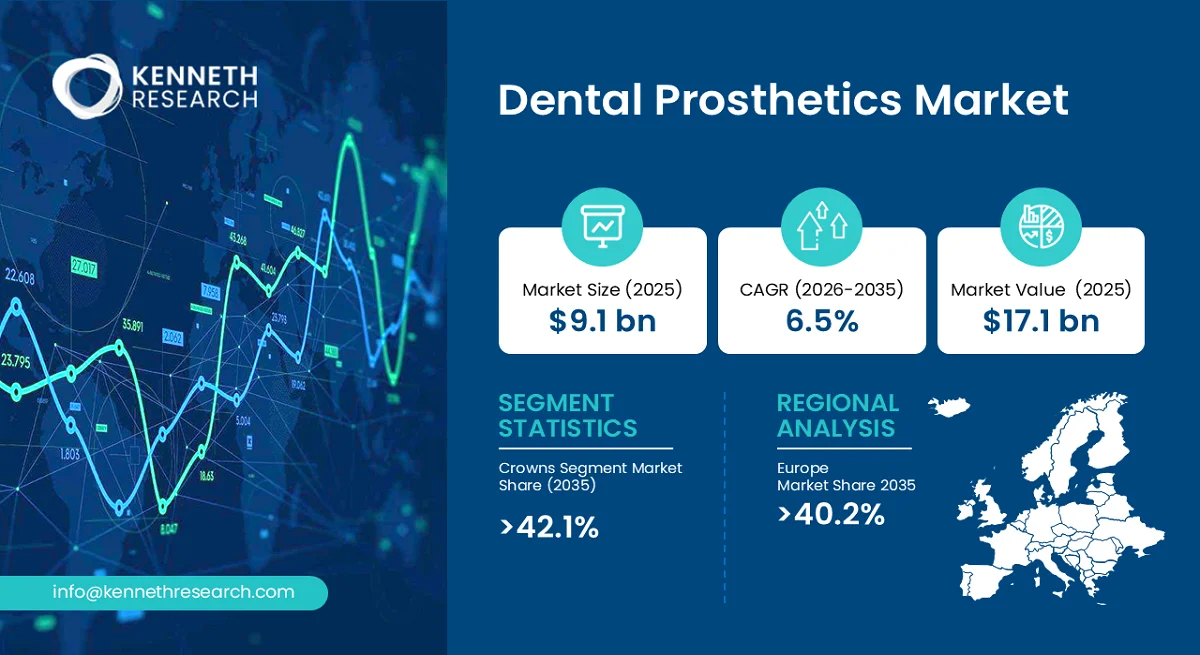
Dental Prosthetics Market size was valued at USD 9.1 billion in 2025 and is projected to reach USD 17.1 billion by the end of 2035, rising at a CAGR of 6.5% during the forecast period, i.e., 2026-2035. In 2026, the industry size of dental prosthetics is estimated at USD 9.7 billion.
The primary growth driver for the dental prosthetics market is the increasing prevalence of dental disorders and rising demand for restorative and cosmetic dental procedures. Growing adoption of advanced materials, digital dentistry technologies, and CAD/CAM-based manufacturing is improving prosthetic accuracy, durability, and accessibility, accelerating global utilization among dental professionals and patients.
The dental prosthetics market includes artificial dental devices and restorative solutions designed to replace, repair, or restore missing, damaged, or compromised teeth and oral structures. Products within this market include crowns, bridges, dentures, implants, and other customized prosthetic solutions manufactured using materials such as ceramics, metals, polymers, and advanced composite materials. Key characteristics of the market include increasing integration of digital dentistry, computer-aided design and manufacturing (CAD/CAM) technologies, 3D printing, and advanced biomaterials that enhance prosthetic precision, aesthetics, and functional performance.
Key Dental Prosthetics Market Insights Summary:
Key Takeaways: Market Trends & Insights
- In the type segment, the crowns sub-segment is anticipated to capture the revenue share of 42.6% during 2026-2035
- Europe dental prosthetics market is projected to hold the largest revenue share of 40.2% by the end of 2035
- Asia Pacific dental prosthetics market is estimated to hold 22.8% of global market share by the end of 2035
Market Drivers
- Rising burden of oral diseases and increasing demand for restorative dentistry
- Increasing adoption of digital dentistry and advanced manufacturing technologies
- Growing aging population requiring dental restoration procedures
- Rising demand for cosmetic dentistry and aesthetic dental solutions
Challenges
- High cost of advanced dental prosthetic solutions.
- Regulatory compliance and manufacturing standardization
Dental Prosthetics Market Overview & Supply Chain
Global adoption of dental prosthetics is increasing due to rising demand for restorative dentistry, growing awareness of oral health, and the expansion of cosmetic dental procedures. Advancements in digital dentistry, including CAD/CAM systems, intraoral scanning, 3D printing, and advanced dental materials, are improving the accuracy, customization, and efficiency of prosthetic manufacturing. Aging populations, increasing dental care accessibility, and improvements in dental infrastructure are further supporting market expansion.
The dental prosthetics market value chain begins with sourcing raw materials such as dental ceramics, metals, polymers, composite resins, and biocompatible materials used in prosthetic manufacturing. Material suppliers provide specialized inputs that meet clinical safety and durability requirements. Manufacturing involves dental laboratories, medical device companies, and specialized manufacturers utilizing conventional fabrication techniques alongside advanced technologies such as CAD/CAM machining and additive manufacturing to produce customized prosthetic devices.
Dental Prosthetics Market: Growth Drivers & Challenges
Growth Drivers:
- Rising burden of oral diseases and increasing demand for restorative dentistry: The increasing prevalence of oral health conditions is a major factor driving demand for dental prosthetics globally. Tooth decay, tooth loss, and periodontal diseases are creating a sustained need for restorative solutions such as crowns, bridges, dentures, and implant-supported prosthetics. Growing awareness of preventive dental care and improved access to dental services are encouraging patients to seek functional and aesthetic restoration procedures. Dental professionals are also adopting advanced prosthetic solutions that provide improved durability, comfort, and natural appearance. The World Health Organization (WHO) reports that oral diseases affect nearly 3.7 billion people worldwide, demonstrating the significant global requirement for improved dental restoration and oral healthcare solutions.
- Increasing adoption of digital dentistry and advanced manufacturing technologies: The integration of digital dentistry technologies is accelerating growth in the dental prosthetics market by improving manufacturing efficiency, customization, and clinical outcomes. Technologies such as CAD/CAM systems, intraoral scanners, digital workflows, and 3D printing are enabling dental professionals and laboratories to produce highly accurate prosthetic devices with shorter turnaround times. These advancements reduce manual fabrication limitations and support the development of patient-specific solutions with enhanced fit and aesthetics. Dental manufacturers are investing in automated production systems and advanced materials to strengthen product portfolios and improve competitiveness.
Challenges:
- High cost of advanced dental prosthetic solutions: The high cost associated with advanced dental prosthetic solutions remains a significant restraint for market expansion, particularly for patients and healthcare systems with limited reimbursement coverage. Premium materials such as advanced ceramics, zirconia, and customized implant-supported prosthetics often require sophisticated manufacturing processes and specialized dental expertise, increasing overall treatment costs. These financial barriers can reduce patient acceptance of elective and restorative procedures while limiting adoption among smaller dental practices with constrained investment capabilities. For manufacturers, pricing pressures and the need to balance product quality with affordability create commercial challenges.
- Regulatory compliance and manufacturing standardization: Dental prosthetic manufacturers face challenges related to stringent regulatory requirements and the need for consistent product quality across different regions. Dental prosthetics must comply with safety, biocompatibility, material performance, and manufacturing standards, requiring extensive testing and quality control processes. Variations in regulatory frameworks between countries can increase approval complexity, extend commercialization timelines, and raise operational costs for manufacturers seeking global expansion. Additionally, maintaining standardized production quality becomes more challenging as companies integrate customized designs and digital manufacturing workflows.
Dental Prosthetics Market Size and Forecast:
| Report Attribute | Details |
|---|---|
| Base Year |
2025 |
| Forecast Year |
2026-2035 |
| CAGR |
6.5% |
| Base Year Market Size (2025) |
USD 9.1 billion |
| Forecast Year Market Size (2035) |
USD 17.1 billion |
| Regional Scope |
|
Dental Prosthetics Market Segmentation Analysis:
Type Segment Analysis
Crowns sub-segment is projected to hold largest share of 42.6% in the global market during the forecast period.
Crowns are expected to maintain the leading position in the dental prosthetics market due to their extensive application in restorative dentistry for repairing damaged, weakened, or aesthetically compromised teeth. Demand for dental crowns is increasing as patients and dental professionals prioritize durable, natural-looking restoration solutions with improved functional performance. The adoption of ceramic, zirconia, and digitally manufactured crowns is rising as dental clinics increasingly integrate CAD/CAM technologies and advanced fabrication methods into treatment workflows. On the supply side, manufacturers are expanding product portfolios through innovations in biocompatible materials, automated manufacturing, and customized prosthetic designs that improve precision and patient outcomes.
End User Segment Analysis
Solo dental practices segment is estimated to hold second-largest share in the global market.
Solo dental practices are projected to experience steady growth within the dental prosthetics market as independent dentists continue to represent an important channel for restorative and cosmetic dental procedures. Demand from solo practices is being driven by increasing patient preference for personalized dental care, rising adoption of digital dentistry tools, and growing investment in practice-level technologies such as intraoral scanners, CAD/CAM systems, and chairside manufacturing solutions. These technologies enable independent practitioners to improve treatment efficiency, offer customized prosthetic solutions, and reduce dependency on external laboratories. On the supply side, dental prosthetic manufacturers are developing user-friendly products, workflow solutions, and service models tailored to smaller practices. The U.S. Bureau of Labor Statistics (BLS) reported that about 73% of dentists were self-employed in 2023, indicating the continued significance of solo and independently operated dental practices within the dental care ecosystem.
Our in-depth analysis of the global dental prosthetics market includes the following segments:
|
Segment |
Sub-segment |
|---|---|
|
Type |
|
|
End Use |
|
Dental Prosthetics Market Regional Insights:
Europe Market Trends & Insights:
Europe is projected to hold the leading position in the dental prosthetics market with a 40.2% market share in 2035, supported by advanced dental healthcare infrastructure, strong adoption of restorative dentistry solutions, and established dental manufacturing capabilities. The region benefits from the presence of leading dental material manufacturers, specialized laboratories, and technology providers focused on ceramics, digital dentistry, and customized prosthetic solutions. High demand for aesthetic dental procedures, increasing adoption of CAD/CAM technologies, and investments in advanced dental manufacturing are strengthening regional competitiveness. Regulatory frameworks emphasizing medical device quality, material safety, and patient protection also support the development and commercialization of reliable dental prosthetic products.
Germany represents a major contributor to Europe’s market leadership due to its strong dental technology industry, advanced manufacturing expertise, and well-established network of dental laboratories and clinics. The country is recognized for innovation in dental materials, precision manufacturing, and digital dentistry solutions.
North America Market Trends & Insights:
North America is emerging as a fastest-growing region in the dental prosthetics market, supported by increasing demand for restorative and cosmetic dental procedures, advanced dental care infrastructure, and rapid adoption of digital dentistry technologies. The region benefits from strong industrial activity involving dental material manufacturers, prosthetic device companies, dental laboratories, and technology providers developing innovative restoration solutions. Government initiatives focused on improving oral healthcare access, preventive dentistry, and healthcare technology adoption are supporting market development. Increasing integration of CAD/CAM systems, 3D printing, and digital treatment workflows is creating new opportunities for manufacturers and dental service providers.
The United States represents the largest contributor within North America due to its advanced dental healthcare ecosystem, strong presence of dental technology companies, and high adoption of innovative restorative procedures. The country’s well-developed network of dental clinics, laboratories, and specialty practices supports continued demand for crowns, bridges, dentures, and other prosthetic solutions.
Canada contributes through its growing dental care infrastructure, increasing adoption of modern dental technologies, and focus on improving oral healthcare services. The country’s expanding dental professional network and investments in healthcare modernization create opportunities for dental prosthetic manufacturers.
Leading Companies Operating in the Global dental prosthetics market:
- Dentsply Sirona (United States)
- Straumann Group (Switzerland)
- Ivoclar Vivadent (Liechtenstein)
- Glidewell Laboratories (United States)
- Nobel Biocare Services AG (Switzerland)
- Osstem Implant Co., Ltd. (South Korea)
Recent Developments
- In June 2025, 3M announced continued investment in dental technology solutions and product innovations following its focus on advancing oral care materials and restorative dentistry applications. Continued innovation supports the company’s role in supplying advanced restorative dental materials and strengthens its position in professional dental care markets.
- In February 2025, Dentsply Sirona announced the launch of new digital dentistry solutions and workflow enhancements at the Chicago Dental Society Midwinter Meeting, expanding its portfolio of connected dental technologies and restorative solutions. The development strengthens Dentsply Sirona’s position in digital dentistry by improving integration between scanning, designing, and manufacturing workflows used for dental prosthetic applications.
Frequently Asked Question
In 2025, the dental prosthetics market exceeded USD 9.1 billion.
The dental prosthetics market is projected to reach USD 17.1 billion by the end of 2035, expanding at a CAGR of 6.5% over the forecast period (2026-2035).
The major players in the market are Dentsply Sirona, Straumann Group, Ivoclar Vivadent, and others.
In the type segment, the crowns sub-segment is anticipated to capture the largest market share of 42.6% in the future and exhibit lucrative growth opportunities during 2026-2035. This growth trajectory is largely attributed to increasing demand for restorative dentistry procedures and adoption of advanced dental materials and digital manufacturing technologies.
Europe is projected to hold the largest market share of 40.2% by the end of 2035 and provide more business opportunities in the future. Strong dental manufacturing capabilities, advanced healthcare infrastructure, and increasing adoption of digital dentistry technologies in Germany and other European countries are fostering the regional dominance.
Why Choose Kenneth Research ?
-
Insight with Impact : We don’t just gather data — we uncover stories, trends, and opportunities that fuel business growth.
-
Experts Who Get It : Our team speaks your industry’s language and knows what really matters to your customers and market.
-
Custom-Built for You : Forget one-size-fits-all. We craft research and consulting solutions as unique as your business vision.
-
Partners, Not Just Providers : We work with you, not for you — collaborating closely to turn insights into smart, strategic moves.
-
Results That Speak : Our work powers brands, startups, and industry leaders alike — with a track record of ideas that work in the real world.
Report ID: 1073 |
Published Date: 12 Aug 2026 |
Report Format: |
Delivery Timeline: 48-72 Business Hours

Copyright © 2025 Kenneth Research. All rights reserved. Terms of Use | Privacy Policy
