Report ID: 1072 |
Published Date: 12 Aug 2026 |
Report Format: |
Delivery Timeline: 48-72 Business Hours
Dental Needle Market Outlook:
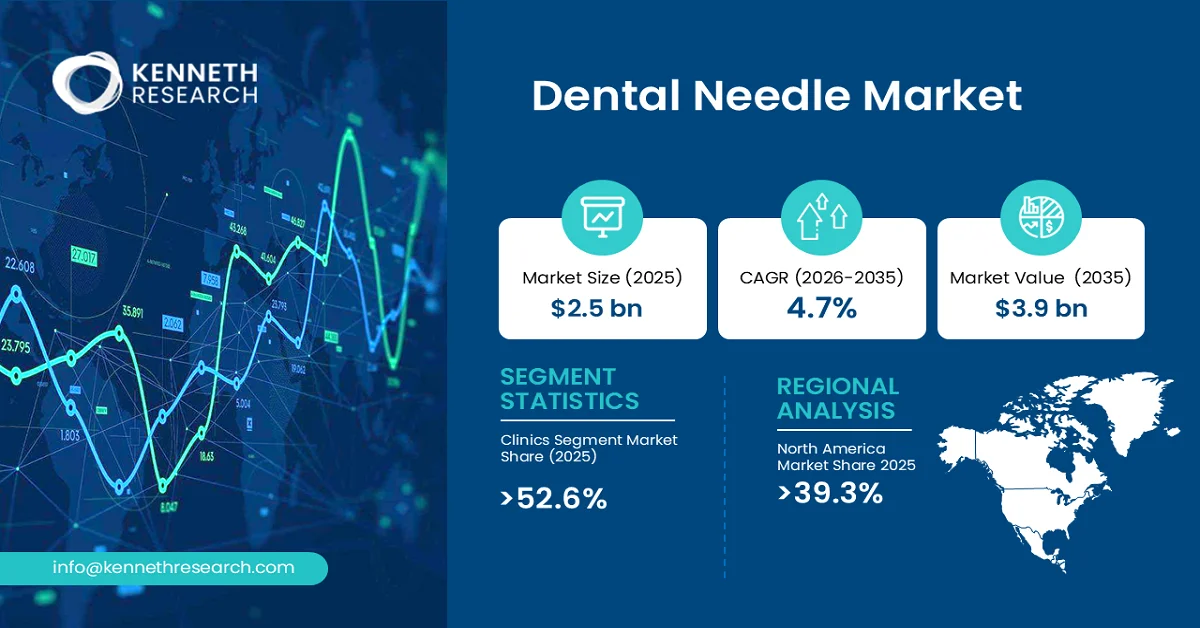
Dental Needle Market size was valued at USD 2.5 billion in 2025 and is projected to reach USD 3.9 billion by the end of 2035, rising at a CAGR of 4.7% during the forecast period, i.e., 2026–2035. In 2026, the industry size of the dental needle is estimated at USD 2.6 billion.
The primary growth driver for the dental needle market is the increasing demand for routine and specialized dental procedures worldwide. Rising awareness of preventive oral healthcare, expanding access to dental services, and growing treatment volumes for restorative, periodontal, and surgical interventions are accelerating the adoption of safe, precision-engineered dental needles across clinical settings.
The dental needle market comprises sterile, single-use or reusable needles specifically designed for administering local anesthesia during dental procedures. These needles are engineered to provide precise anesthetic delivery with minimal patient discomfort and are available in different gauges and lengths to accommodate infiltration, nerve block, and specialized injection techniques. Dental needles are manufactured using high-grade stainless steel and are designed with features such as enhanced bevel geometry, silicone coating, and secure hub connections to improve penetration accuracy and patient safety.
The market serves a broad range of end users, including dental clinics, hospitals, academic institutions, and specialty oral healthcare centers, supporting procedures such as restorative dentistry, tooth extraction, endodontics, implantology, and periodontal treatment. As oral healthcare systems increasingly emphasize infection prevention, patient comfort, and procedural efficiency, the demand for high-quality dental needles continues to grow. According to the World Health Organization, oral diseases affect an estimated 3.7 billion people globally, highlighting the substantial need for accessible dental care and the associated use of anesthesia delivery devices in routine clinical practice.
Key Dental Needle Market Insights Summary:
Key Takeaways: Market Trends & Insights
- The dental needle market is projected to grow from USD 2.6 billion in 2026 to USD 3.9 billion by 2035, registering a CAGR of 4.7% during the forecast period
- Clinics remained the leading end-user segment with a 52.6% market share in 2025, supported by the increasing volume of preventive, restorative, and specialized dental procedures requiring local anesthesia
- North America accounted for the largest regional share of 39.3% in 2025, driven by advanced oral healthcare infrastructure, stringent regulatory standards, and strong demand across the United States and Canada
- Anaesthetic dental needles are expected to witness robust growth owing to rising adoption of minimally invasive dental procedures, technological advancements in injection systems, and increasing focus on patient comfort
- Growing investments in preventive oral healthcare, expansion of dental clinic networks, and continuous innovation in sterile single-use dental consumables are creating long-term growth opportunities across developed and emerging markets
Market Drivers
- Increasing adoption of minimally invasive dental procedures
- Expansion of dental clinics and ambulatory oral healthcare facilities
- Expansion of preventive and public oral health programs
- Rising demand for premium single-use sterile dental consumables
Challenges
- Stringent regulatory compliance and product validation requirements
- Pricing pressure and intense competition in standardized product segments
Dental Needle Market Overview & Supply Chain
The adoption of dental needles is increasing globally as oral healthcare systems expand preventive, restorative, and surgical dental services while prioritizing patient safety, precision, and infection control. Advances in needle manufacturing—including ultra-sharp bevel designs, silicone-coated surfaces, and improved hub engineering—support smoother anesthetic administration and enhance procedural efficiency in dental practices. Regulatory emphasis on single-use sterile devices and stringent quality standards has further reinforced demand for reliable dental injection products across both developed and emerging healthcare markets. The industry's long-term relevance is underpinned by the substantial global burden of oral diseases. According to the World Health Organization (WHO), untreated dental caries in permanent teeth is the most common health condition according to the Global Burden of Disease 2021, highlighting the persistent need for routine dental interventions that depend on effective local anesthesia delivery systems.
The dental needle industry operates through a specialized medical device value chain that begins with the procurement of medical-grade stainless steel tubing, polymer resins for hubs and protective caps, silicone lubricants, and sterile packaging materials sourced from certified industrial suppliers. Manufacturers employ precision tube drawing, bevel grinding, polishing, siliconization, automated assembly, sterilization, and rigorous quality assurance processes to ensure compliance with medical device regulations and performance standards. Finished products are distributed through medical device wholesalers, specialized dental product distributors, e-commerce procurement platforms, and direct sales networks serving institutional and private healthcare providers. Primary end users include dental clinics, hospitals, dental schools, and specialty oral surgery centers performing restorative, periodontal, endodontic, orthodontic, and implant procedures. Major stakeholders across the value chain include raw material suppliers, component manufacturers, contract sterilization providers, regulatory authorities, logistics companies, dental equipment distributors, procurement organizations, and oral healthcare professionals responsible for product selection and clinical utilization.
Dental Needle Market: Growth Drivers & Challenges
Growth Drivers:
- Expansion of preventive and restorative dental care services: The increasing emphasis on preventive oral healthcare and timely restorative treatment is creating sustained demand for dental needles across global healthcare systems. Governments and public health agencies continue to promote routine dental examinations, early diagnosis, and minimally invasive interventions to reduce the burden of advanced oral disease. As a result, dental providers are performing a broader range of procedures requiring local anesthesia, including fillings, periodontal therapy, endodontic treatment, and tooth extractions. This directly increases the consumption of sterile, precision-engineered dental needles in clinical practice. The trend is further supported by expanding dental infrastructure, higher patient awareness, and stronger infection-control standards that encourage the use of high-quality disposable devices. According to the U.S. Centers for Disease Control and Prevention (CDC), more than 1 in 10 children aged 2–5 years had at least one untreated cavity in their baby teeth, demonstrating the continuing need for preventive and restorative dental care that relies on effective anesthesia delivery.
- Continuous innovation in dental injection technologies: Technological advancements in dental injection systems are strengthening the adoption of modern dental needles by improving procedural precision, clinician control, and patient comfort. Manufacturers are introducing thinner-wall needles, optimized bevel configurations, enhanced lubrication coatings, and improved hub compatibility to reduce injection force and tissue trauma during anesthetic administration. These innovations complement the growing use of computer-assisted local anesthesia systems and digital dentistry workflows, enabling more predictable clinical outcomes. Product development is also focused on improving manufacturing consistency, sterility assurance, and regulatory compliance, helping healthcare providers meet increasingly stringent quality expectations. As dental professionals continue to prioritize minimally invasive treatment approaches and superior patient experiences, demand is expected to shift toward premium needle technologies that support greater procedural efficiency, lower complication risks, and improved workflow integration across general dentistry and specialty oral care.
Challenges:
- Stringent regulatory compliance and product validation requirements: Manufacturers of dental needles operate within a highly regulated medical device environment where compliance extends beyond product performance to encompass material traceability, sterilization validation, manufacturing process controls, packaging integrity, and post-market surveillance. Even incremental product modifications, such as changes in needle geometry, coating materials, or manufacturing processes, may require additional testing and regulatory documentation before commercialization. These requirements increase development timelines and operational costs while creating barriers for smaller manufacturers seeking market expansion. Commercially, prolonged approval cycles can delay product launches, reduce responsiveness to customer requirements, and limit the pace of innovation. As regulatory authorities continue to strengthen quality management and patient safety expectations, manufacturers will need to invest further in compliance infrastructure, digital quality systems, and continuous validation capabilities to remain competitive in global markets.
- Pricing pressure and intense competition in standardized product segments: Dental needles are widely regarded as essential clinical consumables, making purchasing decisions heavily influenced by price, procurement contracts, and supplier reliability rather than product differentiation alone. Large healthcare providers, dental service organizations, and group purchasing organizations frequently negotiate volume-based agreements that compress manufacturer margins. At the same time, the availability of multiple domestic and international suppliers offering comparable products intensifies competitive pressure across established markets. This environment discourages premium pricing unless manufacturers can demonstrate measurable improvements in clinical performance or workflow efficiency. Commercially, companies must continuously balance manufacturing quality with cost optimization while maintaining supply reliability. Looking ahead, sustained competition is expected to encourage operational efficiency, strategic partnerships, product portfolio diversification, and greater investment in value-added innovations that distinguish offerings beyond price.
Dental Needle Market Size and Forecast:
| Report Attribute | Details |
|---|---|
| Base Year |
2025 |
| Forecast Year |
2026-2035 |
| CAGR |
4.7% |
| Base Year Market Size (2025) |
USD 2.5 billion |
| Forecast Year Market Size (2035) |
USD 3.9 billion |
| Regional Scope |
|
Dental Needle Market Segmentation Analysis:
End Users Segment Analysis
In the end users segment, the clinics sub-segment is anticipated to capture the largest market share of 52.6% by the end of 2025.
Clinics dominate the dental needle market because they perform the highest volume of routine and specialized dental procedures requiring local anesthesia, including restorative treatments, endodontics, periodontal therapy, oral surgery, and preventive interventions. The widespread availability of private dental practices, community dental clinics, and specialty oral care centers has created consistent demand for sterile, single-use dental needles that support safe and efficient anesthetic administration. Clinics also benefit from streamlined procurement channels, allowing them to maintain regular inventories of consumable products while complying with stringent infection prevention protocols. On the supply side, manufacturers prioritize dental clinics through direct sales networks, distributor partnerships, and product portfolios tailored to varying procedural requirements, ensuring reliable product availability and clinical compatibility. The segment is expected to maintain its leadership as preventive dentistry, cosmetic procedures, and minimally invasive treatments continue to expand globally. Supporting this demand, the U.S. National Center for Health Statistics (NCHS) reported that 65.5% of adults aged 18 years and older had a dental exam or cleaning in the past year in 2023, reflecting sustained utilization of dental clinic services that drive ongoing consumption of dental needles.
Type Segment Analysis
The anaesthetic dental needle is projected to grow as the second-largest segment in the dental needle market due to four converging demand drivers.
The anaesthetic dental needle segment is projected to grow as local anesthesia remains an essential component of restorative, periodontal, endodontic, implant, and oral surgical procedures. Increasing adoption of minimally invasive dentistry and greater emphasis on pain-controlled treatment are encouraging clinicians to use high-performance anaesthetic needles that provide accurate drug delivery while improving patient comfort. Dental professionals are increasingly selecting products with optimized bevel geometry, enhanced lubrication coatings, and improved flexibility to reduce tissue trauma and facilitate precise injections. On the supply side, manufacturers continue to invest in advanced production technologies, automated quality inspection, and sterile packaging to meet stringent regulatory and clinical requirements. Future growth is expected to be supported by rising preventive dental visits, expanding specialty dental services, and continued innovation in anesthesia delivery systems. Reinforcing this trend, Japan's Ministry of health, labour and welfare reported that 63.8% of people underwent a dental check-up during the previous year in its 2024 Survey of Dental Diseases, reflecting sustained utilization of services requiring local anesthetic administration.
Our in-depth analysis of the global dental needle market includes the following segments:
|
Segment |
Sub-segment |
|
Type |
|
|
Gauge |
|
|
Length |
|
|
End Users |
|
Dental Needle Market Regional Insights:
North America Market Trends & Insights:
North America dental needle market is projected to hold the largest revenue share of 39.3% by the end of 2025.
The region benefits from strong manufacturing capabilities for dental consumables, sophisticated distribution infrastructure, and continuous investment in infection prevention and patient safety. Regulatory frameworks governing sterile single-use medical devices further encourage the use of high-quality dental needles across routine and specialized dental procedures. In addition, the presence of leading dental product manufacturers, high procedural volumes, and established reimbursement mechanisms in several care settings reinforce sustained product demand.
The United States represents the largest contributor to regional demand due to its extensive network of private dental clinics, specialty oral surgery centers, dental schools, and advanced procurement systems for clinical consumables. Ongoing innovation in dental equipment, increasing adoption of minimally invasive procedures, and rigorous infection-control practices continue to support consistent demand for premium dental needles.
Canada complements regional growth through expanding access to oral healthcare, a highly regulated medical device environment, and continued investments in preventive dental services. The country's emphasis on improving access to dental care, together with a growing focus on quality assurance and patient safety, supports steady adoption of sterile dental consumables across public and private healthcare settings. Collectively, these factors position North America as the leading regional market for dental needles.
Asia Pacific Market Trends & Insights:
Asia Pacific is emerging as a high-potential region for the dental needle market due to expanding access to oral healthcare services, rising awareness of preventive dentistry, and continuous investments in healthcare infrastructure. Increasing urbanization, improving disposable incomes, and the growing availability of private dental clinics are contributing to higher volumes of restorative, orthodontic, periodontal, and implant procedures that require reliable local anesthesia delivery. Governments across the region are strengthening oral health initiatives, supporting workforce development, and promoting broader access to dental care through public health programs and healthcare modernization strategies. At the same time, the expansion of domestic medical device manufacturing and regional supply networks is improving product availability while encouraging greater adoption of internationally compliant dental consumables. Future opportunities are expected to arise from the integration of digital dentistry, increased utilization of minimally invasive treatment techniques, and continued investment in high-quality infection-control products, positioning the region as an important growth center for manufacturers and distributors of dental needles.
India is witnessing increasing demand for dental needles as the country's network of private dental clinics, multispecialty hospitals, and academic dental institutions continues to expand. Greater awareness of oral hygiene, growing acceptance of cosmetic and restorative dentistry, and initiatives aimed at improving healthcare accessibility are supporting higher procedural volumes. The development of domestic medical device manufacturing capabilities and expanding distribution channels further strengthen market prospects.
Japan remains an important market owing to its advanced dental care system, high clinical standards, and widespread adoption of precision dental technologies. The country's emphasis on preventive dentistry, aging population requiring ongoing oral healthcare, and strong regulatory framework for medical devices continue to support demand for premium dental consumables, while ongoing technological innovation creates opportunities for advanced anesthesia delivery solutions.
Leading Companies Operating in the Global Dental Needle Market:
Here is a list of upstream, downstream, and key players operating in the global dental needle market competitive ecosystem:
- Septodont (France)
- Company Overview
- Business Strategy
- Key Product Offerings
- Financial Performance
- Key Performance Indicators
- Risk Analysis
- Recent Development
- Regional Presence
- SWOT Analysis
- Dentsply Sirona (United States)
- Shanghai Mekon Medical Devices Co., Ltd. (China)
- Berpu Medical Technology Co., Ltd. (China)
- Ultradent Products, Inc. (United States)
Recent Developments
- In March 2025, Terumo Europe N.V. received FDA 510(k) clearance for the K-Pack Enhance Needle (K243581), a sterile, single-use hypodermic needle available in 27G and 29G thin-wall configurations. The device is indicated for general fluid injection and withdrawal and is designed to be substantially equivalent to Terumo's predicate K-Pack II Needle.
Frequently Asked Question
In 2025, the dental needle market exceeded USD 2.5 billion.
The dental needle market is projected to reach USD 3.9 billion by the end of 2035, expanding at a CAGR of 4.7% over the forecast period (2026-2035).
The major players in the market are Septodont (France), Dentsply Sirona (United States), Heraeus Kulzer GmbH (Germany), Shanghai Mekon Medical Devices Co., Ltd. (China), Berpu Medical Technology Co., Ltd. (China), Ultradent Products, Inc. (United States), and others.
In the end users segment, the clinics sub-segment is anticipated to capture the largest market share of 52.6% in the future and exhibit lucrative growth opportunities during 2026-2035. This growth trajectory is largely attributed to the increasing volume of preventive, restorative, and specialized dental procedures requiring local anesthesia across clinical settings.
North America is projected to hold the largest market share of 39.3% by the end of 2025 and provide more business opportunities in the future. Continuous investments in advanced oral healthcare infrastructure, strong regulatory standards, and sustained demand across the United States and Canada are fostering the region's dominance.
Why Choose Kenneth Research ?
-
Insight with Impact : We don’t just gather data — we uncover stories, trends, and opportunities that fuel business growth.
-
Experts Who Get It : Our team speaks your industry’s language and knows what really matters to your customers and market.
-
Custom-Built for You : Forget one-size-fits-all. We craft research and consulting solutions as unique as your business vision.
-
Partners, Not Just Providers : We work with you, not for you — collaborating closely to turn insights into smart, strategic moves.
-
Results That Speak : Our work powers brands, startups, and industry leaders alike — with a track record of ideas that work in the real world.
Report ID: 1072 |
Published Date: 12 Aug 2026 |
Report Format: |
Delivery Timeline: 48-72 Business Hours

Copyright © 2025 Kenneth Research. All rights reserved. Terms of Use | Privacy Policy
