Report ID: 1099 |
Published Date: 18 Aug 2026 |
Report Format: |
Delivery Timeline: 48-72 Business Hours
Dental Chair Market Outlook:
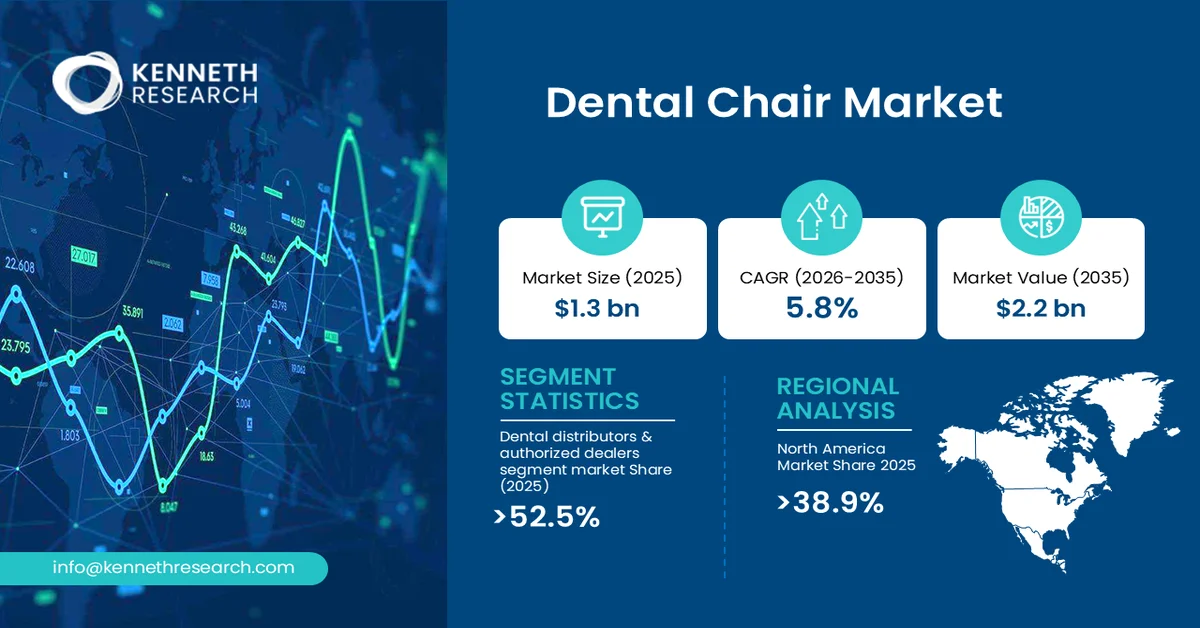
Dental Chair Market size was valued at USD 1.3 billion in 2025 and is projected to reach USD 2.2 billion by the end of 2035, rising at a CAGR of 5.8% during the forecast period, i.e., 2026–2035. In 2026, the industry size of the dental chair is estimated at USD 1.4 billion.
The primary growth driver for the dental chair market is the increasing emphasis on expanding oral healthcare infrastructure and improving access to preventive and restorative dental services. Rising investments in modern dental clinics, technology-enabled treatment environments, and ergonomic equipment procurement are accelerating demand for advanced dental chairs across public and private healthcare settings.
The dental chair market comprises the global manufacturing, distribution, and commercialization of specialized dental chairs designed to support patient positioning and facilitate clinical procedures across preventive, diagnostic, restorative, orthodontic, endodontic, periodontal, and surgical dentistry. These chairs integrate mechanical, hydraulic, or electromechanical adjustment systems with ergonomic seating, instrument delivery units, illumination, cuspidors, and digital interfaces to improve procedural efficiency and patient comfort.
Dental chairs are engineered to provide precise positioning, infection-control compatibility, clinician accessibility, and seamless integration with imaging, suction, and treatment delivery systems. Modern platforms increasingly incorporate programmable positioning, touch-based controls, and compatibility with digital workflows, enabling enhanced productivity in high-volume dental practices.
The market plays a vital role in strengthening oral healthcare delivery by supporting efficient clinical operations in hospitals, dental clinics, academic institutions, and specialty treatment centers. As governments and healthcare systems prioritize broader access to essential oral healthcare services and modernization of dental infrastructure, demand for technologically advanced and durable dental chair systems continues to grow. The market therefore represents a foundational component of the global dental equipment ecosystem, supporting improved treatment quality, operational efficiency, and long-term healthcare capacity.
Key Dental Chair Market Insights Summary:
Key Takeaways: Market Trends & Insights
- Dental Chair Market is projected to grow from USD 1.4 billion in 2026 to USD 2.2 billion by 2035 at a CAGR of 5.8%
- Dental Distributors & Authorized Dealers led the distribution & sales channel segment with a 52.5% share in 2025 supported by strong after-sales service and extensive distribution networks
- Hydraulic Actuation is expected to witness sustained growth driven by its durability cost-effectiveness low maintenance requirements and suitability for diverse dental care settings
- North America accounted for the largest regional share of 38.9% in 2025 led by continuous investments in advanced dental infrastructure across the United States and Canada
- Europe remains a key growth region supported by strong medical device manufacturing capabilities expanding digital dentistry adoption and ongoing modernization of dental healthcare facilities
Market Drivers
- Growing investments in dental education institutions and clinical training infrastructure
- Increasing replacement demand for aging dental equipment across established healthcare facilities
- Rising preference for patient-centric and ergonomic treatment environments
- Expansion of private dental service networks and multi-clinic dental organizations
Challenges
- High Capital Investment and Extended Equipment Replacement Cycles
- Complex Regulatory Compliance and Product Certification Requirements
Dental Chair Market Overview & Supply Chain
The adoption of dental chairs is increasing globally as healthcare providers modernize dental facilities to improve clinical efficiency, patient comfort, infection control, and compatibility with digital dentistry workflows. Growing investments in preventive oral healthcare, expansion of specialty dental clinics, and integration of advanced imaging and treatment systems are encouraging the replacement of legacy equipment with ergonomically designed, technology-enabled dental chairs. Regulatory emphasis on patient safety, practitioner ergonomics, and standardized clinical environments is further supporting procurement across both public and private healthcare settings. The industry's relevance is reinforced by the global burden of oral diseases, which continues to drive demand for accessible dental services. According to the World Health Organization (WHO), nearly 3.7 billion people are affected by oral diseases worldwide, highlighting the sustained need for modern dental treatment infrastructure and equipment.
The dental chair industry value chain begins with the sourcing of structural metals, engineering plastics, upholstery materials, electronic components, hydraulic or electromechanical actuators, precision motors, control systems, LED lighting modules, and medical-grade tubing from specialized industrial suppliers. Manufacturers integrate these components through precision fabrication, machining, electronics assembly, software integration, quality assurance, and regulatory compliance testing to produce complete dental chair systems meeting international medical device standards. Finished products are supplied through authorized distributors, dental equipment dealers, healthcare procurement organizations, and direct sales channels that also provide installation, commissioning, operator training, and after-sales maintenance services. End users include private dental clinics, hospitals, academic institutions, public oral healthcare facilities, and specialty dental centers. Key stakeholders across the ecosystem include component suppliers, original equipment manufacturers (OEMs), regulatory authorities, logistics providers, distributors, service partners, dental professionals, healthcare organizations, and procurement agencies responsible for equipment lifecycle management.
Dental Chair Market: Growth Drivers & Challenges
Growth Drivers:
- Expansion of national oral health programs and healthcare infrastructure: The expansion of national oral health programs and healthcare infrastructure is accelerating demand for modern dental chairs across developed and emerging economies. Governments are increasingly integrating oral health into broader universal health coverage strategies, encouraging investments in public dental facilities, community clinics, and hospital-based dental departments. As healthcare providers modernize treatment environments, procurement increasingly favors ergonomic, digitally compatible, and infection-control-compliant dental chairs that improve clinical efficiency and patient experience. This trend also stimulates replacement demand as existing facilities upgrade aging equipment to meet evolving regulatory and operational standards. Over the long term, sustained policy support for preventive oral healthcare, workforce development, and facility modernization is expected to create stable procurement cycles, encouraging manufacturers to develop technologically advanced chair platforms with enhanced connectivity, automation, and compatibility with digital dentistry ecosystems. In 2023, the World Health Assembly adopted the Global Oral Health Action Plan 2023–2030, which outlines 100 priority actions for Member States to strengthen oral healthcare delivery and integration into health systems.
- Increasing adoption of digital dentistry and ergonomic clinical workflows: The growing adoption of digital dentistry is transforming dental practice operations and increasing the need for advanced dental chair systems that seamlessly integrate with imaging equipment, treatment delivery units, electronic patient records, and diagnostic technologies. Modern clinics increasingly prioritize equipment capable of supporting efficient workflows, minimizing practitioner fatigue, and enhancing patient comfort during complex procedures. Dental chairs equipped with programmable positioning, intuitive control interfaces, integrated lighting, and compatibility with digital diagnostic platforms enable clinicians to improve treatment precision and optimize chairside productivity. This evolution is encouraging healthcare providers to invest in multifunctional treatment platforms rather than standalone equipment. Looking ahead, continued advances in digital workflows, minimally invasive dentistry, artificial intelligence-assisted diagnostics, and connected clinical ecosystems are expected to reinforce demand for next-generation dental chairs that serve as central components of technologically integrated dental treatment environments.
Challenges:
- High capital investment and extended equipment replacement cycles: The high acquisition cost of advanced dental chair systems remains a significant restraint, particularly for independent dental practices, newly established clinics, and healthcare providers operating under constrained capital budgets. Modern dental chairs incorporate integrated electronics, digital interfaces, ergonomic mechanisms, and specialized treatment components, increasing overall procurement and installation costs. Beyond the initial purchase, expenses related to customization, maintenance, calibration, spare parts, and technical servicing further elevate the total cost of ownership. These financial considerations often encourage buyers to extend the operational life of existing equipment instead of investing in new systems. Commercially, manufacturers experience longer sales cycles and increased competition centered on financing options, service contracts, and lifecycle support. Looking ahead, vendors are expected to address this challenge through flexible procurement models, equipment leasing, modular upgrades, and value-added service offerings that reduce upfront investment barriers while improving long-term customer retention.
- Complex regulatory compliance and product certification requirements: Dental chair manufacturers operate within a highly regulated medical device environment where compliance with multiple national and international standards is essential before products can be commercialized. Requirements related to electrical safety, biocompatibility, electromagnetic compatibility, infection control, quality management, and post-market surveillance create lengthy product development and certification processes. For companies serving multiple geographic markets, varying regulatory frameworks increase documentation requirements, testing costs, and approval timelines, delaying product launches and limiting speed to market. These complexities can be particularly challenging for smaller manufacturers seeking international expansion, as regulatory expenses consume substantial research and commercialization resources. From a commercial perspective, prolonged approval cycles may reduce competitive responsiveness and delay revenue generation from innovative products. As regulatory expectations continue to evolve alongside digital healthcare technologies and cybersecurity requirements, manufacturers will need stronger compliance capabilities and continuous investment in quality systems to maintain global market access.
Dental Chair Market Size and Forecast:
| Report Attribute | Details |
|---|---|
| Base Year |
2025 |
| Forecast Year |
2026-2035 |
| CAGR |
5.8% |
| Base Year Market Size (2025) |
USD 1.3 billion |
| Forecast Year Market Size (2035) |
USD 2.2 billion |
| Regional Scope |
|
Dental Chair Market Segmentation Analysis:
Distribution & Sales Channel Segment Analysis
In the distribution & sales channel segment, the dental distributors & authorized dealers sub-segment is anticipated to capture the largest market share of 52.5% by the end of 2025.
The dental distributors & authorized dealers segment dominates the dental chair market because it provides manufacturers with an efficient and scalable route to market while offering customers comprehensive procurement and lifecycle support. Dental practices and hospitals increasingly prefer purchasing through authorized channels due to assured product authenticity, regulatory compliance, installation expertise, financing options, warranty coverage, and timely after-sales service. These distributors also maintain extensive inventories, reducing equipment lead times and ensuring the availability of replacement parts and technical support. On the supply side, manufacturers benefit from established dealer networks that strengthen geographic reach, customer engagement, and localized service capabilities without requiring extensive direct sales infrastructure. The channel is particularly valuable for technologically advanced dental chairs that require professional installation, calibration, and operator training. Future growth is expected to remain strong as distributors expand digital sales capabilities, integrated equipment management services, and value-added maintenance programs to support increasingly sophisticated dental practices. Demand for this channel is supported by continued utilization of dental services. According to the U.S. Centers for Disease Control and Prevention (CDC), 65.5% of adults aged 18 years and older had a dental exam or cleaning during the past year in 2023, reflecting sustained demand for dental practice equipment and clinical infrastructure.
Drive & Adjustment Mechanism Segment Analysis
The hydraulic actuation is projected to grow as the second-largest segment in the dental chair market due to four converging demand drivers.
The hydraulic actuation segment is projected to grow steadily as dental practices continue to prioritize reliable, ergonomic, and cost-effective patient positioning systems. Hydraulic dental chairs provide smooth height and backrest adjustments, high load-bearing capacity, and dependable performance with relatively low maintenance requirements, making them well suited for general dentistry, community clinics, hospitals, and teaching institutions. Their durability and operational simplicity are particularly attractive in facilities seeking long service life and reduced equipment downtime. On the supply side, manufacturers benefit from mature hydraulic component supply chains, standardized production processes, and broad compatibility with existing chair platforms, enabling competitive pricing and efficient servicing. As healthcare providers expand treatment capacity while managing capital expenditure, hydraulic systems remain an attractive option for balancing functionality and affordability. Long-term demand is expected to remain supported by continued growth in dental service utilization and modernization of clinical infrastructure. According to the OECD's Health at a Glance: Europe 2024, the average number of dentists across EU countries increased from 0.7 per 1,000 population in 2010 to 0.8 per 1,000 population in 2022, reflecting expanding oral healthcare capacity that supports demand for dependable dental treatment equipment.
Our in-depth analysis of the global dental chair market includes the following segments:
|
Segment |
Sub-segment |
|
Product Form/ Configuration |
|
|
Delivery System Style |
|
|
Drive and Adjustment Mechanism |
|
|
Price Tier/ Market Segment |
|
|
Distribution and Sales Channel |
|
Dental Chair Market Regional Insights:
North America Market Trends & Insights:
North America dental chair market is projected to hold the largest revenue share of 38.9% by the end of 2025.
The region benefits from a well-established ecosystem of dental equipment manufacturers, authorized distributors, specialized service providers, and technologically advanced healthcare facilities. Frequent replacement of legacy equipment, widespread adoption of digital dentistry, and stringent regulatory standards for medical devices encourage the procurement of high-performance dental chair systems that improve operational efficiency and patient care. Robust reimbursement mechanisms in certain segments, expanding public oral healthcare initiatives, and sustained capital investments in dental clinics further reinforce regional leadership.
The United States represents the largest country market in the region, supported by an extensive network of private dental clinics, dental service organizations, hospitals, academic institutions, and specialty practices that consistently invest in technologically advanced treatment environments. Ongoing adoption of digital workflows, ergonomic treatment equipment, and integrated clinical systems continues to stimulate demand for premium dental chair solutions.
Canada complements regional growth through expanding access to oral healthcare, increasing modernization of dental facilities, and public initiatives designed to improve treatment accessibility. Continued investments in clinic upgrades, professional training, and healthcare infrastructure across both countries are expected to sustain North America's leadership while encouraging manufacturers to introduce innovative, digitally compatible, and service-oriented dental chair platforms.
Europe Market Trends & Insights:
Europe represents a strategically important region for the dental chair market, supported by a mature dental care ecosystem, widespread adoption of advanced clinical technologies, and a strong emphasis on preventive oral healthcare. Demand is driven by the continuous modernization of dental clinics, hospitals, and academic institutions seeking ergonomic, digitally compatible, and infection-control-compliant treatment equipment. The region also benefits from a well-established medical device manufacturing base, sophisticated distribution networks, and stringent regulatory frameworks that encourage the adoption of high-quality dental equipment. Government initiatives aimed at improving healthcare infrastructure, promoting preventive dentistry, and strengthening healthcare resilience continue to support investment in modern dental facilities. Looking ahead, opportunities are expected to arise from the expansion of digital dentistry, increasing integration of connected treatment systems, and the refurbishment of aging healthcare infrastructure. Manufacturers are also expected to benefit from growing demand for energy-efficient, sustainable, and technologically advanced dental chair platforms tailored to evolving clinical workflows.
Germany serves as a major market within Europe due to its strong medical technology manufacturing capabilities, extensive network of dental professionals, and high adoption of technologically advanced treatment equipment. Continuous investment in clinical modernization, research, and precision engineering supports demand for premium dental chair systems that integrate seamlessly with digital diagnostic and treatment solutions.
The United Kingdom contributes significantly through ongoing investments in dental service delivery, modernization of public and private dental practices, and increasing adoption of patient-centric treatment environments. The country's focus on improving access to oral healthcare, enhancing operational efficiency, and incorporating digital technologies into clinical practice is expected to sustain demand for advanced dental chair systems. Together, Germany and the United Kingdom reinforce Europe's position as a key region for innovation, manufacturing, and long-term adoption of sophisticated dental equipment.
Leading Companies Operating in the Global Dental Chair Market:
Here is a list of upstream, downstream, and key players operating in the global dental chair market competitive ecosystem:
- A-dec Inc. (United States)
- Company Overview
- Business Strategy
- Key Product Offerings
- Financial Performance
- Key Performance Indicators
- Risk Analysis
- Recent Development
- Regional Presence
- SWOT Analysis
- Dentsply Sirona Inc. (United States)
- Planmeca Oy (Finland)
- Midmark Corporation (United States)
- Foshan Gladent Medical Instrument Co., Ltd. (China)
- Boyd Industries, Inc. (United States)
Recent Developments
- March 2025: Planmeca unveiled its next-generation Pro40™, Pro50™, and Pro50 S™ dental units at IDS 2025 in Cologne. The new units feature enhanced ergonomics, modular delivery systems, and improved digital integration for modern dental clinics.
- February 2025: British Dental Journal (Nature) highlighted A-dec's award-winning dental chair packages, including the A-dec 500 and A-dec 300 Core, and reported the introduction of the company's new 10-year warranty for core dental equipment.
Frequently Asked Question
In 2025, the dental chair market exceeded USD 1.3 billion.
The dental chair market is projected to reach USD 2.2 billion by the end of 2035, expanding at a CAGR of 5.8% over the forecast period (2026-2035).
The major players in the market are A-dec Inc. (United States), Dentsply Sirona Inc. (United States), Planmeca Oy (Finland), Midmark Corporation (United States), Foshan Gladent Medical Instrument Co., Ltd. (China), Boyd Industries, Inc. (United States), and others.
In the Distribution & Sales Channel segment, the dental distributors & authorized dealers sub-segment is anticipated to capture the largest market share of 52.5% in the future and exhibit lucrative growth opportunities during 2026-2035. This growth trajectory is largely attributed to increasing demand for authorized procurement channels offering installation expertise, regulatory compliance, warranty support, and comprehensive after-sales services.
North America is projected to hold the largest market share of 38.9% by the end of 2025 and provide more business opportunities in the future. Continuous investments in advanced dental infrastructure, digital dentistry adoption, and modernization of healthcare facilities across the United States and Canada are fostering the region's dominance.
Why Choose Kenneth Research ?
-
Insight with Impact : We don’t just gather data — we uncover stories, trends, and opportunities that fuel business growth.
-
Experts Who Get It : Our team speaks your industry’s language and knows what really matters to your customers and market.
-
Custom-Built for You : Forget one-size-fits-all. We craft research and consulting solutions as unique as your business vision.
-
Partners, Not Just Providers : We work with you, not for you — collaborating closely to turn insights into smart, strategic moves.
-
Results That Speak : Our work powers brands, startups, and industry leaders alike — with a track record of ideas that work in the real world.
Report ID: 1099 |
Published Date: 18 Aug 2026 |
Report Format: |
Delivery Timeline: 48-72 Business Hours

Copyright © 2025 Kenneth Research. All rights reserved. Terms of Use | Privacy Policy
