Report ID: 1093 |
Published Date: 17 Aug 2026 |
Report Format: |
Delivery Timeline: 48-72 Business Hours
Dental Chain Market Outlook:
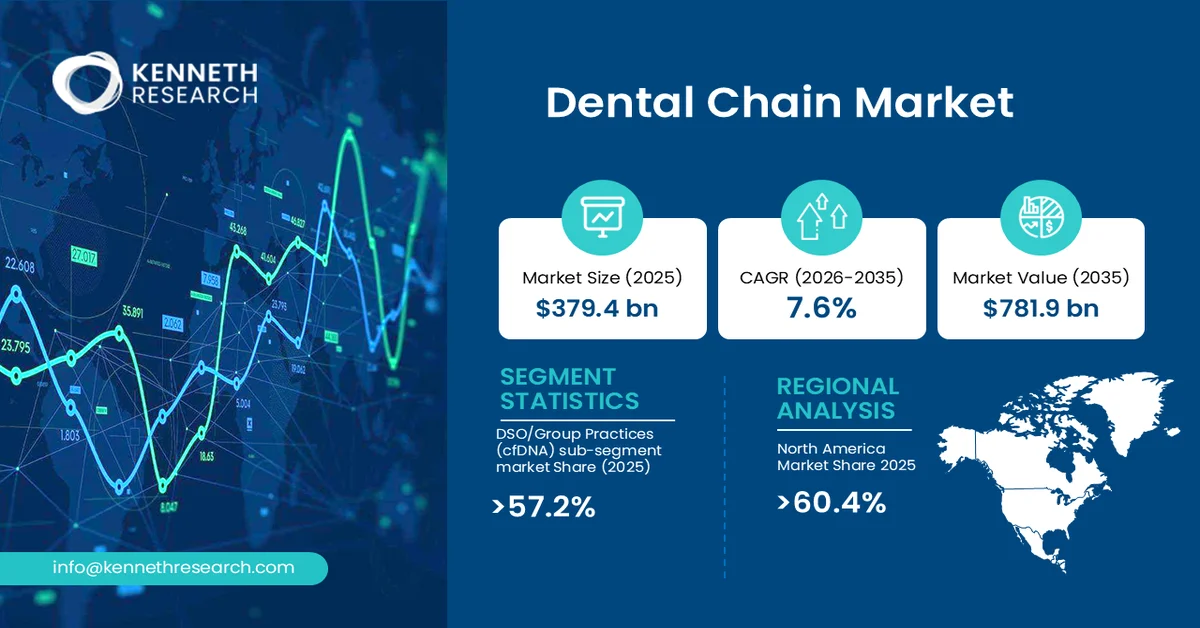
Dental Chain Market size was valued at USD 379.4 billion in 2025 and is projected to reach USD 781.9 billion by the end of 2035, rising at a CAGR of 7.6% during the forecast period, i.e., 2026–2035. In 2026, the industry size of the dental chain is estimated at USD 407.8 billion.
The primary growth driver for the dental chain market is the rising global demand for organized, scalable oral healthcare networks that improve clinical standardization, operational efficiency, and patient access. Growing oral disease prevalence and government emphasis on strengthening oral health systems are encouraging consolidation through multi-location dental service organizations and group practices.
The dental chain market comprises organized networks of dental clinics operating under unified ownership, management, or affiliation models that deliver preventive, restorative, cosmetic, orthodontic, endodontic, prosthodontic, pediatric, and oral surgical services. These networks may function as dental service organizations (DSOs), corporate dental groups, franchise-based clinics, or integrated healthcare providers that centralize administrative, procurement, technology, and operational functions while enabling clinicians to focus on patient care.
A defining characteristic of the market is its emphasis on standardized clinical protocols, centralized procurement, digital workflow integration, multi-location expansion, and consistent patient experience across facilities. Dental chains commonly leverage shared investments in digital imaging, electronic dental records, appointment management platforms, staff training, and revenue-cycle management to improve operational efficiency and service quality.
The market plays an important role in the broader healthcare ecosystem by expanding access to organized oral healthcare, supporting workforce optimization, and facilitating the adoption of advanced dental technologies. Its industrial relevance continues to increase as healthcare systems strengthen oral health strategies and integrate preventive and essential dental services into broader public health and primary care initiatives.
Key Dental Chain Market Insights Summary:
Key Takeaways: Market Trends & Insights
- Dental Chain Market is projected to expand from USD 407.8 billion (2026) to USD 781.9 billion (2035), registering a CAGR of 7.6% over the forecast period
- DSO/Group Practices dominated the End-User segment with a 57.2% share in 2025, supported by increasing consolidation, centralized clinical management, and scalable multi-location dental operations
- North America accounted for the largest regional share of 60.4% in 2025, driven by strong organized dental networks, advanced digital dentistry adoption, and sustained investments across the United States and Canada
- Dental Consumables are expected to record strong growth owing to rising demand for preventive, restorative, and specialty dental procedures, alongside increasing procurement efficiencies within organized dental chains
- The market outlook remains favorable as expanding preventive oral healthcare initiatives, rapid digital transformation, and continued investments in integrated dental care infrastructure accelerate the adoption of organized dental chain models worldwide
Market Drivers
- Expansion of Organized Dental Care Networks
- Digital Dentistry and Clinical Workflow Modernization
- Increasing Adoption of Preventive Oral Healthcare Programs
- Rising Investment in Multi-Specialty and Technology-Enabled Dental Clinics
Challenges
- Workforce Availability and Clinical Standardization Across Networks
- High Capital Requirements for Multi-Location Expansion
Dental Chain Market Overview & Supply Chain
Global adoption of dental chain models is accelerating as healthcare providers seek standardized clinical protocols, centralized administration, digital dentistry integration, and scalable patient access. Dental service organizations and multi-clinic networks enable investments in advanced diagnostic technologies, workforce development, procurement efficiencies, and integrated patient management systems that are often difficult for independent practices to achieve. Regulatory initiatives promoting preventive oral healthcare and broader healthcare system integration are also supporting organized dental delivery models. The industry's importance is reinforced by the growing global burden of oral diseases.
The dental chain market value chain begins with suppliers of dental consumables, biomaterials, pharmaceuticals, diagnostic equipment, digital imaging systems, CAD/CAM solutions, sterilization products, and information technology infrastructure. Equipment manufacturers and software providers support clinic operations through integrated diagnostic, treatment planning, practice management, and patient communication platforms. Dental chains centralize procurement, logistics, quality assurance, workforce training, compliance management, and administrative services to achieve operational consistency across multiple locations. Distribution involves direct manufacturer partnerships, specialized medical distributors, and digital procurement channels that ensure timely supply of clinical products and equipment. Service delivery is performed through networks of general dentists, specialists, dental hygienists, technicians, and administrative professionals operating under standardized clinical and operational frameworks. End users include individual patients, families, employers, insurance providers, and public healthcare programs. Major stakeholders comprise dental service organizations, independent clinic groups, equipment manufacturers, consumable suppliers, regulators, insurers, technology vendors, educational institutions, and professional dental associations collaborating to improve care accessibility and clinical efficiency.
Dental Chain Market: Growth Drivers & Challenges
Growth Drivers:
- Expansion of organized dental care networks: The transition from fragmented independent practices to organized dental service organizations (DSOs) and group practice models is a major growth driver for the dental chain market. Centralized management enables standardized clinical protocols, optimized procurement, digital workflow integration, and more efficient workforce utilization, allowing providers to expand service availability while maintaining consistent quality of care. These networks also improve access to specialized treatments by leveraging shared infrastructure and advanced diagnostic technologies across multiple locations. As healthcare systems increasingly prioritize preventive oral care and integrated patient management, organized dental chains are well positioned to deliver scalable, technology-enabled services. Future market expansion is expected to be supported by continued investments in digital dentistry, operational automation, and coordinated care models that enhance patient experience while improving clinical and administrative efficiency. The need for accessible dental services remains substantial, with the U.S. Centers for Disease Control and Prevention reporting that 1 in 5 adults aged 20–64 years have at least one untreated cavity, underscoring the importance of expanding organized dental care delivery.
- Digital dentistry and clinical workflow modernization: The increasing adoption of digital dentistry technologies is accelerating the transformation of dental chain operations. Integrated practice management platforms, cloud-based patient records, intraoral scanners, artificial intelligence-assisted diagnostics, digital radiography, and CAD/CAM systems enable clinics to improve diagnostic accuracy, treatment planning, and operational productivity. Multi-location dental organizations benefit significantly from centralized data management and standardized digital workflows, allowing clinicians to collaborate more effectively while reducing administrative complexity. These technologies also support predictive maintenance, inventory optimization, appointment scheduling, and patient engagement, strengthening overall operational performance. As digital ecosystems become more interconnected, dental chains are expected to expand investments in automation, remote consultations, cybersecurity, and data-driven clinical decision support. This ongoing modernization will strengthen scalability, improve patient satisfaction, and enhance the competitiveness of organized dental networks across both developed and emerging healthcare markets.
Challenges:
- High capital requirements for multi-location expansion: Expanding and operating dental chains requires substantial upfront investment in clinical infrastructure, digital imaging systems, treatment equipment, sterilization facilities, information technology platforms, and regulatory compliance. Beyond initial setup costs, organizations must continually invest in technology upgrades, staff training, cybersecurity, and facility modernization to maintain consistent standards across geographically dispersed clinics. These financial requirements create barriers for emerging operators and can slow expansion into underserved markets where patient volumes may not initially justify the investment. Commercially, high capital intensity increases dependence on external financing, strategic partnerships, or acquisitions, while extending the time required to achieve profitability for new locations. Looking ahead, operators that successfully optimize asset utilization, centralize procurement, and implement scalable digital infrastructure will be better positioned to mitigate investment pressures and sustain long-term network growth.
- Workforce availability and clinical standardization across networks: Maintaining a consistent standard of care across multiple clinics remains a significant challenge as dental chains expand. Recruiting and retaining qualified dentists, specialists, hygienists, and support staff is increasingly difficult in competitive labor markets, particularly in regions experiencing shortages of oral healthcare professionals. Variations in clinical experience, treatment approaches, and operational practices can affect service consistency, patient satisfaction, and regulatory compliance. Commercially, workforce constraints may limit clinic capacity, delay expansion plans, and increase labor-related operating costs through higher compensation and training expenditures. Ensuring uniform quality also requires continuous investment in clinical governance, standardized protocols, professional development, and performance monitoring. As organized dental networks continue to scale, organizations that strengthen workforce planning, leverage digital collaboration tools, and establish comprehensive quality management frameworks are expected to achieve greater operational resilience and stronger competitive positioning.
Dental Chain Market Size and Forecast:
| Report Attribute | Details |
|---|---|
| Base Year |
2025 |
| Forecast Year |
2026-2035 |
| CAGR |
7.6% |
| Base Year Market Size (2025) |
USD 379.4 billion |
| Forecast Year Market Size (2035) |
USD 781.9 billion |
| Regional Scope |
|
Dental Chain Market Segmentation Analysis:
End-User Segment Analysis
In the end-user segment, the dso/group practices sub-segment is anticipated to capture the largest market share of 57.2% by the end of 2025.
DSO/Group Practices dominate the dental chain market because they offer a scalable operating model that combines centralized administration with standardized clinical delivery. Growing patient demand for comprehensive oral healthcare, shorter appointment wait times, and access to multiple specialties through a single provider has accelerated adoption of organized dental networks. On the supply side, these organizations benefit from centralized procurement, shared investments in digital dentistry technologies, streamlined regulatory compliance, and coordinated workforce management, enabling more efficient expansion than standalone practices. The model also supports continuous clinician training, quality assurance, and data-driven practice management, strengthening operational consistency across multiple locations. Demand for organized dental services continues to be reinforced by the widespread utilization of preventive dental care.
Type Segment Analysis
The dental consumables is projected to grow as the second-largest segment in the dental chain market due to four converging demand drivers.
The dental consumables segment is projected to experience strong growth as organized dental chains continue to expand preventive, restorative, orthodontic, endodontic, and surgical services that require a consistent supply of clinical materials. Routine use of restorative composites, impression materials, cements, bonding agents, endodontic products, infection-control supplies, and preventive care materials makes consumables indispensable to day-to-day dental operations. The increasing adoption of standardized treatment protocols across multi-location dental networks is driving centralized procurement strategies, enabling clinics to secure reliable product availability while maintaining consistent clinical outcomes. On the supply side, manufacturers are introducing advanced biomaterials with improved durability, biocompatibility, and workflow efficiency, strengthening long-term demand from organized providers. Demand is also supported by preventive oral healthcare initiatives. According to the U.S. Centers for Disease Control and Prevention (CDC), 42% of children aged 6–11 years have dental sealants on permanent teeth, reflecting continued utilization of preventive dental materials that contribute to consumables demand across clinical settings. Looking ahead, expanding preventive care programs, increased treatment volumes, and continued innovation in dental materials are expected to sustain robust growth for this segment.
Our in-depth analysis of the global dental chain market includes the following segments:
|
Segment |
Sub-segment |
|
Type |
|
|
End-User |
|
Dental Chain Market Regional Insights:
North America Market Trends & Insights:
North America dental chain market is projected to hold the largest revenue share of 60.4% by the end of 2025.
The region's dominance is supported by its mature oral healthcare infrastructure, widespread adoption of organized dental service organizations (DSOs), high penetration of digital dentistry technologies, and favorable reimbursement mechanisms across public and private healthcare systems. Strong investment in multi-location clinic expansion, advanced diagnostic equipment, electronic practice management platforms, and centralized procurement has enabled dental chains to achieve operational efficiency and consistent clinical quality. Regulatory oversight emphasizing patient safety, infection prevention, and quality standards has further encouraged consolidation into professionally managed dental networks. In addition, continued investments in preventive oral healthcare initiatives and integrated care models reinforce the region's leadership in organized dental service delivery. According to Statistics Canada, approximately 72% of Canadians aged 12 years and older visited an oral health professional during November 2023 to March 2024, reflecting sustained utilization of professional dental services that supports the expansion of organized dental networks.
The United States represents the largest national market within North America, supported by an extensive network of DSOs, high adoption of digital dental technologies, established insurance participation, and continuous investment in specialty dental services. The country also serves as a major center for innovation in clinical workflow automation, imaging systems, and practice management solutions that enhance the scalability of dental chains.
Canada is emerging as an attractive growth market, supported by expanding access to oral healthcare, increasing adoption of organized clinic models, and ongoing public initiatives designed to improve affordability and utilization of dental services. The implementation of national dental coverage programs, coupled with growing investments in modern clinical infrastructure and integrated care delivery, is expected to strengthen the expansion of dental chain operators across the Canadian market in the coming years.
Europe Market Trends & Insights:
Europe represents a strategically important region in the dental chain market, driven by rising demand for organized oral healthcare services, increasing adoption of digital dentistry, and continued modernization of clinical infrastructure. The region is witnessing a gradual shift from independent dental practices toward integrated clinic networks that can deliver standardized treatment protocols, centralized procurement, and operational efficiencies. Growing awareness of preventive oral healthcare, combined with an aging population requiring restorative and prosthodontic treatments, is supporting sustained demand for organized dental services. Government initiatives promoting equitable access to healthcare, stringent quality and infection-control regulations, and broader adoption of digital health technologies are encouraging investments in modern dental facilities. Furthermore, expanding use of artificial intelligence-assisted diagnostics, digital imaging, cloud-based practice management systems, and minimally invasive treatment techniques presents significant opportunities for dental chain operators seeking scalable and technology-enabled business models across European markets.
Germany serves as the leading market within the region, supported by its advanced healthcare infrastructure, strong dental technology manufacturing base, and high adoption of digital clinical workflows. The country's emphasis on quality standards, professional training, and innovation encourages the expansion of organized dental networks capable of delivering comprehensive and specialized oral healthcare services.
The United Kingdom is experiencing growing momentum in the adoption of corporate dental groups and multi-site clinic operators as providers seek greater operational efficiency and standardized patient care. Increasing integration of digital dentistry solutions, evolving patient expectations for accessible dental services, and continued investment in preventive and community-based oral healthcare are expected to strengthen opportunities for organized dental chains. Together, Germany and the United Kingdom are positioned to drive the next phase of regional market development through innovation, clinical standardization, and expanded access to high-quality dental care.
Leading Companies Operating in the Global Dental Chain Market:
Here is a list of upstream, downstream, and key players operating in the global dental chain market competitive ecosystem:
- Heartland Dental (United States)
- Company Overview
- Business Strategy
- Key Product Offerings
- Financial Performance
- Key Performance Indicators
- Risk Analysis
- Recent Development
- Regional Presence
- SWOT Analysis
- Aspen Dental (United States)
- Smile Brands (United States)
- Dental Care Alliance (United States)
- MB2 Dental (United States)
- Affordable Care (Affordable Dentures & Implants) (United States)
- Western Dental (United States)
Recent Developments
- June 2025: Becker's Dental Review reported that Heartland Dental supported more than 1,800 practices, The Aspen Group more than 1,300 practices, and PDS Health more than 1,000 practices, highlighting continued consolidation and expansion within the dental chain (DSO) market.
- August 2025: Heartland Dental announced strong first-half 2025 performance, expanding through affiliations and de novo clinics while increasing investments in digital dentistry, patient financing, and clinical technologies across its supported practices.
Frequently Asked Question
In 2025, the dental chain market exceeded USD 379.4 billion.
The dental chain market is projected to reach USD 781.9 billion by the end of 2035, expanding at a CAGR of 7.6% over the forecast period (2026-2035).
The major players in the market are Heartland Dental (United States), Aspen Dental (United States), Smile Brands (United States), Dental Care Alliance (United States), MB2 Dental (United States), Affordable Care (Affordable Dentures & Implants) (United States), Western Dental (United States), and others.
In the end-user segment, the DSO/Group Practices sub-segment is anticipated to capture the largest market share of 57.2% in the future and exhibit lucrative growth opportunities during 2026-2035. This growth trajectory is largely attributed to the expansion of organized dental care networks supported by centralized clinical management, digital dentistry adoption, and standardized multi-location service delivery.
North America is projected to hold the largest market share of 60.4% by the end of 2025 and provide more business opportunities in the future. Continuous investments in organized dental service organizations, digital dentistry infrastructure, and advanced oral healthcare delivery across the United States and Canada are fostering the region's dominance.
Why Choose Kenneth Research ?
-
Insight with Impact : We don’t just gather data — we uncover stories, trends, and opportunities that fuel business growth.
-
Experts Who Get It : Our team speaks your industry’s language and knows what really matters to your customers and market.
-
Custom-Built for You : Forget one-size-fits-all. We craft research and consulting solutions as unique as your business vision.
-
Partners, Not Just Providers : We work with you, not for you — collaborating closely to turn insights into smart, strategic moves.
-
Results That Speak : Our work powers brands, startups, and industry leaders alike — with a track record of ideas that work in the real world.
Report ID: 1093 |
Published Date: 17 Aug 2026 |
Report Format: |
Delivery Timeline: 48-72 Business Hours

Copyright © 2025 Kenneth Research. All rights reserved. Terms of Use | Privacy Policy
