Report ID: 1085 |
Published Date: 14 Aug 2026 |
Report Format: |
Delivery Timeline: 48-72 Business Hours
Dental Cement Market Outlook:
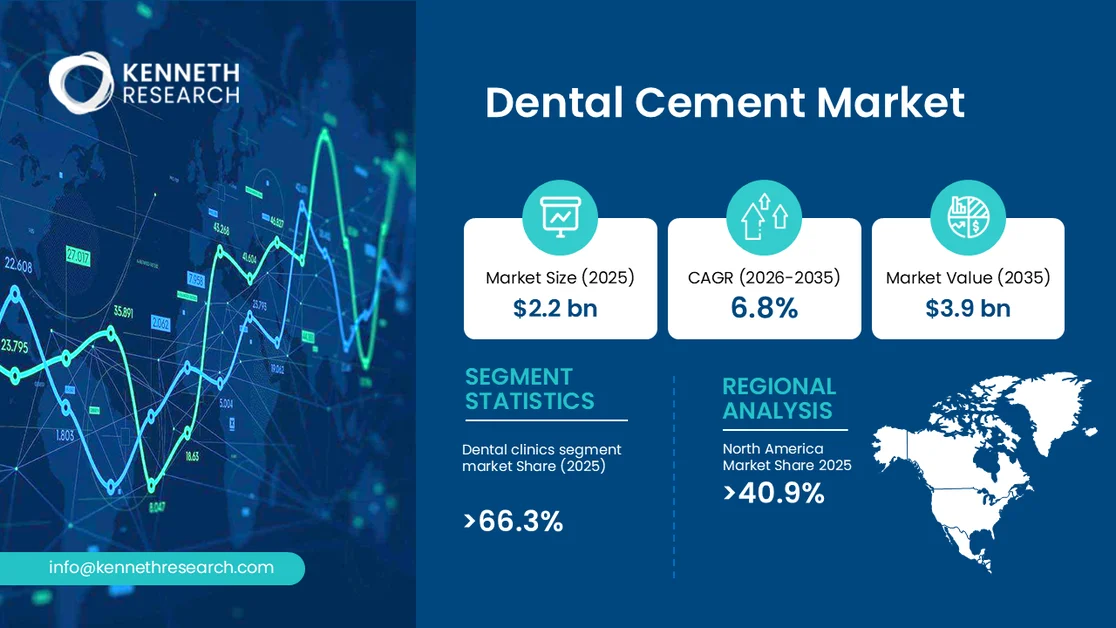
Dental Cement Market size was valued at USD 2.2 billion in 2025 and is projected to reach USD 3.9 billion by the end of 2035, rising at a CAGR of 6.8% during the forecast period, i.e., 2026-2035. In 2026, the industry size of the dental cement is estimated at USD 2.3 billion.
The primary growth driver for the dental cement market is the rising demand for restorative and prosthetic dental procedures driven by the persistent burden of oral diseases. According to the U.S. Centers for Disease Control and Prevention (CDC), 1 in 5 adults aged 20–64 years has at least one untreated cavity, sustaining the need for durable dental cement solutions across clinical settings.
The dental cement market comprises materials used to bond, seal, line, lute, and restore dental prostheses and restorative materials during preventive, restorative, prosthodontic, endodontic, and orthodontic procedures. These cements include permanent and temporary formulations designed to provide reliable adhesion, mechanical strength, biocompatibility, marginal sealing, and resistance to oral fluids. Depending on clinical requirements, dental cements are formulated using glass ionomer, resin-modified glass ionomer, resin, zinc oxide-eugenol, zinc phosphate, polycarboxylate, and other advanced chemistries to support crowns, bridges, veneers, inlays, onlays, implants, orthodontic brackets, and cavity restorations.
The market plays a vital role in modern dentistry by ensuring the long-term stability and functionality of indirect restorations while reducing the risk of microleakage and secondary caries. Continuous improvements in adhesive technologies, esthetics, fluoride release, and simplified clinical handling have expanded the application of dental cements across general and specialized dental practices. Their industrial relevance extends to supporting minimally invasive dentistry, digital restorative workflows, and the increasing adoption of high-performance dental materials, making them indispensable consumables within the global oral healthcare ecosystem.
Key Dental Cement Market Insights Summary:
Key Takeaways: Market Trends & Insights
- The dental cement market was valued at USD 2.2 billion in 2025 and is projected to reach USD 3.9 billion by 2035, registering a 6.8% CAGR during 2026-2035.
- Dental clinics led the end-user segment with a 66.3% share in 2025, driven by increasing restorative, prosthodontic, cosmetic, and implant procedures
- Permanent dental cement is projected to witness strong growth owing to rising adoption of long-lasting restorative materials compatible with digital dentistry and CAD/CAM workflows
- North America accounted for the largest regional share of 40.9% in 2025, supported by advanced oral healthcare infrastructure, strong regulatory frameworks, and widespread adoption of digital restorative technologies
- Asia Pacific is expected to emerge as the fastest-growing regional market, fueled by expanding dental healthcare infrastructure, increasing adoption of advanced restorative procedures, and growing manufacturing capabilities for dental materials
Market Drivers
- Increasing prevalence of restorative and prosthetic dental procedures
- Rising adoption of implant-supported dental restorations
- Growing investments in dental healthcare infrastructure
- Advancements in bioactive and fluoride-releasing dental cement formulations
Challenges
- Stringent regulatory compliance and lengthy product validation requirements
- Clinical sensitivity and material compatibility across diverse restorative applications
Dental Cement Market Overview & Supply Chain
The adoption of dental cement is increasing globally as healthcare systems place greater emphasis on preventive and restorative oral care, while digital dentistry and minimally invasive treatment approaches continue to expand. Advances in adhesive formulations, improved biocompatibility, enhanced bond strength, and compatibility with CAD/CAM restorations have strengthened the clinical value of modern dental cements. Regulatory focus on improving access to oral healthcare and growing investments in dental infrastructure are further supporting market adoption. Industry relevance is reinforced by the global burden of oral disease. The World Health Organization reported in 2025 that oral diseases affect nearly 3.7 billion people worldwide, highlighting the sustained need for restorative materials used in preventive and prosthetic dental procedures.
The dental cement industry value chain begins with the procurement of high-purity raw materials, including resin monomers, glass fillers, polyacrylic acids, zinc compounds, calcium-based materials, silane coupling agents, pigments, and specialty additives supplied by chemical and biomaterial manufacturers. These inputs undergo formulation, blending, sterilization, quality testing, and packaging by dental materials manufacturers operating under stringent medical device quality standards. Finished products are distributed through specialized dental distributors, medical supply companies, e-commerce procurement channels, and direct manufacturer sales networks serving domestic and international markets. Hospitals, dental clinics, academic institutions, and specialty dental laboratories represent the principal end users, selecting products based on clinical performance, ease of handling, regulatory compliance, and compatibility with restorative workflows. Key stakeholders across the value chain include raw material suppliers, contract manufacturers, dental material producers, regulatory authorities, distributors, procurement organizations, dental professionals, research institutions, and healthcare providers that collectively drive product innovation and commercialization.
Dental Cement Market: Growth Drivers & Challenges
Growth Drivers:
- Expansion of digital restorative dentistry and advanced adhesive technologies: The rapid integration of digital dentistry is significantly accelerating demand for high-performance dental cements that deliver predictable bonding, improved esthetics, and compatibility with CAD/CAM restorations. Modern restorative workflows require cements capable of supporting ceramic, zirconia, and composite restorations while reducing chairside time and simplifying clinical procedures. Manufacturers are responding through continuous product innovation and regulatory approvals that expand the availability of advanced self-adhesive and dual-cure formulations. Reflecting this trend, the U.S. Food and Drug Administration (FDA) granted 510(k) clearance on August 9, 2022, for the NOVA RESIN dual cure, self-adhesive resin cement (K213609), demonstrating continued commercialization of next-generation dental cement technologies for clinical practice. These innovations enhance procedural efficiency, strengthen restoration longevity, and are expected to encourage broader adoption of digital restorative solutions across both developed and emerging healthcare markets.
- Growing demand for minimally invasive and long-lasting restorative procedures: The increasing preference for minimally invasive dentistry is creating sustained demand for dental cements that provide superior adhesion, reduced microleakage, and enhanced preservation of healthy tooth structure. Dental professionals are increasingly selecting advanced luting materials that offer durable mechanical performance, fluoride release where applicable, and simplified handling characteristics for complex restorative procedures. This transition is encouraging manufacturers to invest in material science, hybrid chemistries, and application-specific formulations that improve clinical outcomes while supporting efficient workflows. As patient expectations for esthetics and restoration longevity continue to rise, the need for reliable permanent cementation solutions is expected to strengthen. Over the long term, continued innovation in bioactive materials, universal adhesive systems, and compatibility with digital restorative technologies will reinforce the strategic importance of advanced dental cements across preventive, prosthodontic, and implant dentistry.
Challenges:
- Stringent regulatory compliance and lengthy product validation requirements: The development and commercialization of dental cements are constrained by rigorous regulatory expectations governing material safety, biocompatibility, mechanical performance, and long-term clinical reliability. Manufacturers must conduct extensive laboratory testing, validation studies, and quality assurance processes before introducing new formulations, particularly those incorporating novel chemistries or bioactive components. These requirements extend product development timelines and increase compliance-related expenditures, making market entry more challenging for emerging manufacturers. Commercially, delayed product launches can reduce the speed at which companies respond to evolving clinical preferences and technological advancements, allowing established competitors to strengthen their market positions. Differences in regulatory frameworks across regions also complicate international product registration and portfolio expansion. Looking ahead, companies that integrate regulatory planning early in product development and invest in robust quality management systems will be better positioned to accelerate approvals while maintaining consistent compliance across global markets.
- Clinical sensitivity and material compatibility across diverse restorative applications: The performance of dental cement is highly dependent on clinical technique, substrate preparation, moisture control, and compatibility with restorative materials such as ceramics, zirconia, metals, and composite resins. Variations in these factors can influence bond durability, marginal integrity, and the long-term success of restorations. As restorative dentistry increasingly incorporates advanced materials and digital workflows, manufacturers face the challenge of developing cement systems that perform consistently across a broad range of indications without compromising handling characteristics. From a commercial perspective, clinicians often favor products with proven versatility and predictable outcomes, creating intense competition and raising the threshold for product differentiation. Future market success will depend on innovations that simplify clinical protocols, improve tolerance to procedural variability, and deliver reliable performance across increasingly complex restorative and prosthetic treatment scenarios.
Dental Cement Market Size and Forecast:
| Report Attribute | Details |
|---|---|
| Base Year |
2025 |
| Forecast Year |
2026-2035 |
| CAGR |
6.8% |
| Base Year Market Size (2025) |
USD 2.2 billion |
| Forecast Year Market Size (2035) |
USD 3.9 billion |
| Regional Scope |
|
Dental Cement Market Segmentation Analysis:
End-User Segment Analysis
In the end-user segment, the dental clinics sub-segment is anticipated to capture the largest market share of 66.3% by the end of 2025.
Dental clinics remain the dominant end-user segment in the dental cement market because they perform the highest volume of restorative, prosthodontic, cosmetic, and implant procedures requiring reliable cementation materials. The increasing preference for outpatient dental care, shorter treatment durations, and technologically advanced clinic-based services has strengthened demand for permanent and temporary dental cements. Adoption is further supported by the growing integration of digital impression systems, CAD/CAM restorations, and chairside workflows, all of which depend on high-performance luting materials that deliver durable bonding and predictable clinical outcomes. On the supply side, manufacturers prioritize dental clinics through direct sales channels, clinical education programs, and product portfolios tailored to routine restorative procedures, ensuring broad product availability and rapid adoption of innovative formulations. Demand is reinforced by continued utilization of professional dental services.
Product Type Segment Analysis
The permanent is projected to grow as the second-largest segment in the dental cement market due to four converging demand drivers.
The permanent dental cement segment is projected to experience sustained growth as clinicians increasingly prioritize long-lasting restorative solutions that minimize replacement frequency and improve restoration durability. Permanent cements are extensively used for crowns, bridges, inlays, onlays, veneers, and implant-supported prostheses because they provide strong adhesion, high compressive strength, and durable marginal sealing. Their compatibility with advanced restorative materials, including zirconia, lithium disilicate, and CAD/CAM-fabricated restorations, has further accelerated adoption in modern dental practice. Supply-side growth is supported by continuous investments in resin-based and glass ionomer technologies, simplified delivery systems, and formulations designed to improve moisture tolerance and clinical handling while meeting evolving regulatory requirements. Demand for permanent cementation is reinforced by the widespread prevalence of permanent tooth restoration needs. According to the National Institute of Dental and Craniofacial Research (NIDCR), 89.9% of adults aged 20–64 years had experienced dental caries in their permanent teeth based on National Health and Nutrition Examination Survey data, underscoring the continuing need for durable restorative materials. Looking ahead, continued advances in adhesive chemistry, bioactive formulations, and digital restorative workflows are expected to further strengthen the adoption of permanent dental cements.
Our in-depth analysis of the global dental cement market includes the following segments:
|
Segment |
Sub-segment |
|
Product Type |
|
|
Material |
|
|
Application |
|
|
End-User |
|
Dental Cement Market Regional Insights:
North America Market Trends & Insights:
North America dental cement market is projected to hold the largest revenue share of 40.9% by the end of 2025.
The region benefits from a mature network of dental clinics, specialized laboratories, and manufacturers developing high-performance resin, glass ionomer, and bioactive cement technologies. Strong regulatory oversight supports the commercialization of safe and clinically validated dental materials, while widespread adoption of digital dentistry, CAD/CAM restorations, and implant procedures continues to stimulate demand for premium cement formulations. The presence of leading dental material manufacturers, robust research capabilities, and established distribution networks further reinforces regional leadership by ensuring rapid availability of advanced products and consistent clinical adoption across restorative and prosthodontic applications.
The United States represents the largest contributor to regional demand owing to its advanced oral healthcare infrastructure, high utilization of restorative procedures, and continuous product innovation supported by a mature regulatory framework. Demand is further strengthened by the widespread use of digital restorative technologies and specialized dental services.
Canada complements regional growth through expanding access to oral healthcare and continued public investment in dental services. According to statistics Canada, approximately 72% of Canadians aged 12 years and older reported visiting an oral health professional during the period from November 2023 to March 2024, demonstrating strong utilization of professional dental services that supports sustained demand for restorative consumables, including dental cements. Continued investments in preventive care, restorative dentistry, and digital clinical workflows are expected to reinforce North America's market leadership over the forecast period.
Asia Pacific Market Trends & Insights:
Asia Pacific is emerging as a high-growth region for the dental cement market, supported by expanding access to oral healthcare, rapid urbanization, rising awareness of preventive and restorative dentistry, and increasing investments in healthcare infrastructure. The region is witnessing greater adoption of advanced restorative procedures as dental service providers modernize clinical workflows with digital imaging, CAD/CAM systems, and implant-based treatments. Growing domestic production of dental materials, coupled with expanding manufacturing capabilities, has improved product availability and strengthened regional supply chains. Government initiatives promoting broader healthcare coverage, oral health awareness programs, and modernization of medical device regulations are encouraging greater utilization of restorative dental materials across both public and private healthcare settings. Looking ahead, opportunities are expected to arise from the expansion of specialty dental clinics, increased demand for esthetic dentistry, the integration of digital dentistry technologies, and continued investment in research and development of advanced biomaterials tailored to regional clinical requirements.
China represents the largest contributor within the region due to its extensive healthcare infrastructure, expanding dental services sector, and strong manufacturing base for dental consumables and medical devices. Continuous investments in healthcare modernization, increasing adoption of implant and prosthetic procedures, and the growing use of advanced restorative materials are supporting sustained demand for high-performance dental cements.
Japan remains an important market driven by its sophisticated dental care system, emphasis on high-quality restorative treatment, and early adoption of innovative dental technologies. The country's focus on precision dentistry, aging population requiring long-term restorative care, and established collaboration between manufacturers, research institutions, and dental professionals continue to support the uptake of premium permanent dental cement formulations while fostering ongoing product innovation and clinical excellence.
Leading Companies Operating in the Global Dental Cement Market:
Here is a list of upstream, downstream, and key players operating in the global dental cement market competitive ecosystem:
- Dentsply Sirona Inc. (United States)
- Company Overview
- Business Strategy
- Key Product Offerings
- Financial Performance
- Key Performance Indicators
- Risk Analysis
- Recent Development
- Regional Presence
- SWOT Analysis
- Kerr Dental (United States)
- Shofu Dental Corporation (Japan)
- Kuraray Noritake Dental Inc. (Japan)
- SDI Limited (Australia)
- VOCO GmbH (Germany)
- Coltene Holding AG (Switzerland)
Recent Developments
- March 2025: Solventum (formerly 3M Health Care) announced a strategic partnership with SprintRay to develop chairside 3D-printed permanent dental restorations. The collaboration combines Solventum's restorative materials expertise, including dental cement technologies, with SprintRay's digital dentistry platform to enable same-day restorations.
Frequently Asked Question
In 2025, the dental cement market exceeded USD 2.2 billion.
The Dental Cement Market is projected to reach USD 3.9 billion by the end of 2035, expanding at a CAGR of 6.8% over the forecast period (2026-2035).
The major players in the market are Dentsply Sirona Inc. (United States), Kerr Dental (United States), Shofu Dental Corporation (Japan), Kuraray Noritake Dental Inc. (Japan), SDI Limited (Australia), VOCO GmbH (Germany), Coltene Holding AG (Switzerland), and others.
In the end-user segment, the dental clinics sub-segment is anticipated to capture the largest market share of 66.3% in the future and exhibit lucrative growth opportunities during 2026–2035. This growth trajectory is largely attributed to the increasing adoption of restorative, prosthodontic, cosmetic, and implant dental procedures supported by expanding digital dentistry workflows.
North America is projected to hold the largest market share of 40.9% by the end of 2025 and provide more business opportunities in the future. Continuous investments in advanced restorative dentistry, digital dental technologies, and strong oral healthcare infrastructure across the United States and Canada are fostering the region's dominance.
Why Choose Kenneth Research ?
-
Insight with Impact : We don’t just gather data — we uncover stories, trends, and opportunities that fuel business growth.
-
Experts Who Get It : Our team speaks your industry’s language and knows what really matters to your customers and market.
-
Custom-Built for You : Forget one-size-fits-all. We craft research and consulting solutions as unique as your business vision.
-
Partners, Not Just Providers : We work with you, not for you — collaborating closely to turn insights into smart, strategic moves.
-
Results That Speak : Our work powers brands, startups, and industry leaders alike — with a track record of ideas that work in the real world.
Report ID: 1085 |
Published Date: 14 Aug 2026 |
Report Format: |
Delivery Timeline: 48-72 Business Hours

Copyright © 2025 Kenneth Research. All rights reserved. Terms of Use | Privacy Policy
