Report ID: 1083 |
Published Date: 14 Aug 2026 |
Report Format: |
Delivery Timeline: 48-72 Business Hours
Dental Braces Market Outlook:
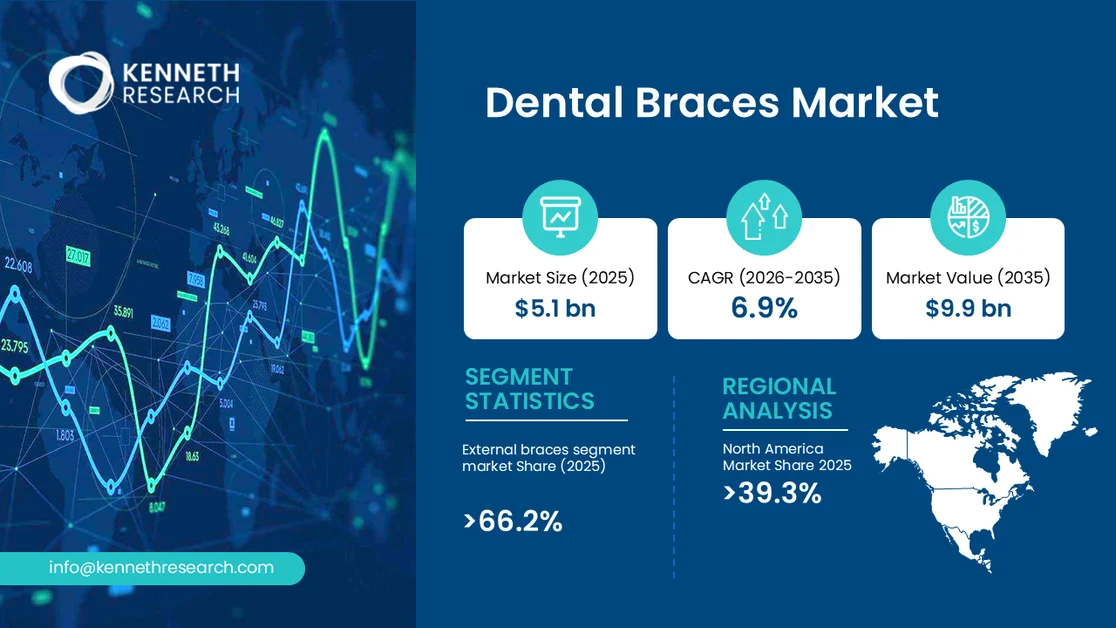
Dental Braces Market size was valued at USD 5.1 billion in 2025 and is projected to reach USD 9.9 billion by the end of 2035, rising at a CAGR of 6.9% during the forecast period, i.e., 2026–2035. In 2026, the industry size of the dental braces is estimated at USD 5.5 billion.
Growing awareness of oral health and increasing demand for orthodontic treatment to correct malocclusion are the primary growth drivers of the dental braces market. Public health emphasis on preventing long-term oral complications and improving functional as well as aesthetic outcomes continues to support adoption across pediatric, adolescent, and adult patient populations. Supported by CDC oral health surveillance highlighting the widespread burden of dental conditions.
The dental braces market comprises orthodontic devices designed to diagnose, prevent, and correct the alignment of teeth and jaws by applying controlled mechanical forces over a prescribed treatment period. These devices include fixed braces, removable braces, ceramic braces, lingual braces, self-ligating braces, and associated orthodontic accessories used in clinical dental practice. The market encompasses manufacturers of orthodontic appliances, dental material suppliers, digital treatment planning providers, orthodontic clinics, hospitals, and specialized dental laboratories involved in delivering comprehensive orthodontic care.
Dental braces are characterized by their ability to address malocclusion, overcrowding, spacing irregularities, overbites, underbites, crossbites, and other occlusal disorders while improving oral function, facial symmetry, and long-term dental health. Modern orthodontic treatment increasingly integrates digital imaging, intraoral scanning, computer-aided treatment planning, and customized appliance fabrication to enhance treatment precision and patient outcomes.
Industrially, the market represents a significant segment of the global dental devices and orthodontics industry, supporting preventive dentistry, restorative care, and aesthetic dental services. Demand is influenced by evolving clinical practices, technological innovation, expanding access to orthodontic services, and growing awareness of comprehensive oral healthcare among patients and providers.
Key Dental Braces Market Insights Summary:
Key Takeaways: Market Trends & Insights
- The dental braces market is projected to grow from USD 5.1 billion in 2025 to USD 9.9 billion by 2035, expanding at a 6.9% CAGR during 2026-2035
- External braces led the position segment with a 66.2% share in 2025, driven by high clinical effectiveness, broad applicability, and continued product innovation
- Teenagers (13–19 years) are expected to witness strong growth due to rising orthodontic awareness, early intervention, and increasing adoption of customized treatment solutions
- North America held the largest regional share at 39.3% in 2025, supported by advanced dental infrastructure, digital orthodontics, and strong healthcare investment
- Europe continues to offer significant growth opportunities, backed by expanding digital dentistry adoption, established medical device manufacturing, and supportive oral healthcare initiatives
Market Drivers
- Increasing adoption of aesthetic orthodontic solutions among adults
- Expansion of digital dentistry and CAD/CAM-enabled orthodontic manufacturing
- Growing availability of specialized orthodontic clinics and dental service organizations
- Continuous innovation in orthodontic materials, self-ligating systems, and treatment planning software
Challenges
- Limited reimbursement coverage and high out-of-pocket treatment costs
- Dependence on specialized orthodontic expertise and lengthy treatment timelines
Dental Braces Market Overview & Supply Chain
Global adoption of dental braces is increasing as healthcare systems place greater emphasis on preventive oral healthcare, early diagnosis of malocclusion, and improved access to orthodontic services. Technological advancements such as digital intraoral scanning, computer-aided treatment planning, and customized orthodontic appliances have enhanced treatment precision and patient experience, encouraging wider acceptance among both adolescents and adults. Regulatory support for integrating oral health into broader healthcare strategies is also strengthening the industry's outlook. According to the World Health Organization (WHO) Global Oral Health Status Report (2022), oral diseases affect 3.5 billion people worldwide, underscoring the significant public health need for preventive and corrective dental interventions, including orthodontic treatment. This widespread disease burden continues to drive investments in advanced orthodontic technologies, specialized dental infrastructure, and professional training across developed and emerging healthcare markets.
The dental braces market value chain begins with suppliers of medical-grade stainless steel, nickel-titanium alloys, ceramics, polymers, elastomers, and specialized orthodontic adhesives used in manufacturing brackets, wires, bands, ligatures, and retainers. Manufacturers integrate precision engineering, digital design software, CAD/CAM systems, and quality assurance processes to produce standardized and customized orthodontic solutions that comply with medical device regulations. Products are distributed through specialized dental distributors, medical device wholesalers, direct sales teams, and increasingly through digital procurement platforms serving hospitals and dental clinics. Orthodontists, dental hospitals, private clinics, academic institutions, and specialty dental centers represent the primary end users responsible for diagnosis, treatment planning, appliance placement, and follow-up care. Major stakeholders include raw material suppliers, component manufacturers, digital technology providers, regulatory authorities, dental laboratories, logistics providers, dental service organizations, insurance providers, and professional orthodontic associations that collectively support product innovation, clinical adoption, reimbursement, and patient access across global markets.
Dental Braces Market: Growth Drivers & Challenges
Growth Drivers:
- Advancements in digital orthodontics and customized treatment solutions: The growing adoption of digital orthodontic workflows is significantly accelerating the dental braces market by improving treatment precision, reducing chairside time, and enhancing patient satisfaction. Orthodontists increasingly utilize intraoral scanners, three-dimensional imaging, artificial intelligence-assisted treatment planning, and computer-aided appliance manufacturing to deliver personalized orthodontic solutions. These technologies improve diagnostic accuracy while enabling more predictable tooth movement and efficient treatment monitoring. Regulatory approvals for innovative orthodontic devices further strengthen market confidence and encourage broader clinical adoption. For example, in May 2023, the U.S. Food and Drug Administration (FDA) granted 510(k) clearance for 3M™ Clarity™ Aligners (Force and Flex), demonstrating continued innovation in orthodontic treatment technologies and expanding the availability of advanced treatment options. Looking ahead, greater integration of digital manufacturing, cloud-based treatment planning, and customized appliances is expected to improve operational efficiency and expand access to orthodontic care across both developed and emerging healthcare markets.
- Rising emphasis on preventive and early orthodontic care: Increasing emphasis on preventive dentistry and early orthodontic intervention is creating sustained demand for dental braces worldwide. Dental professionals are encouraging timely assessment and correction of malocclusion to reduce the likelihood of complex dental complications later in life. Greater awareness among parents, educational institutions, and healthcare providers has contributed to earlier diagnosis and treatment planning, particularly among adolescent populations. Simultaneously, expanding dental insurance coverage in several countries, higher disposable incomes, and improved access to specialized orthodontic services are encouraging more patients to pursue corrective treatment. The growing availability of aesthetically appealing braces and patient-specific treatment options further supports acceptance across different age groups. In the long term, continued investment in preventive oral healthcare, integration of orthodontic services into comprehensive dental care, and expanding specialist networks are expected to reinforce consistent market growth while improving long-term oral health outcomes.
Challenges:
- High treatment costs and limited reimbursement coverage: The high overall cost of orthodontic treatment remains one of the most significant restraints on the dental braces market, particularly in regions where dental care is financed primarily through out-of-pocket spending. Treatment expenses extend beyond the initial appliance installation to include diagnostics, periodic adjustments, emergency visits, retention devices, and post-treatment monitoring. In many healthcare systems, orthodontic procedures are categorized as elective or cosmetic unless they address severe functional abnormalities, limiting insurance reimbursement and reducing affordability for a broad patient population. This pricing barrier constrains patient conversion rates and slows market penetration in cost-sensitive regions. Commercially, manufacturers and providers face pressure to introduce competitively priced solutions without compromising clinical quality or regulatory compliance. Over the long term, broader insurance participation, flexible financing models, and cost-efficient digital treatment workflows will be essential to improving accessibility and sustaining market expansion.
- Dependence on skilled orthodontic professionals and extended treatment duration: The dental braces market is highly dependent on the availability of qualified orthodontists capable of diagnosing complex malocclusions, developing individualized treatment plans, and managing long-term patient care. In many regions, shortages of specialized professionals and uneven distribution of orthodontic services create bottlenecks that limit patient access and extend waiting periods. Additionally, conventional orthodontic treatment often requires regular follow-up appointments over an extended duration, increasing the burden on both providers and patients. These factors reduce clinic capacity, elevate operational costs, and can discourage treatment initiation or completion. From a commercial perspective, manufacturers must invest in clinician training, digital workflow support, and user-friendly technologies that improve treatment efficiency. Looking ahead, innovations in treatment planning, remote monitoring, and practice automation are expected to help mitigate workforce constraints while enhancing scalability across diverse healthcare markets.
Dental Braces Market Size and Forecast:
| Report Attribute | Details |
|---|---|
| Base Year |
2025 |
| Forecast Year |
2026-2035 |
| CAGR |
6.9% |
| Base Year Market Size (2025) |
USD 5.1 billion |
| Forecast Year Market Size (2035) |
USD 9.9 billion |
| Regional Scope |
|
Dental Braces Market Segmentation Analysis:
Position Segment Analysis
In the position segment, the external braces sub-segment is anticipated to capture the largest market share of 66.2% by the end of 2025.
External braces remain the leading segment in the dental braces market due to their broad clinical applicability, proven treatment effectiveness, and ability to manage mild to highly complex malocclusion cases. Orthodontists continue to prefer external braces because they provide precise control over tooth movement, making them suitable for correcting severe alignment, bite, and jaw positioning abnormalities that may not be addressed effectively by alternative orthodontic systems. Continuous advancements in bracket materials, low-friction archwires, self-ligating systems, and aesthetic ceramic variants have further strengthened patient acceptance while preserving clinical performance. From the supply perspective, manufacturers benefit from well-established production processes, standardized product portfolios, and extensive global distribution networks, ensuring consistent availability across hospitals, specialty orthodontic clinics, and dental practices. Demand is also supported by the continued burden of oral diseases. According to the U.S. Centers for Disease Control and Prevention (CDC), 1 in 10 adolescents aged 12–19 years have at least one untreated cavity, highlighting the need for timely dental intervention and reinforcing opportunities for orthodontic evaluation and treatment alongside comprehensive oral healthcare. Looking ahead, digital treatment planning, customized appliance design, and integration with advanced orthodontic workflows are expected to further reinforce the dominance of external braces in both developed and emerging markets.
End-User Segment Analysis
The teenagers (13–19 years) is projected to grow as the second-largest segment in the dental braces market due to four converging demand drivers.
The teenagers (13–19 years) segment is projected to experience strong growth in the dental braces market owing to the high prevalence of orthodontic treatment during adolescence, when permanent dentition is established and jaw development remains responsive to corrective intervention. Orthodontists frequently recommend treatment during these years to achieve predictable clinical outcomes while minimizing the need for more invasive procedures later in life. Increasing awareness among parents, schools, and healthcare providers regarding the long-term benefits of correcting malocclusion has further strengthened demand. On the supply side, manufacturers continue to expand portfolios of aesthetic brackets, self-ligating systems, and digitally customized orthodontic solutions specifically suited to adolescent patients. Demand is also supported by epidemiological evidence. Results from the Sixth German Oral Health Study (DMS 6) found that 40.4% of 8- and 9-year-old children required orthodontic treatment according to statutory health insurance guidelines, demonstrating a substantial pool of patients likely to progress into adolescent orthodontic care. Looking ahead, advances in digital treatment planning, improved patient compliance technologies, and expanded access to specialist orthodontic services are expected to sustain growth in this segment.
Our in-depth analysis of the global dental braces market includes the following segments:
|
Segment |
Sub-segment |
|
Product Type |
|
|
Material |
|
|
Position |
|
|
End-User |
|
Dental Braces Market Regional Insights:
North America Market Trends & Insights:
North America dental braces market is projected to hold the largest revenue share of 39.3% by the end of 2025.
The region benefits from continuous investment in innovative orthodontic technologies, including digital treatment planning, intraoral scanning, customized appliance manufacturing, and practice management software that improve clinical efficiency and patient outcomes. A well-defined regulatory environment for dental devices and sustained investments in oral healthcare innovation further support commercialization of advanced orthodontic solutions. Additionally, extensive collaboration among manufacturers, dental laboratories, academic institutions, and healthcare providers strengthens product development and clinical adoption. Regional demand is reinforced by high awareness of preventive oral healthcare and increasing acceptance of orthodontic treatment across both adolescent and adult populations.
The United States remains the principal contributor to regional leadership owing to its large orthodontic care network, early adoption of advanced dental technologies, and continuous product innovation supported by a mature regulatory framework.
Canada is also strengthening regional demand through expanded access to oral healthcare and federal initiatives that improve dental service utilization. According to Statistics Canada’s 2023–2024 Canadian Oral Health Survey, 72% of Canadians aged 12 years and older reported visiting an oral health professional during the previous year, indicating sustained utilization of dental services that supports orthodontic evaluation and treatment opportunities. Together, these countries provide a favorable ecosystem for manufacturers, distributors, orthodontic practices, and technology providers, positioning North America to maintain its leadership in the dental braces market over the forecast period.
Europe Market Trends & Insights:
Europe represents a strategically important region in the dental braces market, supported by a mature healthcare ecosystem, strong clinical expertise in orthodontics, and widespread adoption of advanced dental technologies. Demand is driven by increasing awareness of preventive oral healthcare, growing acceptance of orthodontic treatment among both adolescents and adults, and the availability of technologically advanced treatment options, including digital workflows and customized orthodontic appliances. The region also benefits from a well-established medical device manufacturing base, enabling continuous innovation in orthodontic materials, appliance design, and digital treatment planning solutions. Government-backed oral health programs, harmonized medical device regulations, and investments in healthcare modernization contribute to consistent industry development. Looking ahead, opportunities are expected to arise from expanding digital dentistry infrastructure, greater integration of artificial intelligence into orthodontic planning, enhanced collaboration between dental laboratories and clinics, and increasing demand for aesthetic and patient-specific treatment solutions across European healthcare markets.
Germany serves as one of Europe's leading orthodontic markets due to its advanced dental care infrastructure, strong manufacturing capabilities in medical devices, and extensive network of specialized orthodontists and dental laboratories. The country's emphasis on research, precision engineering, and adoption of digital dentistry technologies supports continued innovation and clinical efficiency.
The United Kingdom also plays a significant role through its established dental services, growing utilization of digital orthodontic workflows, and increasing focus on preventive oral healthcare. Continuous investment in clinical training, modernization of dental practices, and adoption of digitally enabled treatment planning are improving access to orthodontic services. Together, Germany and the United Kingdom strengthen Europe's position as a major hub for orthodontic innovation, manufacturing, and high-quality patient care, creating favorable conditions for sustained growth in the dental braces market.
Leading Companies Operating in the Global Dental Braces Market:
Here is a list of upstream, downstream, and key players operating in the global dental braces market competitive ecosystem:
- Align Technology, Inc. (United States)
- Company Overview
- Business Strategy
- Key Product Offerings
- Financial Performance
- Key Performance Indicators
- Risk Analysis
- Recent Development
- Regional Presence
- SWOT Analysis
- Dentsply Sirona (United States)
- Henry Schein, Inc. (United States)
- Ultradent Products, Inc. (United States)
- Hangzhou Xingchen 3B Dental (China)
- Straumann Group (Switzerland)
Recent Developments
- July 2025: Align Technology announced the commercial availability of the Invisalign® Palatal Expander System in India after receiving approval from the Central Drugs Standard Control Organization (CDSCO). The removable, 3D-printed expander offers an alternative to traditional metal expanders for growing patients.
- February 2025: Align Technology completed a $30 million equity investment in Smile Doctors, one of the largest orthodontic support organizations in the U.S., to accelerate digital orthodontics adoption and expand access to braces and aligner treatments
Frequently Asked Question
In 2025, the dental braces market exceeded USD 5.1 billion.
The dental braces market is projected to reach USD 9.9 billion by the end of 2035, expanding at a 6.9% CAGR over the forecast period (2026-2035).
The major players in the market are Align Technology, Inc. (United States), Dentsply Sirona (United States), Henry Schein, Inc. (United States), Ultradent Products, Inc. (United States), Hangzhou Xingchen 3B Dental (China), Straumann Group (Switzerland), and others.
In the position segment, the external braces sub-segment is anticipated to capture the largest market share of 66.2% in the future and exhibit lucrative growth opportunities during 2026-2035. This growth trajectory is largely attributed to increasing adoption of digital orthodontic technologies and the proven clinical effectiveness of external braces in treating a broad range of malocclusion cases.
North America is projected to hold the largest market share of 39.3% by the end of 2025 and provide more business opportunities in the future. Continuous investments in advanced orthodontic technologies, strong dental care infrastructure, and ongoing innovation across the United States and Canada are fostering the region's dominance.
Why Choose Kenneth Research ?
-
Insight with Impact : We don’t just gather data — we uncover stories, trends, and opportunities that fuel business growth.
-
Experts Who Get It : Our team speaks your industry’s language and knows what really matters to your customers and market.
-
Custom-Built for You : Forget one-size-fits-all. We craft research and consulting solutions as unique as your business vision.
-
Partners, Not Just Providers : We work with you, not for you — collaborating closely to turn insights into smart, strategic moves.
-
Results That Speak : Our work powers brands, startups, and industry leaders alike — with a track record of ideas that work in the real world.
Report ID: 1083 |
Published Date: 14 Aug 2026 |
Report Format: |
Delivery Timeline: 48-72 Business Hours

Copyright © 2025 Kenneth Research. All rights reserved. Terms of Use | Privacy Policy
