Report ID: 1163 |
Published Date: 25 Aug 2026 |
Report Format: |
Delivery Timeline: 48-72 Business Hours
Defoamers Market Outlook:
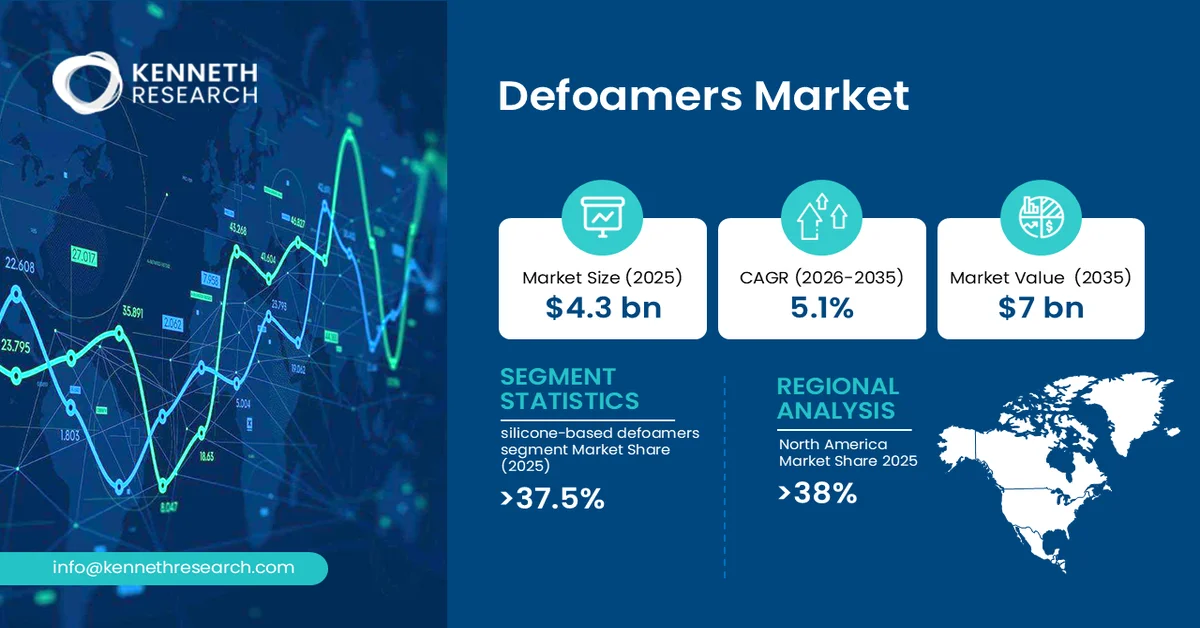
Defoamers Market size was valued at USD 4.3 billion in 2025 and is projected to reach USD 7 billion by the end of 2035, rising at a CAGR of 5.1% during the forecast period, i.e., 2026-2035. In 2026, the industry size of the defoamers is estimated at USD 4.5 billion.
The primary growth driver for the defoamers market is increasing demand for efficient foam control across paints and coatings, inks, adhesives, chemicals, food processing, pulp and paper, and other industrial processes. Uncontrolled foam can reduce production efficiency, affect surface quality, create filling and packaging problems, and interfere with processing operations.
The defoamers market comprises chemical additives designed to prevent, suppress, or eliminate unwanted foam during manufacturing and application processes. Defoamers typically include silicone-based, mineral-oil-based, water-based, and other specialized formulations selected according to the chemistry and processing requirements of the end-use industry.
These additives are used across paints and coatings, inks, adhesives, construction materials, pulp and paper, food processing, wastewater treatment, chemicals, and other industrial applications. Their primary function is to control surface and entrained foam without adversely affecting product appearance, stability, adhesion, or other critical performance characteristics.
Key Defoamers Market Insights Summary:
Key Takeaways: Market Trends & Insights
- The defoamers market is projected to grow from USD 4.3 billion in 2025 to USD 7 billion by 2035, registering a CAGR of 5.1% during the forecast period.
- North America held the largest regional share at 38% in 2025, supported by strong paints and coatings, chemical processing, pulp and paper, and industrial manufacturing activities.
- Silicone-based products accounted for the leading product type segment with a 37.5% share in 2025, owing to their high efficiency, low dosage requirements, and broad compatibility across industrial formulations.
- Paints, coatings & inks remain a key end-use segment, as defoamers help improve surface quality, reduce defects, and enhance manufacturing efficiency during formulation and application processes.
- Growing adoption of water-based coatings, stricter environmental regulations, and increasing demand for sustainable specialty chemicals are encouraging development of low-VOC, silicone-free, and bio-based defoamer technologies.
- Key challenges include regulatory compliance and formulation compatibility, prompting manufacturers to focus on application-specific solutions that balance foam control, product quality, and environmental performance.
Market Drivers
- Expansion of paints, coatings, and printing inks.
- Increasing use of water-based industrial formulations.
- Rising demand for efficient manufacturing processes.
- Growing specialty-chemical consumption across industrial applications.
- Development of application-specific and low-VOC defoamer formulations.
Challenges
- Increasing environmental and regulatory requirements
- Formulation compatibility and performance trade-offs
Defoamers Market: Market Overview & Supply Chain
The defoamers market is supported by demand from paints and coatings, printing inks, adhesives, chemicals, pulp and paper, food processing, construction materials, and other manufacturing industries. Defoamers are important process additives because uncontrolled foam can interfere with mixing, dispersion, pumping, filling, coating application, and finished-product appearance. The U.S. EPA identifies coatings and adhesives manufacturing as an established chemical-manufacturing subsector involving the formulation of paints, inks, adhesives, and related products.
The supply chain begins with raw materials such as silicone compounds, mineral oils, fatty alcohols, surfactants, polymers, emulsifiers, and other specialty chemical ingredients. Defoamer manufacturers formulate these inputs into silicone-based, water-based, oil-based, and other application-specific products. Finished additives are then supplied directly or through specialty distributors to paint and coating manufacturers, ink producers, chemical processors, paper manufacturers, construction-material producers, and other industrial users. Overall, the supply chain includes raw-material suppliers, specialty chemical manufacturers, formulation companies, distributors, and downstream industrial users, with increasing emphasis on high-performance, low-VOC, water-compatible, and application-specific defoamer technologies.
Defoamers Market: Growth Drivers & Challenges
Growth Drivers:
- Expansion of paints, coatings & inks manufacturing: Growing production of paints, coatings, and printing inks is supporting demand for defoamers because foam can develop during mixing, dispersion, pumping, filling, and application. Defoamers help maintain smooth processing and improve finished-surface quality. The U.S. census bureau classifies paint and coating manufacturing as a dedicated manufacturing industry covering paints and related coatings, confirming the scale of this important downstream application.
- Increasing industrial manufacturing activity: Broader manufacturing activity is generating demand for process additives that improve production efficiency and product consistency. Defoamers are used across chemical processing, paper production, adhesives, construction materials, and other industrial formulations where foam can disrupt processing. The U.S. Census Bureau's manufacturing indicators provide ongoing measures of industrial activity and new manufacturing orders, supporting continued demand for specialized production inputs.
Challenges:
- Increasing environmental and regulatory requirements: Defoamer manufacturers face growing pressure to evaluate the environmental and chemical profiles of their formulations. The U.S. EPA's safer choice program specifically reviews defoamer ingredients according to their chemical structure and applicable criteria, including silicone-based and polymer-based defoamers. This increases the importance of ingredient selection, formulation transparency, and development of products that meet evolving environmental requirements. Manufacturers may need to invest in reformulation, testing, and compliance activities while maintaining foam-control performance.
- Formulation compatibility and performance trade-offs: Defoamers must effectively control foam without negatively affecting properties such as coating appearance, adhesion, gloss, surface uniformity, stability, or downstream processing. A formulation that performs well in one application may be less effective in another because performance depends on factors such as viscosity, temperature, surfactant concentration, and processing conditions. Research on silicone-based defoamers demonstrates that performance can vary significantly according to operating conditions. This makes application-specific formulation and testing important, increasing development complexity for suppliers.
Defoamers Market Size and Forecast:
| Report Attribute | Details |
|---|---|
| Base Year |
2025 |
| Forecast Year |
2026-2035 |
| CAGR |
5.1% |
| Base Year Market Size (2025) |
USD 4.3 billion |
| Forecast Year Market Size (2035) |
USD 7 billion |
| Regional Scope |
|
Defoamers Market Segmentation Analysis:
Product Type Segment Analysis
In the Product Type segment, Silicone-based defoamers are anticipated to capture the largest market share of 37.5% in 2025.
Their strong foam-control efficiency, rapid action, persistence, and suitability across different formulation systems make them widely relevant to paints, coatings, inks, adhesives, and industrial processing.
Silicone-based technologies can be formulated for both water-based and solvent-based systems, allowing manufacturers to address different processing requirements. BASF, for example, offers silicone-based defoamers for water-based coatings, printing inks, adhesives, and other formulations, demonstrating their broad industrial applicability. Growing demand for high-quality coatings, improved manufacturing efficiency, and low-VOC formulations is expected to support continued adoption. At the same time, suppliers are developing more compatible and sustainable silicone formulations to reduce surface defects while maintaining efficient foam suppression.
End Use Segment Analysis
The paints, coatings & inks segment is expected to remain a major end-use area for defoamers because foam can develop during high-speed mixing, dispersion, pumping, filling, and application. Excessive foam can create surface defects, pinholes, uneven coating films, and production inefficiencies, making effective foam control important for maintaining consistent product quality.
Defoamers are therefore incorporated into architectural coatings, industrial coatings, printing inks, and specialty formulations to suppress unwanted foam while maintaining properties such as gloss, adhesion, leveling, and surface appearance. Demand is also supported by the continued development of water-based formulations, where formulation chemistry and processing conditions can make foam management particularly important. Manufacturers are increasingly developing application-specific defoamers that provide rapid foam knockdown while minimizing surface defects and compatibility problems. Silicone-based technologies are particularly relevant because of their strong foam-control performance across numerous coating and ink formulations. Continued investment in coatings quality, production efficiency, and specialized formulation technologies should support demand for defoamers in this end-use segment.
Our in-depth analysis of the global defoamers market includes the following segments:
|
Segment |
Sub-segment |
|
Product Type |
|
|
End Use |
|
|
Medium of Dispersion |
|
Defoamers Market Regional Insights:
North America Market Trends & Insights:
North America accounted for 38% of the defoamers market in 2025, supported by established paints and coatings, printing inks, chemicals, pulp and paper, food processing, and industrial manufacturing sectors. The region benefits from a mature specialty-chemicals industry and strong demand for formulation additives that improve processing efficiency and finished-product quality.
The U.S. represents the leading market, supported by its large coatings, chemicals, construction-materials, and industrial manufacturing base. The U.S. Census Bureau identifies Paint and Coating Manufacturing as a dedicated manufacturing industry covering the production of paints, coatings, varnishes, lacquers, and related products, providing an important downstream application base for defoamers.
Canada provides additional demand through its chemical, coatings, printing, construction, and manufacturing industries. Statistics Canada reported CAD 931.2 billion in total manufacturing revenue in 2024, demonstrating the substantial scale of Canada's manufacturing sector. Chemical and non-metallic mineral product manufacturing were also among the more profitable manufacturing subsectors during the year. Continued development of water-based coatings, specialty inks, industrial formulations, and environmentally responsive additives should support regional demand. At the same time, manufacturers are emphasizing low-VOC formulations, improved compatibility, and application-specific defoamer technologies to meet increasingly demanding performance and regulatory requirements.
Europe Market Trends & Insights:
Asia Pacific is a major secondary market for defoamers, supported by expanding paints and coatings, printing inks, chemicals, pulp and paper, construction materials, and manufacturing industries. Japan and China are particularly important markets because of their established industrial bases, advanced manufacturing capabilities, and substantial consumption of specialty chemical additives.
Japan has strong demand from automotive coatings, industrial coatings, electronics, chemicals, and printing applications. Its advanced manufacturing ecosystem supports the use of specialized additives where consistent processing, surface quality, and formulation stability are important.
China offers substantial opportunities through its large-scale coatings, construction, automotive, electronics, chemical, and paper industries. Increasing industrial production and continued development of water-based coatings and inks are supporting the need for effective foam-control technologies. Defoamers are particularly relevant during high-speed dispersion and mixing processes, where uncontrolled foam can affect production efficiency and finished-product quality.
Leading Companies Operating in the Global Defoamers Market:
Here is a list of upstream, downstream, and key players operating in the global defoamers market competitive ecosystem:
- BASF(Germany)
- Company Overview
- Business Strategy
- Key Product Offerings
- Financial Performance
- Key Performance Indicators
- Risk Analysis
- Recent Development
- Regional Presence
- SWOT Analysis
- Dow(United States)
- Evonik Industries(Germany)
- BYK(Germany)
Recent Developments
- December 2024: BYK announced new additive developments for the European Coatings Show, including BYK-1693 SD, a VOC-, mineral-oil-, and silicone-free powder defoamer for aqueous mineral and dispersion-based building-material formulations.
- March 2025: Evonik launched TEGO® Foamex 8420, a siloxane-based defoamer concentrate developed for difficult foam-control applications in waterborne overprint varnishes and printing inks.
Frequently Asked Question
The defoamers market was valued at USD 4.5 billion in 2026.
The market is projected to reach USD 7 billion by 2035, expanding at a CAGR of 5.1% during 2026-2035.
Major companies include BASF, Dow, Evonik, Wacker Chemie, and Kemira, supported by broad product portfolios serving coatings, inks, pulp and paper, chemicals, and other industrial applications.
Silicone-based defoamers are the leading product type segment, accounting for 37.5% in 2025, supported by strong foam-control efficiency and broad industrial applicability.
North America is projected to remain the leading region, accounting for 38% in 2025, supported by established coatings, inks, chemical processing, manufacturing, and other industrial applications.
Why Choose Kenneth Research ?
-
Insight with Impact : We don’t just gather data — we uncover stories, trends, and opportunities that fuel business growth.
-
Experts Who Get It : Our team speaks your industry’s language and knows what really matters to your customers and market.
-
Custom-Built for You : Forget one-size-fits-all. We craft research and consulting solutions as unique as your business vision.
-
Partners, Not Just Providers : We work with you, not for you — collaborating closely to turn insights into smart, strategic moves.
-
Results That Speak : Our work powers brands, startups, and industry leaders alike — with a track record of ideas that work in the real world.
Report ID: 1163 |
Published Date: 25 Aug 2026 |
Report Format: |
Delivery Timeline: 48-72 Business Hours

Copyright © 2025 Kenneth Research. All rights reserved. Terms of Use | Privacy Policy
