Report ID: 1180 |
Published Date: 26 Aug 2026 |
Report Format: |
Delivery Timeline: 48-72 Business Hours
Data Center Water and Wastewater Treatment Equipment Market Outlook:
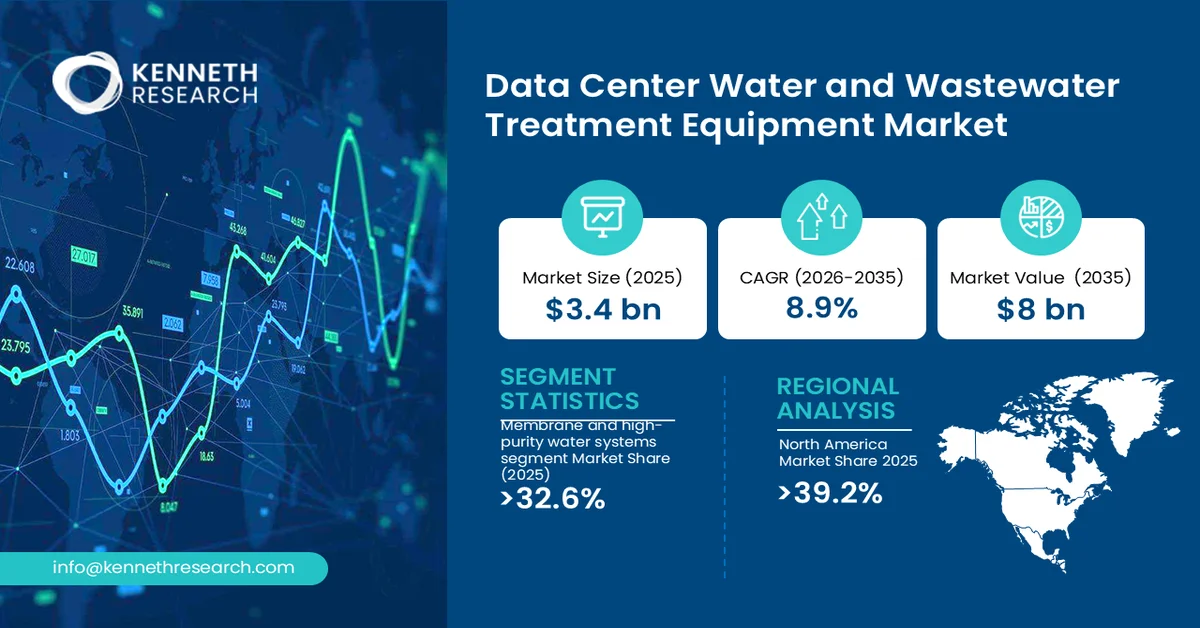
Data Center Water and Wastewater Treatment Equipment Market size was valued at USD 3.4 billion in 2025 and is projected to reach USD 8 billion by the end of 2035, rising at a CAGR of 8.9% during the forecast period, i.e., 2026-2035. In 2026, the industry size of data center water and wastewater treatment equipment is estimated at USD 3.7 billion.
Rising cooling requirements from expanding data-center infrastructure are driving demand for water and wastewater treatment equipment. The U.S. Department of Energy states that data-center cooling can account for up to 40% of overall data-center energy usage, reinforcing the need for efficient cooling-water management, purification, reuse, and wastewater treatment systems.
The data center water and wastewater treatment equipment market comprises equipment and integrated treatment technologies used to manage water quality, cooling-water circulation, high-purity water requirements, and wastewater generated by data-center operations. The market covers treatment solutions deployed across cooling and water-management infrastructure, including filtration, membrane-based purification, reverse osmosis, water reuse, wastewater treatment, and associated process equipment.
A defining characteristic of the market is its close integration with data-center cooling systems. Water treatment helps control dissolved minerals, contaminants, scaling, corrosion, and other water-quality conditions that can impair cooling-system performance. Treatment equipment can also support the recovery and reuse of suitable water streams, reducing dependence on freshwater supplies and improving operational resilience. The U.S. Department of Energy identifies reverse osmosis as a treatment option for producing high-quality water and notes its applicability to cooling-tower blowdown management.
Key Data Center Water and Wastewater Treatment Equipment Market Insights Summary:
Key Takeaways: Market Trends & Insights
- The data center water and wastewater treatment equipment market is valued at USD 3.4 billion in 2025 and is projected to reach USD 8.0 billion by 2035 at a CAGR of 8.9%
- Membrane & High-Purity Water Systems holds a 32.6% market share in 2025 within Equipment Type
- North America leads with a 39.2% market share in 2025, driven by strong data-center infrastructure
- Cooling Water Treatment is projected to be the fastest-growing segment within Treatment Stage
- The United States, Canada, China, and India remain key country opportunities for data-center water treatment equipment
Market Drivers
- Expansion of AI and high-performance computing infrastructure
- Increasing adoption of water-reuse and resource-efficiency strategies
- Stricter environmental and industrial wastewater-management requirements
- Greater deployment of advanced cooling technologies requiring controlled water quality
Challenges
- High Treatment Complexity and Operating Costs
- Water Availability Constraints and Site-Specific Infrastructure Requirements
Data Center Water and Wastewater Treatment Equipment Market Overview & Supply Chain
Adoption of data center water and wastewater treatment equipment is increasing globally as operators seek reliable cooling performance while managing water quality, reuse, and discharge requirements. The relevance of treatment infrastructure is particularly strong where cooling systems generate mineral-rich blowdown that can challenge conventional municipal wastewater facilities. A U.S. Environmental Protection Agency case study documents the commissioning of the Quincy Water Reuse Utility in 2021, specifically to treat cooling water from a data center and return the treated industrial wastewater for reuse as cooling water. The facility incorporates treatment processes including lime softening, ultrafiltration, high-efficiency softening, and reverse osmosis. This demonstrates how water treatment is becoming integrated with data-center infrastructure rather than functioning solely as an ancillary utility.
The industry value chain begins with raw-material and component suppliers providing membranes, filtration media, pumps, valves, piping, sensors, chemicals, resins, tanks, and control components. Equipment manufacturers and engineering firms then integrate these inputs into filtration, membrane purification, cooling-water treatment, wastewater treatment, monitoring, and water-reuse systems tailored to data-center specifications. System integrators and engineering, procurement, and construction contractors connect treatment equipment with cooling infrastructure, utility systems, and facility controls. Distribution occurs through direct manufacturer relationships, specialized water-treatment distributors, engineering contractors, and infrastructure procurement channels. End users include hyperscale, colocation, enterprise, government, and high-performance-computing data centers.
Data Center Water and Wastewater Treatment Equipment Market: Growth Drivers & Challenges
Growth Drivers:
- Expansion of closed-loop water reuse for data center cooling: Growing emphasis on water reuse is creating direct demand for treatment equipment capable of converting cooling-water blowdown and other industrial water streams into reusable cooling water. The mechanism is straightforward: treatment trains incorporating softening, ultrafiltration, reverse osmosis, and related processes can remove dissolved minerals and contaminants that otherwise limit cooling-system performance and increase discharge requirements. A recent U.S. EPA case study highlights the operational Quincy Water Reuse Utility, where treated cooling water is recirculated to a data center rather than being discharged through the municipal wastewater system. The project demonstrates how onsite or dedicated treatment infrastructure can simultaneously address water-quality constraints and freshwater dependence.
- Increasing cooling-system complexity and water-quality management requirements: The increasing thermal intensity and technical complexity of data-center cooling systems is strengthening demand for specialized water-treatment equipment. As operators deploy more sophisticated cooling architectures, maintaining appropriate water chemistry becomes critical to limiting scaling, corrosion, fouling, and heat-transfer degradation. Treatment therefore shifts from a peripheral utility function toward an integral part of cooling-system reliability. Equipment such as filtration systems, softeners, membranes, chemical-dosing units, sensors, and automated controls can help operators maintain defined water-quality conditions while managing blowdown and makeup-water requirements. The resulting demand extends beyond initial equipment purchases because treatment systems require monitoring, maintenance, replacement components, process optimization, and periodic upgrades.
Challenges:
- High treatment complexity and operating costs: Data center cooling-water treatment requires equipment to manage scaling, corrosion, suspended solids, dissolved minerals, and biological growth while maintaining reliable heat-transfer performance. The root challenge is that treatment requirements vary according to cooling architecture, source-water chemistry, climate, and operating conditions, making standardized system design difficult. More advanced treatment approaches can also introduce additional energy consumption, maintenance requirements, chemical management, and monitoring needs. These factors increase total lifecycle costs and can complicate investment decisions, particularly when operators compare water-treatment upgrades with alternative cooling configurations. Commercially, suppliers must therefore demonstrate measurable reliability and operating-value benefits rather than compete solely on equipment price.
- Water availability constraints and site-specific infrastructure requirements: Water availability is becoming a more consequential constraint when developers evaluate locations for data-center facilities using water-intensive cooling systems. The underlying challenge is geographical: treatment requirements, water quality, utility availability, and discharge conditions differ substantially between sites. Consequently, equipment suppliers cannot rely on a single treatment configuration across all projects. Operators may need additional pretreatment, reuse infrastructure, storage, monitoring, or alternative cooling arrangements where freshwater is scarce or costly. This can lengthen engineering cycles and increase project complexity because water-management decisions must be coordinated with cooling design and local utility infrastructure. Commercial implications extend across equipment procurement, installation, commissioning, and long-term service.
Data Center Water and Wastewater Treatment Equipment Market Size and Forecast:
| Report Attribute | Details |
|---|---|
| Base Year |
2025 |
| Forecast Year |
2026-2035 |
| CAGR |
8.9% |
| Base Year Market Size (2025) |
USD 3.4 billion |
| Forecast Year Market Size (2035) |
USD 8 billion |
| Regional Scope |
|
Data Center Water and Wastewater Treatment Equipment Market Segmentation Analysis:
Equipment Type Segment Analysis
In the equipment type segment, the Membrane & High-Purity Water Systems sub-segment is anticipated to capture the largest market share of 32.6% by the end of 2025.
Membrane and high-purity water systems dominate because data centers increasingly require controlled water chemistry to protect cooling equipment, maintain heat-transfer performance, and support water-reuse strategies. Reverse osmosis, ultrafiltration, demineralization, and related membrane technologies can remove dissolved solids and other contaminants from source or recirculated water, making them particularly valuable where mineral accumulation threatens cooling-system reliability. Demand is reinforced by the transition toward higher-density computing, which increases the importance of dependable thermal-management infrastructure and consistent water quality. Government-led deployments also demonstrate the operational value of advanced water-management technologies.
Treatment Stage Segment Analysis
The Cooling Water Treatment is projected to grow as the second-largest segment in the Data Center Water and Wastewater Treatment market due to four converging demand drivers.
Cooling water treatment is projected to expand rapidly because increasingly intensive data-center cooling operations require tighter control of dissolved minerals, suspended solids, fouling, scaling, and corrosion. As cooling systems operate continuously, treatment-stage technologies such as filtration, softening, chemical conditioning, and blowdown management become essential for maintaining heat-transfer performance and equipment reliability. Adoption is also being encouraged by the transition toward water-reuse models, where treated cooling-water streams can be returned to cooling systems instead of being discharged. The U.S. Environmental Protection Agency reported that a U.S. Army analysis found server-cooling blowdown reuse becomes economically favorable when water demand exceeds 130,000 gallons per day, demonstrating a direct economic rationale for treatment and reuse infrastructure.
Our in-depth analysis of the global data center water and wastewater treatment equipment market includes the following segments:
|
Segment |
Sub-segment |
|
Data Center Type |
|
|
Equipment Type |
|
|
Treatment Stage |
|
Data Center Water and Wastewater Treatment Equipment Market Regional Insights:
North America Market Trends & Insights:
North America Data Center Water and Wastewater Treatment market is projected to hold the largest revenue share of 39.2% by the end of 2025.
The region benefits from strong equipment manufacturing and engineering expertise, while operators increasingly integrate water-management technologies with cooling infrastructure to improve reliability and resource efficiency. Regulatory attention toward energy and water performance is also encouraging technology adoption. The U.S. Department of Energy highlights advanced cooling and water-reuse development as priorities within its data-center programs.
The United States represents the principal national market, supported by extensive hyperscale, enterprise, government, and colocation deployments and strong investment in AI-oriented computing infrastructure. Demand for treatment equipment is reinforced by federal research into efficient cooling and water reuse.
Canada offers complementary growth opportunities through data-center development, engineering capabilities, and access to comparatively diverse water resources. Across both countries, suppliers are positioned to benefit from demand for filtration, membrane treatment, cooling-water management, monitoring, and reuse systems as operators prioritize resilient and resource-efficient facilities.
Asia Pacific Market Trends & Insights:
Asia Pacific presents strong opportunities for data center water and wastewater treatment equipment as digital infrastructure expands alongside cloud computing, artificial intelligence, telecommunications, and industrial digitization. Demand is increasingly shaped by the need to reconcile data-center growth with water availability, cooling reliability, and environmental performance. Government initiatives are reinforcing this direction. China’s 2024 Green and Low-Carbon Development Action Plan for Data Centers calls for stronger water-efficiency evaluation for new and expanded facilities, encourages water-saving upgrades, and promotes the use of reclaimed water for equipment cooling. The policy also supports wider deployment of efficient cooling technologies and the development of standards covering data-center water efficiency.
China is a major regional opportunity because its rapidly developing computing infrastructure is being accompanied by increasingly explicit requirements for energy, water, and resource efficiency. National policy encourages more efficient cooling, reclaimed-water utilization, water-saving upgrades, and coordinated planning of data-center resources.
India offers significant potential as data-center infrastructure expands to support digital services, cloud computing, and AI workloads. Government guidance has emphasized reducing water dependence through closed-loop cooling approaches, including air-cooled and liquid-cooling configurations.
Leading Companies Operating in the Global Data Center Water and Wastewater Treatment Equipment Market:
Here is a list of upstream, downstream, and key players operating in the global data center water and wastewater treatment equipment market competitive ecosystem:
- Veolia (France)
- Company Overview
- Business Strategy
- Key Product Offerings
- Financial Performance
- Key Performance Indicators
- Risk Analysis
- Recent Development
- Regional Presence
- SWOT Analysis
- Ecolab Inc. (United States)
- Xylem (United States)
- Garratt-Callahan (United States)
- Lenntech B.V. (Netherlands)
- Gradiant (United States)
Recent Developments
- In April 2026, Veolia partnered with Amazon to develop reclaimed water solutions for data center cooling in Mississippi, deploying autonomous containerized treatment systems that transform wastewater into cooling water. The project is expected to reuse more than 83 million gallons of potable water annually once fully operational, with the first facility planned for 2027. Amazon Web Services will also support Veolia in developing AI-enhanced solutions for real-time process optimization and predictive maintenance.
- In July 2026, Ecolab Inc. completed the acquisition of CoolIT Systems for $4.75 billion to expand its direct-to-chip liquid cooling capabilities for AI data centers. Ecolab CEO Christophe Beck noted that AI data centers could consume more than one trillion gallons of freshwater annually by 2027. The acquisition follows Ecolab's $1.8 billion purchase of Ovivo's electronics division in 2025, extending its water treatment capabilities from semiconductor manufacturing to data center operations.
Frequently Asked Question
In 2025, the data center water and wastewater treatment equipment market exceeded USD 3.4 billion.
The data center water and wastewater treatment equipment market is projected to reach USD 8.0 billion by the end of 2035, expanding at a CAGR of 8.9% over the forecast period (2026-2035).
The major players in the market are Veolia, Ecolab Inc., Xylem, Garratt-Callahan, Lenntech B.V., Gradiant, and others.
In the Equipment Type segment, the Membrane & High-Purity Water Systems sub-segment is anticipated to capture the largest market share of 32.6% in the future and exhibit lucrative growth opportunities during 2026-2035. This growth trajectory is largely attributed to increasing demand for controlled water quality and advanced water-reuse systems for data center cooling.
North America is projected to hold the largest market share of 39.2% by the end of 2035 and provide more business opportunities in the future. Continuous investments in data-center infrastructure across the United States and Canada, alongside growing adoption of advanced cooling and water-management technologies, are fostering the region's dominance.
Why Choose Kenneth Research ?
-
Insight with Impact : We don’t just gather data — we uncover stories, trends, and opportunities that fuel business growth.
-
Experts Who Get It : Our team speaks your industry’s language and knows what really matters to your customers and market.
-
Custom-Built for You : Forget one-size-fits-all. We craft research and consulting solutions as unique as your business vision.
-
Partners, Not Just Providers : We work with you, not for you — collaborating closely to turn insights into smart, strategic moves.
-
Results That Speak : Our work powers brands, startups, and industry leaders alike — with a track record of ideas that work in the real world.
Report ID: 1180 |
Published Date: 26 Aug 2026 |
Report Format: |
Delivery Timeline: 48-72 Business Hours

Copyright © 2025 Kenneth Research. All rights reserved. Terms of Use | Privacy Policy
