Report ID: 1181 |
Published Date: 26 Aug 2026 |
Report Format: |
Delivery Timeline: 48-72 Business Hours
Cyber Security Market Outlook:
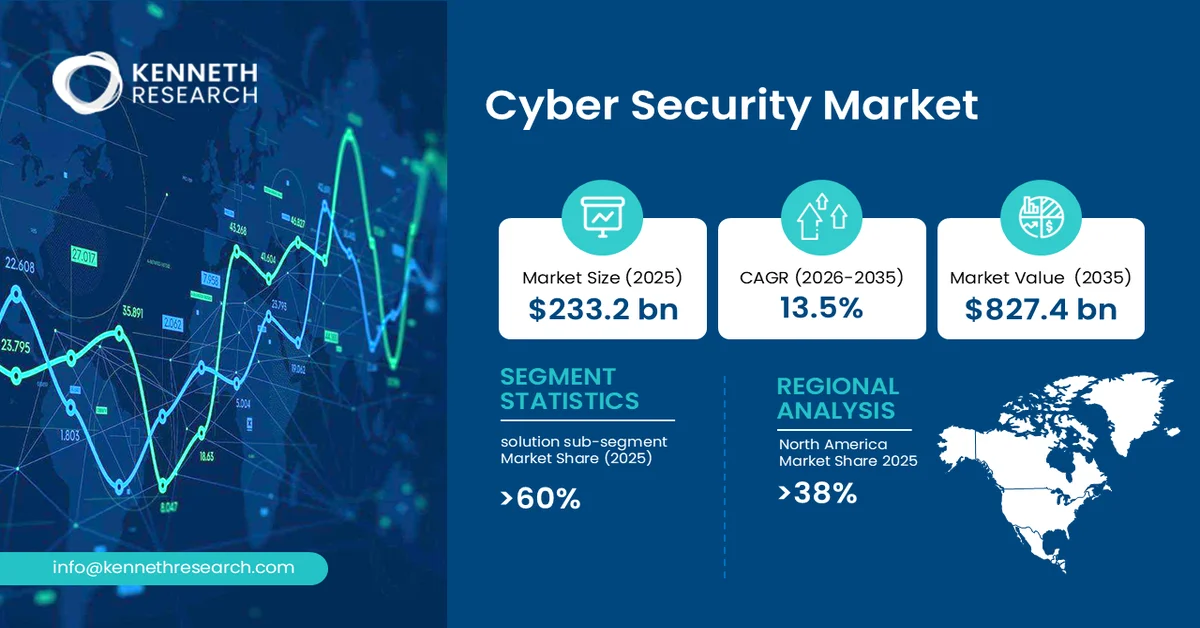
Cyber Security Market size was valued at USD 233.2 billion in 2025 and is projected to reach USD 827.4 billion by the end of 2035, rising at a CAGR of 13.5% during the forecast period, i.e., 2026-2035. In 2026, the industry size of the cyber security is estimated at USD 264.7 billion.
The primary growth driver for the cyber security market is the rapid expansion of digital infrastructure and connected technologies across enterprises, governments, financial institutions, healthcare organizations, and critical infrastructure.
The cyber security market comprises technologies, solutions, and services designed to protect digital systems, networks, devices, applications, data, and connected infrastructure from unauthorized access, cyberattacks, disruption, theft, and malicious activity. The market encompasses capabilities including network security, endpoint protection, cloud security, identity and access management, application security, data security, security monitoring, threat intelligence, vulnerability management, and incident response.
Key characteristics include continuous threat monitoring, automated detection, risk assessment, access control, encryption, security analytics, and incident mitigation. Modern cyber security increasingly integrates artificial intelligence, machine learning, automation, behavioral analytics, and zero-trust architectures to address sophisticated and rapidly evolving threats across distributed IT environments.
Key Cyber Security Market Insights Summary:
Key Takeaways: Market Trends & Insights
- Cyber Security Market projected to grow from USD 233.2 billion in 2025 to USD 827.4 billion by 2035 at a 13.5% CAGR.
- North America accounted for the largest regional share at 38% in 2025, supported by advanced digital infrastructure, strong cybersecurity capabilities, and continued investment in protecting critical and enterprise systems.
- Solution is the leading Component segment with a 60% share in 2025, driven by rising demand for integrated protection across networks, endpoints, applications, identities, data, and cloud environments.
- Cloud-based deployment is expected to witness strong growth as organizations migrate workloads and applications to cloud environments and seek scalable, centralized, and continuously monitored security capabilities.
Market Drivers
- Escalating ransomware and distributed denial-of-service threats.
- Accelerating cloud adoption and digital transformation.
- Growing deployment of connected devices and Internet of Things technologies.
- Increasing regulatory emphasis on data protection and cyber resilience.
Challenges
- Cybersecurity skills shortage and talent constraints.
- Legacy infrastructure and complex security integration.
Cyber Security Market Overview & Supply Chain
Adoption of cyber security solutions is increasing globally as organizations accelerate digital transformation, cloud migration, connected-device deployment, and remote operations. Expanding digital dependence across government, financial services, healthcare, manufacturing, energy, transportation, and communications is creating larger and more complex attack surfaces, while ransomware, phishing, supply-chain compromise, and identity-based attacks are increasing the need for continuous protection. The International Telecommunication Union (ITU) reported that its Global Cybersecurity Index 2024 assessed countries across legal, technical, organizational, capacity-development, and cooperation dimensions, demonstrating the growing institutional focus on national cyber resilience.
The cyber security value chain begins with technology development, where security vendors create software, platforms, appliances, threat-intelligence databases, monitoring technologies, and specialized security tools. Infrastructure and technology partners provide computing, networking, cloud, and hardware environments required to deploy these solutions. Cybersecurity manufacturers and platform providers integrate security capabilities into comprehensive products covering networks, endpoints, identities, applications, data, and cloud environments. System integrators, managed security service providers, consultants, and specialized implementation partners configure and deploy solutions according to organizational risk profiles and compliance requirements. Distribution occurs through direct enterprise sales, technology partnerships, channel partners, and managed-service arrangements.
Cyber Security Market: Growth Drivers & Challenges
Growth Drivers:
- Escalating ransomware and distributed denial-of-service threats: The increasing frequency and sophistication of ransomware, distributed denial-of-service attacks, phishing, and other cyber threats are compelling organizations to strengthen security investments across networks, endpoints, applications, and cloud environments. Attackers are increasingly targeting digitally dependent organizations, making continuous detection, prevention, response, and recovery capabilities essential to operational resilience. The European Union Agency for Cybersecurity (ENISA) reported that its 2024 Threat Landscape analyzed more than 11,000 publicly reported incidents, with threats against availability and ransomware ranking among the leading threat categories.
- Accelerating cloud adoption and digital transformation: The rapid migration of workloads, applications, data, and business processes to cloud environments is creating new cybersecurity requirements across enterprises and public-sector organizations. Cloud architectures introduce distributed identities, application interfaces, remote access points, shared infrastructure, and complex third-party dependencies, requiring security controls that operate consistently across hybrid and multi-cloud environments. Organizations are therefore increasing adoption of cloud security platforms, identity and access management, workload protection, data security, security monitoring, and automated threat detection.
Challenges:
- Cybersecurity skills shortage and talent constraints: The shortage of specialized cybersecurity professionals remains a major constraint on organizations seeking to strengthen their security posture. Cybersecurity requires expertise across threat intelligence, cloud security, incident response, identity management, security architecture, and emerging technologies, making recruitment and retention particularly demanding. The UK Department for Science, Innovation and Technology reported that 70% of cyber firms with vacancies in 2024 experienced at least one hard-to-fill position, reflecting persistent challenges in accessing specialized talent.
- Legacy infrastructure and complex security integration: The continued use of legacy IT infrastructure creates significant barriers to implementing modern cybersecurity architectures. Older systems may lack contemporary security controls, have limited compatibility with newer technologies, and require specialized expertise to maintain or integrate with modern platforms. Organizations must therefore balance modernization with operational continuity, particularly when legacy infrastructure supports critical business processes.
Cyber Security Market Size and Forecast:
| Report Attribute | Details |
|---|---|
| Base Year |
2025 |
| Forecast Year |
2026-2035 |
| CAGR |
13.5% |
| Base Year Market Size (2025) |
USD 233.2 billion |
| Forecast Year Market Size (2035) |
USD 827.4 billion |
| Regional Scope |
|
Cyber Security Market Segmentation Analysis:
Component Segment Analysis
In the component segment, the solution sub-segment is anticipated to capture the largest market share of 60% by the end of 2025.
Its dominance is supported by organizations' increasing preference for integrated cybersecurity platforms capable of addressing multiple risk areas across networks, endpoints, applications, identities, data, and cloud environments. As digital infrastructures become more distributed, standalone security tools can create visibility and management gaps, increasing demand for coordinated solutions that consolidate prevention, detection, response, and recovery capabilities. Supply-side innovation is also strengthening the segment as providers incorporate artificial intelligence, automation, behavioral analytics, and zero-trust architectures into comprehensive security platforms. The National Institute of Standards and Technology (NIST) released Cybersecurity Framework 2.0 in 2024, providing organizations with a broader framework for managing cybersecurity risks across governance, identification, protection, detection, response, and recovery.
Deployment Segment Analysis
In the Deployment segment, the Cloud-based sub-segment is projected to grow strongly as organizations shift workloads, applications, and data toward cloud environments and require security controls that can operate across distributed infrastructures. Cloud-based security enables centralized monitoring, scalable protection, automated policy enforcement, and faster deployment without extensive on-premises security infrastructure. Adoption is also being supported by the growing complexity of hybrid and multi-cloud environments, which increases demand for cloud-native threat detection, identity protection, workload security, and data controls. On the supply side, cybersecurity providers are developing specialized cloud security architectures covering APIs, applications, workloads, identities, and data. The Japan Digital Agency reported that the number of government systems using its Government Cloud reached 671 in August 2024, demonstrating continued institutional migration toward cloud-based infrastructure.
Our in-depth analysis of the global cyber security market includes the following segments:
|
Segment |
Sub-segment |
|
Component |
|
|
Deployment |
|
|
Security Type |
|
|
End User |
|
Cyber Security Market Regional Insights:
North America Market Trends & Insights:
North America accounted for 38% of the cyber security market in 2025, maintaining its position as the dominant region.
The region benefits from extensive digital infrastructure, high enterprise adoption of cloud and connected technologies, sophisticated cybersecurity ecosystems, and strong regulatory attention toward protecting critical infrastructure and sensitive information. The United States remains a major innovation center for cybersecurity technologies, with established vendors developing integrated platforms covering network, endpoint, identity, cloud, and security operations.
Canada is strengthening its cybersecurity ecosystem through government programs focused on protecting organizations and critical infrastructure against evolving digital threats. Together, both countries provide a strong combination of technology development, enterprise demand, regulatory support, and cybersecurity investment, reinforcing North America's regional leadership.
Europe Market Trends & Insights:
Asia Pacific is becoming an important growth region for the cyber security market as governments and enterprises accelerate digital transformation, cloud adoption, connected-device deployment, and modernization of critical infrastructure. Increasing dependence on digital platforms is raising requirements for network protection, endpoint security, identity management, cloud security, and threat monitoring. Governments are also strengthening cybersecurity governance and industry capabilities.
Japan represents a technologically advanced market where extensive digitalization and government-led cybersecurity programs are creating demand for sophisticated security technologies. Japan's government has emphasized strengthening cybersecurity capabilities and cooperation across government and industry, supporting development of a more resilient digital environment.
China offers substantial opportunities as digital transformation expands across enterprises, public services, industrial systems, and connected infrastructure. The country's emphasis on cybersecurity, digital resilience, and protection of critical information infrastructure is encouraging organizations to strengthen security controls and adopt more comprehensive cybersecurity architectures.
Leading Companies Operating in the Global Cyber Security Market:
Here is a list of upstream, downstream, and key players operating in the global cyber security market competitive ecosystem:
- Palo Alto Networks(United States)
- Company Overview
- Business Strategy
- Key Product Offerings
- Financial Performance
- Key Performance Indicators
- Risk Analysis
- Recent Development
- Regional Presence
- SWOT Analysis
- Fortinet(United States)
- Cisco(United States)
- Check Point Software Technologies(Israel)
Recent Developments
- February 2026 –Palo Alto Networks completed its acquisition of CyberArk, integrating CyberArk’s identity security capabilities into its platform to protect human, machine, and agentic identities.
- August 2026 – Fortinet announced the availability of FortiSOC, a unified, cloud-delivered security operations center platform powered by agentic AI. The platform is designed to bring security operations capabilities together and automate detection and response.
Frequently Asked Question
In 2025, the cyber security market exceeded USD 233.2 billion.
The cyber security market is projected to reach USD 827.4 billion by the end of 2035, expanding at a CAGR of 13.5% over the forecast period (2026–2035).
The major players in the market are Palo Alto Networks, Fortinet, Cisco, Check Point Software Technologies, Microsoft, and others.
In the component segment, the solution sub-segment is anticipated to capture the largest market share of 60% in the future and exhibit lucrative growth opportunities during 2026–2035.
North America is projected to hold the largest market share of 38% by the end of 2025 and provide more business opportunities in the future.
Why Choose Kenneth Research ?
-
Insight with Impact : We don’t just gather data — we uncover stories, trends, and opportunities that fuel business growth.
-
Experts Who Get It : Our team speaks your industry’s language and knows what really matters to your customers and market.
-
Custom-Built for You : Forget one-size-fits-all. We craft research and consulting solutions as unique as your business vision.
-
Partners, Not Just Providers : We work with you, not for you — collaborating closely to turn insights into smart, strategic moves.
-
Results That Speak : Our work powers brands, startups, and industry leaders alike — with a track record of ideas that work in the real world.
Report ID: 1181 |
Published Date: 26 Aug 2026 |
Report Format: |
Delivery Timeline: 48-72 Business Hours

Copyright © 2025 Kenneth Research. All rights reserved. Terms of Use | Privacy Policy
