Report ID: 1408 |
Published Date: 25 Sep 2026 |
Report Format: |
Delivery Timeline: 48-72 Business Hours
Critical Power and Cooling Market Outlook:
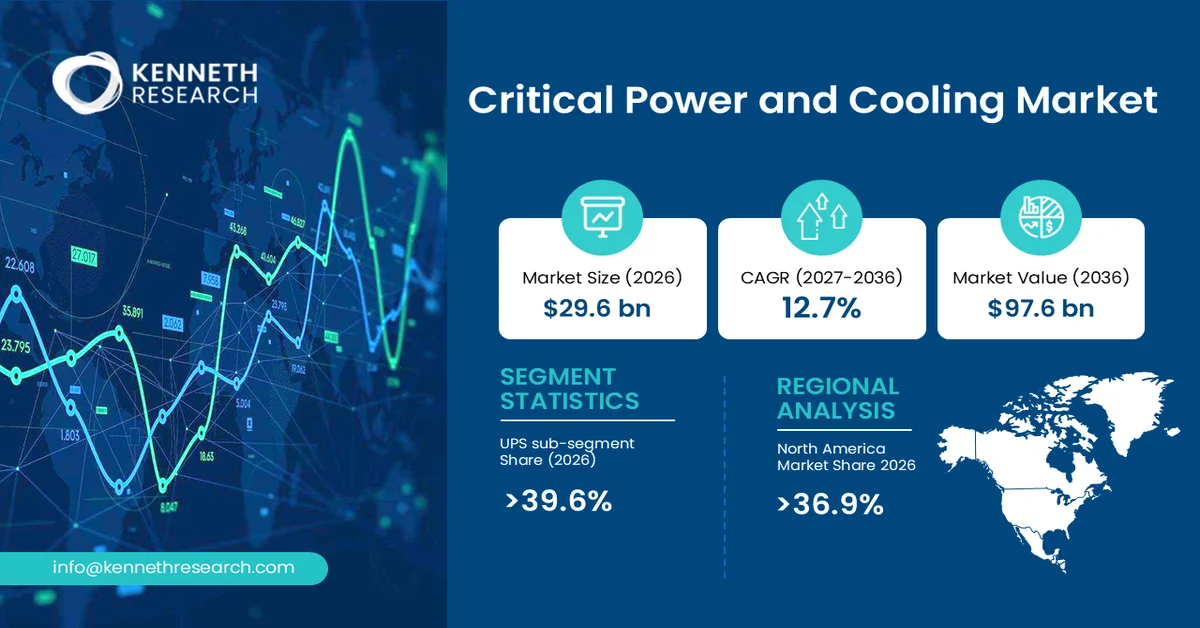
Critical Power and Cooling Market size was valued at USD 29.6 billion in 2026 and is projected to reach USD 97.6 billion by the end of 2036, rising at a CAGR of 12.7% during the forecast period, i.e., 2027–2036. In 2027, the industry size of the global critical power and cooling market is estimated at USD 33.3 billion.
The primary growth driver for the global critical power and cooling market is the rapid expansion of AI-enabled and high-density data centers, which require dependable electricity and increasingly sophisticated thermal management.
The global critical power and cooling market comprises technologies, equipment, and integrated infrastructure designed to maintain continuous electrical power availability and controlled operating conditions for mission-critical facilities. It encompasses uninterruptible power supply systems, backup power equipment, power distribution infrastructure, thermal-management systems, cooling equipment, and associated monitoring and control technologies.
The market is characterized by high reliability requirements, redundancy, power-quality management, temperature and humidity control, scalability, and increasingly stringent efficiency considerations. These capabilities are particularly important where interruptions, electrical disturbances, overheating, or inadequate environmental control can affect computing equipment, industrial processes, communications, or essential services. The International Energy Agency identifies cooling and environmental control as an integral component of data-center infrastructure, with its electricity requirement varying substantially according to facility efficiency and configuration.
Key Critical Power and Cooling Market Insights Summary:
Key Takeaways: Market Trends & Insights
- Global critical power and cooling market is valued at USD 29.6 billion in 2026 and is projected to reach USD 97.6 billion by 2036, reflecting a CAGR of 12.7% during 2027–2036
- UPS is the leading type segment, accounting for 39.6% market share in 2026, supported by increasing requirements for reliable power continuity across mission-critical facilities
- North America is the dominant regional market, holding a 36.9% market share in 2026, supported by established data-center infrastructure and investment in resilient power and cooling systems
- Data centers represent the second and fastest analysis segment within the facility category, driven by expanding cloud computing, artificial intelligence deployment, and high-density computing infrastructure
Market Drivers
- AI and high-density computing infrastructure deployment
- Grid modernization and demand for resilient distributed power systems
- Expansion of high-availability digital and industrial infrastructure
- Integration of energy-efficient power and advanced thermal-management technologies
Challenges
- High Capital and Deployment Complexity
- Power Availability, Grid Constraints, and Cooling Infrastructure Limitations
Critical Power and Cooling Market Overview & Supply Chain
Global adoption of the global critical power and cooling market is increasing as digital infrastructure, AI computing, advanced manufacturing, electrification, and other power-intensive operations place greater demands on reliable electricity and thermal management. Data centers are particularly relevant because their continuous operation requires resilient power and effective cooling.
The global critical power and cooling market value chain begins with raw-material and component suppliers providing copper, aluminum, steel, semiconductors, batteries, power electronics, refrigerants, heat-transfer materials, pumps, compressors, sensors, and control components. Equipment manufacturers then integrate these inputs into UPS systems, switchgear, power-distribution equipment, generators, battery systems, chillers, cooling towers, liquid-cooling systems, and monitoring platforms. System integrators and engineering, procurement, and construction providers configure and deploy these technologies according to facility-specific reliability, redundancy, capacity, and environmental requirements. Distribution occurs through direct manufacturer sales, specialized distributors, electrical-equipment channels, and infrastructure contractors. End users include data centers, telecommunications facilities, healthcare institutions, financial organizations, industrial plants, utilities, and other mission-critical facilities.
Critical Power and Cooling Market: Growth Drivers & Challenges
Growth Drivers
- AI-driven data center expansion: The accelerating deployment of AI infrastructure is increasing requirements for dependable power, power conditioning, backup systems, and advanced thermal management. AI workloads involve high-density computing equipment that generates substantial heat, making uninterrupted electricity and effective cooling essential to maintaining equipment performance and operational continuity. This creates demand across UPS systems, power distribution, energy storage, generators, chillers, and emerging liquid-cooling technologies.
- Rising requirements for power resilience and energy efficiency: Increasing dependence on digitally enabled operations is encouraging organizations to strengthen resilience against power interruptions, voltage disturbances, equipment failures, and thermal events. Mission-critical facilities cannot readily tolerate unplanned downtime, making redundant power architectures, UPS systems, backup generation, monitoring platforms, and efficient cooling increasingly important components of infrastructure planning.
Challenges
- High capital and deployment complexity: Critical power and cooling infrastructure requires substantial upfront investment because facilities often need redundant electrical architectures, backup generation, UPS systems, distribution equipment, cooling systems, controls, monitoring, and specialized installation services. The root cause is the stringent reliability requirements of mission-critical environments, where infrastructure must be engineered around redundancy, maintainability, safety, and continuous operation rather than minimum-capacity requirements.
- Power availability, grid constraints, and cooling infrastructure limitations: The expansion of power-intensive facilities can encounter constraints related to grid connection capacity, local transmission and distribution infrastructure, site-level electrical availability, water access, and cooling-system deployment. The root cause is the geographic concentration of large facilities in locations where suitable power and infrastructure capacity may not expand at the same pace as facility requirements. These constraints can affect site selection, project timelines, equipment specifications, and the feasibility of expansion plans.
Global Critical Power and Cooling Market Size and Forecast:
| Report Attribute | Details |
|---|---|
| Base Year |
2026 |
| Forecast Period |
2027-2036 |
| CAGR |
12.7% |
| Base Year Market Size (2026) |
USD 29.6 Billion |
| Forecast Year Market Size (2036) |
USD 97.6 Billion |
| Regional Scope |
|
Critical Power and Cooling Market Segmentation Analysis:
Type Segment Analysis
In the type segment, UPS sub-segment is anticipated to capture the largest market share of 39.6% by the end of 2026.
UPS systems dominate the type segment because they provide the immediate bridge between utility power disturbances and backup generation, protecting sensitive computing and industrial equipment from interruptions, voltage fluctuations, and frequency disturbances. Their role becomes increasingly important as data-center operators deploy higher-density computing and require continuous availability. The U.S. Department of Energy notes that double-conversion UPS efficiency reached 95% or higher in 2023, strengthening the commercial case for modern UPS replacement and upgrading by reducing conversion losses and associated cooling requirements. Adoption is also supported by modular UPS architectures, which allow operators to align installed capacity with changing facility loads and expand systems as requirements increase.
Facility Segment Analysis
The data centers is projected to grow as the second-largest segment in the global critical power and cooling market due to four converging demand drivers.
Data centers are projected to be a key growth sub-segment within the facility category because the expansion of cloud computing, artificial intelligence, digital services, and high-performance computing is increasing requirements for dependable power and sophisticated thermal-management infrastructure. Adoption is also shifting toward higher-density architectures, requiring operators to evaluate liquid cooling, modular power systems, and integrated thermal-management solutions alongside conventional infrastructure.
Our in-depth analysis of the global critical power and cooling market includes the following segments:
|
Segment |
Sub-segment |
|
Type |
|
|
End Use |
|
|
Facility |
|
Critical Power and Cooling Market Regional Insights:
North America Market Trends & Insights:
North America global critical power and cooling is projected to hold the largest revenue share of 36.9% by the end of 2026.
It is supported by its established data-center ecosystem, substantial investment in digital infrastructure, mature power networks, and strong demand for resilient electrical and thermal-management systems.
The U.S. represents the principal demand center within North America, supported by extensive cloud infrastructure, AI deployment, domestic manufacturing, and ongoing investment in electricity infrastructure. These factors reinforce requirements for UPS, backup generation, power distribution, and advanced cooling.
Canada is strengthening its position through investments in sovereign AI and digital infrastructure. Federal policy emphasizes reliable electricity, responsible data-center development, and infrastructure capable of supporting AI workloads. The government is also addressing electricity availability and environmental considerations as data-center capacity expands.
Asia Pacific Market Trends & Insights:
Asia Pacific is supported by expanding digital infrastructure, cloud adoption, artificial intelligence deployment, industrial automation, and growing requirements for reliable computing infrastructure. Government initiatives are reinforcing this demand by encouraging investment in data centers, national computing networks, renewable-energy integration, and digital infrastructure.
India is strengthening its digital infrastructure through initiatives supporting cloud computing, AI, data centers, and digital public infrastructure. The IndiaAI Mission is designed to expand domestic compute infrastructure through public-private collaboration, supporting additional demand for resilient power and cooling systems.
China is developing an integrated national computing infrastructure and encouraging coordinated deployment of data centers with energy resources. Its East Data, West Computing strategy is supporting data-center clusters and broader industrial ecosystems, creating opportunities for efficient power, cooling, and infrastructure-management technologies.
Leading Companies Operating in the Global Critical Power and Cooling Market:
Here is a list of upstream, downstream, and key players operating in global critical power and cooling market competitive ecosystem:
- Schneider Electric SE (France)
- Company Overview
- Business Strategy
- Key Product Offerings
- Financial Performance
- Key Performance Indicators
- Risk Analysis
- Recent Development
- Regional Presence
- SWOT Analysis
- Vertiv Group Corp. (United States)
- Eaton Corporation plc (Ireland)
- Sudlows (United Kingdom)
Recent Developments
- In January 2026, Schneider Electric's Motivair brand launched the MCDU-70, a 2.5 MW coolant distribution unit (CDU) — the most powerful in its lineup. The unit is designed for gigawatt-scale AI factories and can be scaled to 10 MW+ using six units in a 4+2 redundant configuration, aligning with NVIDIA's Omniverse DSX Blueprint for 10 MW deployments.
- In March 2026, Vertiv announced a collaboration with Netweb Technologies to deliver integrated liquid-cooled rack solutions for AI data centers in India. The partnership combines Netweb's GPU compute platforms with Vertiv's coolant distribution units, free-cooling chillers, busways, and UPS systems, enabling rack densities exceeding 200 kW per rack
Frequently Asked Question
In 2026, the critical power and cooling market exceeded USD 29.6 billion.
The critical power and cooling market is projected to reach USD 97.6 billion by the end of 2036, expanding at a CAGR of 12.7% over the forecast period (2027-2036).
The major players in the market are Schneider Electric SE (France), Vertiv Group Corp. (United States), Eaton Corporation plc (Ireland), Sudlows (United Kingdom), and others.
In the Type segment, the UPS sub-segment is anticipated to capture the largest market share of 39.6% in the future and exhibit lucrative growth opportunities during 2027-2036. This growth trajectory is largely attributed to increasing requirements for reliable power continuity across mission-critical facilities.
North America is projected to hold the largest market share of 36.9% by the end of 2036 and provide more business opportunities in the future. Continuous investments in data centers, digital infrastructure, and resilient power and cooling systems across the United States and Canada are fostering the region's dominance.
Why Choose Kenneth Research ?
-
Insight with Impact : We don’t just gather data — we uncover stories, trends, and opportunities that fuel business growth.
-
Experts Who Get It : Our team speaks your industry’s language and knows what really matters to your customers and market.
-
Custom-Built for You : Forget one-size-fits-all. We craft research and consulting solutions as unique as your business vision.
-
Partners, Not Just Providers : We work with you, not for you — collaborating closely to turn insights into smart, strategic moves.
-
Results That Speak : Our work powers brands, startups, and industry leaders alike — with a track record of ideas that work in the real world.
Report ID: 1408 |
Published Date: 25 Sep 2026 |
Report Format: |
Delivery Timeline: 48-72 Business Hours

Copyright © 2025 Kenneth Research. All rights reserved. Terms of Use | Privacy Policy
