Report ID: 1285 |
Published Date: 01 Sep 2026 |
Report Format: |
Delivery Timeline: 48-72 Business Hours
Coolant Monitoring Sensors Market Outlook:
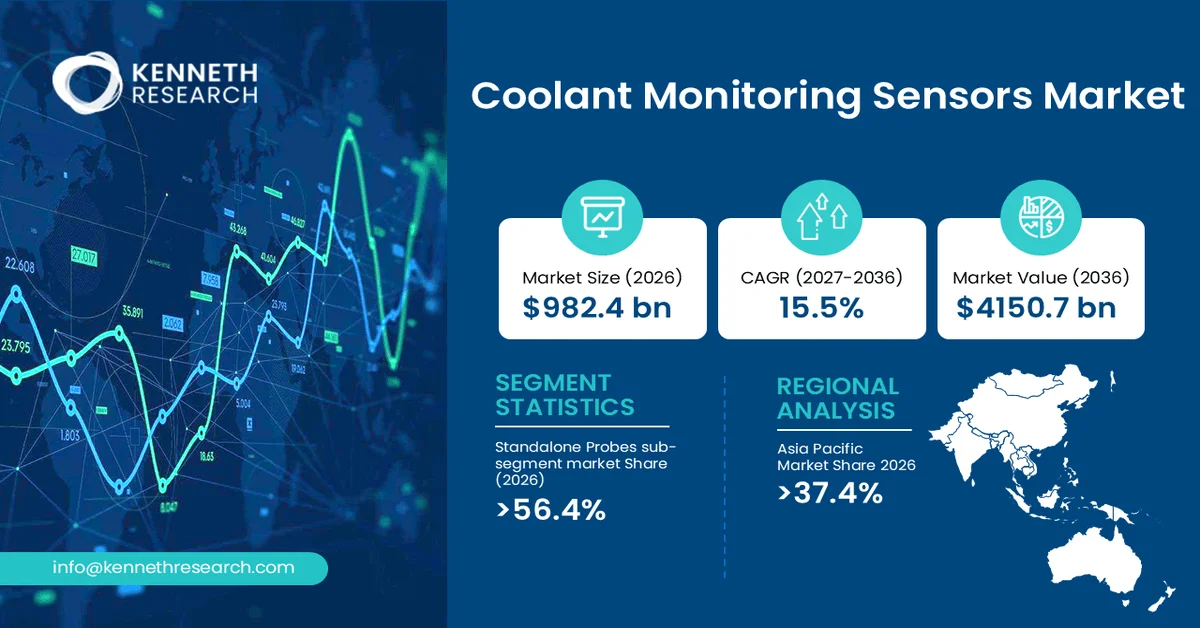
Coolant Monitoring Sensors Market size was valued at USD 982.4 million in 2026 and is projected to reach USD 4,150.7 million by the end of 2036, rising at a CAGR of 15.5% during the forecast period, i.e., 2027–2036. In 2027, the industry size of the coolant monitoring sensors is estimated at USD 1,134.7 million.
The primary growth driver for the coolant monitoring sensors market is the increasing adoption of advanced thermal management systems across automotive, industrial, and electronic applications.
Coolant monitoring sensors are electronic sensing devices designed to measure and monitor coolant-related parameters such as temperature, level, pressure, flow, concentration, or chemical condition within cooling systems. These sensors provide real-time data that enables control systems to identify abnormal coolant conditions, optimize thermal performance, prevent overheating, and support predictive maintenance.
The coolant monitoring sensors market encompasses the development, manufacturing, integration, and deployment of sensing solutions used across automotive cooling systems, industrial machinery, power equipment, electronics, data centers, battery systems, and other temperature-sensitive applications. Depending on the application, sensors may operate as standalone probes or as integrated components within broader monitoring architectures. Technological developments in MEMS, miniaturized electronics, signal processing, and connected sensing are improving measurement accuracy and enabling faster diagnostics.
Key Coolant Monitoring Sensors Market Insights Summary:
Key Takeaways: Market Trends & Insights
- Coolant Monitoring Sensors Market projected to grow from USD 982.4 million in 2026 to USD 4,150.7 million by 2036 at a 15.5% CAGR.
- Asia-Pacific accounted for the largest regional share at 37.4% in 2026, supported by expanding automotive manufacturing, electric-vehicle production, electronics manufacturing, and advanced thermal-management technologies across Japan and China.
- Standalone Probes are expected to remain the leading Integration Level segment with a 56.4% share in 2026, supported by installation flexibility, compatibility with existing cooling systems, and ease of replacement.
- MEMS technology is projected to witness strong growth as manufacturers increasingly adopt compact, high-precision sensing solutions for electric-vehicle batteries, power electronics, industrial equipment, and other space-constrained thermal-management applications.
Market Drivers
- Increasing electrification and thermal-management requirements.
- Rising adoption of predictive and intelligent thermal monitoring.
- Growing integration of MEMS-based sensing technologies.
- Increasing demand for real-time condition monitoring and automated thermal control.
Challenges
- Sensor reliability under harsh thermal and chemical conditions.
- Complexity of integrating advanced sensors into existing systems.
Coolant Monitoring Sensors Market Overview & Supply Chain
The global adoption of coolant monitoring sensors is increasing as automotive, electronics, industrial equipment, and energy systems require more precise thermal management and real-time condition monitoring. Electrification is particularly relevant because batteries, power electronics, and electric drivetrains depend on controlled operating temperatures to maintain performance, safety, and component longevity. The International Energy Agency reported that global electric car sales exceeded 17 million units in 2024, demonstrating the expanding deployment of vehicles requiring sophisticated thermal-management architectures.
The coolant monitoring sensors market value chain begins with semiconductor materials, sensing elements, substrates, electronic components, protective housings, wiring, connectors, and specialized materials used to manufacture sensing assemblies. Sensor manufacturers design and produce probes, MEMS sensing elements, signal-conditioning electronics, and finished monitoring devices, followed by calibration, testing, encapsulation, and quality assurance. Products are then supplied directly or through specialized industrial and automotive channels to system integrators, original equipment manufacturers, and thermal-management solution providers.
Coolant Monitoring Sensors Market: Growth Drivers & Challenges
Growth Drivers
- Increasing electrification and thermal management requirements: The rapid transition toward electrified vehicles is increasing the need for accurate coolant monitoring across batteries, electric motors, inverters, and power electronics. Unlike conventional powertrains, electric vehicles require coordinated thermal management across multiple high-power components, making real-time temperature and coolant-condition feedback increasingly important. The U.S. Department of Energy identifies thermal control as critical to the power density, cost, and reliability of power electronics and electric machines, while its recent research emphasizes integrated thermal-management architectures for electric drives.
- Rising adoption of predictive and intelligent thermal monitoring: The growing integration of intelligent monitoring and predictive maintenance systems is creating another important growth opportunity for coolant monitoring sensors. Modern industrial and automotive systems increasingly depend on continuous data from sensors to identify abnormal thermal conditions before they cause equipment degradation or operational interruptions. Coolant temperature, flow, pressure, and condition data can be combined with electronic control systems to optimize cooling performance and support automated diagnostics. This shift is encouraging manufacturers to move beyond basic temperature measurement toward multifunctional sensing platforms capable of delivering more detailed operational information.
Challenges
- Sensor reliability under harsh thermal and chemical conditions: Coolant monitoring sensors must operate reliably while exposed to temperature cycling, vibration, pressure variations, humidity, and direct contact with coolant fluids. Different coolant formulations can also affect sensing accuracy, materials, seals, and long-term stability. These requirements increase engineering complexity because manufacturers must validate sensor performance across multiple operating environments and coolant chemistries. For automotive applications, the challenge is particularly significant because sensors may be installed close to heat-generating components where thermal and mechanical stresses are substantial. The resulting qualification, calibration, and materials-validation requirements can increase development costs and lengthen product development cycles.
- Complexity of integrating advanced sensors into existing systems: The increasing sophistication of coolant monitoring creates integration challenges for manufacturers and equipment developers. Advanced systems may require sensors to communicate with electronic control units, thermal-management controllers, diagnostic platforms, or broader industrial monitoring architectures. Integrating sensing elements, signal-conditioning electronics, communication interfaces, and protective packaging while maintaining compact dimensions can increase design complexity and system-development costs. MEMS-based solutions introduce additional requirements for packaging, calibration, thermal compensation, and reliability validation.
Coolant Monitoring Sensors Market Size and Forecast:
| Report Attribute | Details |
|---|---|
| Base Year |
2026 |
| Forecast Year |
2027-2036 |
| CAGR |
15.5% |
| Base Year Market Size (2026) |
USD 982.4 billion |
| Forecast Year Market Size (2036) |
USD 4150.7 billion |
| Regional Scope |
|
Coolant Monitoring Sensors Market Segmentation Analysis:
Integration Level Segment Analysis
In the Integration Level segment, the Standalone Probes sub-segment is anticipated to capture the largest market share of 56.4% in 2026.
Standalone probes remain widely adopted because they provide direct, flexible measurement of coolant temperature and other operating conditions without requiring extensive integration into broader electronic architectures. Their compatibility with existing cooling systems makes them attractive for automotive, industrial machinery, power equipment, and specialized thermal-management applications. Demand is also supported by the increasing complexity of vehicle thermal-management systems, where independent sensing points can provide localized measurements for control and diagnostics. According to the U.S. Department of Energy, more than 1.4 million electric vehicles were sold in the United States in 2023, highlighting the expanding installed base of vehicles requiring sophisticated thermal-management systems.
Technology Segment Analysis
In the Technology segment, the MEMS sub-segment is projected to witness strong growth as manufacturers increasingly seek compact, accurate, and highly integrated sensing solutions for advanced thermal-management systems. MEMS technology enables miniaturized sensing architectures that can combine multiple measurement functions while supporting high sensitivity, rapid response, and scalable manufacturing. A 2023 study published in the Journal of Energy Storage demonstrated an integrated coolant conductivity and temperature micro-sensor fabricated using MEMS technology specifically for electric vehicle battery coolant monitoring. The researchers reported that the MEMS-based sensor offered smaller size, high sensitivity, favorable consistency, and strong stability, highlighting its potential for online coolant monitoring applications.
Our in-depth analysis of the global coolant monitoring sensors market includes the following segments:
|
Segment |
Sub-segment |
|
Parameter |
|
|
Technology |
|
|
Integration Level |
|
|
End User |
|
Coolant Monitoring Sensors Market Regional Insights:
Asia-Pacific Market Trends & Insights:
Asia-Pacific accounted for 37.4% of the coolant monitoring sensors market in 2026, maintaining its position as the dominant regional market. Regional leadership is supported by the concentration of automotive manufacturing, electronics production, semiconductor activity, industrial equipment manufacturing, and rapidly expanding electric-vehicle ecosystems. Japan and China have strong engineering and manufacturing capabilities that support the development and deployment of advanced thermal-management technologies. Increasing investment in vehicle electrification, battery systems, power electronics, and industrial automation is creating additional demand for reliable coolant sensing solutions. Regulatory emphasis on vehicle efficiency, emissions reduction, electrification, and industrial energy performance is also encouraging manufacturers to adopt more sophisticated thermal monitoring architectures.
Japan remains an important market because of its established automotive industry, advanced electronics manufacturing, and emphasis on precision engineering. Demand is supported by the development of hybrid and electric vehicles and increasingly sophisticated thermal-management systems.
China is expected to remain a major regional growth engine because of its extensive automotive and electronics manufacturing base, expanding electric-vehicle ecosystem, and strong domestic production capabilities.
North America Market Trends & Insights:
North America represents a strong market for coolant monitoring sensors, supported by advanced automotive manufacturing, industrial automation, electronics, data-center infrastructure, and growing deployment of electrified transportation. Demand is being reinforced by the increasing complexity of thermal-management architectures, where continuous monitoring helps maintain operating conditions and protect high-value components. The U.S. Department of Energy identifies thermal management as critical to the performance, efficiency, cost, and reliability of electric power electronics and machines, highlighting the broader industrial importance of advanced cooling technologies.
The U.S. is the primary contributor to regional demand, supported by its established automotive and technology industries, extensive R&D ecosystem, and government-industry collaboration focused on electric-drive and thermal-management technologies.
Canada provides additional opportunities through its automotive manufacturing base, clean-technology development, and expanding electrification ecosystem. Together, the two countries offer a favorable environment for coolant monitoring sensor manufacturers developing compact, accurate, and increasingly integrated thermal-monitoring solutions.
Leading Companies Operating in the Global Coolant Monitoring Sensors Market:
Here is a list of upstream, downstream, and key players operating in the global coolant monitoring sensors market competitive ecosystem:
- TDK Electronics (Germany)
- Company Overview
- Business Strategy
- Key Product Offerings
- Financial Performance
- Key Performance Indicators
- Risk Analysis
- Recent Development
- Regional Presence
- SWOT Analysis
- ARaymond (France)
- Sensata Technologies (India)
Recent Developments
- February 2026: TDK launched a new family of high-reliability automotive NTC thermistors rated for operation at high temperatures. The new products use conductive-glue-compatible terminals and are designed to meet automotive-grade requirements.
- February 2025: ARaymond released an updated temperature-sensor product offering for electric-vehicle thermal management, featuring standalone and integrated sensor configurations designed for fluid-handling applications.
Frequently Asked Question
In 2026, the coolant monitoring sensors market exceeded USD 982.4 million.
The coolant monitoring sensors market is projected to reach USD 4150.7 million by the end of 2036, expanding at a CAGR of 15.5% over the forecast period (2027-2036).
The major players in the market are Sensata Technologies, Amphenol Advanced Sensors, HELLA, TDK Electronics, ARaymond, Sensing Technologies, and others.
In the Integration Level segment, the Standalone Probes sub-segment is anticipated to capture the largest market share of 56.4% in the future and exhibit lucrative growth opportunities during 2027–2036.
Asia-Pacific is projected to hold the largest market share of 37.4% by the end of 2036 and provide more business opportunities in the future.
Why Choose Kenneth Research ?
-
Insight with Impact : We don’t just gather data — we uncover stories, trends, and opportunities that fuel business growth.
-
Experts Who Get It : Our team speaks your industry’s language and knows what really matters to your customers and market.
-
Custom-Built for You : Forget one-size-fits-all. We craft research and consulting solutions as unique as your business vision.
-
Partners, Not Just Providers : We work with you, not for you — collaborating closely to turn insights into smart, strategic moves.
-
Results That Speak : Our work powers brands, startups, and industry leaders alike — with a track record of ideas that work in the real world.
Report ID: 1285 |
Published Date: 01 Sep 2026 |
Report Format: |
Delivery Timeline: 48-72 Business Hours

Copyright © 2025 Kenneth Research. All rights reserved. Terms of Use | Privacy Policy
