Report ID: 1355 |
Published Date: 15 Sep 2026 |
Report Format: |
Delivery Timeline: 48-72 Business Hours
Converted Flexible Packaging Market Outlook:
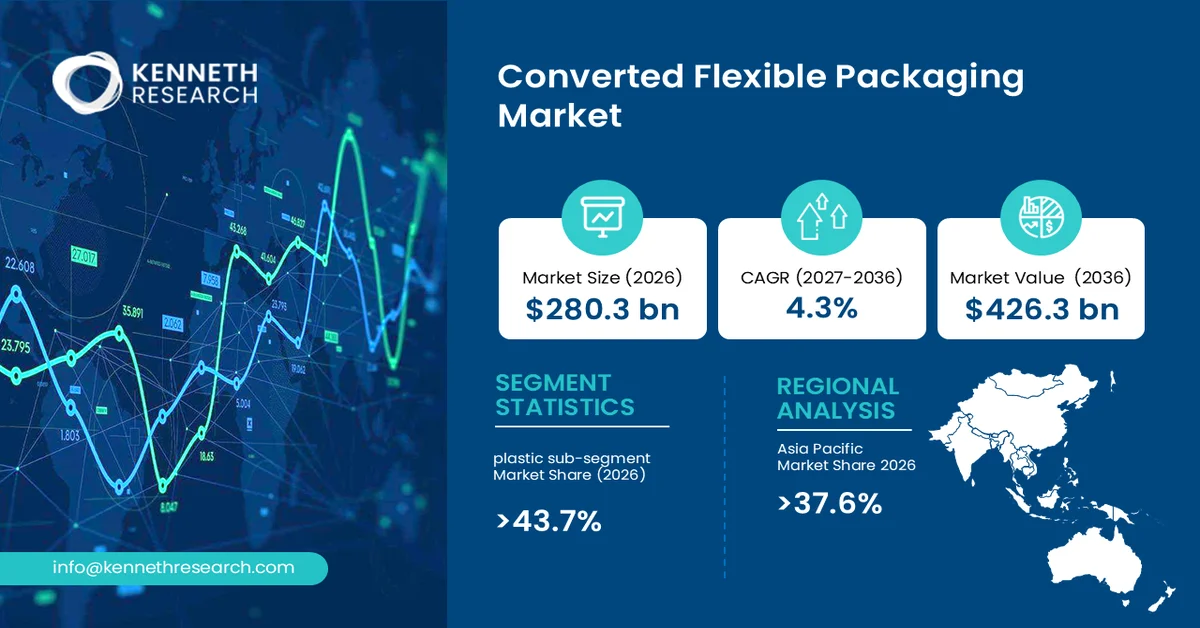
Converted Flexible Packaging Market size was valued at USD 280.3 billion in 2026 and is projected to reach USD 426.3 billion by the end of 2036, rising at a CAGR of 4.3% during the forecast period, i.e., 2027–2036. In 2027, the industry size of the converted flexible packaging market is estimated at USD 291.8 billion.
A primary growth driver is the expansion of food processing and modern supply chains, which increases demand for lightweight, protective, convenient packaging formats. India’s food-processing sector recorded GVA of ₹2.08 lakh crore in 2021–22, supported by government initiatives targeting modern infrastructure, supply-chain efficiency, reduced food wastage, and greater processing capacity.
Converted flexible packaging refers to packaging materials manufactured by transforming flexible substrates into finished packaging structures designed to contain, protect, preserve, present, and distribute products. Conversion can involve processes such as printing, laminating, coating, extrusion, slitting, forming, sealing, and other finishing operations that tailor substrates to specific packaging requirements.
The market encompasses packaging produced from materials including plastic films, paper, aluminum foil, and multilayer structures. Finished formats can include pouches, bags, sachets, wraps, films, and other flexible constructions. Depending on the application, these structures can be engineered to provide barrier protection against moisture, oxygen, light, aroma, contamination, and mechanical damage while supporting product visibility, branding, and convenient handling.
Key Converted Flexible Packaging Market Insights Summary:
Key Takeaways: Market Trends & Insights
- Converted flexible packaging market is projected to reach USD 426.3 Billion by 2036 at a CAGR of 4.3%
- Plastic leads the Material Type segment with a 43.7% market share in 2026
- Pouches represent the second and fastest analysis segment under Product Type
- Asia Pacific dominates the market with a 37.6% market share in 2026
- China and India are the key countries supporting Asia Pacific’s regional leadership
Market Drivers
- Rising demand for recyclable and circular packaging structures
- Expansion of convenience-oriented packaging formats
- Increasing penetration of flexible packaging across food, beverage, pharmaceutical, personal-care, and household applications
- Advancement of digital printing, high-barrier materials, smart packaging, and automated converting technologies
Challenges
- Recycling complexity of multilayer structures
- Fragmented collection and end-of-life infrastructure
Converted Flexible Packaging Market Overview & Supply Chain
Global adoption of converted flexible packaging is increasing as manufacturers and brand owners seek packaging that supports product protection, shelf-life management, transport efficiency, convenience, and adaptable product presentation. The technology is particularly relevant to food and beverage supply chains, where packaging performance can directly influence product preservation and distribution outcomes.
The supply chain for converted flexible packaging begins with raw-material and substrate suppliers providing plastic films, paper, aluminum foil, inks, adhesives, coatings, resins, and other conversion inputs. Converters then transform these substrates through printing, coating, laminating, extrusion, slitting, pouch making, bag making, and sealing operations according to application requirements. Finished packaging moves through distributors, logistics providers, packaging intermediaries, or directly to brand owners and contract manufacturers. End users span food and beverage producers, pharmaceutical companies, personal-care manufacturers, household-product companies, and industrial-product manufacturers. Major stakeholders therefore include polymer and substrate producers, paper and foil manufacturers, ink and adhesive suppliers, packaging converters, equipment manufacturers, distributors, logistics providers, brand owners, retailers, and regulatory authorities.
Converted Flexible Packaging Market - Growth Drivers & Challenges
Growth Drivers
- Rising Demand for Recyclable Packaging Structures: Regulatory and sustainability requirements are accelerating the redesign of flexible packaging structures. Brand owners and converters are increasingly shifting toward mono-material films, recyclable laminates, downgauged structures, and packaging designs compatible with established waste-management systems. This creates demand for new converting technologies, compatible coatings, barrier solutions, adhesives, and printing processes that maintain packaging performance while improving end-of-life outcomes.
- Expansion of Convenience-Oriented Packaging Formats: Consumer and industrial demand for convenient packaging is supporting the adoption of pouches, sachets, bags, wraps, and other flexible formats. These structures allow manufacturers to develop packaging around specific product requirements, including portion control, resealability, easy opening, portability, dispensing, and extended protection. Pouches are particularly adaptable because they can accommodate different closure systems, shapes, barrier properties, and filling technologies while providing substantial surface area for branding and product information.
Challenges
- Recycling Complexity of Multilayer Structures: A major restraint is the technical difficulty of recycling multilayer flexible packaging. Converters use combinations of polymers, aluminum, paper, adhesives, coatings, and barrier layers to achieve the required protection, sealing, strength, and shelf-life performance. However, these combinations can complicate sorting, separation, and reprocessing after use. The Basel Convention’s technical guidance identifies flexible multilayer packaging recycling as technically and economically challenging because individual layers may require separate identification and processing, while contamination can further reduce recovery potential.
- Fragmented Collection and End-of-Life Infrastructure: Inadequate collection, sorting, and recycling infrastructure remains a structural restraint for converted flexible packaging, particularly for lightweight films, small-format sachets, and contaminated post-consumer materials. These formats can have low recovery value and may be difficult to separate economically from other waste streams. Consequently, converters and brand owners face uncertainty over whether packaging designed for recyclability will actually reach appropriate recovery channels.
Converted Flexible Packaging Market Size and Forecast:
| Report Attribute | Details |
|---|---|
| Base Year |
2026 |
| Forecast Year |
2027-2036 |
| CAGR |
4.3% |
| Base Year Market Size (2026) |
USD 280.3 billion |
| Forecast Year Market Size (2036) |
USD 426.3 billion |
| Regional Scope |
|
Converted Flexible Packaging Market - Segment Analysis
Material Type Segment Analysis
In the material type segment, plastic sub-segment is anticipated to capture the largest market share of 43.7% by the end of 2026.
Plastic dominates the material-type segment because it offers converters a broad combination of barrier performance, lightweight construction, sealability, mechanical strength, printability, and processing flexibility. These properties make plastic films suitable for demanding applications across food, beverages, pharmaceuticals, personal care, household products, and industrial goods. Demand is reinforced by the need for packaging that protects products from moisture, oxygen, contamination, and physical damage while supporting high-speed filling and distribution. Government data also indicates the continuing scale of plastic-packaging consumption: Eurostat reported that 36.1 kg of plastic packaging waste was generated per person in the EU in 2022, providing a direct indication of the substantial role of plastic in packaging applications.
Product Type Segment Analysis
The pouches is projected to grow as the second-largest segment in the converted flexible packaging market due to four converging demand drivers.
Pouches are projected to experience strong growth because they combine lightweight construction, portability, resealability, convenient dispensing, and adaptable barrier performance. These characteristics make them increasingly suitable for processed foods, beverages, sauces, snacks, pet food, personal care products, and household goods. From the supply side, converters can manufacture pouches using different film structures, closures, spouts, barrier layers, and printing technologies, enabling customization across applications. Government product-classification systems also explicitly recognize bags and pouches made from single-web and multilayer plastic films, confirming their established role within packaging manufacturing.
Our in-depth analysis of the converted flexible packaging market includes the following segments:
|
Segment |
Sub-segment |
|
Product Type |
|
|
Material Type |
|
|
Packaging Technology |
|
|
End-Use |
|
Converted Flexible Packaging Market - Regional Analysis
Asia Pacific Market Trends & Insights:
Asia Pacific converted flexible packaging market is projected to hold the largest revenue share of 37.6% by the end of 2026.
Its dominance reflects the region’s extensive manufacturing base, large consumer markets, expanding processed-food industries, and established polymer, film, printing, laminating, and packaging-conversion ecosystems.
China remains a major regional manufacturing and consumption hub, supported by extensive food, beverage, consumer-goods, pharmaceutical, and industrial production networks. Its mature converting infrastructure enables high-volume production and increasingly sophisticated flexible formats.
India offers another significant growth platform, supported by expanding food processing, organized retail, consumer packaged goods, and domestic manufacturing investment.
North America Market Trends & Insights:
North America represents a significant secondary market for converted flexible packaging, supported by sophisticated food and beverage manufacturing, established consumer-goods industries, pharmaceutical production, and advanced retail and distribution networks. Demand is increasingly shaped by convenience, product protection, shelf-life requirements, premium presentation, and sustainability objectives.
The United States remains the region’s principal industrial and consumption hub, supported by extensive packaged-food, beverage, healthcare, personal-care, household-product, and e-commerce ecosystems. Its mature converting base supports high-volume production while encouraging development of advanced materials and automated manufacturing processes.
Canada provides complementary opportunities through its strong food-processing industry and government-backed initiatives targeting domestic processing capacity, supply-chain resilience, sustainable plastics, and environmentally preferable packaging. Canadian policy is also encouraging greater attention to recyclable and recycled-content packaging, creating opportunities for converters that can align product design with evolving regulatory requirements.
Converted Flexible Packaging Market Competitive Landscape
Here is a list of upstream, downstream, and key players operating in converted flexible packaging competitive ecosystem:
- Amcor plc (Australia)
- Company Overview
- Business Strategy
- Key Product Offerings
- Financial Performance
- Key Performance Indicators
- Risk Analysis
- Recent Development
- Regional Presence
- SWOT Analysis
- Sealed Air Corporation (United States)
- Sonoco Products Company (United States)
- Huhtamaki Oyj (Finland)
- ProAmpac Holdings Inc. (United States)
- Uflex Limited (India)
Recent Developments
- In July 2026, Amcor plc began an expansion project at its flexible packaging facility in Dongguan, China. The project includes a new 7,000-square-meter manufacturing plant and automated warehouse, expanding the campus to over 38,000 square meters. The expansion will feature automated solvent-free laminators, high-speed bag-making machines, and automated bag arranging systems to support recycle-ready packaging solutions for food, home, and personal care applications. Construction is expected to be completed by July 2027.
- In June 2026, Sealed Air Corporation's CRYOVAC MonoPP Flowpack solution helped SPAR Austria reduce plastic usage by 14 tonnes annually. The recyclable packaging system, which replaced traditional tray-and-lid meat packaging, achieved approximately 70% reduction in plastic usage by weight and roughly 70% lower CO₂ emissions. The solution is certified recyclable by the Cyclos-HTP Institute and operates at a production output of 44 packs per minute.
Frequently Asked Question
In 2026, the converted flexible packaging market exceeded USD 280.3 billion.
The converted flexible packaging market is projected to reach USD 426.3 billion by the end of 2036, expanding at a CAGR of 4.3% over the forecast period (2027-2036).
The major players in the market are Amcor plc, Sealed Air Corporation, Sonoco Products Company, Huhtamaki Oyj, ProAmpac Holdings Inc., Uflex Limited, and others.
In the Material Type segment, the Plastic sub-segment is anticipated to capture the largest market share of 43.7% in the future and exhibit lucrative growth opportunities during 2027-2036. This growth trajectory is largely attributed to increasing demand for lightweight, protective, and versatile packaging structures.
Asia Pacific is projected to hold the largest market share of 37.6% by the end of 2026 and provide more business opportunities in the future. Continuous investments and expanding packaging, food processing, and manufacturing activities in China and India are fostering the region's dominance.
Why Choose Kenneth Research ?
-
Insight with Impact : We don’t just gather data — we uncover stories, trends, and opportunities that fuel business growth.
-
Experts Who Get It : Our team speaks your industry’s language and knows what really matters to your customers and market.
-
Custom-Built for You : Forget one-size-fits-all. We craft research and consulting solutions as unique as your business vision.
-
Partners, Not Just Providers : We work with you, not for you — collaborating closely to turn insights into smart, strategic moves.
-
Results That Speak : Our work powers brands, startups, and industry leaders alike — with a track record of ideas that work in the real world.
Report ID: 1355 |
Published Date: 15 Sep 2026 |
Report Format: |
Delivery Timeline: 48-72 Business Hours

Copyright © 2025 Kenneth Research. All rights reserved. Terms of Use | Privacy Policy
