Report ID: 1376 |
Published Date: 17 Sep 2026 |
Report Format: |
Delivery Timeline: 48-72 Business Hours
Contract Manufacturing Market Outlook:
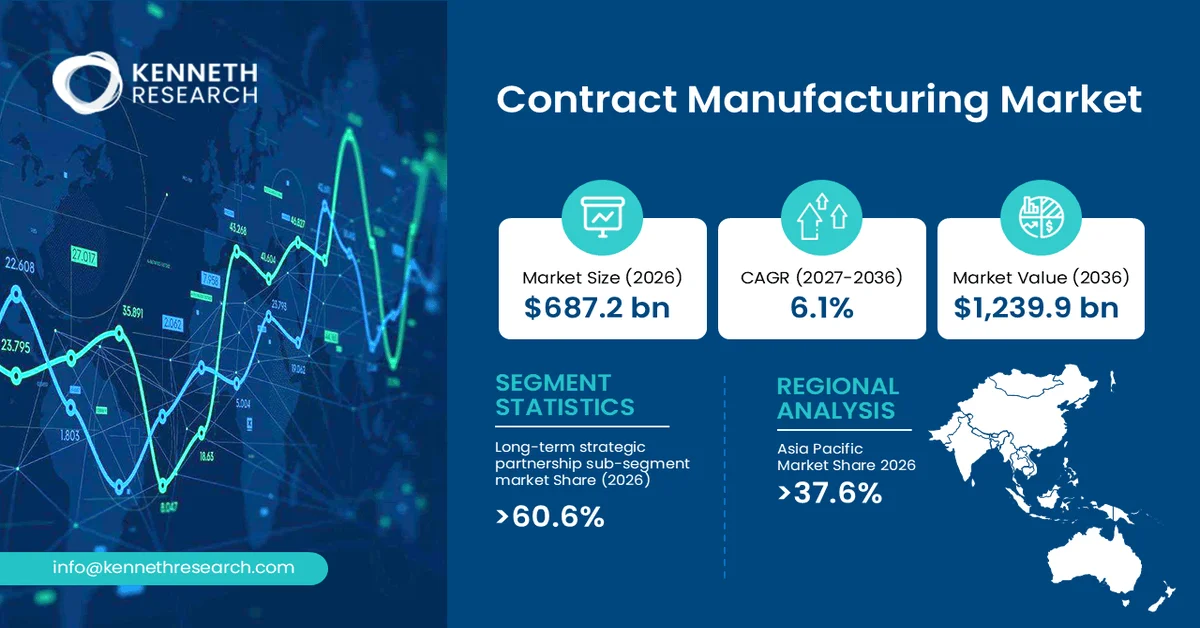
Contract Manufacturing Market size was valued at USD 687.2 billion in 2026 and is projected to reach USD 1,239.9 billion by the end of 2036, rising at a CAGR of 6.1% during the forecast period, i.e., 2027-2036. In 2027, the industry size of the global contract manufacturing is estimated at USD 727.7 billion.
A primary growth driver for the contract manufacturing market is the increasing internationalisation and complexity of pharmaceutical and medical-product supply chains. OECD reports that global medical-device trade reached USD 700 billion in 2022, reinforcing demand for specialised external manufacturing capabilities, distributed production, and supply-chain flexibility across healthcare-related industries.
The contract manufacturing market comprises outsourced manufacturing services in which a company engages an external manufacturer to produce goods, components, intermediates, or finished products according to defined technical, quality, regulatory, and commercial requirements. The arrangement allows an outsourcing company to access manufacturing capabilities without performing every production activity internally.
Key characteristics include specialised production expertise, contractual manufacturing arrangements, quality-control systems, regulatory compliance, scalable capacity, technology transfer, and coordination across suppliers and production locations. Contract manufacturers may support individual manufacturing stages or broader production requirements, depending on the industry and contractual structure. In healthcare, for example, external manufacturers can participate in primary manufacturing involving active pharmaceutical ingredients as well as secondary manufacturing involving finished pharmaceutical products.
Key Contract Manufacturing Market Insights Summary:
Key Takeaways: Market Trends & Insights
- Contract manufacturing market is valued at USD 687.2 billion in 2026
- Contract manufacturing market is projected to reach USD 1,239.9 billion by 2036, expanding at a CAGR of 6.1% during 2027-2036
- Long-term strategic partnership is the leading contract type sub-segment, accounting for 60.6% market share in 2026
- Asia Pacific dominates the contract manufacturing market with a 37.6% market share in 2026, supported by strong manufacturing capabilities across China and Japan
- Pharmaceuticals, Healthcare & Medical Devices is projected to be the fastest-growing End-Use segment, driven by specialised manufacturing requirements and increasing outsourcing adoption
Market Drivers
- Expanding pharmaceutical and healthcare manufacturing requirements
- Increasing adoption of flexible outsourced production models
- Advancement of automation and digital manufacturing technologies
- Growing emphasis on resilient and geographically diversified supply chains
Challenges
- Regulatory and quality-control complexity
- Supply-chain dependency and loss of operational control
Contract Manufacturing Market Overview & Supply Chain
Adoption of the contract manufacturing market is increasing globally as manufacturers seek flexible production capacity, specialised technical capabilities, and greater resilience across increasingly internationalised supply networks. The model is particularly relevant to pharmaceuticals, healthcare products, and medical devices, where production requires stringent quality systems, regulatory oversight, specialised facilities, and coordinated supplier networks. Regulatory scrutiny also reinforces the strategic importance of capable external manufacturing partners.
The value chain of the contract manufacturing market begins with sourcing raw materials, active ingredients, chemicals, components, packaging materials, and specialised inputs from qualified suppliers. Contract manufacturers then convert these inputs into intermediate or finished products through formulation, fabrication, assembly, processing, testing, and packaging activities, depending on the industry. Quality assurance, validation, documentation, and regulatory compliance are embedded throughout production. Finished goods subsequently move through logistics providers, distributors, wholesalers, or directly to brand owners and institutional purchasers. End users ultimately include healthcare providers, industrial customers, consumer-facing companies, and other organisations incorporating outsourced products into their operations.
Contract Manufacturing Market: Growth Drivers & Challenges
Growth Drivers:
- Growing demand for outsourced pharmaceutical and healthcare production: The expanding complexity of pharmaceutical and healthcare manufacturing is strengthening demand for specialised external production partners. Drug developers and healthcare companies increasingly require access to validated facilities, specialised equipment, technical expertise, quality-management systems, and regulatory capabilities without building every manufacturing function internally. This creates opportunities for contract manufacturers that can provide formulation, processing, filling, packaging, testing, and technology-transfer capabilities.
- Increasing need for flexible and technology-enabled production capacity: Manufacturers are increasingly using outsourcing to improve production flexibility, manage capacity requirements, and respond more efficiently to changing demand. Contract manufacturers can provide specialised facilities and production expertise that allow brand owners and original equipment manufacturers to scale selected activities without making equivalent investments in internal infrastructure. Technology is reinforcing this model through automation, advanced process controls, digital quality systems, real-time monitoring, and data-enabled production management.
Challenges:
- Regulatory and quality-control complexity: The contract manufacturing market faces significant restraint from the difficulty of maintaining consistent regulatory compliance across outsourced production networks. The root cause is that manufacturing activities may span multiple facilities, suppliers, jurisdictions, and quality systems, creating additional requirements for qualification, documentation, auditing, change control, data integrity, and oversight. This complexity can lengthen supplier-selection and onboarding processes and increase the resources required from both contract manufacturers and outsourcing companies.
- Supply-chain dependency and loss of operational control: Dependence on external manufacturers can expose companies to operational risks that are difficult to control directly. The root cause is the transfer of critical production activities to third parties whose capacity, processes, suppliers, workforce, technology infrastructure, and operational priorities may differ from those of the outsourcing company. Problems involving production quality, technology transfer, capacity availability, raw-material procurement, or communication can therefore propagate across the wider supply chain.
Contract Manufacturing Market Size and Forecast:
| Report Attribute | Details |
|---|---|
| Base Year |
2026 |
| Forecast Period |
2027-2036 |
| CAGR |
6.1% |
| Base Year Market Size (2026) |
USD 687.2 billion |
| Forecast Year Market Size (2036) |
USD 1,239.9 billion |
| Regional Scope |
|
Contract Manufacturing Market Segmentation Analysis:
Contract Type Segment Analysis
In the contract type segment, long-term strategic partnership sub-segment is anticipated to capture the largest market share of 60.6% by the end of 2026.
Long-term Strategic Partnership dominates the contract manufacturing market because outsourcing relationships are increasingly moving beyond transactional production toward integrated, multi-year collaboration. Demand is supported by manufacturers seeking dependable capacity, specialised capabilities, regulatory expertise, and closer coordination with external production partners. This model is particularly relevant to pharmaceutical and healthcare supply chains, where continuity, quality assurance, and technology transfer are critical. The U.S. Food and Drug Administration reported that 694 generic-drug applications were approved in FY2024, highlighting sustained activity requiring compliant manufacturing capacity and reinforcing the value of established production relationships. Supply-side providers benefit from longer commitments because they can justify investment in dedicated facilities, equipment, process optimisation, and workforce capabilities.
End-Use Segment Analysis
The pharmaceuticals, healthcare & medical devices is projected to grow as the second-largest segment in the contract manufacturing market due to four converging demand drivers.
The pharmaceuticals, healthcare & medical devices segment is projected to grow as healthcare companies increasingly outsource specialised manufacturing to access technical expertise, compliant facilities, advanced production capabilities, and flexible capacity. Demand is supported by continued innovation in therapeutic products and medical technologies, which creates recurring requirements for development, scale-up, testing, and commercial production. The U.S. Food and Drug Administration reported that its Oncology Center of Excellence facilitated 89 oncology drug and biologic product approvals in 2024, including new medical entities, biologics applications, new indications, and biosimilars. This breadth of product activity supports demand for capable external manufacturing networks. On the supply side, contract manufacturers are expanding specialised capabilities, quality systems, and technology platforms to serve increasingly complex healthcare products.
Our in-depth analysis of the contract manufacturing market includes the following segments:
|
Segment |
Sub-segment |
|
Contract Type |
|
|
End-Use |
|
Contract Manufacturing Market Regional Insights:
Asia Pacific Market Trends & Insights:
Asia Pacific contract manufacturing market is projected to hold the largest revenue share of 37.6% by the end of 2026.
Asia Pacific is the dominant region in the contract manufacturing market, supported by its extensive manufacturing ecosystem, established supplier networks, skilled industrial workforce, and expanding healthcare and technology production base. The region benefits from strong pharmaceutical, electronics, automotive, consumer goods, and industrial manufacturing activity, creating a broad customer base for outsourced production.
China remains a major production hub because of its extensive manufacturing infrastructure, integrated supplier base, export capabilities, and ability to support high-volume and specialised production. Its large industrial ecosystem enables contract manufacturers to serve both domestic and international customers across multiple end-use industries.
Japan complements the regional landscape through advanced manufacturing capabilities, precision engineering, established quality systems, and strong pharmaceutical and medical-device production. Japan’s Ministry of Health, Labour and Welfare reported substantial domestic pharmaceutical and medical-device production activity in its latest manufacturing statistics, reinforcing the country’s importance within Asia Pacific’s sophisticated production network.
North America Market Trends & Insights:
North America represents a strategically important region for the contract manufacturing market, supported by sophisticated industrial infrastructure, advanced technology adoption, strong healthcare manufacturing capabilities, and demand for resilient domestic supply chains. The United States is the region's principal industrial hub, benefiting from deep manufacturing expertise, advanced research infrastructure, sophisticated healthcare production, and federal efforts to strengthen domestic manufacturing. The U.S. government has specifically identified pharmaceuticals and active pharmaceutical ingredients as critical supply-chain areas requiring greater resilience and domestic capability.
Canada complements this ecosystem through its pharmaceutical, biomanufacturing, medical-device, and advanced manufacturing capabilities. Government initiatives supporting biomanufacturing and life sciences are creating additional opportunities for specialised production and supply-chain partnerships. Cross-border regulatory cooperation under CUSMA also supports pharmaceutical and medical-device trade and manufacturing integration between the two markets.
Leading Companies Operating in the Global Contract Manufacturing Market:
Here is a list of upstream, downstream, and key players operating in contract manufacturing market competitive ecosystem:
- Lonza Group AG (Switzerland)
- Company Overview
- Business Strategy
- Key Product Offerings
- Financial Performance
- Key Performance Indicators
- Risk Analysis
- Recent Development
- Regional Presence
- SWOT Analysis
- Catalent, Inc. (United States)
- WuXi AppTec Co., Ltd. (China)
- Samsung Biologics (South Korea)
Recent Developments
- In August 2026, Catalent, Inc. and Taysha Gene Therapies announced a commercial supply agreement for TSHA-102, a gene therapy for Rett syndrome. Building on a partnership since 2020, Catalent will serve as Taysha's primary commercial manufacturer following potential FDA approval, providing GMP manufacturing at its FDA-licensed gene therapy facility in Harmans, Maryland, leveraging experience across more than 90 gene therapy programs.
- In May 2026, WuXi AppTec Co., Ltd. announced a global capacity expansion with capital expenditure of RMB 6.5–7.5 billion for 2026. The company will begin operations at its new 1.74 million sq ft Middletown, Delaware facility in Q4 2026 for oral solid dosage manufacturing, expand Couvet, Switzerland with spray drying capabilities, and advance new API plants in Taixing, China, with Singapore operations expected in 2027.
Frequently Asked Question
In 2026, the contract manufacturing market exceeded USD 687.2 billion.
The contract manufacturing market is projected to reach USD 1,239.9 billion by the end of 2036, expanding at a CAGR of 6.1% over the forecast period (2027-2036).
The major players in the market are Lonza Group AG, Catalent, Inc., WuXi AppTec Co., Ltd., Samsung Biologics, and others.
In the contract type segment, the long-term strategic partnership sub-segment is anticipated to capture the largest market share of 60.6% in 2026 and exhibit lucrative growth opportunities during 2027-2036. This growth trajectory is largely attributed to increasing demand for dependable manufacturing capacity, specialised capabilities, regulatory expertise, and closer coordination with external production partners.
Asia Pacific is projected to hold the largest market share of 37.6% in 2026 and provide more business opportunities in the future. Continuous investments in manufacturing infrastructure, pharmaceutical production, advanced technologies, and supply-chain capabilities across China and Japan are fostering the region's dominance.
Why Choose Kenneth Research ?
-
Insight with Impact : We don’t just gather data — we uncover stories, trends, and opportunities that fuel business growth.
-
Experts Who Get It : Our team speaks your industry’s language and knows what really matters to your customers and market.
-
Custom-Built for You : Forget one-size-fits-all. We craft research and consulting solutions as unique as your business vision.
-
Partners, Not Just Providers : We work with you, not for you — collaborating closely to turn insights into smart, strategic moves.
-
Results That Speak : Our work powers brands, startups, and industry leaders alike — with a track record of ideas that work in the real world.
Report ID: 1376 |
Published Date: 17 Sep 2026 |
Report Format: |
Delivery Timeline: 48-72 Business Hours

Copyright © 2025 Kenneth Research. All rights reserved. Terms of Use | Privacy Policy
