Report ID: 1467 |
Published Date: 28 Sep 2026 |
Report Format: |
Delivery Timeline: 48-72 Business Hours
Connected Home Security System Market Outlook:
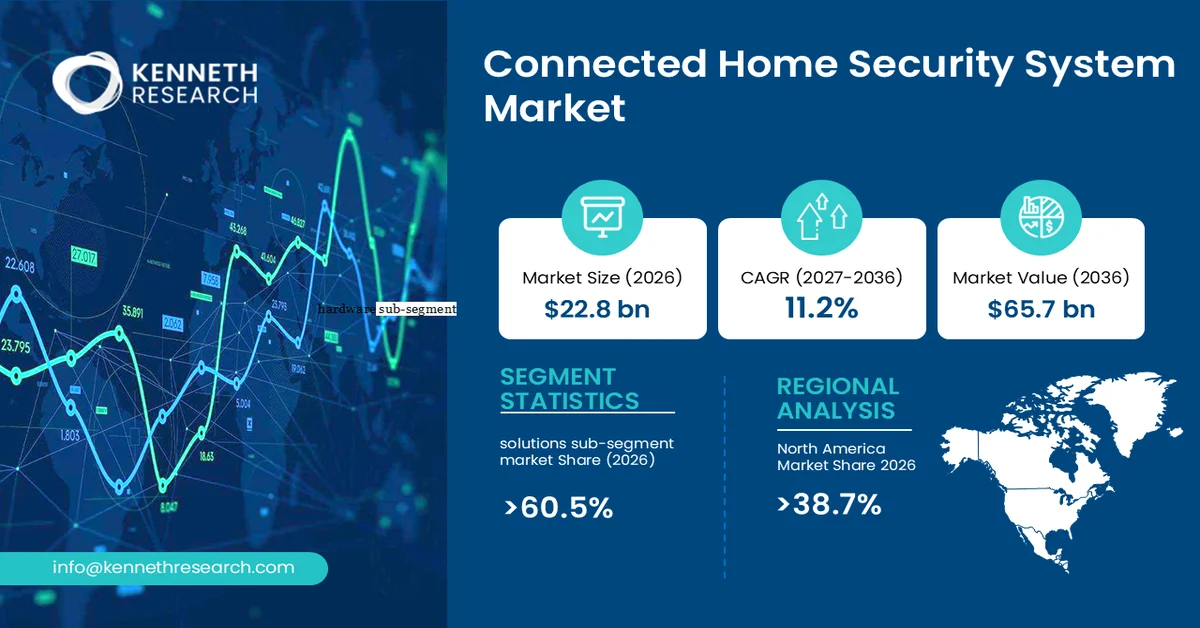
Connected Home Security System Market size was valued at USD 22.8 billion in 2026 and is projected to reach USD 65.7 billion by the end of 2036, rising at a CAGR of 11.2% during the forecast period, i.e., 2027–2036. In 2027, the industry size of the global global connected home security system market is estimated at USD 25.3 billion.
The primary growth driver is the increasing adoption of internet-connected smart-home devices, which expands the installed base for remotely monitored security solutions. Statistics Canada reported continued growth in smart-home-device use, while its survey specifically identifies internet-connected cameras and smart locks as household technologies, supporting broader integration of connected security functionality.
The connected home security system Market comprises hardware, software, connectivity, and security services that protect residential properties through internet-enabled and digitally integrated technologies. These systems combine devices such as security cameras, smart door and window locks, alarms, sensors, video doorbells, and related control equipment with applications or cloud platforms that enable remote monitoring, notification, automation, and management.
A defining characteristic is interoperability: connected security equipment can communicate through home networks and digital platforms, allowing users to monitor security conditions remotely and receive information from distributed devices. Government statistical frameworks identify internet-connected security cameras, home alarm systems, door locks, and related safety solutions as part of connected smart-home technologies.
Key Connected Home Security System Market Insights Summary:
Key Takeaways: Market Trends & Insights
- Connected home security system market is valued at USD 22.8 billion in 2026 and is projected to reach USD 65.7 billion by 2036, expanding at a CAGR of 11.2% during 2027–2036
- Hardware dominates the Component segment with a 60.5% market share in 2026, supported by demand for connected cameras, sensors, alarms, locks, and other residential security devices
- North America leads the global connected home security system market with a 38.7% market share in 2026, supported by established connected-home infrastructure and professional monitoring capabilities
- Professionally monitored systems are positioned for continued expansion as connected security platforms increasingly combine remote monitoring, alarm verification, video surveillance, and automated security functions
- Asia Pacific presents further opportunities through smart-home development, IoT integration, connected residential technologies, and expanding digital infrastructure across China and Japan
Market Drivers
- Expansion of internet-connected residential security devices
- Integration of AI, cloud platforms, and remote monitoring
- Growing interoperability between connected security devices and broader smart-home ecosystems
- Increasing demand for remotely managed residential access, surveillance, and alarm functions
Challenges
- Cybersecurity and Data-Privacy Exposure
- Fragmented Ecosystems and Integration Complexity
Connected Home Security System Market Overview & Supply Chain
Adoption of connected home security systems is increasing globally as households integrate internet-enabled devices, remote monitoring, automation, and digital access controls into residential environments. Improved connectivity, cloud platforms, mobile applications, sensor technologies, and interoperable smart-home ecosystems are strengthening the functional value of connected security solutions.
The value chain begins with raw materials and electronic inputs, including semiconductors, sensors, printed circuit boards, imaging components, batteries, plastics, metals, and connectivity modules. Component suppliers provide these inputs to manufacturers and original equipment manufacturers that design and assemble cameras, alarms, sensors, locks, hubs, control panels, and related connected devices. Software developers and platform providers contribute firmware, mobile applications, cloud infrastructure, analytics, device-management capabilities, and cybersecurity functions. Distribution then moves through electronics distributors, specialist security channels, telecommunications operators, system integrators, retailers, and e-commerce platforms.
Connected Home Security System Market: Growth Drivers & Challenges
Growth Drivers
- Expansion of internet-connected residential security devices: The increasing penetration of connected residential devices is directly expanding the addressable base for connected security solutions. Internet connectivity enables cameras, locks, alarms, sensors, and doorbells to communicate with mobile applications and cloud platforms, shifting residential security from isolated equipment toward integrated, remotely managed systems.
- Integration of ai, cloud platforms, and remote monitoring: Advances in artificial intelligence, cloud computing, edge processing, and wireless connectivity are increasing the functional capabilities of connected security systems. Modern platforms can combine multiple sensors and cameras, process security events, generate automated notifications, and provide users with remote visibility through smartphones and web interfaces. This improves the operational value of security systems beyond conventional intrusion detection by enabling continuous monitoring, automated event recognition, and coordinated responses.
Challenges
- Cybersecurity and data-privacy exposure: Connected security systems depend on network connectivity, cloud platforms, mobile applications, and continuously communicating devices, creating multiple points where unauthorized access can occur. The root cause is the convergence of physical security infrastructure with consumer IoT ecosystems that may involve heterogeneous hardware, software, communication protocols, and third-party services. A security weakness in one component can potentially affect connected devices or expose sensitive household information.
- Fragmented ecosystems and integration complexity: Fragmentation across device manufacturers, connectivity standards, operating platforms, and proprietary software environments remains a significant constraint on connected residential security deployment. Systems purchased from different suppliers may offer inconsistent interoperability, requiring gateways, additional configuration, specialized installation, or replacement of existing equipment. The root cause is the presence of competing technology architectures and commercial ecosystems, alongside differences in device capabilities and software interfaces.
Global Connected Home Security System Market Size and Forecast:
| Report Attribute | Details |
|---|---|
| Base Year |
2026 |
| Forecast Period |
2027-2036 |
| CAGR |
11.2% |
| Base Year Market Size (2026) |
USD 22.8 Billion |
| Forecast Year Market Size (2036) |
USD 65.7 Billion |
| Regional Scope |
|
Connected Home Security System Market Segmentation Analysis:
Component Segment Analysis
In the component segment, hardware sub-segment is anticipated to capture the largest market share of 60.5% by the end of 2026.
Hardware leads the component segment because physical devices remain the essential infrastructure through which connected residential security functions are delivered. Cameras, sensors, alarms, locks, video doorbells, control panels, and gateways provide the sensing, detection, access-control, and communication capabilities required by connected security architectures. Demand is supported by household adoption of remotely accessible security equipment and by the replacement of conventional security products with network-enabled alternatives. Hardware adoption also benefits manufacturers from continued innovation in imaging, sensors, wireless connectivity, edge processing, and device miniaturization. Supply-side competition is encouraging more capable products, easier installation, and integration with broader smart-home ecosystems. Going forward, hardware demand should remain closely linked to interoperability, AI-enabled sensing, cybersecurity, and the expansion of professionally managed security services.
System Type Segment Analysis
The professionally monitored systems is projected to grow as the second-largest segment in the global connected home security system market due to four converging demand drivers.
Professionally monitored systems are positioned for continued expansion because they combine connected security hardware with human-led surveillance, alarm verification, and escalation to emergency responders. Demand is supported by households seeking continuous protection when occupants are away, asleep, or unable to respond directly to an alert. Industry adoption is also moving toward integrated platforms that combine remote access, video, automation, and monitoring within a single service proposition. On the supply side, monitoring providers are expanding cloud-based infrastructure, centralized monitoring capabilities, alarm verification, and AI-assisted event assessment. Canada's official classification system specifically recognizes residential building security-system monitoring, including remote video-camera monitoring, as a defined service category.
Our in-depth analysis of the connected home security system market includes the following segments:
|
Segment |
Sub-segment |
|
Component |
|
|
System Type |
|
|
Product |
|
|
Sales Channel |
|
Connected Home Security System Market Regional Insights:
North America Market Trends & Insights:
North America connected home security system is projected to hold the largest revenue share of 38.7% by the end of 2026.
Its leadership is supported by mature residential security infrastructure, high household connectivity, established monitoring-service networks, and strong participation from technology, telecommunications, and security-equipment providers. The region benefits from substantial consumption of connected residential technologies, while established manufacturing, distribution, installation, and professional monitoring channels support deployment at scale. The U.S. Census Bureau's 2023 American Community Survey recorded 121,147,400 households with an internet subscription, providing an important connectivity foundation for remotely managed residential security solutions.
In the United States, demand is supported by established security-service providers, smart-home adoption, technology investment, and broad availability of connected infrastructure. The country also provides a substantial ecosystem for security hardware, software, cloud platforms, and monitoring services.
In Canada, adoption is supported by strong household connectivity and an established smart-home ecosystem. Government data show continued penetration of connected residential technologies, creating opportunities for security-device suppliers and monitoring providers. Together, the two countries provide North America with an integrated commercial environment spanning device manufacturing, technology development, distribution, installation, and professional monitoring.
Asia Pacific Market Trends & Insights:
Asia Pacific is supported by rising demand for connected residential technologies, expanding digital infrastructure, and increasing integration of smart-home functions with security, automation, and remote monitoring. Industrial activity spans consumer electronics, telecommunications, IoT platforms, semiconductor manufacturing, security equipment, and software development, creating a broad regional supplier ecosystem.
In China, extensive electronics and communications capabilities support domestic production and deployment of connected security equipment, while government-backed digital-home and IoT initiatives encourage interoperability and intelligent residential applications.
In Japan, the policy environment is emphasizing digital transformation and IoT cybersecurity. METI launched the JC-STAR IoT product security labeling scheme in 2025, with smart-home devices identified for future expansion of the product categories covered by the scheme. This creates opportunities for security vendors that can combine connected functionality with stronger cybersecurity and compliance capabilities.
Leading Companies Operating in the Global Connected Home Security System Market:
Here is a list of upstream, downstream, and key players operating in connected home security system market competitive ecosystem:
- Honeywell International Inc. (United States)
- Company Overview
- Business Strategy
- Key Product Offerings
- Financial Performance
- Key Performance Indicators
- Risk Analysis
- Recent Development
- Regional Presence
- SWOT Analysis
- ADT Inc. (United States)
- Samsung Electronics Co. Ltd. (South Korea)
- SimpliSafe (United States)
- NETGEAR (United States)
Recent Developments
- In February 2026, ADT Inc. announced the acquisition of Origin AI for $170 million in cash. Origin AI's sensing technology enables human presence detection and motion classification without cameras, audio, or wearables. ADT expects to begin commercializing offerings incorporating Origin's AI sensing technology in 2027, with applications including reducing false alarms and supporting aging-in-place solutions.
- In April 2026, Samsung Electronics announced a major update to its SmartThings platform, strengthening Family Care services and integrating Home Security, Family Care, and Pet Care into Now Brief. The update includes Care on Call for checking on loved ones via phone calls, continuous monitoring of connected appliances for unusual patterns, and enhanced Safety Patrol using the Bespoke AI Jet Bot Steam Ultra robot vacuum to check areas around the home. Now Brief will expand to TVs and Family Hub refrigerators.
Frequently Asked Question
In 2026, the global connected home security system market exceeded USD 22.8 billion.
The global connected home security system market is projected to reach USD 65.7 billion by the end of 2036, expanding at a CAGR of 11.2% over the forecast period (2027-2036).
The major players in the market are Honeywell International Inc., ADT Inc., Samsung Electronics Co. Ltd., SimpliSafe, NETGEAR, and others.
In the Component segment, the Hardware sub-segment is anticipated to capture the largest market share of 60.5% in the future and exhibit lucrative growth opportunities during 2027-2036. This growth trajectory is largely attributed to increasing adoption of internet-connected residential security devices.
North America is projected to hold the largest market share of 38.7% by the end of 2036 and provide more business opportunities in the future. Continuous investments in connected residential infrastructure, smart-home technologies, and professional monitoring services across the United States and Canada are supporting the region's dominance.
Why Choose Kenneth Research ?
-
Insight with Impact : We don’t just gather data — we uncover stories, trends, and opportunities that fuel business growth.
-
Experts Who Get It : Our team speaks your industry’s language and knows what really matters to your customers and market.
-
Custom-Built for You : Forget one-size-fits-all. We craft research and consulting solutions as unique as your business vision.
-
Partners, Not Just Providers : We work with you, not for you — collaborating closely to turn insights into smart, strategic moves.
-
Results That Speak : Our work powers brands, startups, and industry leaders alike — with a track record of ideas that work in the real world.
Report ID: 1467 |
Published Date: 28 Sep 2026 |
Report Format: |
Delivery Timeline: 48-72 Business Hours

Copyright © 2025 Kenneth Research. All rights reserved. Terms of Use | Privacy Policy
