Report ID: 1027 |
Published Date: 29 Jul 2026 |
Report Format: |
Delivery Timeline: 48-72 Business Hours
Composite Resin Market Outlook:
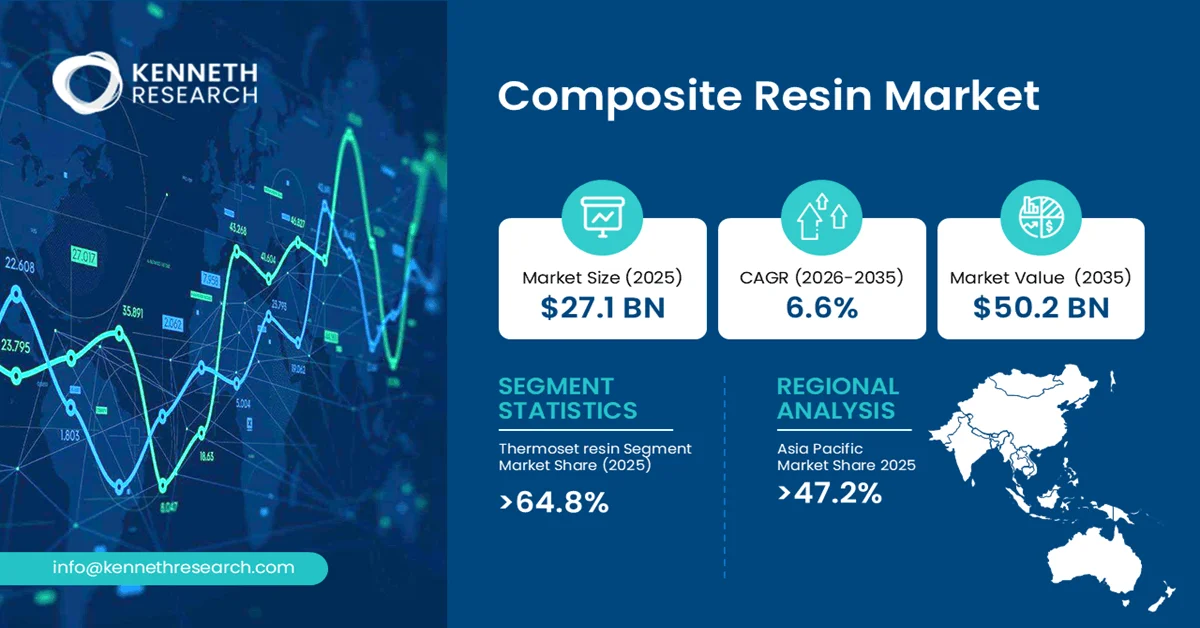
Composite Resin Market size was valued at USD 27.1 billion in 2025 and is projected to reach USD 50.2 billion by the end of 2035, rising at a CAGR of 6.6% during the forecast period, i.e., 2026-2035. In 2026, the industry size of the composite resin is estimated at USD 28.9 billion.
The primary growth driver for the composite resin market is the increasing adoption of lightweight, high-performance materials across transportation, construction, wind energy, electrical, and industrial applications. Composite resins enhance structural strength, corrosion resistance, and durability while reducing overall component weight, enabling manufacturers to meet stringent performance, efficiency, and sustainability requirements.
The composite resin market encompasses the production, distribution, and application of polymer-based resins that serve as the binding matrix in fiber-reinforced composite materials. These resins encapsulate reinforcing fibers such as glass, carbon, or aramid, transferring mechanical loads while providing dimensional stability, chemical resistance, and environmental protection. Composite resins are available in thermoset and thermoplastic formulations, with each offering distinct processing characteristics and performance attributes suited to diverse manufacturing requirements.
Composite resins are characterized by their excellent strength-to-weight ratio, corrosion resistance, thermal stability, design flexibility, and compatibility with multiple reinforcement materials and fabrication processes. Their ability to produce durable, lightweight components makes them suitable for applications requiring high structural integrity under demanding operating conditions. Depending on end-use requirements, manufacturers select resin systems that optimize mechanical performance, processing efficiency, and long-term reliability.
The market plays a critical role across industries including aerospace, automotive, construction, wind energy, marine, electrical and electronics, and industrial manufacturing. By enabling the production of lightweight, durable, and high-performance composite structures, composite resins support advancements in energy efficiency, infrastructure development, renewable energy deployment, and next-generation engineering solutions.
Key Composite Resin Market Insights Summary:
Key Takeaways: Market Trends & Insights
- The composite resin market is projected to grow from USD 27.1 billion in 2025 to USD 50.2 billion by 2035 at a CAGR of 6.6% during 2026-2035
- Thermoset Resin accounted for the largest resin type share at 64.8% in 2025, supported by increasing adoption across wind energy, aerospace, and transportation
- Asia Pacific led the global market with a 47.2% share in 2025, driven by expanding manufacturing capacity and industrial investments in China and India
- The Layup manufacturing process is expected to register strong growth owing to its cost efficiency, production flexibility, and suitability for large composite structures
- Rising demand for lightweight, durable, and corrosion-resistant composite materials across renewable energy, construction, aerospace, and automotive industries continues to support long-term market expansion
Market Drivers
- Increasing renewable energy infrastructure investments
- Growing lightweight material adoption in transportation and industrial manufacturing
- Advancements in automated composite manufacturing technologies
- Rising infrastructure modernization and corrosion-resistant material demand
Challenges
- Volatility in petrochemical feedstock supply and pricing
- Limited end-of-life recycling and circular economy integration
Composite Resin Market Overview & Supply Chain
The global adoption of composite resins is accelerating as industries seek materials that combine lightweight performance with high mechanical strength, corrosion resistance, and long service life. These resins have become indispensable in sectors such as wind energy, transportation, construction, electrical equipment, and aerospace, where reducing structural weight while maintaining durability improves operational efficiency and sustainability. Technological advancements in resin chemistry have also enhanced processing speed, thermal stability, and compatibility with automated manufacturing methods, enabling broader industrial deployment. The growing emphasis on renewable energy infrastructure is further strengthening demand because composite resins are integral to manufacturing wind turbine blades and other structural components. According to the International Energy Agency (IEA), global wind capacity additions reached a record level in 2024, highlighting continued investment in composite-intensive renewable energy infrastructure and reinforcing the long-term industrial relevance of advanced composite materials.
The composite resin market value chain begins with the procurement of petrochemical and specialty chemical feedstocks, including epoxy precursors, unsaturated polyester intermediates, vinyl ester ingredients, catalysts, curing agents, accelerators, fillers, and performance additives sourced from global chemical producers. Resin manufacturers convert these raw materials into formulated composite resin systems through controlled synthesis, blending, quality testing, and packaging processes tailored to specific manufacturing technologies and end-use requirements. The finished resins are supplied directly to composite fabricators or distributed through specialty chemical distributors and regional supply networks. Composite manufacturers combine these resin systems with reinforcement materials such as glass, carbon, or aramid fibers using processes including layup, resin transfer molding, pultrusion, and filament winding to produce finished composite components. The principal stakeholders include raw material suppliers, resin formulators, composite manufacturers, equipment providers, distributors, OEMs, engineering companies, certification bodies, and end users across transportation, aerospace, construction, renewable energy, marine, electrical, and industrial sectors.
Composite Resin Market: Growth Drivers & Challenges
Growth Drivers:
- Expanding Renewable Energy Infrastructure Accelerating Composite Material Demand: The rapid expansion of renewable energy infrastructure is creating sustained demand for composite resins, particularly in wind energy applications where lightweight, fatigue-resistant, and corrosion-resistant materials are essential for manufacturing larger and more efficient turbine blades. Advanced resin systems enable improved structural integrity, longer service life, and lower maintenance costs, making them indispensable for modern renewable energy projects. As governments and utilities continue investing in clean energy generation, manufacturers are increasing production capacities and developing resin formulations with enhanced mechanical and thermal performance. This trend is strengthening collaboration between resin suppliers, composite fabricators, and turbine manufacturers while encouraging innovation in sustainable material technologies. According to the International Energy Agency (IEA), global renewable capacity is expected to grow by 2.7 times by 2030 under existing policies, with solar PV and wind accounting for 95% of renewable capacity growth, reinforcing long-term demand for composite materials across the renewable energy value chain.
- Rising Lightweight Material Adoption Across Transportation and Industrial Manufacturing: The increasing preference for lightweight, high-strength materials across transportation and industrial manufacturing is significantly supporting the adoption of composite resins. Automotive, aerospace, rail, and marine manufacturers are integrating composite structures to improve fuel efficiency, reduce emissions, enhance payload capacity, and extend product lifespan. Composite resins provide excellent adhesion with reinforcing fibers while delivering superior chemical resistance, dimensional stability, and mechanical durability under demanding operating conditions. Continuous advancements in automated manufacturing technologies, resin infusion techniques, and rapid curing systems are further improving production efficiency and lowering processing costs. Looking ahead, the growing focus on electrification, sustainable mobility, advanced infrastructure, and industrial modernization is expected to encourage wider deployment of composite components, prompting resin manufacturers to develop next-generation formulations that balance performance, recyclability, and manufacturing productivity.
Challenges:
- Volatility in Petrochemical Feedstock Supply and Pricing: The composite resin industry remains highly dependent on petrochemical-derived raw materials, making it vulnerable to fluctuations in the availability and pricing of key feedstocks such as epoxy precursors, polyester intermediates, vinyl ester chemicals, and specialty additives. Supply disruptions caused by refinery outages, geopolitical uncertainties, logistics constraints, or shifts in crude oil markets can significantly increase production costs and reduce procurement predictability. These fluctuations complicate long-term supply contracts and inventory planning for resin manufacturers, while downstream composite fabricators face higher material costs that affect project profitability and pricing competitiveness. Commercially, manufacturers are compelled to diversify supplier networks, secure strategic sourcing agreements, and invest in alternative feedstock development to mitigate risk. Looking ahead, greater emphasis on regional supply chain resilience and bio-based raw materials is expected, although achieving stable costs and consistent material performance will remain a significant industry challenge.
- Limited End-of-Life Recycling and Circular Economy Integration: A major restraint for the composite resin market is the limited recyclability of conventional thermoset resin systems, which are permanently cross-linked after curing and cannot be remelted or reshaped using traditional recycling methods. This technical limitation creates challenges in managing end-of-life composite components from industries such as wind energy, construction, transportation, and marine applications. Disposal costs, evolving environmental regulations, and increasing sustainability expectations are placing pressure on manufacturers to develop circular material solutions without compromising structural performance. Commercially, companies must allocate additional resources toward research, advanced recycling technologies, and recyclable resin formulations, increasing product development costs and extending commercialization timelines. In the coming years, innovation in recyclable thermoset chemistries, thermoplastic composites, and chemical recycling processes is expected to become a key competitive differentiator as sustainability requirements continue to strengthen.
Composite Resin Market Size and Forecast:
| Report Attribute | Details |
|---|---|
| Base Year |
2025 |
| Forecast Year |
2026-2035 |
| CAGR |
6.6% |
| Base Year Market Size (2025) |
USD 27.1 billion |
| Forecast Year Market Size (2035) |
USD 50.2 billion |
| Regional Scope |
|
Composite Resin Market Segmentation Analysis:
Resin Type Segment Analysis
In the resin type segment, the thermoset resin sub-segment is anticipated to capture the largest market share of 64.8% by the end of 2025.
Thermoset resin is the leading segment in the composite resin market because it offers an optimal combination of high mechanical strength, dimensional stability, chemical resistance, and long-term durability required in structural composite applications. Industries including aerospace, wind energy, construction, marine, electrical, and transportation continue to favor thermoset systems such as epoxy, polyester, and vinyl ester resins due to their excellent adhesion with reinforcing fibers and their ability to retain performance under demanding thermal and mechanical conditions. On the supply side, thermoset resins benefit from well-established manufacturing technologies, mature raw material supply chains, and broad compatibility with fabrication methods including layup, resin transfer molding, pultrusion, and filament winding, supporting large-scale commercial production. Demand is also reinforced by expanding wind energy deployment, where thermoset-based composites remain the industry standard for turbine blade manufacturing. According to the U.S. Department of Energy, the United States has more than 500 manufacturing facilities specializing in wind components such as blades, towers, generators, and turbine assembly, underscoring sustained industrial demand for thermoset composite materials across the wind energy supply chain. Looking ahead, continued investments in high-performance infrastructure, transportation, and renewable energy are expected to preserve the segment's market leadership while encouraging innovations in recyclable and lower-emission thermoset resin technologies.
Manufacturing Process Segment Analysis
The Layup is projected to grow as the second-largest segment in the composite resin market due to four converging demand drivers.
The layup manufacturing process is projected to witness strong growth due to its versatility, cost-effectiveness, and ability to produce large, structurally complex composite components across multiple industries. The process is widely adopted in the manufacture of wind turbine blades, marine structures, transportation components, construction products, and aerospace parts because it accommodates a broad range of reinforcement materials and resin systems while requiring comparatively lower capital investment than highly automated processes. Increasing demand for large composite structures is encouraging manufacturers to enhance layup operations through digital process monitoring, automated material placement, and quality control technologies to improve production consistency and reduce waste. On the supply side, established manufacturing expertise, readily available tooling, and compatibility with both manual and semi-automated production methods continue to support widespread industrial adoption. Reflecting this trend, the U.S. Department of Energy (DOE) announced support in 2024 for a project to develop machine learning-based online layup, infusion, and curing process monitoring for large wind blade manufacturing, highlighting ongoing government-backed efforts to improve productivity and quality in composite layup processes. Looking ahead, continued advancements in automation, process optimization, and smart manufacturing are expected to further strengthen the role of layup in high-volume composite production.
Our in-depth analysis of the global composite resin market includes the following segments:
|
Segment |
Sub-segment |
|
Resin Type |
|
|
Manufacturing Process |
|
|
Application |
|
Composite Resin Market Regional Insights:
Asia Pacific Market Trends & Insights:
Asia Pacific composite resin market is projected to hold the largest revenue share of 47.2% by the end of 2025.
The region's leadership is supported by its extensive manufacturing ecosystem, strong demand from construction, transportation, electrical and electronics, wind energy, and industrial sectors, and continuous investment in advanced materials production. Countries across the region benefit from integrated petrochemical value chains, cost-competitive manufacturing, and expanding infrastructure development, enabling large-scale production and consumption of composite resin products. Favorable industrial policies, increasing renewable energy deployment, and ongoing investments in high-value manufacturing further reinforce regional competitiveness. A significant contributor to this leadership is the rapid expansion of clean energy infrastructure, which relies heavily on composite materials. According to China's National Bureau of Statistics, the country's grid-connected wind power generation capacity reached 441.34 million kilowatts at the end of 2023, increasing by 20.7% year over year, highlighting the growing industrial demand for composite-intensive applications.
China remains the primary growth engine within the region owing to its large-scale chemical manufacturing base, advanced composite processing capabilities, and strong domestic demand from aerospace, automotive, renewable energy, electrical equipment, and infrastructure sectors. The country's integrated supply chains and continuous investments in advanced manufacturing technologies enable efficient production and global exports of composite materials.
India is emerging as another key market, supported by expanding industrialization, infrastructure modernization, renewable energy projects, and increasing domestic manufacturing under national industrial development initiatives. Rising investments in transportation, construction, and electrical equipment manufacturing are encouraging greater adoption of composite resin systems. Together, China and India provide a robust production and consumption base, strengthening Asia Pacific's position as the global hub for composite resin manufacturing, technological development, and downstream industrial applications.
North America Market Trends & Insights:
North America represents a strategically important region in the composite resin market, driven by strong demand from aerospace, automotive, wind energy, marine, electrical, and construction industries. The region benefits from a well-established composites manufacturing ecosystem, advanced research capabilities, and widespread adoption of high-performance materials for lightweight engineering applications. Government initiatives supporting domestic manufacturing, infrastructure modernization, clean energy deployment, and advanced materials innovation continue to encourage investment across the composite value chain. Increasing emphasis on fuel efficiency, electrification, renewable energy expansion, and sustainable industrial practices is accelerating the development of next-generation resin systems with improved mechanical performance and environmental characteristics. Looking ahead, continued advancements in automated composite manufacturing, recyclable resin technologies, and digital production processes are expected to create new opportunities for material suppliers, component manufacturers, and original equipment manufacturers throughout the region.
The United States leads the regional market through its extensive aerospace, defense, transportation, and renewable energy industries, supported by a mature chemical manufacturing base and strong investment in advanced composite technologies. Ongoing research collaborations between industry, national laboratories, and academic institutions are driving innovation in high-performance resin formulations and manufacturing processes.
Canada complements regional growth through its expanding aerospace sector, growing wind energy installations, marine applications, and advanced manufacturing initiatives. The country's focus on sustainable industrial development and composite material innovation is encouraging broader adoption across infrastructure, transportation, and clean energy projects, strengthening North America's position as a key center for composite resin development and high-value industrial applications.
Leading Companies Operating in the Global Composite Resin Market:
Here is a list of upstream, downstream, and key players operating in the global composite resin market competitive ecosystem:
- Polynt S.p.A. (Italy)
- Company Overview
- Business Strategy
- Key Product Offerings
- Financial Performance
- Key Performance Indicators
- Risk Analysis
- Recent Development
- AOC (United States)
- Scott Bader Company Ltd. (United Kingdom)
- Westlake Corporation (United States)
- Allnex (Germany)
- Vikram Resins and Polymers (India)
Recent Developments
- December 2024 – INEOS Enterprises announced an agreement to sell its INEOS Composites business to KPS Capital Partners, enabling the composites resin business to operate as an independent company focused on future growth and investment.
- March 2025 – Alta Performance Materials officially launched as the new identity of the former INEOS Composites business following the completion of its acquisition by KPS Capital Partners.
Frequently Asked Question
In 2025, the composite resin market exceeded USD 27.1 billion.
The composite resin market is projected to reach USD 50.2 billion by the end of 2035, expanding at a CAGR of 6.6% over the forecast period (2026-2035).
The major players in the market are BASF SE, Huntsman Corporation, Hexion Inc., Olin Corporation, Westlake Corporation, Reichhold LLC, Ashland Inc., Allnex, Covestro AG, Evonik Industries AG, SABIC, Mitsubishi Chemical Group, Sumitomo Bakelite Co., Ltd., Toray Industries, Inc., Teijin Limited, Syensqo, Scott Bader Company Ltd., INEOS Composites, AOC, Polynt S.p.A., and others.
In the Resin Type segment, the Thermoset Resin sub-segment is anticipated to capture the largest market share of 64.8% in the future and exhibit lucrative growth opportunities during 2026-2035. This growth trajectory is largely attributed to its extensive adoption in wind energy, aerospace, transportation, and industrial applications due to its superior mechanical strength, durability, and chemical resistance.
Asia Pacific is projected to hold the largest market share of 47.2% by the end of 2035 and provide more business opportunities in the future. Continuous investments in advanced manufacturing, renewable energy infrastructure, and industrial expansion across China and India are fostering the region's dominance.
Why Choose Kenneth Research ?
-
Insight with Impact : We don’t just gather data — we uncover stories, trends, and opportunities that fuel business growth.
-
Experts Who Get It : Our team speaks your industry’s language and knows what really matters to your customers and market.
-
Custom-Built for You : Forget one-size-fits-all. We craft research and consulting solutions as unique as your business vision.
-
Partners, Not Just Providers : We work with you, not for you — collaborating closely to turn insights into smart, strategic moves.
-
Results That Speak : Our work powers brands, startups, and industry leaders alike — with a track record of ideas that work in the real world.
Report ID: 1027 |
Published Date: 29 Jul 2026 |
Report Format: |
Delivery Timeline: 48-72 Business Hours

Copyright © 2025 Kenneth Research. All rights reserved. Terms of Use | Privacy Policy
