Report ID: 1053 |
Published Date: 05 Aug 2026 |
Report Format: |
Delivery Timeline: 48-72 Business Hours
Composite Coatings Market Outlook:
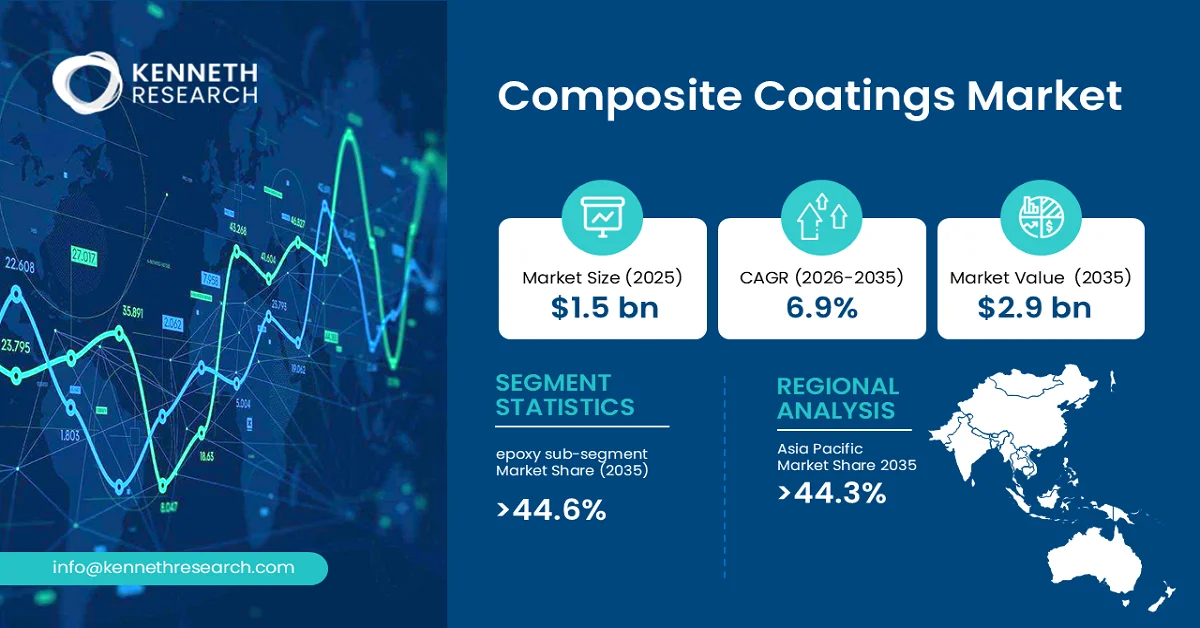
Composite Coatings Market size was valued at USD 1.5 billion in 2025 and is projected to reach USD 2.9 billion by the end of 2035, rising at a CAGR of 6.9% during the forecast period, i.e., 2026-2035. In 2026, the industry size of the composite coatings is estimated at USD 1.6 billion.
The primary growth driver of the global composite coatings market is the increasing requirement for durable corrosion protection across high-performance industrial assets. Growing investments in energy infrastructure, transportation equipment, and advanced manufacturing are accelerating demand for composite coating systems that improve service life, reduce maintenance frequency, and enhance operational reliability under harsh environments.
The global composite coatings market comprises advanced protective coating systems formulated with composite materials that combine polymeric resins with reinforcing fillers, ceramic particles, metallic additives, or other engineered materials to enhance surface performance. These coatings are applied to metal, concrete, composites, and other substrates to provide superior resistance against corrosion, abrasion, erosion, chemicals, ultraviolet radiation, moisture, and extreme operating temperatures. Depending on application requirements, composite coatings can be engineered to deliver improved mechanical strength, lower friction, enhanced wear resistance, electrical insulation, or thermal protection.
Composite coatings play a significant role across industries where equipment longevity, operational efficiency, and asset integrity are critical. They are extensively utilized in sectors such as oil and gas, marine, aerospace, automotive, industrial manufacturing, power generation, and infrastructure. By extending maintenance intervals and protecting critical components from aggressive operating conditions, these coatings contribute to lower lifecycle costs and improved equipment reliability. Continuous advances in resin chemistry, reinforcement technologies, and application techniques are further expanding the adoption of composite coatings across demanding industrial environments.
Key Composite Coatings Market Insights Summary:
Key Takeaways: Market Trends & Insights
- Global composite coatings market projected to grow from USD 1.5 billion in 2025 to USD 2.9 billion by 2035 at a 6.9% CAGR.
- Asia Pacific is projected to lead the global market with a 44.3% share by 2035, supported by strong industrial manufacturing, expanding energy infrastructure, and growing investments across China and Japan.
- Epoxy is expected to remain the leading resin type segment with a 44.6% market share, driven by its superior corrosion resistance, excellent adhesion, and extensive use across industrial and infrastructure applications.
- The oil & gas end-user industry is expected to witness robust growth due to increasing investments in pipelines, refineries, offshore facilities, and asset integrity management requiring high-performance protective coatings.
- The market is benefiting from rising demand for durable corrosion protection solutions, continued advancements in high-performance composite coating technologies, and increasing focus on extending industrial asset lifecycle while reducing maintenance costs.
Market Drivers
- Increasing deployment of corrosion-resistant coatings in marine and offshore infrastructure.
- Advancements in nanocomposite and multifunctional coating technologies.
- Growing emphasis on extending industrial asset lifecycle through predictive maintenance strategies.
- Rising demand for environmentally compliant, low-emission, high-performance coating formulations.
Challenges
- High formulation complexity and lengthy qualification requirements.
- Surface preparation and application sensitivity affecting long-term coating performance.
Composite Coatings Market Overview & Supply Chain
The adoption of composite coatings is increasing globally as industries seek advanced surface protection solutions that improve equipment durability, reduce maintenance requirements, and enhance operational efficiency in aggressive service environments. Rapid industrial modernization, expanding energy infrastructure, and the growing deployment of high-value assets in sectors such as oil and gas, marine, transportation, and manufacturing are strengthening demand for high-performance protective coatings. Sustainability objectives are also encouraging manufacturers to develop longer-lasting coating systems that minimize material replacement and lifecycle environmental impacts. This trend is reinforced by rising investment in industrial and energy infrastructure. According to the International Energy Agency (IEA), global energy investment is expected to exceed USD 3 trillion in 2024 for the first time, reflecting substantial capital deployment into infrastructure requiring durable protective materials, including advanced coating technologies. The increasing scale of industrial assets directly supports long-term demand for composite coatings in corrosion and wear protection applications.
The composite coatings value chain begins with the procurement of key raw materials, including epoxy and other specialty resins, curing agents, ceramic reinforcements, metallic powders, pigments, additives, and specialty fillers sourced from chemical manufacturers and advanced materials suppliers. These inputs undergo formulation, blending, dispersion, and quality validation before being processed into coating products tailored for specific performance requirements. Manufacturers optimize formulations to achieve targeted corrosion resistance, abrasion resistance, thermal stability, and chemical durability while complying with industrial performance standards. Distribution occurs through direct industrial sales, regional distributors, coating applicators, engineering procurement contractors, and original equipment manufacturers that integrate coating systems into industrial assets. End users include oil and gas operators, marine companies, aerospace manufacturers, automotive producers, infrastructure developers, and power generation facilities. Key stakeholders throughout the value chain comprise raw material suppliers, coating formulators, equipment manufacturers, certification bodies, industrial contractors, logistics providers, maintenance service companies, and asset owners responsible for long-term infrastructure performance.
Composite Coatings Market: Growth Drivers & Challenges
Growth Drivers:
- Rising investments in energy infrastructure requiring advanced asset protection: Expanding investments in energy infrastructure are creating sustained demand for composite coatings that protect critical equipment from corrosion, erosion, chemical exposure, and harsh operating conditions. Pipelines, offshore platforms, storage tanks, refineries, and renewable energy installations require high-performance coating systems to maximize operational life while minimizing maintenance-related downtime. Composite coatings enable operators to reduce lifecycle costs by preserving structural integrity in aggressive environments where conventional coatings often fail. As governments and private investors continue upgrading energy networks and industrial facilities, the need for durable protective materials is increasing across both new construction and maintenance projects. This trend is expected to encourage continued innovation in resin formulations, application technologies, and environmentally compliant coating systems designed for long-term infrastructure resilience. According to the International Energy Agency (IEA), investment in clean energy technologies and infrastructure is projected to exceed USD 2 trillion in 2024, demonstrating the expanding infrastructure base that requires advanced protective coating solutions.
- Increasing adoption of high-performance materials across industrial manufacturing: Industrial manufacturers are increasingly adopting composite coatings to improve equipment durability, production reliability, and operational efficiency under demanding service conditions. Modern manufacturing facilities require surfaces capable of withstanding abrasion, chemical attack, thermal cycling, and continuous mechanical stress without compromising performance. Composite coating technologies address these requirements through enhanced adhesion, wear resistance, and customized functional properties, making them suitable for heavy machinery, process equipment, and engineered components. The growing emphasis on predictive maintenance and asset lifecycle optimization is further strengthening demand, as longer-lasting protective systems reduce maintenance frequency and unexpected operational interruptions. Future advancements in multifunctional coatings, including self-healing, low-friction, and environmentally sustainable formulations, are expected to broaden industrial adoption across sectors such as transportation, marine, aerospace, power generation, and advanced manufacturing, reinforcing long-term market expansion.
Challenges:
- High formulation complexity and qualification requirements: Composite coatings require carefully engineered combinations of resins, reinforcing materials, curing agents, and functional additives to achieve application-specific performance. Developing formulations that consistently deliver corrosion resistance, abrasion protection, chemical stability, and long-term adhesion across different operating environments demands extensive laboratory validation and field qualification. These rigorous development and certification processes increase product development timelines and technical costs for manufacturers. For end users, qualification requirements often delay the adoption of newer coating technologies because operators prioritize proven long-term performance over newly introduced formulations. Commercially, this raises barriers for emerging suppliers attempting to enter industries with stringent performance specifications, such as energy, marine, and aerospace. Looking ahead, manufacturers are expected to invest more heavily in accelerated testing methods, digital material modeling, and collaborative qualification programs to shorten commercialization cycles while maintaining reliability and regulatory compliance.
- Surface preparation and application sensitivity: The effectiveness of composite coatings depends heavily on proper surface preparation, environmental conditions during application, and strict adherence to curing procedures. Variations in substrate cleanliness, surface profile, humidity, temperature, or application technique can significantly affect coating adhesion and long-term protective performance. As a result, industrial users often require skilled applicators, specialized equipment, and comprehensive quality control procedures, increasing project complexity and operational costs. In large infrastructure and industrial facilities, inconsistent application quality may lead to premature coating failure, additional maintenance, and unplanned shutdowns, reducing confidence in coating performance despite advanced material properties. From a commercial perspective, these installation challenges can slow project execution and increase lifecycle expenditures. Future improvements in application technologies, automated inspection systems, and more application-tolerant coating formulations are expected to mitigate these limitations and improve deployment efficiency.
Composite Coatings Market Size and Forecast:
| Report Attribute | Details |
|---|---|
| Base Year |
2025 |
| Forecast Year |
2026-2035 |
| CAGR |
6.9% |
| Base Year Market Size (2025) |
USD 1.5 billion |
| Forecast Year Market Size (2035) |
USD 2.9 billion |
| Regional Scope |
|
Composite Coatings Market Segmentation Analysis:
Resin Type Segment Analysis
In the resin type segment, the epoxy sub-segment is anticipated to capture the largest market share of 44.6% by the end of 2035.
The epoxy sub-segment dominates the global composite coatings market owing to its exceptional adhesion, corrosion resistance, chemical durability, and mechanical strength, making it the preferred resin system for demanding industrial applications. Epoxy-based composite coatings are extensively used to protect pipelines, storage tanks, offshore structures, industrial machinery, marine equipment, and transportation assets operating under aggressive environmental conditions. Their ability to form dense, highly cross-linked protective films enables longer maintenance intervals and improved asset reliability, driving sustained demand across infrastructure, manufacturing, and energy sectors. On the supply side, well-established epoxy resin production capabilities, mature processing technologies, and broad compatibility with reinforcing fillers and functional additives have supported widespread commercialization and product innovation. Manufacturers continue to develop advanced epoxy formulations with enhanced abrasion resistance, thermal stability, and reduced environmental impact to meet evolving industrial requirements. Future demand is expected to remain strong as governments and industries invest in resilient infrastructure and long-life industrial assets. Supporting this trend, Eurostat reported that the European Union produced 218 million tonnes of industrial chemicals in 2023, reflecting the substantial industrial chemical base that underpins the availability and adoption of epoxy-based coating materials across multiple manufacturing sectors.
End User Segment Analysis
The oil & gas end-user segment is projected to witness strong growth as operators continue prioritizing asset integrity, operational reliability, and lifecycle cost optimization across upstream, midstream, and downstream facilities. Composite coatings are increasingly specified for pipelines, storage tanks, offshore platforms, refineries, processing equipment, and transmission infrastructure because they provide superior resistance to corrosion, erosion, chemical exposure, and harsh environmental conditions. The industry's focus on extending maintenance intervals and minimizing unplanned shutdowns is accelerating the adoption of advanced coating systems capable of performing under demanding operating conditions. On the supply side, coating manufacturers are expanding portfolios with high-performance formulations tailored for elevated temperatures, aggressive process chemicals, and long-term durability while meeting increasingly stringent industrial specifications. Looking ahead, continued investment in refining, transportation, and energy infrastructure is expected to sustain demand for protective coating technologies. Supporting this outlook, the International Energy Agency (IEA) projects that global refining capacity will increase by 3.3 million barrels per day between 2023 and 2030, indicating continued expansion of refining assets that require advanced protective coating solutions throughout their operational lifecycle.
Our in-depth analysis of the global composite coatings market includes the following segments:
|
Segment |
Sub-segment |
|
Resin Type |
|
|
End User Industry |
|
|
Technology |
|
|
Function |
|
|
Application |
|
|
Substrate |
|
Composite Coatings Market Regional Insights:
Asia Pacific Market Trends & Insights:
Asia Pacific is projected to account for 44.3% of the global composite coatings market by 2035, making it the leading regional market throughout the forecast period.
The region's dominance is supported by its extensive industrial manufacturing base, large-scale infrastructure development, expanding energy and transportation sectors, and strong investment in industrial modernization. Asia Pacific also benefits from an integrated supply chain for specialty chemicals, resins, and advanced materials, enabling efficient production and commercialization of composite coating technologies. Increasing investment in heavy industries, marine infrastructure, industrial equipment, and power generation continues to reinforce demand for high-performance protective coatings. Regulatory emphasis on extending asset life, improving industrial efficiency, and reducing maintenance-related downtime further encourages the adoption of advanced composite coating systems across critical infrastructure and manufacturing facilities. These structural advantages position the region as the primary production and consumption hub for composite coatings.
Among the region's major contributors, China remains the leading manufacturing center due to its extensive industrial capacity, large chemical industry, and continuous investment in energy and infrastructure projects requiring advanced protective coatings. Japan supports regional leadership through its highly developed automotive, electronics, marine, and advanced manufacturing industries, where premium-performance coating technologies are widely adopted to enhance product durability and operational reliability. Supporting the region's industrial strength, UNIDO's international yearbook of industrial statistics 2024 reports that Asia accounted for approximately 54% of global manufacturing value added in 2023, underscoring the region's dominant position in global industrial production and the resulting demand for industrial coating technologies used to protect manufacturing assets and infrastructure.
North America Market Trends & Insights:
North America represents a strategically important market for composite coatings, supported by strong demand from energy, aerospace, defense, transportation, marine, and industrial manufacturing sectors. Asset owners across the region increasingly prioritize protective coating technologies that extend equipment service life, improve operational reliability, and reduce maintenance-related disruptions. The region also benefits from a mature industrial ecosystem, advanced research capabilities, and widespread adoption of high-performance materials across critical infrastructure projects. Government initiatives focused on infrastructure modernization, domestic manufacturing expansion, energy security, and industrial sustainability continue to create opportunities for advanced coating solutions. In addition, increasing emphasis on predictive maintenance, digital asset management, and lifecycle cost optimization is encouraging industries to adopt durable composite coating systems capable of performing under demanding operating conditions. Future opportunities are expected to arise from modernization of aging industrial assets, expansion of energy infrastructure, and continued investment in advanced manufacturing technologies requiring high-performance surface protection.
The United States remains the largest contributor to regional demand due to its extensive oil and gas infrastructure, aerospace manufacturing base, chemical processing facilities, defense sector, and industrial production capacity. Continuous investments in refinery upgrades, transportation infrastructure, and advanced manufacturing support sustained adoption of composite coatings across diverse industrial applications.
Canada complements regional growth through its significant energy production, mining operations, marine infrastructure, and industrial processing industries, where corrosion resistance and equipment longevity are critical operational priorities. The country's continued focus on infrastructure resilience, resource development, and industrial modernization is expected to strengthen demand for advanced composite coating technologies, while collaboration between manufacturers, engineering firms, and industrial asset owners will further support innovation and long-term market expansion.
Leading Companies Operating in the Global Composite Coatings Market:
Here is a list of upstream, downstream, and key players operating in the global composite coatings market competitive ecosystem:
- Akzo Nobel N.V(Netherlands)
- Company Overview
- Business Strategy
- Key Product Offerings
- Financial Performance
- Key Performance Indicators
- Risk Analysis
- Recent Development
- Regional Presence
- SWOT Analysis
- The Sherwin-Williams Company(United States)
- Jotun A/S(Norway)
- Hempel A/S(Denmark)
- ITW Performance Polymers(United States)
Recent Developments
- March 2026: PPG launched PPG SIGMASHIELD® 950 and PPG SIGMASHIELD® 899 GF, two glass-flake epoxy coatings engineered for offshore energy, oil & gas, and infrastructure applications, offering enhanced corrosion resistance and durability.
- March 2025: Sherwin-Williams expanded its global core protective coatings portfolio with standardized inorganic zinc primers, epoxy primers, epoxy intermediate coats, and urethane topcoats available globally.
- October 2025: PPG introduced PPG ENVIROCRON® Extreme Protection Edge Plus, a patent-pending powder coating designed to improve edge coverage and corrosion protection while reducing coating defects.
Frequently Asked Question
In 2025, the global composite coatings market exceeded USD 1.5 billion.
The global composite coatings market is projected to reach USD 2.9 billion by the end of 2035, expanding at a CAGR of 6.9% over the forecast period (2026-2035).
The major players in the market are Akzo Nobel N.V., PPG Industries, Inc., The Sherwin-Williams Company, Jotun A/S, Hempel A/S, Belzona International Ltd., ITW Performance Polymers, and others.
In the resin type segment, the epoxy sub-segment is anticipated to capture the largest market share of 44.6% in the future and exhibit lucrative growth opportunities during 2026-2035. This growth trajectory is largely attributed to its superior corrosion resistance, strong adhesion, and widespread adoption in demanding industrial applications.
Asia Pacific is projected to hold the largest market share of 44.3% by the end of 2035 and provide more business opportunities in the future. Continuous investments in industrial manufacturing, energy infrastructure, and advanced production capabilities across Japan and China are fostering the region's dominance.
Why Choose Kenneth Research ?
-
Insight with Impact : We don’t just gather data — we uncover stories, trends, and opportunities that fuel business growth.
-
Experts Who Get It : Our team speaks your industry’s language and knows what really matters to your customers and market.
-
Custom-Built for You : Forget one-size-fits-all. We craft research and consulting solutions as unique as your business vision.
-
Partners, Not Just Providers : We work with you, not for you — collaborating closely to turn insights into smart, strategic moves.
-
Results That Speak : Our work powers brands, startups, and industry leaders alike — with a track record of ideas that work in the real world.
Report ID: 1053 |
Published Date: 05 Aug 2026 |
Report Format: |
Delivery Timeline: 48-72 Business Hours

Copyright © 2025 Kenneth Research. All rights reserved. Terms of Use | Privacy Policy
