Report ID: 1119 |
Published Date: 20 Aug 2026 |
Report Format: |
Delivery Timeline: 48-72 Business Hours
Composite Adhesives Market Outlook:
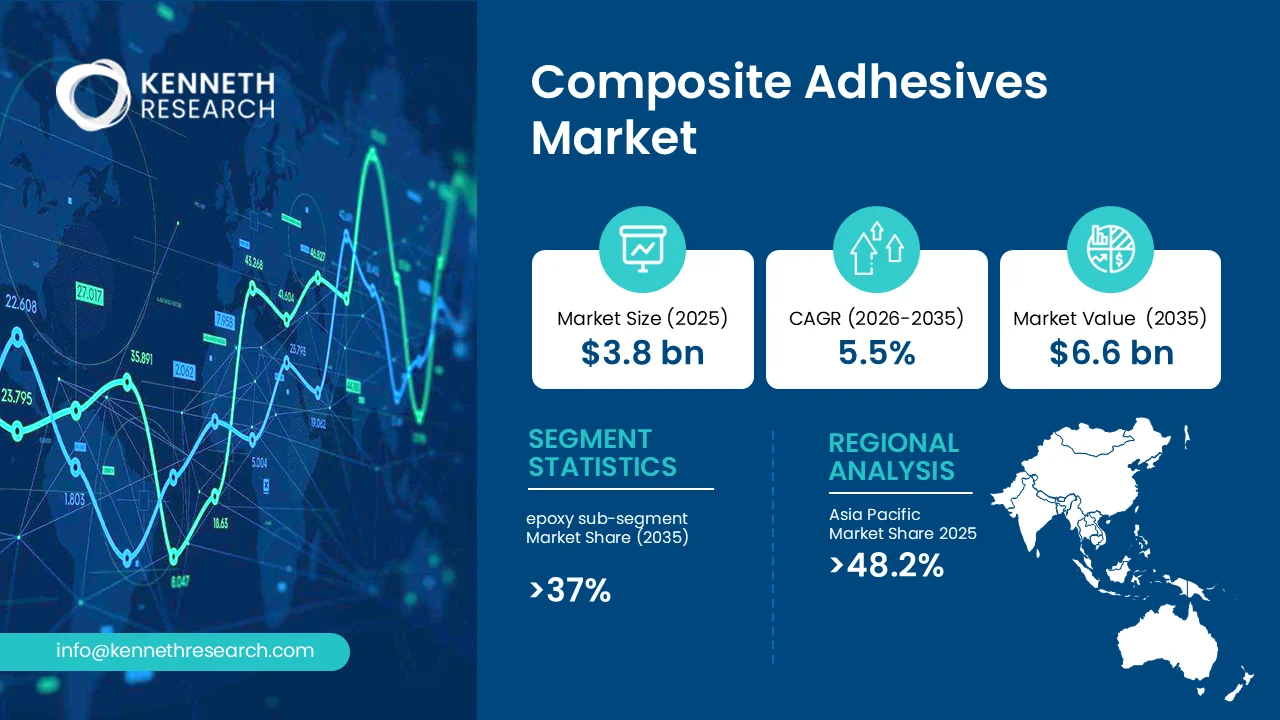
Composite Adhesives Market size was valued at USD 3.8 billion in 2025 and is projected to reach USD 6.6 billion by the end of 2035, rising at a CAGR of 5.5% during the forecast period, i.e., 2026-2035. In 2026, the industry size of the composite adhesives is estimated at USD 4.1 billion.
The primary growth driver for the composite adhesives market is the increasing use of lightweight composite materials across transportation, aerospace, wind energy, and industrial manufacturing. As manufacturers seek stronger, corrosion-resistant, and durable bonded assemblies while reducing mechanical fastening, demand for high-performance structural adhesive technologies continues to expand across advanced engineering applications.
The composite adhesives market comprises adhesive formulations specifically designed to bond composite materials, including carbon fiber-reinforced polymers, glass fiber-reinforced plastics, aramid composites, and hybrid engineered materials. These adhesives are formulated to deliver high mechanical strength, fatigue resistance, impact durability, and environmental stability while maintaining structural integrity under demanding operating conditions. Common chemistries include epoxy, polyurethane, acrylic, and other high-performance resin systems developed for structural and semi-structural bonding applications.
Composite adhesives play a critical role in modern manufacturing by replacing conventional fastening methods such as welding, riveting, and bolting, enabling lighter assemblies with improved stress distribution and enhanced design flexibility. They are widely used in automotive, aerospace, marine, wind energy, construction, electronics, and industrial equipment manufacturing, where reliable bonding of dissimilar materials is essential. Their ability to improve durability, corrosion resistance, vibration damping, and manufacturing efficiency makes them an integral component of advanced composite structures. As industries continue adopting lightweight engineering materials to improve product performance, energy efficiency, and lifecycle reliability, composite adhesives remain an indispensable enabling technology for next-generation manufacturing solutions.
Key Composite Adhesives Market Insights Summary:
Key Takeaways: Market Trends & Insights
- Composite Adhesives Market projected to grow from USD 3.8 billion in 2025 to USD 6.6 billion by 2035 at a 5.5% CAGR.
- Asia Pacific accounted for the largest regional share at 48.2% in 2025, supported by its extensive composite manufacturing ecosystem, strong industrial base, and continued investments in advanced manufacturing across Japan and China.
- Epoxy is expected to remain the leading Product segment with a 37% market share, driven by its superior structural bonding strength, durability, and widespread adoption in aerospace, automotive, wind energy, and industrial composite applications.
- Automotive & Transportation is projected to witness significant growth as manufacturers increasingly adopt lightweight composite materials and structural adhesive technologies to improve vehicle efficiency, durability, and manufacturing flexibility.
- The market is benefiting from increasing demand for lightweight engineered structures, expansion of renewable energy and advanced manufacturing industries, and continuous innovation in high-performance structural adhesive technologies.
Market Drivers
- Growing deployment of composite materials in wind energy infrastructure and renewable energy equipment.
- Rising demand for durable bonding solutions in aerospace and defense manufacturing.
- Continuous advancements in high-performance epoxy, polyurethane, and acrylic adhesive formulations.
- Increasing emphasis on corrosion-resistant and maintenance-efficient bonded structures across industrial applications.
Challenges
- Complex qualification and certification requirements for structural bonding applications.
- Processing sensitivity and manufacturing integration constraints.
Composite Adhesives Market Overview & Supply chain
The adoption of composite adhesives is increasing globally as manufacturers accelerate the use of lightweight, high-strength composite materials to improve product performance, energy efficiency, and durability. Structural adhesives enable the bonding of dissimilar substrates while reducing component weight, improving fatigue resistance, and simplifying complex assembly processes. These capabilities have made them increasingly important across aerospace, automotive, renewable energy, marine, and industrial equipment manufacturing. Their relevance has also strengthened with the expansion of clean-energy infrastructure, particularly wind energy, where composite materials and structural adhesives are integral to rotor blade manufacturing and assembly. According to the International Energy Agency, global investment in the manufacturing of clean energy technologies reached USD 200 billion in 2023, reflecting the rapid expansion of industries that depend on advanced composite manufacturing and high-performance bonding technologies. This industrial momentum continues to reinforce demand for composite adhesives across multiple end-use sectors.
The composite adhesives value chain begins with the procurement of specialty chemical feedstocks, including epoxy resins, polyurethane precursors, acrylic monomers, curing agents, hardeners, fillers, toughening additives, and performance modifiers supplied by chemical manufacturers. These raw materials are formulated through controlled mixing, polymerization, quality testing, and packaging processes to produce structural adhesive systems tailored for composite bonding applications. Manufacturers collaborate closely with composite fabricators, original equipment manufacturers (OEMs), and engineering teams to customize formulations according to mechanical, thermal, and environmental performance requirements. Finished products are distributed through direct industrial sales channels, regional distributors, specialty chemical suppliers, and technical service networks that support application development and process optimization. End users include aerospace manufacturers, automotive producers, wind turbine manufacturers, marine equipment builders, construction companies, and industrial machinery manufacturers. Key stakeholders throughout the value chain include raw material suppliers, adhesive formulators, composite component manufacturers, OEMs, distributors, certification bodies, and aftermarket maintenance providers.
Composite Adhesives Market: Growth Drivers & Challenges
Growth Drivers:
- Expanding adoption of lightweight composite structures across transportation and industrial manufacturing: The increasing adoption of lightweight composite materials across transportation, aerospace, marine, and industrial equipment manufacturing is a major driver for the composite adhesives market. As manufacturers seek to improve fuel efficiency, operational performance, and component durability, structural adhesives are increasingly replacing conventional joining methods such as welding, riveting, and bolting. Composite adhesives distribute stresses more uniformly, reduce localized material fatigue, and enable reliable bonding between dissimilar materials without compromising structural integrity. This capability supports greater design flexibility while simplifying assembly processes for complex engineered components. Product innovation is also reinforcing market expansion. For example, Sika continues to expand its portfolio of structural adhesive technologies specifically designed for composite systems, including solutions that provide high shear strength, fatigue resistance, and compatibility with automated manufacturing processes for composite assemblies. These developments are expected to accelerate the adoption of advanced bonding technologies across high-performance manufacturing industries.
- Increasing automation and high-performance manufacturing requirements: The transition toward automated manufacturing and precision assembly is creating sustained demand for advanced composite adhesive technologies. Modern production facilities require bonding solutions that provide consistent application, predictable curing behavior, and compatibility with robotic dispensing systems while maintaining high structural performance. Composite adhesives help manufacturers reduce assembly complexity, improve dimensional accuracy, and minimize post-processing operations, thereby supporting higher production efficiency and product quality. Their ability to join multiple substrate combinations also enables greater engineering flexibility as manufacturers integrate metals, polymers, and fiber-reinforced composites within a single assembly. Looking ahead, continued investment in digital manufacturing, automated inspection, and advanced composite processing is expected to increase the importance of adhesives engineered for rapid processing, enhanced durability, and long-term reliability. As industrial production shifts toward smarter and more resource-efficient manufacturing, composite adhesives will remain a critical enabling technology for next-generation engineered products.
Challenges:
- Complex qualification and certification requirements for structural bonding applications: One of the most significant restraints affecting the composite adhesives market is the extensive qualification and certification process required for structural bonding applications. Adhesives intended for use in aerospace, automotive safety components, marine structures, and other critical engineering systems must undergo rigorous mechanical, thermal, environmental, and durability validation before commercial adoption. The qualification process often varies by industry, customer specifications, and regional regulatory requirements, increasing development timelines and engineering costs. For adhesive manufacturers, repeated testing, documentation, and customer-specific approvals delay product commercialization and slow portfolio expansion. End users are also cautious about replacing established bonding systems because requalification can interrupt production schedules and increase compliance costs. As composite applications become more sophisticated, certification requirements are expected to become increasingly stringent, encouraging manufacturers to invest in advanced testing capabilities and collaborative product development while extending commercialization cycles.
- Processing sensitivity and manufacturing integration constraints: Composite adhesives require tightly controlled processing conditions to consistently achieve their designed structural performance, making manufacturing integration a persistent challenge. Bond quality is influenced by substrate preparation, surface cleanliness, adhesive mixing accuracy, dispensing precision, curing temperature, humidity, and production timing. Variations in any of these parameters can affect bond integrity, resulting in additional inspection, rework, or rejected components. Integrating adhesive bonding into existing production lines often requires specialized dispensing equipment, curing infrastructure, workforce training, and process validation, creating higher implementation costs for manufacturers transitioning from conventional fastening techniques. These operational complexities can discourage adoption among organizations with limited technical resources or legacy manufacturing systems. Looking ahead, improvements in automated dispensing technologies, simplified curing systems, and process-monitoring solutions are expected to reduce integration challenges, although manufacturing consistency will remain a key competitive factor.
Composite Adhesives Market Size and Forecast:
| Report Attribute | Details |
|---|---|
| Base Year |
2025 |
| Forecast Year |
2026-2035 |
| CAGR |
5.5% |
| Base Year Market Size (2025) |
USD 3.8 billion |
| Forecast Year Market Size (2035) |
USD 6.6 billion |
| Regional Scope |
|
Composite Adhesives Market Segmentation Analysis:
Product Segment Analysis
In the product segment, the epoxy sub-segment is anticipated to capture the largest market share of 37% by the end of 2035.
The epoxy segment leads the composite adhesives market owing to its superior structural bonding performance, high mechanical strength, excellent adhesion to fiber-reinforced composites, and long-term resistance to fatigue, chemicals, and harsh environmental conditions. These characteristics make epoxy adhesives the preferred choice for demanding applications in aerospace, automotive, wind energy, marine, and industrial equipment manufacturing, where structural reliability is critical. Current demand is supported by the increasing production of advanced composite components that require durable bonding solutions capable of maintaining performance under dynamic loading conditions. On the supply side, adhesive manufacturers continue to invest in formulation improvements that enhance toughness, curing flexibility, and compatibility with automated manufacturing processes, enabling wider adoption in high-volume production environments. Demand is also reinforced by continued investment in composite-intensive industries. According to the U.S. Department of Energy, the United States has more than 500 manufacturing facilities specializing in wind components such as blades, towers, generators, and turbine assembly, highlighting the growing industrial ecosystem that relies heavily on composite materials and structural epoxy bonding technologies. Looking ahead, continued advances in composite engineering, automated manufacturing, and lightweight product design are expected to further strengthen the segment's leadership.
Automotive & Transportation Segment Analysis
The Automotive & Transportation segment is projected to witness strong growth as manufacturers increasingly rely on composite materials to reduce vehicle weight, improve structural performance, and enhance energy efficiency. Composite adhesives enable the reliable bonding of lightweight materials such as carbon fiber composites, aluminum, and engineered plastics without introducing stress concentrations associated with mechanical fasteners. Their use also supports streamlined assembly processes, improved corrosion resistance, and greater design flexibility for next-generation vehicles. On the supply side, adhesive manufacturers are developing faster-curing, automation-compatible formulations that integrate efficiently with high-volume vehicle production while meeting demanding durability and crash-performance requirements. Continued investments in advanced manufacturing and vehicle electrification are further strengthening demand for structural bonding technologies. According to Innovation, Science and Economic Development Canada, more than 1.31 million light-duty vehicles were assembled in Canada in 2024, supported by a domestic network of nearly 700 automotive parts suppliers, reflecting the scale of modern vehicle manufacturing that increasingly depends on advanced material joining technologies. Looking ahead, broader adoption of multi-material vehicle architectures and automated production systems is expected to sustain the segment's long-term growth.
Our in-depth analysis of the global composite adhesives market includes the following segments:
|
Segment |
Sub-segment |
|
Product |
|
|
Application |
|
|
Composite Type |
|
|
Technology |
|
|
End user |
|
Composite Adhesives Market Regional Insights:
Asia Pacific Market Trends & Insights:
Asia Pacific accounted for the largest regional share of 48.2% in 2025, supported by its extensive manufacturing base, well-established composite materials ecosystem, and strong presence across automotive, aerospace, electronics, marine, and renewable energy industries.
The region benefits from significant investments in advanced manufacturing, increasing production of lightweight engineered components, and continued expansion of industrial infrastructure. Government initiatives promoting high-value manufacturing, clean-energy technologies, and industrial modernization have further accelerated the adoption of composite materials, creating sustained demand for high-performance structural adhesives. In addition, the concentration of composite fabricators, adhesive manufacturers, and original equipment manufacturers (OEMs) strengthens regional supply chains and enables efficient commercialization of advanced bonding technologies. According to Japan's Ministry of Economy, Trade and Industry (METI), its Current Survey of Production continuously monitors production across key manufacturing industries—including transport machinery, manufactured chemical products, plastics, machinery, and precision equipment—highlighting the region's broad industrial foundation that supports demand for composite adhesive technologies.
Japan remains a technology-driven market characterized by advanced capabilities in precision manufacturing, automotive engineering, aerospace components, and specialty materials. Continuous investment in industrial innovation and high-performance manufacturing supports the use of structural composite adhesives in demanding applications requiring durability and reliability. China complements this leadership through its large-scale manufacturing capacity, integrated supply chains, and expanding production of electric vehicles, wind energy equipment, rail transportation systems, and industrial machinery. The country's emphasis on advanced materials and manufacturing modernization continues to encourage wider adoption of composite bonding solutions. Together, Japan's technological expertise and China's manufacturing scale provide Asia Pacific with a highly competitive ecosystem for composite adhesive development, production, and commercialization, reinforcing the region's long-term leadership in the global market.
North America Market Trends & Insights:
North America represents a strategically important region for the composite adhesives market due to its mature manufacturing ecosystem, strong research and development capabilities, and widespread adoption of advanced composite materials across multiple industries. Demand is driven by the continued use of structural adhesives in aerospace, automotive, defense, wind energy, marine, and industrial equipment manufacturing, where high-performance bonding solutions are essential for lightweight and durable assemblies. The region also benefits from close collaboration between adhesive formulators, composite material suppliers, original equipment manufacturers, and research institutions, enabling rapid commercialization of innovative adhesive technologies. Government initiatives supporting domestic manufacturing, clean-energy deployment, infrastructure modernization, and advanced materials research are expected to create additional opportunities for composite adhesive applications. Looking ahead, increasing automation, digital manufacturing, and the transition toward multi-material product designs are likely to reinforce long-term demand for high-performance structural bonding solutions throughout the region.
The United States remains the largest contributor within North America, supported by its extensive aerospace, defense, automotive, and renewable energy manufacturing industries. Continuous investment in advanced manufacturing technologies and composite-intensive production processes encourages the development and adoption of specialized adhesive systems for structural applications. Strong collaboration among industrial manufacturers, technology developers, and material science organizations further strengthens innovation across the value chain.
Canada complements regional growth through its established automotive manufacturing sector, expanding aerospace industry, and increasing emphasis on sustainable industrial production. The country's expertise in advanced materials engineering and its integration with North American manufacturing supply chains support wider adoption of composite adhesives across transportation, industrial machinery, and infrastructure-related applications. Together, these factors position North America as a key innovation and production hub for next-generation composite bonding technologies.
Leading Companies Operating in the Global Composite Adhesives Market:
Here is a list of upstream, downstream, and key players operating in the global composite adhesives market competitive ecosystem:
- Henkel AG & Co. KGaA(Germany)
- Company Overview
- Business Strategy
- Key Product Offerings
- Financial Performance
- Key Performance Indicators
- Risk Analysis
- Recent Development
- Regional Presence
- SWOT Analysis
- Sika AG(Switzerland)
- 3M(United States)
- Huntsman Corporation(United States)
Recent Developments
- March 2025: H.B. Fuller Launched the Millennium PG-1 EF ECO₂ commercial roofing adhesive featuring ECO₂ Driven™ propellant technology that eliminates conventional chemical blowing agents.
- January 2025: Sika AG Announced record 2024 sales and confirmed investments in new manufacturing plants in China, Indonesia, and Peru, expanding production capacity for construction and industrial adhesive solutions.
- November 2024: Henkel partnered with Celanese to manufacture water-based adhesives using carbon capture-derived methanol, incorporating captured CO₂ into adhesive production.
Frequently Asked Question
In 2025, the composite adhesives market exceeded USD 3.8 billion.
The composite adhesives market is projected to reach USD 6.6 billion by the end of 2035, expanding at a CAGR of 5.5% over the forecast period (2026-2035).
The major players in the market are Henkel AG & Co. KGaA, Sika AG, 3M, Huntsman Corporation, H.B. Fuller Company, Arkema (Bostik), Permabond LLC, Parson Adhesives, Inc., and others.
In the product segment, the epoxy sub-segment is anticipated to capture the largest market share of 37% in the future and exhibit lucrative growth opportunities during 2026-2035. This growth trajectory is largely attributed to the increasing adoption of lightweight composite materials across transportation, aerospace, wind energy, and industrial manufacturing, where high-strength structural bonding solutions are essential.
Asia Pacific is projected to hold the largest market share of 48.2% by the end of 2035 and provide more business opportunities in the future. Continuous investments in advanced manufacturing, composite engineering, and industrial modernization across Japan and China are fostering the region's dominance.
Why Choose Kenneth Research ?
-
Insight with Impact : We don’t just gather data — we uncover stories, trends, and opportunities that fuel business growth.
-
Experts Who Get It : Our team speaks your industry’s language and knows what really matters to your customers and market.
-
Custom-Built for You : Forget one-size-fits-all. We craft research and consulting solutions as unique as your business vision.
-
Partners, Not Just Providers : We work with you, not for you — collaborating closely to turn insights into smart, strategic moves.
-
Results That Speak : Our work powers brands, startups, and industry leaders alike — with a track record of ideas that work in the real world.
Report ID: 1119 |
Published Date: 20 Aug 2026 |
Report Format: |
Delivery Timeline: 48-72 Business Hours

Copyright © 2025 Kenneth Research. All rights reserved. Terms of Use | Privacy Policy
