Report ID: 1457 |
Published Date: 29 Sep 2026 |
Report Format: |
Delivery Timeline: 48-72 Business Hours
Commercial Security Market Outlook:
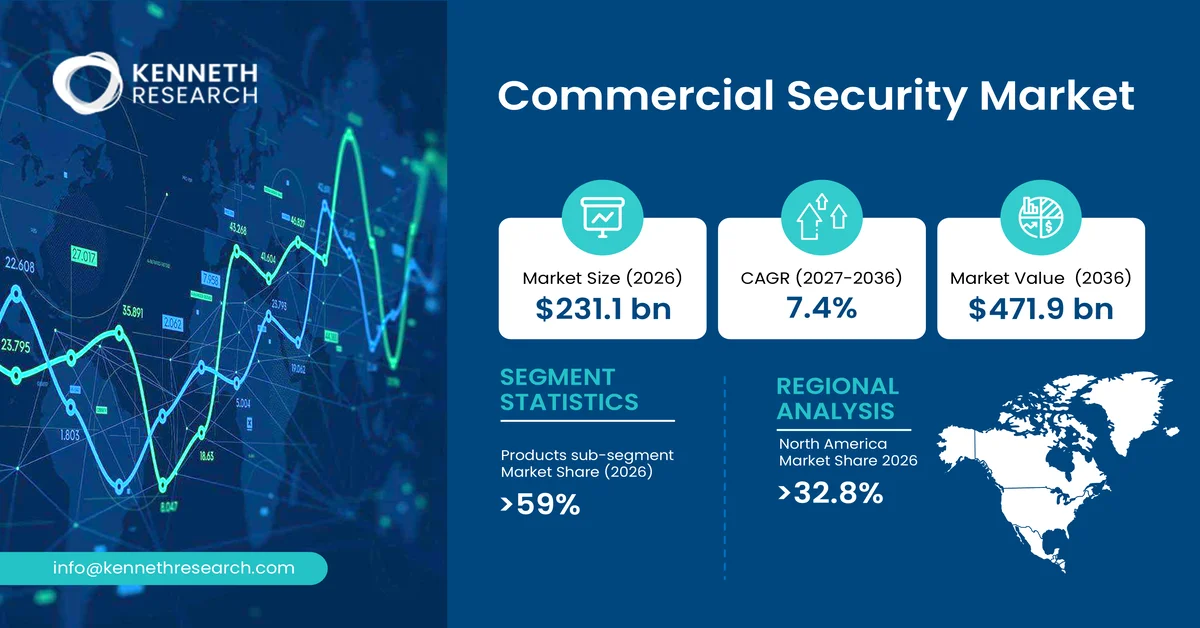
Commercial security market size was valued at USD 231.1 billion in 2026 and is projected to reach USD 471.9 billion by the end of 2036, rising at a CAGR of 7.4% during the forecast period, i.e., 2027–2036. In 2027, the industry size of the commercial security market is estimated at USD 248.2 billion.
The primary growth driver for the commercial security market is the increasing need to protect businesses against evolving physical and digital threats.
The commercial security market comprises products, systems, and services designed to protect commercial facilities, personnel, assets, information, and business operations from physical and security-related threats. It includes security products such as surveillance cameras, access control systems, intrusion detection equipment, alarms, security screening systems, and related technologies, along with services such as system integration, installation, monitoring, maintenance, and security management.
Key characteristics of the commercial security market include technology-enabled threat detection, continuous monitoring, controlled facility access, video surveillance, identity verification, alarm management, and integration of multiple security functions through centralized platforms.
Key Commercial Security Market Insights Summary:
Key Takeaways: Market Trends & Insights
- Commercial Security Market is projected to grow from USD 231.1 billion in 2026 to USD 471.9 billion by 2036 at a 7.4% CAGR
- North America accounted for the largest regional share at 32.8% in 2026, supported by established security infrastructure, facility modernization, and continued investment in surveillance and access-control technologies
- Products is expected to remain the leading by component segment with a 59.0% market share in 2026, driven by sustained demand for surveillance, access control, intrusion detection, and other security equipment
- System Integration & Installation Services is expected to witness continued growth as commercial organizations increasingly require customized deployment, integration, configuration, and maintenance of interconnected security systems
Market Drivers
- Government-led strengthening of facility security standards
- Integration of connected and intelligent security technologies
- Modernization of legacy surveillance and access-control infrastructure
- Rising demand for centralized security management across distributed commercial facilities
Challenges
- Integration Complexity and Legacy Infrastructure
- Data Management, Privacy, and Cybersecurity Requirements
Commercial Security Market - Market Overview & Supply Chain
The commercial security market is expanding as businesses increasingly prioritize protection of facilities, employees, equipment, inventory, and operational infrastructure. Adoption is supported by the growing use of surveillance, access control, intrusion detection, alarm systems, and integrated security platforms across offices, retail facilities, industrial sites, financial institutions, warehouses, and other commercial environments. The convergence of physical security with connected technologies is also improving centralized monitoring, real-time threat detection, and security management across geographically distributed facilities.
The commercial security market value chain begins with inputs including cameras, sensors, access-control hardware, alarm components, networking equipment, embedded electronics, software, and other technology inputs. Manufacturers transform these inputs into finished surveillance, access-control, intrusion detection, screening, and security management products. System integrators and installation providers combine products into customized security infrastructure based on facility requirements.
Commercial Security Market: Growth Drivers & Challenges
Growth Drivers
- Government-Led Strengthening of Facility Security Standards: Government requirements for physical security are supporting demand for commercial security products by encouraging organizations to deploy standardized surveillance, intrusion detection, and access-control infrastructure. Such requirements reinforce the importance of integrated security infrastructure and can influence procurement practices beyond government facilities by establishing clearer expectations for facility protection. For manufacturers, this environment supports demand for interoperable cameras, intrusion detection equipment, access-control technologies, and associated management systems.
- Integration of Connected and Intelligent Security Technologies: Commercial facilities are increasingly adopting connected security technologies that combine surveillance, access control, intrusion detection, analytics, and centralized management. The integration of these functions allows security teams to coordinate information from multiple systems, improve incident visibility, and manage facilities more efficiently. Cloud connectivity, networked cameras, biometric identification, intelligent sensors, and software-based security management are further broadening the capabilities of commercial security infrastructure.
Challenges
- Integration Complexity and Legacy Infrastructure: Many commercial facilities operate security equipment installed at different times and from different manufacturers. Integrating legacy cameras, access-control systems, alarms, sensors, and management platforms can create compatibility and interoperability challenges. Replacement may also require significant installation work, network modifications, system testing, and operational downtime. These requirements can lengthen procurement cycles and increase the complexity of deployment.
- Data Management, Privacy, and Cybersecurity Requirements: Connected commercial security systems generate and transmit substantial amounts of sensitive information, including video footage, access records, identity information, and incident data. Organizations therefore need to address data governance, privacy, cybersecurity, retention, and authorized-access requirements alongside physical security objectives. Increasing connectivity can also expand the potential attack surface of security infrastructure.
Commercial Security Market Size and Forecast:
| Report Attribute | Details |
|---|---|
| Base Year |
2026 |
| Forecast Year |
2027-2036 |
| CAGR |
7.4% |
| Base Year Market Size (2026) |
USD 231.1 billion |
| Forecast Year Market Size (2036) |
USD 471.9 billion |
| Regional Scope |
|
Commercial Security Market: Largest Segment Analysis
Product Type Segment Analysis
In the component segment, the Products sub-segment is anticipated to capture the largest market share of 59% in 2026.
Demand is supported by the continuing need for physical protection across commercial buildings, retail establishments, industrial facilities, offices, financial institutions, and other business premises. Security cameras, access-control equipment, alarms, intrusion detection systems, screening equipment, and related hardware form the foundational infrastructure required to monitor facilities and control access.
On the supply side, manufacturers are increasingly developing connected and interoperable products that can integrate with centralized security-management platforms. Future demand is expected to benefit from modernization of legacy equipment, expansion of connected surveillance, and greater adoption of integrated facility-security architectures.
Service Type Segment Analysis
In the By Service Type segment, the System Integration & Installation Services sub-segment is projected to grow as commercial organizations increasingly require coordinated deployment of surveillance, access control, intrusion detection, alarms, and other security technologies. Businesses operating multiple facilities often require customized system architecture, equipment configuration, network integration, testing, commissioning, and installation rather than standalone product purchases.
On the supply side, system integrators can combine products from multiple manufacturers and tailor deployments to individual facility requirements. Installation providers additionally support configuration, system testing, maintenance, and upgrades. As commercial facilities modernize legacy infrastructure and adopt connected security architectures, demand for integration and installation expertise is expected to expand.
Our in-depth analysis of the global commercial security market includes the following segments:
|
Segment |
Sub-segment |
|
Component |
|
|
System Type |
|
|
End User |
|
|
Service Type |
|
Commercial Security Market - Regional Analysis
North America Market Trends & Insights:
North America is the dominant region in the commercial security market, accounting for 32.8% in 2026.
Regional leadership is supported by established security infrastructure, high adoption of surveillance and access-control technologies, and continued investment in protecting commercial, institutional, and government facilities. The region also benefits from a mature ecosystem of security-product manufacturers, technology providers, system integrators, and installation specialists.
In the U.S., demand is supported by modernization of physical security infrastructure and the need to strengthen access management, surveillance, screening, and facility monitoring. Federal security requirements can also encourage broader adoption of interoperable and technologically advanced security solutions across institutional environments.
In Canada, physical security remains an important element of the government's broader security framework for protecting people, information, and physical assets.
Asia-Pacific Market Trends & Insights:
Asia-Pacific represents an important growth market for the commercial security market, supported by expanding commercial infrastructure, industrial activity, urban development, and increasing requirements for facility protection. Businesses across the region are adopting surveillance, access control, intrusion detection, and integrated security-management technologies to protect commercial premises and operational assets.
In Japan, demand is supported by the modernization of connected infrastructure and increasing emphasis on cybersecurity, secure information systems, and coordinated protection of government and organizational networks. The country’s policy direction creates opportunities for security technology providers offering integrated and technologically advanced solutions.
In China, commercial security demand benefits from extensive industrial and infrastructure activity and continued development of digital security capabilities. Government policy emphasizes strengthening security alongside economic and infrastructure development.
Commercial Security Market Competitive Landscape
Here is a list of upstream, downstream, and key players operating in the global commercial security market competitive ecosystem:
- Johnson Controls (U.S.)
- Company Overview
- Business Strategy
- Key Product Offerings
- Financial Performance
- Key Performance Indicators
- Risk Analysis
- Recent Development
- Regional Presence
- SWOT Analysis
- Honeywell (U.S.)
- Axis Communications (Sweden)
- Dormakaba (Germany)
- Hikvision (China)
Recent Developments
- September 2026 —Johnson Controls introduced updates to its commercial security portfolio, including exacqVision 26.2 and Software House C•CURE IQ 3.20, alongside managed security services and proactive video solutions. The company highlighted AI-driven insights, centralized monitoring, incident-response capabilities, and cloud-enabled access control.
- September 2026 —Honeywell announced the deployment of its LenelS2 OnGuard access-control system for the U.S. Marine Corps' Barracks 2030 modernization initiative. The centrally managed platform enables remote access-permission management and activity monitoring across participating installations.
Frequently Asked Question
In 2026, the commercial security market exceeded USD 231.1 billion.
The commercial security market is projected to reach USD 471.9 billion by the end of 2036, expanding at a CAGR of 7.4% over the forecast period (2027-2036).
The major players in the market are Johnson Controls, Honeywell, Axis Communications, dormakaba, and others.
In the component segment, the products sub-segment is anticipated to capture the largest market share of 59.0% in the future and exhibit lucrative growth opportunities during 2027-2036.
North America is projected to hold the largest market share of 32.8% by the end of 2026 and provide more business opportunities in the future.
Why Choose Kenneth Research ?
-
Insight with Impact : We don’t just gather data — we uncover stories, trends, and opportunities that fuel business growth.
-
Experts Who Get It : Our team speaks your industry’s language and knows what really matters to your customers and market.
-
Custom-Built for You : Forget one-size-fits-all. We craft research and consulting solutions as unique as your business vision.
-
Partners, Not Just Providers : We work with you, not for you — collaborating closely to turn insights into smart, strategic moves.
-
Results That Speak : Our work powers brands, startups, and industry leaders alike — with a track record of ideas that work in the real world.
Report ID: 1457 |
Published Date: 29 Sep 2026 |
Report Format: |
Delivery Timeline: 48-72 Business Hours

Copyright © 2025 Kenneth Research. All rights reserved. Terms of Use | Privacy Policy
