Report ID: 1162 |
Published Date: 25 Aug 2026 |
Report Format: |
Delivery Timeline: 48-72 Business Hours
Commercial Battery Energy Storage As a Service Market Outlook:
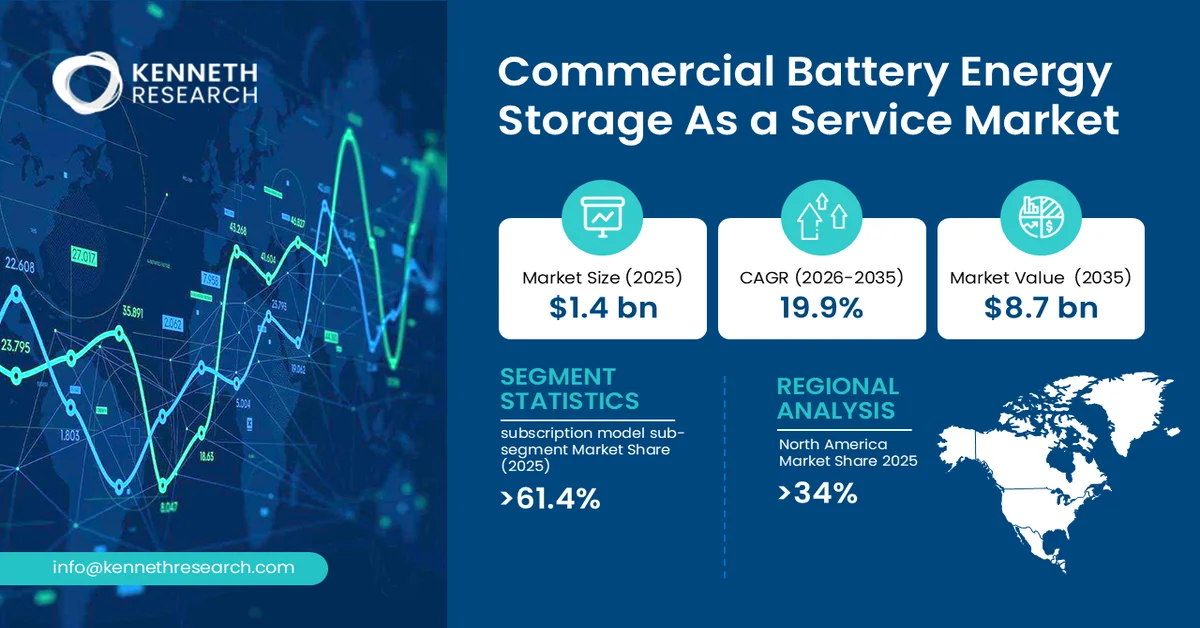
Commercial Battery Energy Storage As a Service Market size was valued at USD 1.4 billion in 2025 and is projected to reach USD 8.7 billion by the end of 2035, rising at a CAGR of 19.9% during the forecast period, i.e., 2026-2035. In 2026, the industry size of the commercial battery energy storage as a service is estimated at USD 1.7 billion.
The primary growth driver is increasing commercial demand for flexible energy-management solutions without the upfront burden of owning and operating battery systems. Energy-as-a-service models allow providers to finance, install, operate, and maintain storage assets while customers access demand management, backup power, and energy-cost optimization through contracted service arrangements.
The Commercial Battery Energy Storage As a Service Market comprises service-based business models through which commercial customers obtain battery energy storage capabilities without necessarily purchasing, financing, and managing the underlying storage assets themselves. Service providers can assume responsibilities spanning system design, financing, installation, ownership, operation, maintenance, monitoring, and performance management, with customers paying through contracted service arrangements. The model is particularly relevant to commercial facilities seeking to improve electricity-cost management, manage demand, provide backup power, integrate renewable generation, and increase operational resilience while limiting upfront capital requirements.
Key Commercial Battery Energy Storage As a Service Market Insights Summary:
Key Takeaways: Market Trends & Insights
- Commercial Battery Energy Storage As a Service Market projected to grow from USD 1.4 billion in 2025 to USD 8.7 billion by 2035 at a 19.9% CAGR.
- North America accounted for the largest regional share at 34% in 2025, supported by mature energy-service infrastructure, commercial storage adoption, and growing demand for flexible energy management across the U.S. and Canada.
- Subscription Model is expected to remain the leading Service Type segment with a 61.4% share, driven by commercial customers' preference for predictable service costs and reduced upfront capital requirements.
- Behind-the-Meter (BTM) deployment is gaining momentum as businesses seek to manage peak electricity demand, improve power resilience, integrate distributed renewable generation, and optimize on-site energy consumption.
Market Drivers
- Growing demand for flexible commercial energy management
- Increasing adoption of behind-the-meter storage
- Rising integration of renewable energy with commercial facilities
- Increasing preference for low-capital energy-service models
Challenges
- Financing and revenue uncertainty for service-based storage projects
- Complex regulatory, permitting, and utility-market requirements
Commercial Battery Energy Storage As a Service Market: Market Overview & Supply Chain
Commercial adoption of battery energy storage is increasing as businesses seek greater control over electricity consumption, resilience, renewable-energy integration, and operating costs without committing substantial capital to storage ownership. The International Energy Agency reported that battery storage deployment in the power sector more than doubled year-on-year in 2023, with growth occurring across utility-scale and behind-the-meter applications. This expanding deployment base strengthens the relevance of service-based models, as commercial customers can access storage functionality while specialized providers manage financing, system operation, maintenance, monitoring, and optimization.
The value chain begins with battery-cell and module manufacturers, power-conversion equipment suppliers, energy-management technology providers, and system integrators supplying the hardware and software required for commercial storage installations. Service providers then combine these technologies with financing, engineering, installation, monitoring, maintenance, and energy-management capabilities to create an integrated as-a-service offering. Depending on the commercial model, the provider may own or finance the storage asset while managing its operation throughout the contracted period. Distribution occurs primarily through direct provider-to-business relationships, energy-service companies, utilities, developers, and specialized project partners.
Commercial Battery Energy Storage As a Service Market: Growth Drivers & Challenges
Growth Drivers:
- Rising demand for flexible commercial energy management: Growing demand for flexible electricity management is strengthening the commercial case for battery storage as a service. Businesses can use contracted storage capacity to shift electricity consumption, manage peak loads, improve resilience, and participate in demand-response programs without taking full responsibility for asset ownership and operation. The U.S. Department of Energy explains that demand flexibility enables facilities to reduce or shift electricity use during specific periods and participate in programs offered by utilities and grid operators.
- Increasing adoption of behind-the-meter storage: Behind-the-meter battery deployment is creating a larger addressable opportunity for service-based commercial storage models. Businesses can use on-site batteries to manage electricity consumption, support renewable-energy integration, provide backup capability, and improve operational flexibility. The International Energy Agency identifies behind-the-meter batteries as an increasingly important application as battery costs decline and renewable electricity penetration rises
Challenges:
- Financing and revenue uncertainty for service-based storage projects: A major restraint is the difficulty of securing financing for commercial storage-as-a-service projects when future revenues depend on electricity tariffs, demand-management opportunities, grid programs, and customer usage patterns. The U.S. Department of Energy identifies lack of debt financing caused by perceived technical risk and unpredictable cash flows as a barrier to deploying energy-storage technologies at scale. For service providers, this can increase the cost of capital and make long-term contracts more difficult to structure, particularly when customers expect predictable subscription payments while project economics remain exposed to changing electricity-market conditions.
- Complex regulatory, permitting, and utility-market requirements: Regulatory and market complexity can slow deployment because commercial BESS projects must navigate interconnection requirements, local permitting, safety rules, utility tariffs, and varying market-access conditions. These requirements can differ substantially between jurisdictions, creating additional development costs and extending project timelines. The U.S. Department of Energy has identified regulatory hurdles as an issue for energy-storage deployment and has pursued measures intended to reduce costs and delays associated with environmental review for certain storage projects.
Commercial Battery Energy Storage As a Service Market Size and Forecast:
| Report Attribute | Details |
|---|---|
| Base Year |
2025 |
| Forecast Year |
2026-2035 |
| CAGR |
19.9% |
| Base Year Market Size (2025) |
USD 1.4 billion |
| Forecast Year Market Size (2035) |
USD 8.7 billion |
| Regional Scope |
|
Commercial Battery Energy Storage As a Service Market Segmentation Analysis:
Service Type Segment Analysis
In the service type segment, the subscription model sub-segment is anticipated to capture the largest market share of 61.4% by the end of 2025.
In the Service Type segment, the Subscription Model is anticipated to remain the leading sub-segment, supported by commercial customers' preference for predictable service arrangements rather than direct ownership of complex battery assets. Subscription structures can bundle storage access with financing, monitoring, maintenance, software optimization, and performance management, reducing the operational burden placed on facility owners. Demand is also supported by the growing role of behind-the-meter storage in commercial energy management, where batteries can help manage loads, improve resilience, and coordinate with on-site generation. The U.S. Department of Energy's 2024 Beyond the Meter Energy Storage Integration Prize specifically sought innovations that could help consumers unlock the value of behind-the-meter storage and gain greater control over energy use and bills.
Deployment Mode Segment Analysis
The Behind-the-Meter (BTM) deployment segment is projected to grow as commercial customers increasingly use on-site battery systems to manage electricity demand, improve resilience, integrate distributed renewable generation, and optimize energy consumption. BTM systems allow storage assets to operate directly alongside commercial loads, enabling service providers to tailor contracts around facility-specific energy-management requirements. Industry adoption is supported by the increasing recognition of distributed storage as a tool for improving grid flexibility and accommodating renewable generation. China's National Development and Reform Commission and National Energy Administration identified energy storage and intelligent dispatch as key measures for improving power-system flexibility and supporting large-scale renewable-energy development.
Our in-depth analysis of the global Commercial Battery Energy Storage As a Service Market includes the following segments:
|
Segment |
Sub-segment |
|
Service Type |
|
|
Deployment Mode |
|
|
Enterprise Size |
|
|
Industry Vertical |
|
Commercial Battery Energy Storage As a Service Market Regional Insights:
North America Market Trends & Insights:
North America accounted for 34% of the Commercial Battery Energy Storage As a Service Market in 2025, supported by mature energy-service ecosystems, expanding battery-storage deployment, grid modernization, and strong commercial interest in flexible energy management. The region benefits from established financing, energy-management, utility, and technology-provider networks that facilitate service-based storage models. In the U.S., battery storage capacity continued to expand rapidly, with the U.S. Energy Information Administration reporting that cumulative utility-scale battery storage capacity exceeded 26 GW in 2024. This expanding storage ecosystem strengthens opportunities for providers offering subscription-based financing, operation, monitoring, and optimization.
U.S. is the principal regional market, supported by substantial battery-storage deployment and growing demand for flexible electricity management among commercial and industrial customers. Federal initiatives are also encouraging behind-the-meter energy-storage innovation; the U.S. Department of Energy reopened its Beyond the Meter Prize in 2026 to accelerate consumer-focused integration of BTM resources and storage systems.
Canada provides additional opportunities through grid modernization, renewable-energy integration, and growing interest in distributed storage. Together, the U.S. and Canada offer favorable conditions for service providers combining battery assets with financing, energy management, and long-term operational services.
Asia Pacific Market Trends & Insights:
Asia Pacific is emerging as an important growth market for commercial battery energy storage as a service, supported by expanding renewable-energy deployment, industrial electrification, grid modernization, and increasing interest in distributed energy resources. Businesses are seeking flexible storage solutions that can support energy resilience, renewable integration, and electricity-cost management without requiring full ownership of battery assets. Government-backed clean-energy policies and expanding battery manufacturing ecosystems are creating favorable conditions for service providers.
Japan represents a technologically mature opportunity, supported by advanced energy infrastructure, renewable-energy integration, and strong interest in resilience-oriented distributed energy solutions. Commercial customers can benefit from service-based storage models that reduce the operational complexity associated with battery ownership.
China offers substantial growth potential because of its extensive battery manufacturing ecosystem, expanding renewable-energy capacity, and ongoing development of energy-storage infrastructure. The country's large commercial and industrial base provides a broad customer pool for providers offering financing, installation, monitoring, and optimization through service contracts.
Leading Companies Operating in the Global Commercial Battery Energy Storage As a Service Market:
Here is a list of upstream, downstream, and key players operating in the global Commercial Battery Energy Storage As a Service Market competitive ecosystem:
- ABB(Switzerland)
- Company Overview
- Business Strategy
- Key Product Offerings
- Financial Performance
- Key Performance Indicators
- Risk Analysis
- Recent Development
- Regional Presence
- SWOT Analysis
- Schneider Electric(France)
- Honeywell(United States)
Recent Developments
- October 2025: ABB highlighted the rollout of its BESS-as-a-Service model for businesses, combining battery storage with design, installation, maintenance, monitoring, optimization, and lifecycle management.
- May 2025: ABB and GridBeyond announced a strategic partnership to deliver ABB's newly launched BESS-as-a-Service offering to commercial and industrial customers, combining ABB's electrification expertise with GridBeyond's intelligent energy-management capabilities.
Frequently Asked Question
In 2025, the commercial battery energy storage as a service market exceeded USD 1.4 billion.
The commercial battery energy storage as a service market is projected to reach USD 8.7 billion by the end of 2035, expanding at a CAGR of 19.9% over the forecast period (2026–2035).
The major players in the market are ABB, Schneider Electric, ENGIE, Siemens, Honeywell, and others.
In the service type segment, the subscription Model sub-segment is anticipated to capture the largest market share of 61.4% in the future and exhibit lucrative growth opportunities during 2026-2035. This growth trajectory is largely attributed to increasing commercial preference for predictable service arrangements that reduce upfront capital requirements and simplify storage management.
North America is projected to hold the largest market share of 34% by the end of 2025 and provide more business opportunities in the future. Strong commercial energy-storage adoption, mature energy-service infrastructure, and growing demand for flexible energy management in the U.S. and Canada are fostering the region's dominance.
Why Choose Kenneth Research ?
-
Insight with Impact : We don’t just gather data — we uncover stories, trends, and opportunities that fuel business growth.
-
Experts Who Get It : Our team speaks your industry’s language and knows what really matters to your customers and market.
-
Custom-Built for You : Forget one-size-fits-all. We craft research and consulting solutions as unique as your business vision.
-
Partners, Not Just Providers : We work with you, not for you — collaborating closely to turn insights into smart, strategic moves.
-
Results That Speak : Our work powers brands, startups, and industry leaders alike — with a track record of ideas that work in the real world.
Report ID: 1162 |
Published Date: 25 Aug 2026 |
Report Format: |
Delivery Timeline: 48-72 Business Hours

Copyright © 2025 Kenneth Research. All rights reserved. Terms of Use | Privacy Policy
