Report ID: 1455 |
Published Date: 28 Sep 2026 |
Report Format: |
Delivery Timeline: 48-72 Business Hours
Commercial and Industrial Solar Tracker Market Outlook:
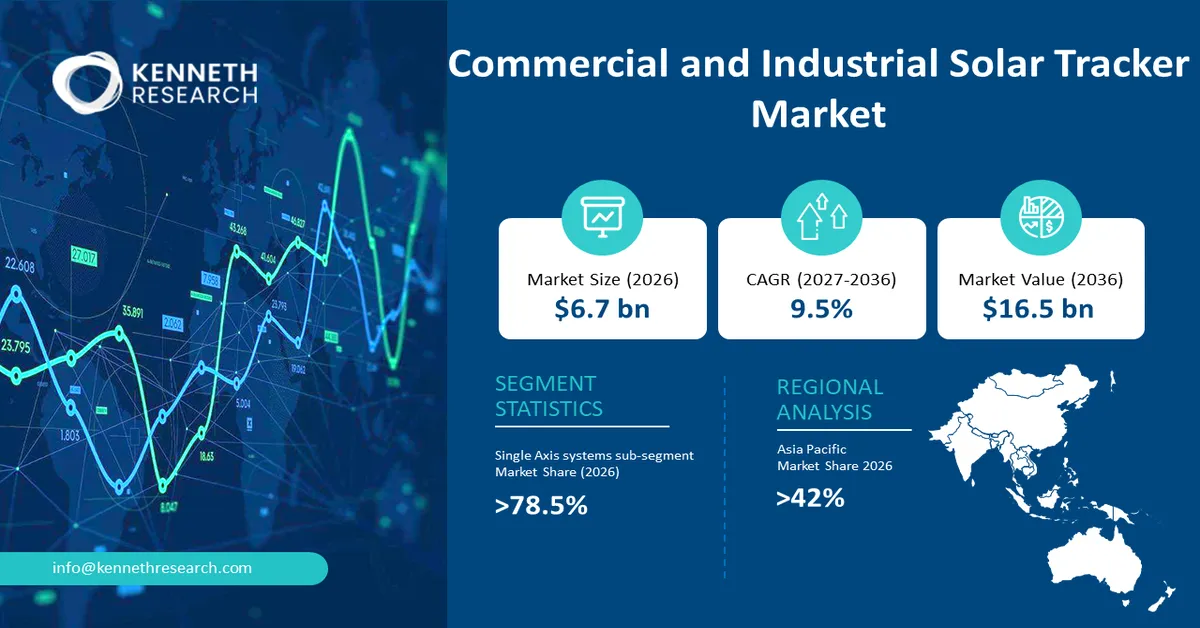
Commercial and Industrial Solar Tracker Market size was valued at USD 6.7 billion in 2026 and is projected to reach USD 16.5 billion by the end of 2036, rising at a CAGR of 9.5% during the forecast period, i.e., 2027-2036. In 2027, the industry size of the commercial and industrial solar tracker is estimated at USD 7.3 billion.
The primary growth driver for the commercial and industrial solar tracker market is the increasing deployment of utility and commercial solar projects seeking higher energy yields from available land.
The commercial and industrial solar tracker market comprises tracking systems used with photovoltaic installations to adjust the orientation of solar panels according to the sun’s position, thereby improving solar-energy capture. These systems primarily include single-axis and other tracker configurations, supported by mechanical structures, drive mechanisms, sensors, controllers, and tracking software. Single-axis trackers rotate photovoltaic modules along one axis, while more advanced systems can provide additional degrees of movement depending on project requirements.
Key characteristics include automated solar-position tracking, structural durability, wind-load resistance, installation flexibility, and compatibility with different photovoltaic module configurations. Industrial relevance stems from the ability of tracking systems to improve the utilization of solar-generation assets by maintaining favorable module orientation throughout operating hours.
Key Commercial and Industrial Solar Tracker Market Insights Summary:
Key Takeaways: Market Trends & Insights
- Commercial and industrial solar tracker market projected to grow from USD 6.7 billion in 2026 to USD 16.5 billion by 2036 at a 9.5% CAGR
- Asia-Pacific accounted for the largest regional share at 42% in 2026, supported by expanding solar-power deployment, large-scale photovoltaic projects, and growing investment in renewable-energy infrastructure across Japan and China
- Single Axis systems are expected to remain the leading By Type segment, accounting for 78.5% of the market in 2026, supported by their balance of energy-yield improvement, deployment flexibility, and system economics
- Active Trackers will continue to gain traction within the technology segment as automated tracking, sensors, control systems, and digital monitoring help optimize photovoltaic module orientation and energy capture
Market Drivers
- Rising deployment of single-axis solar tracking systems
- Increasing focus on solar-project energy-yield optimization
- Growing adoption of bifacial photovoltaic modules
- Technological improvements in tracker reliability, controls, and monitoring
Challenges
- Higher Installation and Maintenance Complexity
- Site-Specific Performance and Terrain Constraints
Commercial and Industrial Solar Tracker Market Overview & Supply Chain
The adoption of solar tracking systems is increasing globally alongside rapid expansion of photovoltaic power generation and the growing focus on improving energy yields from solar installations. Trackers enable photovoltaic modules to follow the sun during operating hours, supporting greater utilization of available generation assets and making them relevant to large commercial, industrial, and utility-scale projects. Increasing deployment is also encouraging project developers to evaluate tracker technologies based on energy yield, land utilization, system reliability, installation requirements, and operating conditions.
The supply chain for the commercial and industrial solar tracker market begins with suppliers of steel, aluminum, bearings, motors, actuators, electronic controls, sensors, communication components, and other mechanical and electrical inputs. Tracker manufacturers integrate these components into structural assemblies, drive systems, controllers, and tracking mechanisms designed for photovoltaic installations. Production involves engineering, fabrication, component integration, software and control-system configuration, testing, and quality assurance.
Commercial and Industrial Solar Tracker Market: Growth Drivers & Challenges
Growth Drivers:
- Rising deployment of single-axis solar tracking systems: The increasing deployment of large-scale photovoltaic projects is supporting demand for single-axis tracking systems because they can improve energy capture by adjusting module orientation throughout the day. The technology has also become increasingly established within utility-scale PV system design. As commercial and industrial developers increasingly evaluate projects according to lifetime energy yield and asset productivity, single-axis systems can provide a practical mechanism for optimizing photovoltaic output. Continued improvements in tracking algorithms, mechanical durability, and system monitoring are expected to strengthen adoption across diverse solar-resource conditions.
- Increasing focus on solar-project energy yield optimization: Solar developers and commercial and industrial energy users are increasingly focused on maximizing electricity generation from available project sites. Tracking systems support this objective by continuously adjusting photovoltaic module orientation, allowing projects to capture solar radiation more effectively during changing daily sun positions. The resulting emphasis on energy yield is encouraging developers to evaluate tracker technology alongside module efficiency, inverter configuration, land characteristics, and operating costs during project design.
Challenges:
- Higher installation and maintenance complexity: Solar trackers generally require more mechanical and electrical components than fixed-tilt mounting structures, increasing engineering, installation, commissioning, and maintenance requirements. Motors, actuators, bearings, controllers, sensors, structural assemblies, and communication systems must operate reliably under outdoor conditions for extended project lifetimes. Tracker installation can also require careful alignment, terrain assessment, row configuration, and control-system commissioning. These requirements can increase project execution complexity and create additional maintenance responsibilities for asset owners and operators.
- Site-specific performance and terrain constraints: The economic and technical suitability of solar trackers varies according to project location, terrain, weather conditions, solar resource, land configuration, and photovoltaic system design. Uneven or challenging terrain can complicate tracker installation and increase civil and structural requirements, while high wind conditions can impose additional structural and operational demands. Row spacing and backtracking requirements can also influence land utilization and energy yield. These factors mean that a tracker design optimized for one project may require modification for another site.
Commercial and Industrial Solar Tracker Market Size and Forecast:
| Report Attribute | Details |
|---|---|
| Base Year |
2026 |
| Forecast Period |
2027-2036 |
| CAGR |
9.5% |
| Base Year Market Size (2026) |
USD 6.7 billion |
| Forecast Year Market Size (2036) |
USD 16.5 billion |
| Regional Scope |
|
Commercial and Industrial Solar Tracker Market Segmentation Analysis:
Type Segment Analysis
In the type segment, Single Axis systems are anticipated to capture the largest market share of 78.5% by the end of 2026.
Their dominance is supported by their ability to adjust photovoltaic modules along a single rotational axis while maintaining a relatively straightforward mechanical configuration compared with more complex tracking arrangements. Single-axis systems are particularly relevant for large solar installations where developers prioritize improved energy capture, scalable deployment, and practical installation and maintenance requirements. Their established use in photovoltaic project engineering also supports a broad supply base comprising tracker structures, drive mechanisms, controllers, and associated monitoring systems.
Technology Type Segment Analysis
In the technology segment, active trackers are projected to experience strong growth as commercial and industrial solar projects increasingly prioritize automated control and optimized photovoltaic energy capture. Active trackers use motors, sensors, controllers, and tracking algorithms to adjust panel positioning according to the sun’s movement, allowing operators to optimize module orientation throughout the operating day. Their integration with digital monitoring and automated control systems also supports more precise project-level performance management. Government-backed solar deployment is reinforcing the underlying demand for technologies that improve photovoltaic-system productivity. Active tracker manufacturers are consequently focusing on reliable drive systems, advanced controls, terrain adaptability, and compatibility with larger and bifacial modules.
Our in-depth analysis of the global commercial and industrial solar tracker market includes the following segments:
|
Segment |
Sub-segment |
|
By Type |
|
|
Technology |
|
|
Application |
|
|
End Use |
|
Commercial and Industrial Solar Tracker Market Regional Insights:
Asia-Pacific Market Trends & Insights:
Asia-Pacific commercial and industrial solar tracker market is projected to hold the largest revenue share of 42% by the end of 2026.
The region's leading position is supported by rapid photovoltaic deployment, large-scale solar project development, and expanding commercial and industrial solar installations. The region has a large project pipeline across China, Japan, India, and other Asian economies, creating sustained opportunities for solar-tracking technologies that can improve photovoltaic energy capture and project productivity.
China represents a major market within Asia-Pacific due to its extensive solar-project pipeline, established photovoltaic manufacturing ecosystem, and continued investment in utility-scale and distributed solar generation.
Japan also contributes to regional demand as developers seek to maximize solar generation from available project sites. The combination of continued renewable-energy investment, technological development, and demand for improved photovoltaic energy yields supports opportunities for solar tracker manufacturers across the region.
North America Market Trends & Insights:
North America represents an important secondary region for the global commercial and industrial solar tracker market, supported by expanding photovoltaic deployment, established solar-project development capabilities, and continued investment in renewable-energy infrastructure. The region benefits from a mature ecosystem encompassing project developers, engineering-procurement-construction contractors, tracker manufacturers, module suppliers, financing institutions, and energy offtakers.
The U.S is the principal market within North America, supported by extensive solar development, strong corporate renewable-energy procurement, and a growing domestic manufacturing ecosystem.
Canada offers opportunities through expanding photovoltaic deployment, provincial renewable-energy initiatives, and growing interest in commercial, industrial, and utility-scale solar projects. The country's decentralized policy environment, including provincial incentives and federal clean-technology investment measures, supports continued development of solar infrastructure.
Leading Companies Operating in the Commercial and Industrial Solar Tracker Market:
Here is a list of upstream, downstream, and key players operating in the global commercial and industrial solar tracker market competitive ecosystem:
- Nextracker (U.S)
- Company Overview
- Business Strategy
- Key Product Offerings
- Financial Performance
- Key Performance Indicators
- Risk Analysis
- Recent Development
- Regional Presence
- SWOT Analysis
- Array Technologies (U.S)
- Arctech Solar (China)
- PV Hardware (PVH) (Spain)
- GameChange Solar (U.S)
- Soltec (Spain)
Recent Developments
- August 2026 – ARRAY reported the advancement of its tracker portfolio, including the formal launch of DuraTrack D2S and next-generation OmniTrack. The company also reported continued expansion of its integrated solar-tracking and foundation solutions.
- August 2026 – PVH announced that it is supplying more than 150 MW of solar trackers for projects in Romania and has participated in more than 25 solar projects across Eastern Europe. The company also reported a regional pipeline exceeding 2 GW.
Frequently Asked Question
In 2026, the commercial and industrial solar tracker market exceeded USD 6.7 billion.
The commercial and industrial solar tracker market is projected to reach USD 16.5 billion by the end of 2036, expanding at a CAGR of 9.5% over the forecast period (2027-2036).
The major players in the market are Nextracker, Array Technologies, Arctech Solar, PV Hardware (PVH), GameChange Solar, Soltec, and IDEEMATEC, and others.
In the by type segment, the single axis sub-segment is anticipated to capture the largest market share of 78.5% in the future and exhibit lucrative growth opportunities during 2027-2036.
Asia-Pacific is projected to hold the largest market share of 42% by the end of 2026 and provide more business opportunities in the future.
Why Choose Kenneth Research ?
-
Insight with Impact : We don’t just gather data — we uncover stories, trends, and opportunities that fuel business growth.
-
Experts Who Get It : Our team speaks your industry’s language and knows what really matters to your customers and market.
-
Custom-Built for You : Forget one-size-fits-all. We craft research and consulting solutions as unique as your business vision.
-
Partners, Not Just Providers : We work with you, not for you — collaborating closely to turn insights into smart, strategic moves.
-
Results That Speak : Our work powers brands, startups, and industry leaders alike — with a track record of ideas that work in the real world.
Report ID: 1455 |
Published Date: 28 Sep 2026 |
Report Format: |
Delivery Timeline: 48-72 Business Hours

Copyright © 2025 Kenneth Research. All rights reserved. Terms of Use | Privacy Policy
