Report ID: 1362 |
Published Date: 15 Sep 2026 |
Report Format: |
Delivery Timeline: 48-72 Business Hours
Commercial Aircraft Manufacturing Market Outlook:
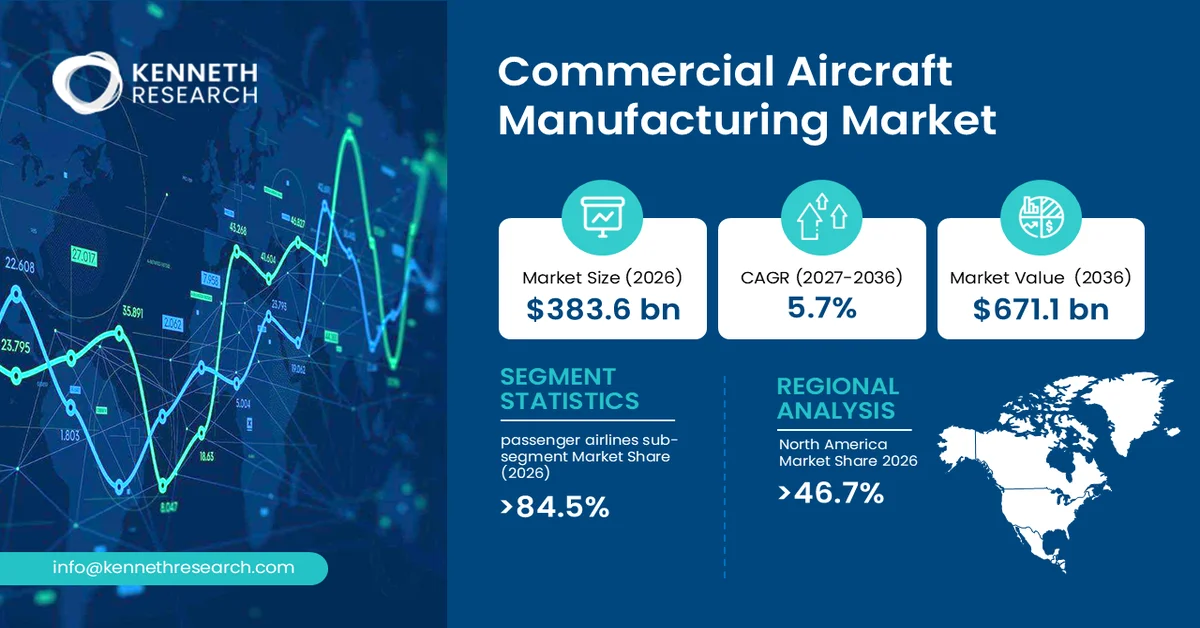
Commercial Aircraft Manufacturing Market size was valued at USD 383.6 billion in 2026 and is projected to reach USD 671.1 billion by the end of 2036, rising at a CAGR of 5.7% during the forecast period, i.e., 2027–2036. In 2027, the industry size of the commercial aircraft manufacturing market is estimated at USD 407.5 billion.
Rising passenger air travel is a primary growth driver for the commercial aircraft manufacturing market. ICAO reported that scheduled passenger traffic reached 4.7 billion in 2024, reinforcing sustained airline demand for fleet renewal, capacity expansion, and replacement aircraft as carriers respond to strengthening travel activity across international and domestic networks.
The commercial aircraft manufacturing market comprises the industrial production and assembly of aircraft designed primarily for civil passenger and air transport operations. It covers the engineering, fabrication, integration, testing, and delivery of complete aircraft, together with activities such as prototype development, major aircraft conversion, and complete overhaul or rebuilding where these activities form part of the manufacturing scope.
The market is characterized by highly complex production programs, stringent airworthiness requirements, long development cycles, extensive supplier networks, and substantial integration of structures, propulsion, avionics, flight-control, cabin, and other aircraft systems. Manufacturers typically coordinate specialized component suppliers and certification processes before delivering aircraft to airlines, leasing companies, and other commercial operators. Commercial aircraft manufacturing is industrially relevant because it connects advanced aerospace engineering with large-scale precision manufacturing, materials processing, electronics, software, and systems integration.
Key Commercial Aircraft Manufacturing Market Insights Summary:
Key Takeaways: Market Trends & Insights
- Commercial aircraft manufacturing market is valued at USD 383.6 billion in 2026
- Commercial aircraft manufacturing market is projected to reach USD 671.1 billion by 2036 at a CAGR of 5.7% during 2027–2036
- Passenger Airlines dominates the End-User segment with an 84.5% market share in 2026
- Narrowbody Aircraft represents the second and fastest analysis segment within the Aircraft Type category
- North America leads the global market with a 46.7% market share in 2026, supported by the United States and Canada
Market Drivers
- Growing demand for fleet modernization
- Expansion of emerging-market aviation networks
- Increasing demand for fuel-efficient aircraft
- Need for greater airline fleet flexibility
Challenges
- Supply Chain Fragility and Production Bottlenecks
- Certification Complexity and Approval Uncertainty
Commercial Aircraft Manufacturing Market Overview & Supply Chain
Global adoption of commercial aircraft is strengthening as airlines respond to renewed passenger demand, fleet replacement requirements, route expansion, and the industry's transition toward more fuel-efficient and technologically advanced aircraft. Manufacturers are therefore increasingly focused on advanced materials, digital engineering, automation, propulsion efficiency, and production scalability, while regulatory requirements continue to raise expectations for safety, emissions performance, and operational reliability.
The value chain of commercial aircraft manufacturing market begins with specialized inputs including aluminum and titanium alloys, composites, specialty steels, electronics, avionics, engines, landing systems, and other certified components supplied by globally distributed tier-one and tier-two suppliers. Aircraft manufacturers integrate these inputs through engineering, design, machining, structural assembly, systems integration, propulsion installation, software configuration, testing, certification, and final assembly. Distribution is primarily organized through direct manufacturer-to-airline sales, leasing companies, government procurement channels, and aircraft financing arrangements, supported by logistics providers and authorized maintenance networks. End users include passenger airlines, cargo operators, charter carriers, governments, and other commercial aviation organizations.
Commercial Aircraft Manufacturing Market - Growth Drivers & Challenges
Growth Drivers
- Rising Passenger Air Travel and Fleet Renewal: Passenger demand is strengthening aircraft procurement as airlines seek sufficient capacity, replace aging equipment, and improve operating efficiency. This creates a direct growth mechanism for commercial aircraft manufacturers because sustained traffic activity encourages carriers to expand fleets while retiring less efficient aircraft. The effect extends across the manufacturing ecosystem, supporting demand for airframes, engines, avionics, interiors, and specialized components while increasing the importance of production capacity and delivery reliability.
- Accelerating Aircraft Efficiency and Operational Optimization: Airlines are increasingly prioritizing aircraft that can reduce operating costs while providing greater route flexibility. This is strengthening demand for modern platforms incorporating aerodynamic improvements, advanced propulsion, lightweight structures, digital systems, and enhanced fleet commonality. Narrowbody aircraft are particularly well positioned because their operational flexibility enables carriers to serve short- and medium-haul routes across both mature and emerging markets.
Challenges
- Supply Chain Fragility and Production Bottlenecks: Commercial aircraft manufacturing market remains exposed to disruptions across a highly specialized, globally distributed supplier network. The root cause is the industry's dependence on certified suppliers for complex components, materials, engines, electronics, and other systems, making substitution difficult when a supplier encounters capacity, labor, quality, or procurement constraints. The U.S. Government Accountability Office identified workforce and material shortages as key factors affecting manufacturers' ability to increase aircraft production, with shortages extending from semiconductors and aluminum to engines and other specialized components.
- Certification Complexity and Approval Uncertainty: The industry's stringent safety requirements create a structural barrier to rapid commercialization of new aircraft, systems, and technologies. Aircraft manufacturers must demonstrate compliance with extensive airworthiness requirements, while internationally marketed products can require additional validation by authorities in destination markets. This creates uncertainty when certification requirements evolve, documentation requirements expand, or regulatory authorities have limited capacity to process complex applications.
Commercial Aircraft Manufacturing Market Size and Forecast:
| Report Attribute | Details |
|---|---|
| Base Year |
2026 |
| Forecast Year |
2027-2036 |
| CAGR |
5.7% |
| Base Year Market Size (2026) |
USD 383.6 billion |
| Forecast Year Market Size (2036) |
USD 671.1 billion |
| Regional Scope |
|
Commercial Aircraft Manufacturing Market - Segment Analysis
End-User Segment Analysis
In the end-user segment, passenger airlines sub-segment is anticipated to capture the largest market share of 84.5% by the end of 2026.
Passenger airlines dominate the end-user landscape because they represent the primary commercial operators of aircraft and directly translate passenger mobility requirements into fleet procurement, replacement, and expansion decisions. Demand is being supported by recovering international travel, route expansion, fleet modernization, and airlines' need to improve fuel efficiency and operating economics. This is encouraging carriers to replace older aircraft with newer platforms offering improved range, capacity utilization, digital capabilities, and lower operating costs. Supply-side conditions are also reinforcing the segment: manufacturers and their suppliers are prioritizing production programs around high-volume passenger aircraft, while leasing companies provide airlines with additional fleet-acquisition flexibility. Government data reinforce the strength of passenger demand: Canadian air carriers transported 92.7 million passengers in 2024, with international traffic reaching 48.2 million passengers.
Aircraft Type Segment Insights
The narrowbody aircraft is projected to grow as the second-largest segment in the commercial aircraft manufacturing market due to four converging demand drivers.
Narrowbody aircraft are projected to expand as airlines prioritize fleet flexibility, route economics, and efficient deployment across short- and medium-haul networks. Their single-aisle configuration enables carriers to match capacity more closely with demand while supporting higher-frequency services and thinner routes than larger widebody platforms. Adoption is also being encouraged by fleet renewal programs, as newer narrowbody aircraft incorporate improved propulsion, aerodynamics, lightweight structures, and digital operating systems. On the supply side, manufacturers and component suppliers are concentrating engineering and production resources on high-volume single-aisle programs. Looking ahead, narrowbody aircraft should benefit from airline fleet modernization, network expansion, and continued emphasis on operating efficiency.
Our in-depth analysis of the commercial aircraft manufacturing market includes the following segments:
|
Segment |
Sub-segment |
|
Aircraft Type |
|
|
Component |
|
|
End-User |
|
Commercial Aircraft Manufacturing Market - Regional Analysis
North America Market Trends & Insights:
North America commercial aircraft manufacturing market is projected to hold the largest revenue share of 46.7% by the end of 2026.
It is supported by a mature aerospace manufacturing ecosystem, established aircraft and engine production capabilities, extensive supplier networks, and sustained airline fleet activity. The region benefits from concentrated engineering expertise, advanced aerospace infrastructure, established certification frameworks, and significant private and public investment in aircraft technologies and production capacity.
The United States remains the region's principal aerospace manufacturing hub, supported by major aircraft, propulsion, avionics, and component capabilities alongside a large domestic airline network.
Canada complements this ecosystem through established aerospace manufacturing, aviation services, component production, and specialized engineering capabilities.
Asia Pacific Market Trends & Insights:
Asia Pacific presents strong opportunities for the commercial aircraft manufacturing market as expanding air connectivity, rising passenger mobility, fleet modernization, and the development of aviation infrastructure encourage airlines to increase and renew aircraft capacity. Industrial activity is also deepening as regional manufacturers, component suppliers, maintenance providers, and technology companies strengthen their participation in increasingly integrated aerospace supply chains.
China is strengthening its aviation ecosystem through infrastructure expansion, international aviation-hub development, technological innovation, and greater integration of civil aviation with broader industrial development. Its policy direction creates opportunities for domestic aircraft programs, suppliers, engineering organizations, and aviation-service providers.
Japan has an established aerospace manufacturing base and is pursuing policies focused on strengthening aircraft-industry capabilities, supply-chain resilience, testing and demonstration infrastructure, and engine-related maintenance capabilities. These priorities can support deeper participation in global aircraft programs while creating opportunities in advanced manufacturing and aerospace technologies.
Commercial Aircraft Manufacturing Market Competitive Landscape
Here is a list of upstream, downstream, and key players operating in commercial aircraft manufacturing market competitive ecosystem:
- Airbus SE (France)
- Company Overview
- Business Strategy
- Key Product Offerings
- Financial Performance
- Key Performance Indicators
- Risk Analysis
- Recent Development
- Regional Presence
- SWOT Analysis
- COMAC (Commercial Aircraft Corporation of China) (China)
- Northrop Grumman Corporation (United States)
- Safran S.A. (France)
Recent Developments
- In August 2026, Airbus began construction of a 6,221 sq m extension to its Belfast, Northern Ireland wing facility, supporting the A220 production ramp-up. The project will house a third composite autoclave alongside specialised wing tooling and cranage, supporting Airbus's goal of reaching 13 A220 deliveries per month by 2028. The site will also add 40 new apprentices in September 2026 and modernise infrastructure, including a new office block and expanded car park.
Frequently Asked Question
In 2026, the commercial aircraft manufacturing market exceeded USD 383.6 billion.
The commercial aircraft manufacturing market is projected to reach USD 671.1 billion by the end of 2036, expanding at a CAGR of 5.7% over the forecast period (2027-2036).
The major players in the market are Airbus SE, COMAC (Commercial Aircraft Corporation of China), Northrop Grumman Corporation, Safran S.A., and others.
In the End-User segment, the Passenger Airlines sub-segment is anticipated to capture the largest market share of 84.5% in the future and exhibit lucrative growth opportunities during 2027-2036. This growth trajectory is largely attributed to fleet modernization and sustained passenger travel demand.
North America is projected to hold the largest market share of 46.7% by the end of 2026 and provide more business opportunities in the future. Continuous investments in aerospace manufacturing, fleet modernization, aviation infrastructure, and advanced aircraft technologies across the United States and Canada are fostering the region's dominance.
Why Choose Kenneth Research ?
-
Insight with Impact : We don’t just gather data — we uncover stories, trends, and opportunities that fuel business growth.
-
Experts Who Get It : Our team speaks your industry’s language and knows what really matters to your customers and market.
-
Custom-Built for You : Forget one-size-fits-all. We craft research and consulting solutions as unique as your business vision.
-
Partners, Not Just Providers : We work with you, not for you — collaborating closely to turn insights into smart, strategic moves.
-
Results That Speak : Our work powers brands, startups, and industry leaders alike — with a track record of ideas that work in the real world.
Report ID: 1362 |
Published Date: 15 Sep 2026 |
Report Format: |
Delivery Timeline: 48-72 Business Hours

Copyright © 2025 Kenneth Research. All rights reserved. Terms of Use | Privacy Policy
