Report ID: 1026 |
Published Date: 29 Jul 2026 |
Report Format: |
Delivery Timeline: 48-72 Business Hours
Coating Pigment Market Outlook:
Coating Pigment Market size was valued at USD 22.5 billion in 2025 and is projected to reach USD 27.6 billion by the end of 2035, rising at a CAGR of 2.1% during the forecast period, i.e., 2026-2035. In 2026, the industry size of the coating pigment is estimated at USD 22.9 billion.
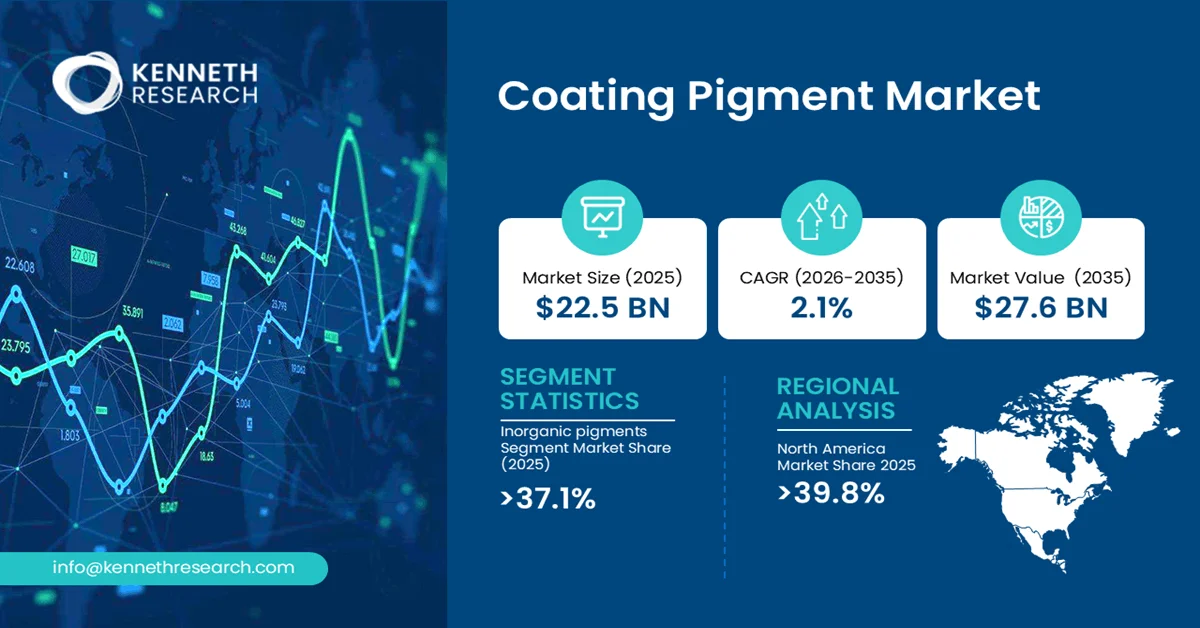
Growing demand for high-performance and sustainable coating formulations is the primary growth driver of the coating pigment market. Expanding construction, infrastructure modernization, automotive refinishing, and industrial manufacturing activities are increasing the need for pigments that deliver enhanced durability, weather resistance, color consistency, corrosion protection, and compliance with evolving environmental regulations.
The coating pigment market comprises the global production, distribution, and utilization of pigments incorporated into coating formulations to impart color, opacity, durability, corrosion resistance, ultraviolet protection, and decorative or functional properties. These pigments are broadly categorized into inorganic and organic types, with applications spanning architectural, industrial, automotive, marine, wood, packaging, and protective coatings. They are formulated to achieve specific performance requirements such as weatherability, chemical stability, thermal resistance, hiding power, and long-term color retention across diverse operating environments.
Coating pigments play a vital role in enhancing both the aesthetic appeal and functional performance of coated surfaces. Advances in pigment engineering have enabled manufacturers to develop products with improved dispersion, higher tinting strength, lower environmental impact, and compatibility with waterborne, powder, and high-solids coating technologies. The market is strategically important to industries including construction, transportation, infrastructure, consumer goods, and manufacturing, where coatings contribute to asset protection, regulatory compliance, product differentiation, and lifecycle extension. As end users increasingly prioritize durability and sustainable coating systems, coating pigments remain an indispensable component of modern coating technologies.
Key Coating Pigment Market Insights Summary:
Key Takeaways: Market Trends & Insights
- Coating Pigment market valued at USD 22.5 billion in 2025 and projected to reach USD 27.6 billion by 2035 at a 2.1% CAGR
- Inorganic Pigments led the type segment with a 37.1% share in 2025 driven by superior durability, opacity, and weather resistance across coating applications
- Architectural Coatings are expected to remain the fastest-growing application segment supported by increasing residential and commercial construction and sustainable building initiatives
- North America accounted for the largest regional share of 39.8% in 2025 backed by its advanced coatings manufacturing ecosystem, strong infrastructure investments, and focus on sustainable coating technologies
- Leading companies including Tronox Holdings plc, Kronos Worldwide, Inc., Heubach Group, Synthesia, a.s., Tata Pigments, and Sun Chemical continue to strengthen the market through product innovation and expansion of high-performance pigment portfolios
Market Drivers
- Rising adoption of waterborne and low-VOC coating formulations
- Increasing infrastructure modernization and public construction investments
- Rising investment in sustainable and energy-efficient building construction
- Expanding demand for high-durability industrial and protective coatings
Challenges
- Volatility in raw material availability and input costs
- Increasing regulatory pressure on hazardous pigment formulations
Coating Pigment Market Overview & Supply Chain
The adoption of coating pigments is increasing globally as manufacturers seek coatings that combine superior durability, corrosion protection, ultraviolet resistance, and aesthetic performance with stricter environmental compliance. Growing investments in residential and commercial construction, transportation infrastructure, industrial equipment, and energy assets continue to expand the need for advanced coating systems, where pigments are essential for color stability and long-term surface protection. Technological advances in waterborne, powder, and high-solids coatings are also driving demand for pigments with improved dispersion, opacity, and weather resistance. Industry relevance is reinforced by the OECD's assessment that the construction sector represents approximately 13% of global GDP, making it the largest consumer of sand and silicate materials used across the built environment, including coatings and paints, thereby supporting sustained demand for coating pigments across infrastructure and building applications.
The coating pigment industry operates through a multi-stage value chain beginning with the extraction and processing of mineral resources such as titanium dioxide feedstocks, iron ore, chromium compounds, zinc minerals, and specialty industrial minerals, alongside petrochemical intermediates used for organic pigment synthesis. Raw material suppliers provide refined inputs to pigment manufacturers, where controlled chemical processing, milling, surface treatment, quality testing, and formulation are performed to achieve specific optical and functional properties. Finished pigments are supplied directly or through specialty chemical distributors to paint and coating formulators, who integrate them with resins, additives, solvents, and binders to produce commercial coating systems. Distribution networks serve regional manufacturers, industrial distributors, and OEM supply chains before reaching end users across architectural construction, automotive, industrial equipment, marine, aerospace, packaging, and protective coatings. Key stakeholders include mining companies, chemical producers, pigment manufacturers, coating formulators, distributors, regulatory agencies, OEMs, construction firms, and industrial maintenance providers, all of whom influence product quality, compliance, innovation, and long-term supply reliability.
Coating Pigment Market: Growth Drivers & Challenges
Growth Drivers:
- Rising Investment in Sustainable and Energy-Efficient Building Construction: The growing emphasis on sustainable construction and energy-efficient buildings is accelerating demand for high-performance coating pigments that enhance durability, reflectivity, weather resistance, and long-term asset protection. Modern architectural coatings increasingly require pigments capable of maintaining color stability while supporting low-VOC and environmentally compliant formulations. As governments strengthen building efficiency standards and promote resilient infrastructure, coating manufacturers are expanding the use of advanced inorganic and specialty pigments to improve coating lifespan and reduce maintenance requirements. This trend encourages innovation in pigment technologies that are compatible with waterborne and high-solids coating systems. Continued investment in sustainable construction is expected to strengthen long-term demand for high-performance coating pigments across commercial, residential, and public infrastructure projects.
- Expanding Demand for High-Durability Industrial and Protective Coatings: Increasing industrialization and the modernization of manufacturing facilities are driving demand for coating pigments that provide superior corrosion resistance, chemical stability, and long-term surface protection. Industries such as automotive, marine, heavy equipment, renewable energy, and general manufacturing rely on advanced coating systems to extend equipment life while minimizing maintenance costs. Pigment manufacturers are responding by developing products with enhanced dispersion, improved weatherability, and compatibility with evolving coating chemistries. The shift toward automated production and higher performance specifications is encouraging wider adoption of functional pigments that deliver consistent quality under demanding operating conditions. Looking ahead, the expansion of industrial infrastructure, greater emphasis on lifecycle asset management, and increasing adoption of environmentally responsible coating technologies are expected to reinforce demand for advanced coating pigments capable of meeting stringent performance and regulatory requirements across diverse industrial applications.
Challenges
- Volatility in Raw Material Availability and Input Costs: The coating pigment industry remains highly exposed to fluctuations in the availability and pricing of essential raw materials, including mineral feedstocks and specialty chemical intermediates. Supply disruptions caused by geopolitical tensions, mining constraints, environmental regulations, transportation bottlenecks, and energy price volatility can significantly increase production costs and create procurement uncertainty for manufacturers. These challenges affect production planning, inventory management, and long-term supply agreements, particularly for producers serving high-volume coating applications. Commercially, persistent cost fluctuations reduce profit margins and complicate pricing strategies, especially in highly competitive markets where passing increased costs to customers is difficult. Looking ahead, manufacturers are expected to strengthen supplier diversification, invest in localized sourcing strategies, and improve raw material efficiency to reduce exposure to supply chain risks while maintaining product quality and reliable customer delivery.
- Increasing Regulatory Pressure on Hazardous Pigment Formulations: Growing environmental and chemical safety regulations are creating significant compliance challenges for manufacturers producing conventional pigment formulations. Restrictions on heavy metals and other hazardous substances require continuous product reformulation, extensive testing, certification, and investment in environmentally compliant alternatives. These regulatory requirements increase research and development expenses while extending product commercialization timelines. For coating manufacturers, changing compliance standards may require reformulating existing products and qualifying new pigment suppliers, resulting in additional operational complexity. Commercially, companies unable to adapt quickly risk losing market access and customer confidence in regions with stringent environmental standards. Over the long term, regulatory evolution is expected to accelerate innovation in safer, high-performance pigment technologies while increasing competitive pressure on manufacturers with limited technical capabilities.
Coating Pigment Market Size and Forecast:
| Report Attribute | Details |
|---|---|
| Base Year |
2025 |
| Forecast Year |
2026-2035 |
| CAGR |
2.1% |
| Base Year Market Size (2025) |
USD 22.5 billion |
| Forecast Year Market Size (2035) |
USD 27.6 billion |
| Regional Scope |
|
Coating Pigment Market Segmentation Analysis:
Type Segment Analysis
In the type segment, the inorganic pigments sub-segment is anticipated to capture the largest market share of 37.1% by the end of 2025.
The inorganic pigments segment dominates the coating pigment market owing to its superior durability, excellent opacity, weather resistance, thermal stability, and cost-effectiveness across a broad range of coating applications. These pigments are extensively used in architectural, industrial, automotive, marine, and protective coatings where long service life and resistance to harsh environmental conditions are essential. Growing investments in infrastructure development and industrial manufacturing continue to reinforce demand for inorganic pigments, particularly titanium dioxide and iron oxide-based products that provide high hiding power and corrosion protection. From a supply perspective, established mining operations, mature processing technologies, and well-developed global manufacturing networks ensure reliable availability and consistent product quality for large-scale coating producers. Demand is further supported by the U.S. Geological Survey (USGS), which states that approximately 95% of titanium is consumed in the form of titanium dioxide (TiO₂), a white pigment used in paints, paper, and plastics, highlighting the critical role of inorganic pigments in coating formulations. Looking ahead, continued innovation in environmentally compliant, high-performance inorganic pigments is expected to sustain the segment's leadership as coating manufacturers prioritize durability, regulatory compliance, and long-term product performance.
Application Segment Analysis
The architectural coatings is projected to grow as the second-largest segment in the coating pigment market due to four converging demand drivers.
The architectural coatings segment is projected to witness sustained growth as residential, commercial, and institutional construction activities continue to expand globally, driving demand for high-performance coating pigments. These coatings rely on pigments to deliver superior color retention, opacity, ultraviolet resistance, and weather protection, making them indispensable for both interior and exterior building applications. Increasing renovation activities, green building initiatives, and the adoption of low-VOC coating systems are encouraging manufacturers to develop advanced pigment formulations compatible with environmentally compliant coatings. On the supply side, continuous investments in pigment processing technologies, improved dispersion techniques, and reliable raw material sourcing enable coating manufacturers to meet evolving quality and sustainability requirements. Demand is further supported by the U.S. Census Bureau, which reported that the value of private residential construction in 2024 reached USD 917.9 billion, representing a 5.9% increase compared with 2023, reflecting continued activity in building projects that require architectural coatings. Looking ahead, increasing urbanization, infrastructure modernization, and rising demand for durable and sustainable building finishes are expected to strengthen the long-term growth of architectural coatings.
Our in-depth analysis of the global coating pigment market includes the following segments:
|
Segment |
Sub-segment |
|
Type |
|
|
Application |
|
|
Formulation |
|
|
End Use |
|
Coating Pigment Market Regional Insights:
North America Market Trends & Insights:
North America coating pigment market is projected to hold the largest revenue share of 39.8% by the end of 2025.
The region's dominance is supported by its well-established coatings manufacturing base, advanced chemical processing capabilities, and strong demand from the construction, automotive, industrial equipment, aerospace, and infrastructure sectors. Continuous investments in high-performance and environmentally compliant coating technologies have encouraged the adoption of advanced inorganic and organic pigments that offer improved durability, corrosion resistance, and weatherability. Stringent environmental regulations have also accelerated innovation in low-emission coating formulations, prompting pigment manufacturers to develop products compatible with waterborne, powder, and high-solids coatings. The presence of integrated raw material suppliers, global coating producers, and extensive research and development capabilities further strengthens the region's competitive position across the coating value chain.
The United States remains the largest contributor to regional demand due to its extensive construction industry, diversified manufacturing base, and continuous investment in infrastructure and industrial facilities. According to the U.S. Census Bureau, construction spending during December 2024 reached a seasonally adjusted annual rate of USD 2,192.2 billion, highlighting the scale of building activity that supports demand for architectural and protective coatings.
Canada complements regional growth through expanding infrastructure modernization, commercial development, and increasing adoption of sustainable construction practices, which continue to support the consumption of high-performance coating pigments across residential, commercial, and industrial applications.
Europe Market Trends & Insights:
Europe represents a strategically important market for coating pigments, supported by its well-established paints and coatings industry, advanced manufacturing capabilities, and strong emphasis on sustainability. Demand for high-performance pigments is driven by architectural renovation, industrial manufacturing, automotive production, protective infrastructure coatings, and wood finishing applications. The region's transition toward low-emission and resource-efficient coating technologies has encouraged manufacturers to develop pigments compatible with waterborne, powder, and other environmentally responsible coating systems. Government policies promoting circular economy principles, energy-efficient buildings, and reduced hazardous substance use continue to influence product development and investment across the pigment value chain. Looking ahead, increasing refurbishment of aging infrastructure, growth in renewable energy installations, and continued innovation in sustainable coating technologies are expected to create new opportunities for pigment manufacturers serving diverse end-use industries.
Germany remains the leading contributor to the regional market due to its strong automotive, industrial machinery, and specialty chemicals sectors, all of which require advanced coating solutions with superior durability and corrosion resistance. The country's robust research and manufacturing ecosystem also supports the development of next-generation pigment technologies.
France complements regional growth through expanding residential and commercial renovation activities, aerospace manufacturing, transportation infrastructure projects, and decorative coatings demand. Increasing adoption of environmentally compliant coating formulations and investments in sustainable construction continue to strengthen the need for high-performance pigments across multiple industries, reinforcing Europe's long-term position as a key regional market for coating pigments.
Leading Companies Operating in the Global Coating Pigment Market:
Here is a list of upstream, downstream, and key players operating in the global coating pigment market competitive ecosystem:
- Tronox Holdings plc (United States)
- Company Overview
- Business Strategy
- Key Product Offerings
- Financial Performance
- Key Performance Indicators
- Risk Analysis
- Recent Development
- Kronos Worldwide, Inc. (United States)
- Heubach Group (Germany)
- Synthesia, a.s. (Czech Republic)
- Tata Pigments (India)
- Sun Chemical (United States)
Recent Developments
- In January 2026, Tronox Holdings plc announced the permanent closure of its 46,000 metric ton per year TiO₂ pigment plant in Fuzhou, China, citing prolonged weak domestic demand, increasing raw material costs, and excess Chinese titanium dioxide production. The company stated that production would be supported through its global manufacturing network.
- In October 2024, BASF Coatings introduced its 2024–2025 Automotive Color Trends collection, "ROUTING," featuring new color concepts with enhanced metallic effects and a focus on sustainability, renewable materials, and coatings designed for future mobility applications.
Frequently Asked Question
In 2025, the coating pigment market exceeded USD 22.5 billion.
The coating pigment market is projected to reach USD 27.6 billion by the end of 2035, expanding at a CAGR of 2.1% over the forecast period (2026-2035).
The major players in the market are BASF SE, The Chemours Company, Tronox Holdings plc, Kronos Worldwide, Inc., Venator Materials PLC, LANXESS AG, Heubach Group, Cathay Industries, Clariant AG, DIC Corporation, Sun Chemical, Ferro Corporation, Shepherd Color Company, Sudarshan Chemical Industries Limited, Altana AG, Merck KGaA, Pidilite Industries Limited, Toyo Ink SC Holdings Co., Ltd., Cabot Corporation, Synthesia, a.s., and others.
In the Type segment, the Inorganic Pigments sub-segment is anticipated to capture the largest market share of 37.1% in the future and exhibit lucrative growth opportunities during 2026-2035. This growth trajectory is largely attributed to increasing demand for durable, weather-resistant, and high-performance coating formulations across construction, automotive, and industrial applications.
North America is projected to hold the largest market share of 39.8% by the end of 2035 and provide more business opportunities in the future. Continuous investments in construction, industrial manufacturing, and sustainable coating technologies across the United States and Canada are fostering the region's dominance.
Why Choose Kenneth Research ?
-
Insight with Impact : We don’t just gather data — we uncover stories, trends, and opportunities that fuel business growth.
-
Experts Who Get It : Our team speaks your industry’s language and knows what really matters to your customers and market.
-
Custom-Built for You : Forget one-size-fits-all. We craft research and consulting solutions as unique as your business vision.
-
Partners, Not Just Providers : We work with you, not for you — collaborating closely to turn insights into smart, strategic moves.
-
Results That Speak : Our work powers brands, startups, and industry leaders alike — with a track record of ideas that work in the real world.
Report ID: 1026 |
Published Date: 29 Jul 2026 |
Report Format: |
Delivery Timeline: 48-72 Business Hours

Copyright © 2025 Kenneth Research. All rights reserved. Terms of Use | Privacy Policy
