Report ID: 1372 |
Published Date: 10 Sep 2026 |
Report Format: |
Delivery Timeline: 48-72 Business Hours
CNC Controller Market Outlook:
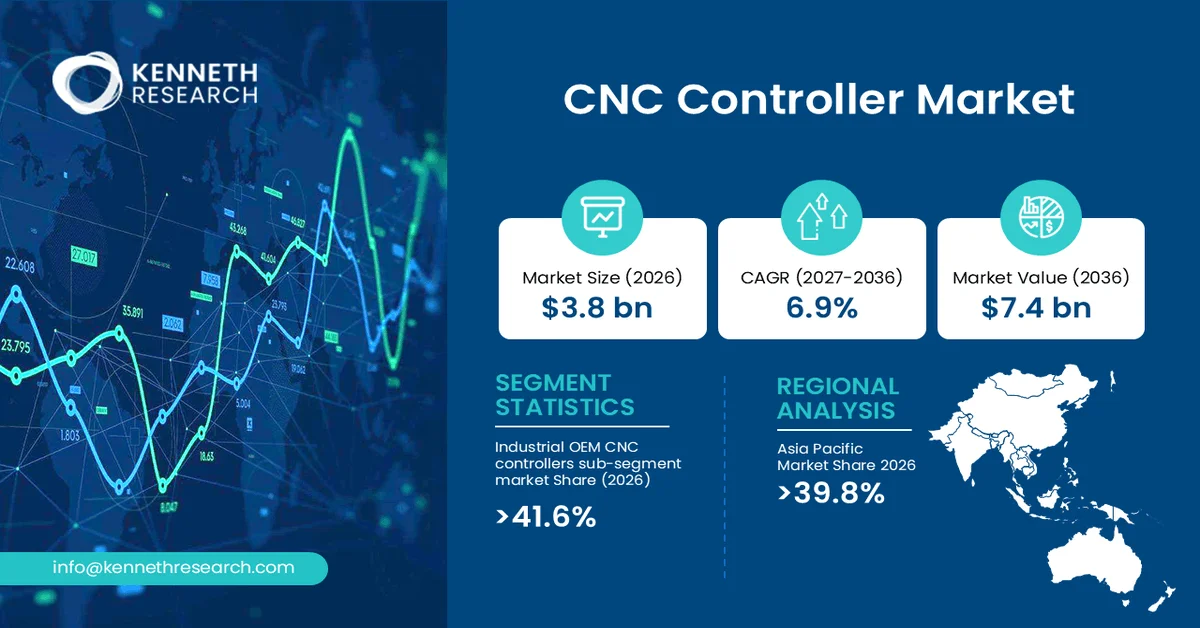
CNC Controller Market size was valued at USD 3.8 billion in 2026 and is projected to reach USD 7.4 billion by the end of 2036, rising at a CAGR of 6.9% during the forecast period, i.e., 2027–2036. In 2027, the industry size of the CNC controller is estimated at USD 4.1 billion.
A primary growth driver for the CNC controller market is the modernization of manufacturing systems toward digitally integrated, automated production. Government industrial-policy initiatives emphasize technological upgrading, equipment renewal, and intelligent manufacturing, increasing the need for advanced control technologies that coordinate machine operations, improve process consistency, and support connected production environments.
The CNC controller market comprises hardware and software systems that control the movement, sequencing, positioning, and operating parameters of computer numerical control (CNC) machine tools. These controllers interpret programmed machining instructions and translate them into coordinated commands for machine axes, drives, spindles, and other machine functions.
Key characteristics include programmable motion control, multi-axis coordination, precision positioning, machining-process management, and integration with associated automation equipment. Modern CNC control architectures can also support data exchange, connectivity, diagnostics, and integration with broader digital manufacturing environments. Japan’s Ministry of Economy, Trade and Industry identifies CNC systems, servo mechanisms, and programmable logic controllers as control-related equipment associated with machine tools and industrial robots.
Key CNC Controller Market Insights Summary:
Key Takeaways: Market Trends & Insights
- Global CNC controller market is projected to grow from USD 3.8 billion in 2026 to USD 7.4 billion by 2036, reflecting a 6.9% CAGR over 2027-2036
- Industrial OEM CNC Controllers lead the Product Type segment with a 41.6% market share in 2026, supported by direct integration with newly manufactured machine tools
- The 4 Axis & 5 Axis segment is positioned for strong growth as manufacturers increasingly require complex multi-axis machining, higher precision, and reduced manual repositioning
- Asia Pacific dominates the regional landscape with a 39.8% market share in 2026, supported by manufacturing strength and automation investment across China and Japan
- North America represents a key secondary opportunity, with the United States and Canada benefiting from advanced manufacturing, automation adoption, equipment modernization, and domestic production initiatives
Market Drivers
- Increasing adoption of industrial automation
- Rising demand for complex multi-axis machining
- Expansion of connected and digitally integrated manufacturing
- Growing CNC modernization and retrofit activity
Challenges
- Cybersecurity exposure from connected CNC systems
- Shortage of specialized CNC and automation skills
CNC Controller Market Overview & Supply Chain
Adoption of the CNC controller market is increasing as manufacturers modernize production assets, pursue higher process automation, and integrate machine tools with digitally connected manufacturing environments. CNC controllers are increasingly relevant to precision machining because they coordinate machine movement, tooling, spindle functions, and programmed production sequences while supporting more flexible and repeatable operations. The broader manufacturing environment is also being reshaped by industrial electrification and investment in advanced production capacity.
The CNC controller market value chain begins with input suppliers providing semiconductors, processors, memory components, circuit boards, sensors, power-management components, displays, communication interfaces, and industrial-grade electronic materials. Specialized software, firmware, and control algorithms form an additional technology input layer. Controller manufacturers then integrate these components into hardware platforms and develop the software architecture required for motion control, programming, diagnostics, machine communication, and multi-axis coordination. Distribution typically involves direct sales, authorized industrial automation distributors, machine-tool builders, system integrators, and regional technology partners. Machine-tool manufacturers and automation integrators connect controllers with machining centers, lathes, milling equipment, robotics, drives, and related production systems. End users include automotive, aerospace, electronics, machinery, metalworking, and precision-engineering manufacturers.
CNC Controller Market: Growth Drivers & Challenges
Growth Drivers:
- Increasing adoption of industrial automation: The accelerating adoption of industrial automation is a major growth driver for the CNC controller market because automated production requires precise coordination between machine axes, servo drives, spindles, tooling, sensors, and other equipment. As manufacturers move toward integrated production cells, CNC controllers are increasingly expected to support sophisticated motion control, machine communication, diagnostics, and interaction with robotics and factory automation systems. The International Federation of Robotics reported that 542,076 industrial robots were installed globally in 2024, demonstrating continued investment in automated manufacturing.
- Rising demand for complex multi-axis machining: Increasing requirements for complex, high-precision components are driving demand for advanced CNC control capabilities, particularly in four-axis and five-axis machining applications. Multi-axis controllers enable simultaneous coordination of several machine movements, allowing manufacturers to produce intricate geometries while reducing repositioning requirements and improving machining flexibility. This capability is especially relevant to aerospace, automotive, medical-device, energy, and precision-engineering applications where component complexity and dimensional accuracy are critical.
Challenges:
- Cybersecurity exposure from connected CNC systems: The increasing connectivity of CNC controllers creates a structural restraint as manufacturers link shop-floor operational technology with enterprise networks, remote-access platforms, and production-management systems. CNC equipment that was historically isolated can become exposed to unauthorized access, malware, data manipulation, and disruptions when connected environments are inadequately segmented or maintained. This creates additional requirements for authentication, secure software updates, network monitoring, access control, and system integrity protection.
- Shortage of specialized CNC and automation skills: The shortage of personnel capable of programming, configuring, integrating, troubleshooting, and maintaining sophisticated CNC control systems can constrain adoption, particularly as controller architectures become more software-intensive. Modern CNC environments require expertise spanning machining processes, motion control, automation, networking, diagnostics, and digital manufacturing software. This creates a skills bottleneck because manufacturers must either develop existing employees or compete for personnel with specialized technical capabilities.
| Report Attribute | Details |
|---|---|
| Base Year |
2026 |
| Forecast Period |
2027-2036 |
| CAGR |
6.9% |
| Base Year Market Size (2026) |
USD 3.8 billion |
| Forecast Year Market Size (2036) |
USD 7.4 billion |
| Regional Scope |
|
CNC Controller Market Segmentation Analysis:
Product Type Segment Analysis
In the product type segment, industrial OEM CNC controllers sub-segment is anticipated to capture the largest market share of 41.6% by the end of 2026.
Industrial OEM CNC controllers lead the product-type segment because they are embedded directly into newly manufactured machine tools and are engineered for coordinated operation with the machine builder’s mechanical, electrical, and automation architecture. Demand is supported by factory automation, replacement of aging production equipment, and increasing requirements for integrated machining, diagnostics, and digital connectivity. The strength of China’s manufacturing equipment ecosystem further reinforces OEM demand. From the supply side, OEM controllers benefit from established relationships between controller developers, machine-tool manufacturers, drive suppliers, and automation integrators. These arrangements facilitate standardized engineering, commissioning, software integration, and after-sales support.
Type Segment Analysis
The 4 Axis & 5 Axis is projected to grow as the second-largest segment in the CNC controller market due to four converging demand drivers.
The 4 axis & 5 axis segment is projected to grow as manufacturers increasingly require flexible machining of complex geometries, tighter process control, and fewer repositioning operations. Aerospace, automotive, energy, and precision-engineering applications particularly benefit from multi-axis coordination because sophisticated components can be machined with greater continuity and reduced manual intervention. Adoption is also being reinforced by equipment modernization initiatives that encourage manufacturers to replace aging machinery and introduce advanced digital production technologies. China’s Ministry of Industry and Information Technology specifically identifies the upgrading of high-end equipment and promotes the renewal and application of CNC machine tools and other intelligent manufacturing equipment.
Our in-depth analysis of the CNC controller market includes the following segments:
|
Segment |
Sub-segment |
|
Product Type |
|
|
Type |
|
|
End-Use Industry |
|
CNC Controller Market Regional Insights:
Asia Pacific Market Trends & Insights:
Asia Pacific CNC controller market is projected to hold the largest revenue share of 39.8% by the end of 2026.
It is supported by its extensive machine-tool manufacturing base, large industrial production ecosystem, and sustained investment in factory automation. China, Japan, South Korea, Taiwan, and other manufacturing economies provide a dense concentration of machine-tool producers, component suppliers, automation companies, and downstream users.
China represents the region’s principal demand center because of its large manufacturing base spanning automotive, electronics, machinery, metalworking, and other precision-intensive industries. Its combination of domestic machine-tool production, automation investment, and industrial-policy support creates favorable conditions for controller deployment and replacement.
Japan remains a strategically important market through its advanced machine-tool industry, precision manufacturing capabilities, and established expertise in robotics, automation, and CNC technologies. Japan’s Ministry of Economy, Trade and Industry maintains comprehensive production statistics covering machinery and manufacturing equipment, demonstrating the depth of its industrial production infrastructure.
North America Market Trends & Insights:
North America represents an important market for CNC controllers, supported by advanced manufacturing, reshoring efforts, factory automation, and modernization of machine-tool fleets. Demand is concentrated in precision-intensive industries such as aerospace, automotive, medical equipment, electronics, and industrial machinery, where manufacturers increasingly require connected, flexible, and highly automated machining systems.
The United States remains the principal country within North America, supported by a broad industrial base and strong emphasis on advanced manufacturing, domestic production capabilities, and technology commercialization. Federal initiatives encourage manufacturers to adopt innovative production technologies while improving supply-chain resilience.
Canada offers complementary opportunities through government-supported advanced-manufacturing programs focused on automation, digital technologies, advanced sensing, and intelligent production. Its National Research Council is actively supporting technologies designed to improve manufacturing productivity, sustainability, and competitiveness. Together, the two countries provide a mature ecosystem for CNC controller suppliers, machine-tool manufacturers, automation integrators, and industrial technology providers.
Leading Companies Operating in the Global CNC Controller Market:
Here is a list of upstream, downstream, and key players operating in CNC controller market competitive ecosystem:
- Dr. Johannes Heidenhain GmbH (Germany)
- Company Overview
- Business Strategy
- Key Product Offerings
- Financial Performance
- Key Performance Indicators
- Risk Analysis
- Recent Development
- Regional Presence
- SWOT Analysis
- Okuma Corporation (Japan)
- Fagor Automation (Spain)
- Yaskawa Electric Corporation (Japan)
Recent Developments
- In August 2026, Yaskawa America introduced Compass 2, a CNC software solution for the iCube Control platform. The system combines G-code processing, path planning, and interface design with the iC9200 controller and Sigma-X servomotors, primarily targeting CNC routers. Compass Designer enables machine builders to create custom operator interfaces as independent Windows applications, allowing adaptation to different machine designs without relying on standardised CNC screens.
- In February 2026, Fagor Automation unveiled CNCelite 2.0 at the 33rd BIEMH exhibition in Spain. The new version offers a more intuitive, customizable HTML5-based HMIelite interface with multi-touch control. Fagor also introduced the CNC 8065elite 2.0 G, a dedicated model for grinding applications featuring an extensive library of conversational cycles.
Frequently Asked Question
In 2026, the CNC controller market exceeded USD 3.8 billion.
The CNC controller market is projected to reach USD 7.4 billion by the end of 2036, expanding at a CAGR of 6.9% over the forecast period (2027-2036).
The major players in the market are Dr. Johannes Heidenhain GmbH (Germany), Okuma Corporation (Japan), Fagor Automation (Spain), Yaskawa Electric Corporation (Japan), and others.
In the product type segment, the industrial OEM CNC Controllers sub-segment is anticipated to capture the largest market share of 41.6% in the future and exhibit lucrative growth opportunities during 2027-2036. This growth trajectory is largely attributed to increasing adoption of industrial automation.
Asia Pacific is projected to hold the largest market share of 39.8% by the end of 2026 and provide more business opportunities in the future. Continuous investments in manufacturing automation, machine tools, and industrial modernization across China and Japan are fostering the region's dominance.
Why Choose Kenneth Research ?
-
Insight with Impact : We don’t just gather data — we uncover stories, trends, and opportunities that fuel business growth.
-
Experts Who Get It : Our team speaks your industry’s language and knows what really matters to your customers and market.
-
Custom-Built for You : Forget one-size-fits-all. We craft research and consulting solutions as unique as your business vision.
-
Partners, Not Just Providers : We work with you, not for you — collaborating closely to turn insights into smart, strategic moves.
-
Results That Speak : Our work powers brands, startups, and industry leaders alike — with a track record of ideas that work in the real world.
Report ID: 1372 |
Published Date: 10 Sep 2026 |
Report Format: |
Delivery Timeline: 48-72 Business Hours

Copyright © 2025 Kenneth Research. All rights reserved. Terms of Use | Privacy Policy
